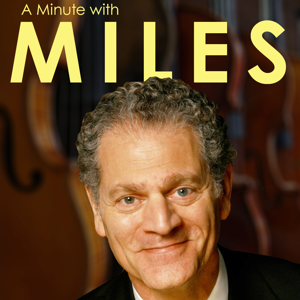
A Minute with Miles

A Minute with Miles

By Miles HoffmanMusic
Download on the App Store

A Minute with Miles episodes

  • A Minute With Miles: Brass Magic
    For those of us who don’t play a brass instrument, watching brass players play always seems a bit like watching a magic show. We hear the French hornists, trumpeters, trombonists, and tuba players playing plenty of different notes, but the number of times they move their fingers — or in the case of trombonists their slides — doesn’t nearly add up to the number of notes. Not to mention the fact that where they put their fingers or slides doesn’t seem to bear any relation to which notes they’re
    1 min
  • The Violin Family
    The members of the modern violin family are the violin, viola, cello, and double bass. These instruments are descendants of various kinds of medieval fiddles—fiddle, by the way, being an older word than violin—and the medieval fiddles themselves were bowed stringed instruments that were originally imported to Europe from the Middle East.
    1 min
  • The Oboe
    The modern oboe most likely originated in France in the 1600's. The word oboe, which is the instrument’s name in both English and Italian, comes from the French name, hautbois , meaning “high wood,” or “loud wood.” Oboes are usually made of African blackwood, which is sometimes called grenadilla.

    1 min
  • Vibrato Part 3
    I’ve been talking this week about vibrato, the vibrato that string players use to warm up their sounds, and the vocal vibrato that’s the natural product of healthy singing. All vibrato consists of small oscillations in pitch, but not all vibrato is a blessing.
    1 min
  • Vibrato Part 2
    Yesterday I talked about vibrato, the technique that string players use—rocking the fingers of their left hands back and forth to create small oscillations in pitch that result in a warmer, more resonant sound.
    1 min
  • Vibrato Part 1
    When violinists play, their left hands always seem to shake. But it’s not because they’re nervous. Violinists, violists, cellists, and double bass players all use a technique called vibrato .
    1 min
  • Music on a Desert Island 3
    Yesterday I listed several pieces of music that would definitely not be the pieces I’d want to be limited to if I were stranded on a desert island. And I’m afraid I can’t resist adding to the list today, especially since I’ve had a few excellent suggestions from friends. Handel’s Water Music , for example.
    1 min
  • Program Notes for Non-Musicians
    A word of advice today for non-musicians reading program notes in concert programs: If the program notes are heavy on technical analysis and are loaded with terms like modulation, inversion, augmentation, diatonic intervals, chromatic progression, modified sonata form, what have you… ignore them.
    1 min
  • Music on a Desert Island 2
    Yesterday I mentioned a few pieces of music I’d like to have with me if I were marooned on a desert island. Today I thought I’d list a few pieces I would definitely not want along. I’m assuming my island would be surrounded by water, so right away Debussy’s La Mer would be out —great piece, but it would be superfluous, to put it mildly, and probably pretty annoying, under the circumstances.
    1 min
  • Music on a Desert Island 1
    It’s an old question: if you were going to be dropped off on a desert island and you could only take a few recorded pieces of music with you, what would they be? For me, the first piece on the list is easy: Mozart’s Marriage of Figaro .
    1 min

About A Minute with Miles

From the publisher's feed

Illuminating 60-second flights through the world of classical music with host and longtime NPR commentator Miles Hoffman. Produced by South Carolina Public Radio.You can enjoy an archive of these…