Sign up to save your podcastsEmail addressPasswordRegisterOrContinue with GoogleAlready have an account? Log in here.
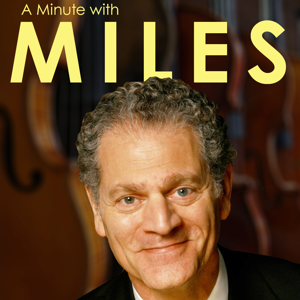
Illuminating 60-second flights through the world of classical music with host and longtime NPR commentator Miles Hoffman. Produced by South Carolina Public Radio.You can enjoy an archive of these segm... more
FAQs about A Minute with Miles:How many episodes does A Minute with Miles have?The podcast currently has 1,516 episodes available.
April 29, 2019NeuroscienceI’m grateful for advances in neuroscience, and for many reasons glad that every day we know more about how the brain works. But for all the studies of left brains, right brains, and neuron networks, some things will remain mysteries, and there’s no way around it....more1minPlay
April 26, 2019SpiccatoThe literal meaning of the Italian word spiccato is similar to that of staccato —“detached,” or “distinct.” In string playing, to play notes spiccato means to play them with a bouncing bow. With its stiff but flexible stick and tightened horsehair, the bow is like a long spring, so it wants to bounce. But spiccato involves a controlled bouncing. The bow comes off the string after each note, but the player has to find the balance between making the bow bounce and letting it bounce....more1minPlay
April 25, 2019StringsThe strings of stringed instruments—violins, violas, cellos, basses, guitars, and harps—may be made of steel, nylon or other synthetics, or of gut. Often the steel, nylon, or gut serves as the core of the string, and around the core is a tight winding of very fine wire—wire of steel, aluminum, or silver....more1minPlay
April 24, 2019Interesting Facts 5: RavelIt’s one of the hallmarks of great composers that they’re not limited by the practices of their times. Their imaginations are enriched, but not hemmed in, by the traditions they inherit, and they tend to push boundaries....more1minPlay
April 23, 2019Interesting Facts 4: BlochThe composer Ernest Bloch was born in Switzerland, and after spending time in America, he was thinking of returning to Europe. But a visit in 1922 to the Library of Congress, in Washington DC, convinced Bloch to stay in this country, and to take American citizenship. He was a famous composer, but Bloch was also one of this country’s most important educators, the founding director of the Cleveland Institute of Music and the first director of the San Francisco Conservatory of Music....more1minPlay
April 22, 2019Interesting Facts 3: Da PonteImagine, for a moment, Mozart walking down Broadway, in New York City. It’s not so easy. But Lorenzo da Ponte, who wrote the librettos for Mozart’s operas Don Giovanni, The Marriage of Figaro, and Così fan tutte, died a New Yorker....more1minPlay
April 19, 2019Interesting Facts 2: ProkofievSergey Prokofiev was a giant of 20 th -century composition. He wrote great symphonies, operas, ballets, concertos, piano sonatas, and chamber music pieces, not to mention Peter and the Wolf....more1minPlay
April 18, 2019Interesting Facts 1: ChaussonThis week we’ll focus on interesting facts and stories about important musicians. The first interesting item about the French composer Ernest Chausson is his name. The word chausson, in French, means “slipper” – as in the slippers you wear on your feet. But a chausson aux pommes is an apple turnover....more1minPlay
April 17, 2019Progress in MusicFor musicians and music teachers, the concept of Progress can be misleading. We can strive in our own ways to emulate the masters who’ve preceded us, but it’s a mistake to think there’s such a thing as being better than those masters....more1minPlay
April 16, 2019Progress in Science Vs. Progress in MusicIn fields such as science and technology, or in medicine, we’re used to achievements that represent Progress, progress that is obvious and indisputable. We do things better than we did before. But in the field of music, Progress has at times been a misleading concept....more1minPlay
FAQs about A Minute with Miles:How many episodes does A Minute with Miles have?The podcast currently has 1,516 episodes available.