
Sign up to save your podcasts
Or

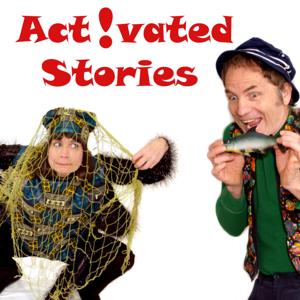


“When April Went to Visit March” is a story from the Ukraine about the seasons, or rather about one season, and how it can be unseasonable, especially in a chilly climate like the Ukraine. The months of spring are appropriately personified to reflect the weather that typically accompanies them: harsh March, airy April and mellow May. Except sometimes May may show the traits of March, so this tale offers a fanciful explanation.
We come to you from Sacramento, California, where we are doing a series of library performances for National Library Week. And we're doing stories especially appropriate for Earth Day, which the Sacramento County Library System is commemorating with a green theme.
And speaking of spring, we recount our recent visit to Saratoga, WY, which has a hot mineral spring that anyone can bathe in free at any time, year-round. But while we were there, we encountered some snowy weather, as we did during the entire month of March, which seemed to be anticipating the venting of a great deal of wrath toward May.
Happy Listening!
Dennis (March, Narrator) and Kimberly (April, May, Wind)
Comments and folktale requests 206-426-0436.
Links:
Comments and folktale requests 206-426-0436.
Links:
Long before Marvel Comics created Spiderman, a spiderman was created by the Ashanti tribe of western Africa. The frequent trickster (and sometimes victim of other animals' tricks) has appeared in many aliases, and in many other parts of the world, including the Caribbean, Central America and the U.S. Sometimes he appears as a spider, sometimes a man, and sometimes both. In the Southern U.S., “he” sometimes turned into Aunt Nancy. In our story for this month, he retains his original name and gender, even though he has been transplanted to Jamaica, mon. And alas, it's another one of those cases (like “Anansi Goes Fishing”, which we're currently performing on tour) where he ends up on the short end of the storytellers' stick.
We thought an Anansi story would be particularly appropriate for Black History Month, otherwise known as February. (In Great Britain, it's celebrated in October.) The month, which was originally just a week, traces its roots back to 1926, when prominent historian Dr. Carter Woodson began crusading to remedy the way his fellow African-Americans had been neglected in the history books. February is also the anniversary of the Fifteenth Amendment granting African-Americans the right to vote, and the swearing in of Hiram Revels as the first African-American member of the U.S. Senate. And February contains the birthday of the early civil rights leader W.E.B. DuBois, who along with Dr. Woodson, helped found the NAACP in 1909—during, would you believe it, the month of February. And you thought this month was just for presidents, groundhogs and chocolate.
Happy Listening!
Dennis (Narrator, Hog, Monkey) and Kimberly (Anansi, Goat)
Links Mentioned in this Podcast
The Coyote is a prominent recurring anthropomorphic character in the folklore of many Native American tribes, particularly in the Southwest. He is generally portrayed as a trickster, a semicomic hero who gets the better of some of the other critters. (He didn't get his comeuppance until the Twentieth Century, thanks to the Roadrunner.) Our current stage production, “Creepy Crawly Critter Tales”, features a yarn about how the Coyote and the Eagle attempt to rescue the sun from a band of kachinas (spirits) who have stolen it. But in our podcast story for this month, it is the Coyote—aided and abetted by a few animal sidekicks—who steal something: namely, fire. This tale, although it involves animals, has strong parallels in the myths of many other cultures about the heroic figures who first brought fire to humankind: Prometheus among the Greeks, Maui among the Polynesians and Loki among the Norse, for instance.
We come to you this month from Orlando, Florida, where we've assembled quite a cast of guest stars. We're joined by our son Zephyr, his girlfriend Cassia from Massachusetts, and their friends Amylynn from Chicago, Lani from Denver and Emily from Michigan. And as long as they were coming to Orlando long enough to do the podcast, we decided to dig up something fun for them to do. The best we could come up with was seven days at the Disney theme parks. Sorry, guys.
Happy Listening!
Dennis (Frog, Villager), Kimberly (Squirrel, Villager), Zephyr (Coyote, Villager), Cassia (Narrator), AmyLynn (Fire Being), Emily (Fire Being), and Lani (Chipmunk, Fire Being)
Links:
“The Elves and the Envious Neighbor” is a story from Japan that we bring in especially for the holidays. Not that it's a holiday story, mind you. But it does feature elves, and indeed elves who give a gift... by taking something away! It also features a Scrooge-like character driven by greed and envy. In some respects, it's similar to “Ali Baba and the Forty Thieves”. We come to you from Tallahassee, Florida, where we don't exactly expect to have a white Christmas. But it still looks very like that season around here, because we're surrounded by Fraser Firs, Canaan Firs, Scotch Pines and White Pines, oh my. We're babysitting a Christmas tree lot at the Tallahassee Mall, where we have the unheard-of opportunity to remain parked in one spot for more than a month—with free electricity thrown in to boot—as we start making preparations for next summer's tour. Yes, we've been away from the podcast universe for a while—since August, to be exact. And we bring you up to date on what's been happening in the meantime, including our fun, fascinating, productive October in Salem, where we met up with the LOUD Family, the subjects of the TV miniseries “Six for the Road”. And we answer that burning question on everyone's mind: where in the world is Zephyr? By the way, did you know that you can track the progress of Santa's sleigh online on Christmas Eve? We've been doing it for years. Amazing what they can do with radar these days. To all of you from all two of us, we wish you the happiest of holiday seasons, and a fantastic 2009. Happy Listening! Dennis (Man, Neighbor and Elves) and Kimberly (Narrator, King and other elves)
Links:
Stonehenge, Easter Island and the Old Stone Mill. What do they all have in common besides being situated on islands? They're all mysterious stone structures that have generated all kinds of colorful legends. The first two date to ancient times, the third to Colonial or possibly even Viking times. In the old days, folks were fascinated by rock formations that were even remotely out of the ordinary, and their imaginations ran wild, weaving fantastic stories about how such formations used to be giants, animals or spirits. It is one such formation that inspired our story on this podcast, "The Legend of the Rollright Stones".
We present this tale without benefit of Zephyr, who's in Oregon attending Not Back to School Camp, an annual gathering for homeschoolers. We come to you from North Attleboro, south of Boston.
Our story selection was prompted by our recent visit to Newport, RI (our first time ever to go there, and it isn't often that we visit a place for the first time anymore), where we saw the nation's oldest synagogue, the nation's oldest lending library, and Fort Adams Park, site of the annual Newport Folk Festival, which has showcased such legendary talents as Bob Dylan, Pete Seeger (a co-founder of the event) and Joan Baez. Oh yes, and we also saw the Old Stone Mill, the third stone oddity mentioned above. Nobody knows who built it or when or why, but there has been speculation that Norsemen under Leif Erickson erected it when they allegedly dropped by a millennium ago – its style is similar to that of certain Scandinavian churches. Another popular theory is that it was built as a mill by Rhode Island colonial governor Benedict Arnold, great-grandfather of the more famous (and infamous) individual bearing that name. (Supporters of the Viking theory point out that even if Arnold did use it as a mill, that doesn't mean he built it, and it could have been much older.) Still another hypothesis is that it was a watchtower constructed or used by a Portuguese explorer around 1500. Hey, maybe all three are sort of true.
We breezed through Newport on our bicycles as part of a 10-day bike marathon, starting from Norton, MA, then proceeding to Plymouth, Cape Cod, southern MA, then Newport and back up to Norton. We covered more than 320 miles in all, spending the nights in a tent and buying food at produce stands. What a great way to see the country! As long as you don't run over any big rocks.
Happy Listening!
Dennis (Farmer, Villager), Kimberly (Narrator, Fairy, Villager) and Zephyr (Marcel Marceau impersonator)
P.S. Apologies for the audio quality of the past two podcasts. We've had major technical gremlins, which we've been struggling to put back into their cages. Hopefully, all will be peachy keen next time.
Links:
"The Jester and the Straw Roof" is a trickster tale from India about a poor man who gets his due by exercising his wits - in effect, by playing a joke on someone rich and powerful, which is appropriate, since this individual is a joker by trade. But we trade the traditional concept of a court jester for the persona of Batman's nemesis The Joker, as interpreted by the late Heath Ledger, and ably imitated by our resident mimic Zephyr. We also are aided and abetted this week by our friend Cassia, since we come to you from her hometown in Massachusetts.
We talk about the tour that Dennis and Zephyr took of Valley Forge National Park, just north of Philadelphia. During the winter of 1777-78, Gen. George Washington and his men took a very different kind of tour of this property, a military stand to fight back the British invasion. It was a harsh winter and the troops worked under extreme hardships, often having inadequate clothing and little food.
Even Washington had it rough, sharing cramped quarters, with several members of his staff - although he certainly was better off than the troops. At least he was in a fine old house with servants and a comfortable bed; they on the other hand, slept in crude little log huts - or on the ground while they were constructing these!
We were able to see some very accurate replicas of these huts, and they looked anything but inviting, in any kind of weather. We also toured Gen. Washington's painstakingly restored house on the Schuylkill River, furnished just as it might have been when he was using it, down to the pens and papers on the desk.
We also mention the alternating days of bike touring that Kimberly and Dennis have been doing from Valley Forge to Bristol, CT, getting in as many as 65 miles a day - often on very hilly terrain. At least the soldiers never had do that!
Happy Listening,
Dennis (Maharajah), Kimberly (narrator), Zephyr (Jester/Joker) and Cassia (the wife)
Learn more about Valley Forge
"Stone Soup" is not only a popular folk tale with variants in many cultures and countries, it's also become a proverbial expression of sorts -- not to mention the name of a popular magazine for children. In some versions of the tale, the cornucopian object might be a nail, a button, or even an axe. And in some versions there is only one miserly individual involved, as opposed to a whole village. But there is something particularly resonant about the image of getting nourishment from a stone, and even more so about being able to feed an entire community, even if it involves a little deception.
One reason for the story's endurance is that it can be interpreted in a number of ways. There's the concept, for instance, of the whole being greater than the sum of its parts. There's the importance of pitching in to help your neighbors -- it takes a village to feed a village. There's the principle of making something from nothing, or at least being productive in difficult times. And of course there's the motif of applying psychology to encourage cooperation -- prompting people to contribute by appealing to their pride in creating a desirable outcome, rather than just telling them their efforts are needed (somewhat similar to Tom Sawyer's trick with the fence.) We come to you from the outskirts of Philadelphia, where we've returned to perform again at the Free Library of Philadelphia. Zephyr rejoins us after spending a couple of weeks in Winston-Salem, while Dennis and Kimberly report on their recent visit to Pennsylvania's capital city, Harrisburg, where they took a pleasant bike ride on a 20-mile loop that took them one of the finest nature preserves they've ever seen.
Happy Listening!
Dennis (Soldier, villagers), Kimberly (Narrator, Villagers), Zephyr (Villagers, including the Joker)
Links:
"The Peacock and the Crane" is one of Aesop's fables, and (surprise) it has a little lesson to teach: namely that it's wiser to make good use of the skill you have than to boast or make a display of yourself. The peacock has long been a symbol of vanity and ostentatiousness, and it may have been Aesop who started that tradition. NBC seemed to have had something else in mind, however, when it adopted a peacock for its network logo during the early days of color programming.
We come to you, minus Zephyr, from West Virginia, where we are having a busy week during our summer library tour, helping youngsters "Catch the Reading Bug" (that's the theme of the summer reading program for many of the nation's libraries this year). Our first West Virginia performance was in Point Pleasant, so named because it is a pleasant point at which the Ohio and Kanawha Rivers come together.
Up until 42 years ago, the town was best known as the site of the first battle between Native Americans and European settlers, which occurred here in 1774. As usual, the Natives (led by Chief Cornstalk) got the worst end of it. There's an impressive mural of the battle painted on the wall that runs along the riverfront by the national park that commemorates the event.
Okay, that was the town's old claim to fame. But in November 1966 it was the site of the reputed appearance of a strange creature that came to be known as the Mothman. He stood about 8 feet tall and looked like a cross between a human and a moth. He may have been of extraterrestrial origin, or he may have just been the Reading Bug. Or he may have been someone's hyperactive imagination. We can't know for certain, because he did not strut around like a peacock, but hid in the dark like a moth. But whatever he was, he is now folklore, and that's where we come in. There is a life-size statue of him in downtown Point Pleasant, so you can form your own theories. And be thankful that it wasn't you who ran into him.
Happy Listening!
Dennis (Crane, Farmer) and Kimberly (Narrator, Peacock)
Comments and folktale requests 206-426-0436.
Links: The Coyote and Eagle can be found on the Out of the Bag audio collection. And here is a kachina activity sheet to print and color (.PDF)
Award winning storyteller Sean Buvala offers teleconferences and coaching for storytellers.
Reading bug PSA courtesy of the Collaborative Summer Library Program
In folk tales, as in cartoons, the laws of physics and biology often are violated without a second thought. Things get blown up, and then are fine; coyotes run off the edge of a cliff and hover in mid-air a moment before plunging; and mice have their tails cut off and then restored. As in the British story "The Cat and the Mouse", which is based on the cumulative list motif, similar to the nursery rhyme "The House That Jack Built". The best-known version of the story is itself told in rhyme by folklorist Joseph Jacobs, who included it in a volume of English stories published in 1890. And it was this version that was familiar to our winner in the Be A Character Contest, a young man from Indiana named Aiden. He requested this story, so we made him the mouse (Ouch! Sorry about that.) But of course we weren't content to copy someone else's version of the tale (tail) despite its appealing rhyming rhythmic lines. We devised, as usual, our own madcap, quasi-improvised retelling.
We bring this podcast to you from Quincy, IL and Hannibal, MO, where we return to perform at libraries in both cities. And the libraries, we're happy to say, were not damaged by the recent flooding of the Mississippi River, though some parts of both cities definitely were soaked. So far, all systems are go for the annual Tom Sawyer Days held during the Independence Day weekend in Hannibal. And we're back to participate for the first time in several years.
We also tell you all about our recent encounter in Hawaii with Wally Amos, the famous cookie guru who now is heavily involved with promoting reading, particularly reading aloud to children. Not only does he read to kids himself, he is chair of the Read It Loud Foundation, which has a goal of enticing at least 5 million parents to read to their kids each day for at least 10 minutes. He donates 10 percent of the profits from his cookie stores in Kailua and Honolulu to this endeavor, and makes promotional appearances across the country to promote it -- including Savannah, GA., where Read It Loud! Savannah already has enjoyed considerable success. One of the activities of the program in Savannah is to donate a book to the parents of each child born in the community. It's never too early to start!
We salute Wally Amos and Read It Loud for the admirable work they do -- which, after all, is very much in line with the work we do ourselves.
Happy Listening (whatever your age),
Dennis (Narrator, Cow, Farmer's Wife, Butcher, Painter), Kimberly (Cat, Farmer, Baker), and Zephyr (Mouse)
Link: Folktales to Read Out Loud
From the publisher's feed