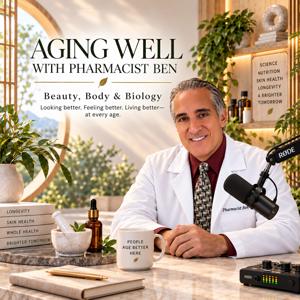
Aging Well With Pharmacist Ben
The Hidden History of Vitamins, Beriberi, Mitochondria, and Ultra-Processed Food
Pharmacist Ben opens the hour by describing his mother's decline as the reason he launched this show, then traces the science of aging from 1980s bodybuilding-era nutrition through the discovery of vitamins, the biology of mitochondria, and the food industry's engineering of ultra-processed cravings, before pitching his own Youngevity supplement line.
A Mother's Decline Sparks a New Mission
Pharmacist Ben opens with a burst of enthusiasm over an AI-generated intro song built by his producer Douglas, joking that a Staples Singers-style tribute would have cost thousands of dollars only a few years ago. He pivots quickly to the reason the show exists at all: a visit to his 93-year-old mother in New York, once a vital Army-tough woman, whom he found unable to rise from a chair without pulling herself up by a railing, her memory slipping even as her mind stayed mostly sharp. At 66 and, in his words, "right behind her," Ben says the visit convinced him to spend whatever years remain helping people age with more strength and clarity than she has left. He frames the entire program, Aging Well with Pharmacist Ben, as an answer to a world that can send people to Mars yet still cannot teach its citizens how to run their own bodies.
From the Weight Room to Pharmacy School
Ben traces his fascination with nutrition to the 1980s gym culture he grew up in, poring over bodybuilding magazines about Arnold Schwarzenegger and Lou Ferrigno while experimenting with whey protein, creatine, and branched-chain amino acids to build muscle. That curiosity led him to pharmacy school hoping to study, as he puts it, food as medicine, only to discover the curriculum was built around medicating toxicity rather than nourishing the body. He recalls being struck that prescription drugs work in doses as small as a few grains of salt, and that the liver's first-pass detoxification means every dose is inflated to survive being cleared from the body. From that frustration grew his lifelong distinction between macronutrients, the proteins, fats, and carbohydrates that supply energy, and micronutrients, the vitamins, minerals, amino acids, and fatty acids he calls the mighty ninety essential nutrients, which the body needs to actually use that energy.
White Rice, Beriberi, and the First Vitamin
Ben walks listeners through the history of nutrition science, arguing that agriculture, beginning roughly ten thousand years ago with the cracking of grain, made humans shorter and sicker even as it fed more of them, a thesis he credits to historian Jared Diamond. He lands on the late nineteenth century, when American colonizers brought white, polished rice to the Philippines, and Filipinos abandoned their traditional brown rice to imitate their conquerors. Within years, the indigenous population began suffering burning nerve pain, brain problems, and cracked, ulcerated skin, a cluster of symptoms doctors eventually named beriberi. Scientists later examined the discarded brown rice polishings and isolated the substance missing from the polished rice, thiamine, or vitamin B1, the first vitamin ever identified. Ben calls this the birth of the entire concept of deficiency disease, the idea that a single missing nutrient, rather than a germ or a toxin, could be the true cause of a devastating illness.
Mitochondria, ATP, and Subclinical Deficiency
Ben connects that century-old discovery to the present, noting that peripheral neuropathy, the burning nerve pain in hands and feet that callers ask him about on nearly every show, was the hallmark symptom of beriberi and disappeared once patients received thiamine. He introduces the idea of subclinical deficiency, a shortfall not severe enough to cause outright disease but enough to leave a person, in his phrase, leaving health on the table. From there he moves inside the cell to the mitochondria, the structures that convert sugar and fat into usable energy called ATP, explaining that nearly every modern disease is increasingly understood as a mitochondrial or energy disease. He mentions recent public fascination with methylene blue, NAD, NADH, and NMN as evidence that mitochondrial health has become mainstream, arguing that without enough micronutrients the body takes in plenty of energy from food but cannot actually use it, leaving people what he calls starving and obese at once.
Engineering Ultra-Processed Food and MSG
Ben shifts to how the food industry engineered the modern diet, tracing the shift to the Industrial Revolution, when factories could suddenly produce more goods than there were buyers, forcing companies to make food irresistible rather than merely nourishing. He describes early twentieth-century products like Cracker Jack, Wonder Bread, and Crisco shortening as the first wave of foods concentrated with sugar and fat while their bitter, nutrient-dense parts were stripped away, and notes the cereal industry's deliberate targeting of children who had no willpower to resist. He then recounts how Japanese soldiers in World War I gained a reputation for the best rations after scientists discovered monosodium glutamate, a molecule that could make any food, in his words, taste like filet mignon, at the cost of exciting and eventually damaging brain cells. Ben warns that MSG now hides on ingredient labels under names like hydrolyzed protein, yeast extract, and natural flavoring.
Beyond Tangy Tangerine and Inflammation as Defense
With time running short, Ben pivots to the Youngevity supplement line he has endorsed for thirty years, singling out the powdered blend Beyond Tangy Tangerine as, in his telling, life-changing for himself, his mother, and countless patients, and directing listeners to his sites, Pharmacist Ben's Academy and The Mineral Way. He briefly distinguishes dementia types, including Alzheimer's, vascular dementia, Lewy body dementia, and frontotemporal dementia, arguing all of them are, at root, inflammatory diseases of the brain. He then defines inflammation itself as the calling card of the immune system, calling it a survival mechanism that becomes destructive only in excess, and suggests that a body chronically inflamed reflects a life spent chronically on the defensive. Running out of time before he can finish the thought, Ben promises to continue on the next broadcast, Monday, September 28th, and signs off wishing listeners a wonderful week.