All Things Plantagenet

All Things Plantagenet

By Donnie J, HazelHistory
Download on the App Store
  • Favorites

    24

    Followers

  • Typical duration

    60 min

    per episode

Based on Podcast App listening data

All Things Plantagenet episodes

  • Episode 294 - King Henry V and the Battle of Agincourt - Part 01
    The Battle of Agincourt was one of the greatest English victories in the Hundred Years' War. It took place on 25 October 1415 (Saint Crispin's Day) near Azincourt in northern France. England's unexpected victory against a numerically superior French army boosted English morale and prestige, crippled France, and started a new period of English dominance in the war. After several decades of relative peace, the English had renewed their war effort in 1415 amid the failure of negotiations with the French. In the ensuing campaign, many soldiers died due to disease and the English numbers dwindled; they tried to withdraw to English-held Calais but found their path blocked by a considerably larger French army. Despite the disadvantage, the following battle ended in an overwhelming tactical victory for the English. King Henry V of England led his troops into battle and participated in hand-to-hand fighting. King Charles VI of France did not command the French army himself, as he suffered from severe psychotic illnesses with moderate mental incapacitation. Instead, the French were commanded by Constable Charles d'Albret and various prominent French noblemen of the Armagnac party. This battle is notable for the use of the English longbow in very large numbers, with the English and Welsh archers making up nearly 80 percent of Henry's army. Agincourt is one of England's most celebrated victories and was one of the most important English triumphs in the Hundred Years' War, along with the Battle of Crécy (1346) and Battle of Poitiers (1356). It forms the centrepiece of the play Henry V by William Shakespeare. The Battle of Agincourt is well documented by at least seven contemporary accounts, three from eyewitnesses. The approximate location of the battle has never been in dispute and the place remains relatively unaltered after 600 years. Immediately after the battle, Henry summoned the heralds of the two armies who had watched the battle together with principal French herald Montjoie, and they settled on the name of the battle as Azincourt after the nearest fortified place. Two of the most frequently cited accounts come from Burgundian sources, one from Jean Le Fèvre de Saint-Remy who was present at the battle, and the other from Enguerrand de Monstrelet. The English eyewitness account comes from the anonymous Gesta Henrici Quinti, believed to be written by a chaplain in the King's household who would have been in the baggage train at the battle. A recent re-appraisal of Henry's strategy of the Agincourt campaign incorporates these three accounts and argues that war was seen as a legal due process for solving the disagreement over claims to the French throne
    1 hr 1 min
  • Episode 294 - Poor King John and the Magna Carta - Part 02
    Magna Carta Libertatum (Medieval Latin for "the Great Charter of the Liberties"), commonly called Magna Carta (also Magna Charta; "Great Charter"), is a charter of rights agreed to by King John of England at Runnymede, near Windsor, on 15 June 1215. First drafted by the Archbishop of Canterbury to make peace between the unpopular King and a group of rebel barons, it promised the protection of church rights, protection for the barons from illegal imprisonment, access to swift justice, and limitations on feudal payments to the Crown, to be implemented through a council of 25 barons. Neither side stood behind their commitments, and the charter was annulled by Pope Innocent III, leading to the First Barons' War.
    After John's death, the regency government of his young son, Henry III, reissued the document in 1216, stripped of some of its more radical content, in an unsuccessful bid to build political support for their cause. At the end of the war in 1217, it formed part of the peace treaty agreed at Lambeth, where the document acquired the name Magna Carta, to distinguish it from the smaller Charter of the Forest which was issued at the same time. Short of funds, Henry reissued the charter again in 1225 in exchange for a grant of new taxes. His son, Edward I, repeated the exercise in 1297, this time confirming it as part of England's statute law. The charter became part of English political life and was typically renewed by each monarch in turn, although as time went by and the fledgling Parliament of England passed new laws, it lost some of its practical significance.
    At the end of the 16th century there was an upsurge in interest in Magna Carta. Lawyers and historians at the time believed that there was an ancient English constitution, going back to the days of the Anglo-Saxons, that protected individual English freedoms. They argued that the Norman invasion of 1066 had overthrown these rights, and that Magna Carta had been a popular attempt to restore them, making the charter an essential foundation for the contemporary powers of Parliament and legal principles such as habeas corpus. Although this historical account was badly flawed, jurists such as Sir Edward Coke used Magna Carta extensively in the early 17th century, arguing against the divine right of kings propounded by the Stuart monarchs. Both James I and his son Charles I attempted to suppress the discussion of Magna Carta, until the issue was curtailed by the English Civil War of the 1640s and the execution of Charles. The political myth of Magna Carta and its protection of ancient personal liberties persisted after the Glorious Revolution of 1688 until well into the 19th century. It influenced the early American colonists in the Thirteen Colonies and the formation of the American Constitution in 1787, which became the supreme law of the land in the new republic of the United States. Research by Victorian historians showed that the original 1215 charter had concerned the medieval relationship between the monarch and the barons, rather than the rights of ordinary people, but the charter remained a powerful, iconic document, even after almost all of its content was repealed from the statute books in the 19th and 20th centuries.
    Magna Carta still forms an important symbol of liberty today, often cited by politicians and campaigners, and is held in great respect by the British and American legal communities, Lord Denning describing it as "the greatest constitutional document of all times – the foundation of the freedom of the individual against the arbitrary authority of the despot". In the 21st century, four exemplifications of the original 1215 charter remain in existence, two at the British Library, one at Lincoln Cathedral and one at Salisbury Cathedral. There are also a handful of the subsequent charters in public and private ownership, including copies of the 1297 charter in both the United States and Australia. The original charters were written on parchment sheet
    35 min
  • Episode 293 - Poor King John and the Magna Carta - Part 01
    Magna Carta Libertatum (Medieval Latin for "the Great Charter of the Liberties"), commonly called Magna Carta (also Magna Charta; "Great Charter"), is a charter of rights agreed to by King John of England at Runnymede, near Windsor, on 15 June 1215. First drafted by the Archbishop of Canterbury to make peace between the unpopular King and a group of rebel barons, it promised the protection of church rights, protection for the barons from illegal imprisonment, access to swift justice, and limitations on feudal payments to the Crown, to be implemented through a council of 25 barons. Neither side stood behind their commitments, and the charter was annulled by Pope Innocent III, leading to the First Barons' War.
    After John's death, the regency government of his young son, Henry III, reissued the document in 1216, stripped of some of its more radical content, in an unsuccessful bid to build political support for their cause. At the end of the war in 1217, it formed part of the peace treaty agreed at Lambeth, where the document acquired the name Magna Carta, to distinguish it from the smaller Charter of the Forest which was issued at the same time. Short of funds, Henry reissued the charter again in 1225 in exchange for a grant of new taxes. His son, Edward I, repeated the exercise in 1297, this time confirming it as part of England's statute law. The charter became part of English political life and was typically renewed by each monarch in turn, although as time went by and the fledgling Parliament of England passed new laws, it lost some of its practical significance.
    At the end of the 16th century there was an upsurge in interest in Magna Carta. Lawyers and historians at the time believed that there was an ancient English constitution, going back to the days of the Anglo-Saxons, that protected individual English freedoms. They argued that the Norman invasion of 1066 had overthrown these rights, and that Magna Carta had been a popular attempt to restore them, making the charter an essential foundation for the contemporary powers of Parliament and legal principles such as habeas corpus. Although this historical account was badly flawed, jurists such as Sir Edward Coke used Magna Carta extensively in the early 17th century, arguing against the divine right of kings propounded by the Stuart monarchs. Both James I and his son Charles I attempted to suppress the discussion of Magna Carta, until the issue was curtailed by the English Civil War of the 1640s and the execution of Charles. The political myth of Magna Carta and its protection of ancient personal liberties persisted after the Glorious Revolution of 1688 until well into the 19th century. It influenced the early American colonists in the Thirteen Colonies and the formation of the American Constitution in 1787, which became the supreme law of the land in the new republic of the United States. Research by Victorian historians showed that the original 1215 charter had concerned the medieval relationship between the monarch and the barons, rather than the rights of ordinary people, but the charter remained a powerful, iconic document, even after almost all of its content was repealed from the statute books in the 19th and 20th centuries.
    Magna Carta still forms an important symbol of liberty today, often cited by politicians and campaigners, and is held in great respect by the British and American legal communities, Lord Denning describing it as "the greatest constitutional document of all times – the foundation of the freedom of the individual against the arbitrary authority of the despot". In the 21st century, four exemplifications of the original 1215 charter remain in existence, two at the British Library, one at Lincoln Cathedral and one at Salisbury Cathedral. There are also a handful of the subsequent charters in public and private ownership, including copies of the 1297 charter in both the United States and Australia. The original charters were written on parchment sheet
    1 hr 1 min
  • Episode 292 - Lecture on Simon de Montfort - Part 02
    Simon de Montfort, 6th Earl of Leicester (c. 1208 – 4 August 1265), sometimes referred to as Simon V de Montfort to distinguish him from his namesake relatives, was a nobleman of French origin and a member of the English peerage, who led the baronial opposition to the rule of King Henry III of England, culminating in the Second Barons' War. Following his initial victories over royal forces, he became de facto ruler of the country, and played a major role in the constitutional development of England.
    During his rule, Montfort called two famous parliaments. The first stripped the King of unlimited authority, while the second included ordinary citizens from the towns. For this reason, Montfort is regarded today as one of the progenitors of modern parliamentary democracy. As Earl of Leicester he expelled Jews from that city; as he became ruler of England he also cancelled debts owed to Jews through violent seizures of records. Events in London and Worcester, for instance, led to massacres. After a rule of just over a year, Montfort was killed by forces loyal to the King in the Battle of Evesham.
    Montfort was a younger son of Simon de Montfort, 5th Earl of Leicester, a French nobleman and crusader, and Alix de Montmorency. His paternal grandmother was Amicia de Beaumont, the senior co-heiress to the Earldom of Leicester and a large estate owned by her brother Robert de Beaumont, 4th Earl of Leicester, in England.
    With the irrevocable loss of Normandy, King John refused to allow the elder Simon to succeed to the earldom of Leicester and instead placed the estates and title into the hands of Montfort senior's cousin Ranulf, the Earl of Chester. The elder Simon had also acquired vast domains during the Albigensian Crusade, but was killed during the Siege of Toulouse in 1218 and his eldest son Amaury was not able to retain them. When Amaury was rebuffed in his attempt to get the earldom back, he agreed to allow his younger brother Simon to claim it in return for all family possessions in France.
    Simon arrived in England in 1229, with some education but no knowledge of English, and received a sympathetic hearing from King Henry III, who was well-disposed towards foreigners speaking French, then the language of the English court. Henry was in no position to confront the powerful Earl of Chester, so Simon approached the older, childless man himself and convinced him to cede him the earldom. It would take another nine years before Henry formally invested him with the title Earl of Leicester.
    As a younger son, Simon de Montfort attracted little public attention during his youth, and the date of his birth remains unknown. He is first mentioned when his mother made a grant to him in 1217. As a boy, Montfort accompanied his parents during his father's campaigns against the Cathars. He was with his mother at the Siege of Toulouse in 1218, where his father died after being struck on the head by a stone pitched by a mangonel. In addition to Amaury, Simon had another older brother, Guy, who was killed at the siege of Castelnaudary in 1220. As a young man, Montfort probably took part in the Albigensian Crusades of the early 1220s. He and Amaury both took part in the Barons' Crusade.
    In 1229 the two surviving brothers (Amaury and Simon) came to an arrangement with King Henry whereby Simon gave up his rights in France and Amaury gave up his rights in England. Thus freed from any allegiance to the King of France, Montfort successfully petitioned for the English inheritance, which he received the next year, although he did not take full possession for several years, and did not win formal recognition as Earl of Leicester until February 1239.
    Montfort became a favourite of King Henry III and even issued a charter as "Earl of Leicester" in 1236, despite having not yet been granted the title.
    In that same year Simon tried to persuade Joan, Countess of Flanders to marry him. The idea of an alliance between the rich County of Flanders and a close a

    33 min
  • Episode 291 - Lecture on Simon de Montfort - Part 01
    Simon de Montfort, 6th Earl of Leicester (c. 1208 – 4 August 1265), sometimes referred to as Simon V de Montfort to distinguish him from his namesake relatives, was a nobleman of French origin and a member of the English peerage, who led the baronial opposition to the rule of King Henry III of England, culminating in the Second Barons' War. Following his initial victories over royal forces, he became de facto ruler of the country, and played a major role in the constitutional development of England.
    During his rule, Montfort called two famous parliaments. The first stripped the King of unlimited authority, while the second included ordinary citizens from the towns. For this reason, Montfort is regarded today as one of the progenitors of modern parliamentary democracy. As Earl of Leicester he expelled Jews from that city; as he became ruler of England he also cancelled debts owed to Jews through violent seizures of records. Events in London and Worcester, for instance, led to massacres. After a rule of just over a year, Montfort was killed by forces loyal to the King in the Battle of Evesham.
    Montfort was a younger son of Simon de Montfort, 5th Earl of Leicester, a French nobleman and crusader, and Alix de Montmorency. His paternal grandmother was Amicia de Beaumont, the senior co-heiress to the Earldom of Leicester and a large estate owned by her brother Robert de Beaumont, 4th Earl of Leicester, in England.
    With the irrevocable loss of Normandy, King John refused to allow the elder Simon to succeed to the earldom of Leicester and instead placed the estates and title into the hands of Montfort senior's cousin Ranulf, the Earl of Chester. The elder Simon had also acquired vast domains during the Albigensian Crusade, but was killed during the Siege of Toulouse in 1218 and his eldest son Amaury was not able to retain them. When Amaury was rebuffed in his attempt to get the earldom back, he agreed to allow his younger brother Simon to claim it in return for all family possessions in France.
    Simon arrived in England in 1229, with some education but no knowledge of English, and received a sympathetic hearing from King Henry III, who was well-disposed towards foreigners speaking French, then the language of the English court. Henry was in no position to confront the powerful Earl of Chester, so Simon approached the older, childless man himself and convinced him to cede him the earldom. It would take another nine years before Henry formally invested him with the title Earl of Leicester.
    As a younger son, Simon de Montfort attracted little public attention during his youth, and the date of his birth remains unknown. He is first mentioned when his mother made a grant to him in 1217. As a boy, Montfort accompanied his parents during his father's campaigns against the Cathars. He was with his mother at the Siege of Toulouse in 1218, where his father died after being struck on the head by a stone pitched by a mangonel. In addition to Amaury, Simon had another older brother, Guy, who was killed at the siege of Castelnaudary in 1220. As a young man, Montfort probably took part in the Albigensian Crusades of the early 1220s. He and Amaury both took part in the Barons' Crusade.
    In 1229 the two surviving brothers (Amaury and Simon) came to an arrangement with King Henry whereby Simon gave up his rights in France and Amaury gave up his rights in England. Thus freed from any allegiance to the King of France, Montfort successfully petitioned for the English inheritance, which he received the next year, although he did not take full possession for several years, and did not win formal recognition as Earl of Leicester until February 1239.
    Montfort became a favourite of King Henry III and even issued a charter as "Earl of Leicester" in 1236, despite having not yet been granted the title.
    In that same year Simon tried to persuade Joan, Countess of Flanders to marry him. The idea of an alliance between the rich County of Flanders and a close a
    1 hr 1 min
  • Episode 290 - King Richard III - King in the Car Park
    The exhumation and reburial of Richard III of England began with the discovery of the king's remains within the site of the former Greyfriars Friary Church in Leicester, England, in September 2012. Following extensive anthropological and genetic testing, the remains of Richard III, the last English king killed in battle, were ultimately reinterred at Leicester Cathedral on 26 March 2015.
    Richard III, the final ruler of the Plantagenet dynasty, was killed on 22 August 1485 in the Battle of Bosworth Field, the last significant battle of the Wars of the Roses. His body was taken to Greyfriars Friary in Leicester, where it was buried in a crude grave in the friary church. Following the friary's dissolution in 1538 and subsequent demolition, Richard's tomb was lost. An erroneous account arose that Richard's bones had been thrown into the River Soar at the nearby Bow Bridge.
    A search for Richard's body began in August 2012, initiated by the Looking for Richard project with the support of the Richard III Society. The archaeological excavation was led by the University of Leicester Archaeological Services, working in partnership with Leicester City Council. On the first day a human skeleton belonging to a man in his thirties was uncovered showing signs of severe injuries. The skeleton, which had several unusual physical features, most notably scoliosis, a severe curvature of the back, was exhumed to allow scientific analysis. Examination showed that the man had probably been killed either by a blow from a large bladed weapon, probably a halberd, which cut off the back of his skull and exposed the brain, or by a sword thrust that penetrated all the way through the brain. Other wounds on the skeleton had probably occurred after death as "humiliation injuries", inflicted as a form of posthumous revenge.
    The age of the bones at death matched that of Richard when he was killed; they were dated to about the period of his death and were mostly consistent with physical descriptions of the king. Preliminary DNA analysis showed that mitochondrial DNA extracted from the bones matched that of two matrilineal descendants, one 17th-generation and the other 19th-generation, of Richard's sister Anne of York. Taking these findings into account along with other historical, scientific and archaeological evidence, the University of Leicester announced on 4 February 2013 that it had concluded beyond reasonable doubt that the skeleton was that of Richard III.
    As a condition of being allowed to disinter the skeleton, the archaeologists agreed that, if Richard were found, his remains would be reburied in Leicester Cathedral. A controversy arose as to whether an alternative reburial site, York Minster or Westminster Abbey, would be more suitable. A legal challenge confirmed there were no public law grounds for the courts to be involved in that decision. Reinterment took place in Leicester on 26 March 2015, during a televised memorial service held in the presence of the Archbishop of Canterbury and senior members of other Christian denominations.
    1 hr 16 min
  • Episode 289 - 1381 - The Peasants Revolt
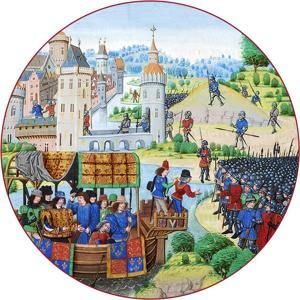
    The Peasants' Revolt, also named Wat Tyler's Rebellion or the Great Rising, was a major uprising across large parts of England in 1381. The revolt had various causes, including the socio-economic and political tensions generated by the Black Death in the 1340s, the high taxes resulting from the conflict with France during the Hundred Years' War, and instability within the local leadership of London. The final trigger for the revolt was the intervention of a royal official, John Bampton, in Essex on 30 May 1381. His attempts to collect unpaid poll taxes in Brentwood ended in a violent confrontation, which rapidly spread across the south-east of the country. A wide spectrum of rural society, including many local artisans and village officials, rose up in protest, burning court records and opening the local gaols. The rebels sought a reduction in taxation, an end to the system of unfree labour known as serfdom, and the removal of the King's senior officials and law courts. Inspired by the sermons of the radical cleric John Ball and led by Wat Tyler, a contingent of Kentish rebels advanced on London. They were met at Blackheath by representatives of the royal government, who unsuccessfully attempted to persuade them to return home. King Richard II, then aged 14, retreated to the safety of the Tower of London, but most of the royal forces were abroad or in northern England. On 13 June, the rebels entered London and, joined by many local townsfolk, attacked the gaols, destroyed the Savoy Palace, set fire to law books and buildings in the Temple, and killed anyone associated with the royal government. The following day, Richard met the rebels at Mile End and acceded to most of their demands, including the abolition of serfdom. Meanwhile, rebels entered the Tower of London, killing the Lord Chancellor and the Lord High Treasurer, whom they found inside. On 15 June, Richard left the city to meet Tyler and the rebels at Smithfield. Violence broke out, and Richard's party killed Tyler. Richard defused the tense situation long enough for London's mayor, William Walworth, to gather a militia from the city and disperse the rebel forces. Richard immediately began to re-establish order in London and rescinded his previous grants to the rebels. The revolt had also spread into East Anglia, where the University of Cambridge was attacked and many royal officials were killed. Unrest continued until the intervention of Henry Despenser, who defeated a rebel army at the Battle of North Walsham on 25 or 26 June. Troubles extended north to York, Beverley and Scarborough, and as far west as Bridgwater in Somerset. Richard mobilised 4,000 soldiers to restore order. Most of the rebel leaders were tracked down and executed; by November, at least 1,500 rebels had been killed. The Peasants' Revolt has been widely studied by academics. Late 19th-century historians used a range of sources from contemporary chroniclers to assemble an account of the uprising, and these were supplemented in the 20th century by research using court records and local archives. Interpretations of the revolt have shifted over the years. It was once seen as a defining moment in English history, but modern academics are less certain of its impact on subsequent social and economic history. The revolt heavily influenced the course of the Hundred Years' War, by deterring later Parliaments from raising additional taxes to pay for military campaigns in France. The revolt has been widely used in socialist literature, including by the author William Morris, and remains a potent political symbol for the political left, informing the arguments surrounding the introduction of the Community Charge in the United Kingdom during the 1980s.
    1 hr 8 min
  • Episode 288 - King Richard II - Biography - Part 14
    Richard II (6 January 1367 – c. 14 February 1400), also known as Richard of Bordeaux, was King of England from 1377 until he was deposed in 1399. Richard's father, Edward the Black Prince, died in 1376, leaving Richard as heir apparent to King Edward III. Upon the death of his grandfather Edward III, the 10-year-old Richard succeeded to the throne.
    During Richard's first years as king, government was in the hands of a series of regency councils, influenced by Richard's uncles John of Gaunt and Thomas of Woodstock. England then faced various problems, most notably the Hundred Years' War. A major challenge of the reign was the Peasants' Revolt in 1381, and the young king played a central part in the successful suppression of this crisis. Less warlike than either his father or grandfather, he sought to bring an end to the Hundred Years' War. A firm believer in the royal prerogative, Richard restrained the power of the aristocracy and relied on a private retinue for military protection instead. In contrast to his grandfather, Richard cultivated a refined atmosphere at court, in which the king was an elevated figure, with art and culture at its centre.
    The king's dependence on a small number of courtiers caused discontent among the influential, and in 1387 control of government was taken over by a group of aristocrats known as the Lords Appellant. By 1389 Richard had regained control, and for the next eight years governed in relative harmony with his former opponents. In 1397, Richard took his revenge on the Appellants, many of whom were executed or exiled. The next two years have been described by historians as Richard's "tyranny". In 1399, after John of Gaunt died, the king disinherited Gaunt's son, Henry of Bolingbroke, who had previously been exiled. Henry invaded England in June 1399 with a small force that quickly grew in numbers. Meeting little resistance, Bolingbroke deposed Richard and had himself crowned king. Richard is thought to have been starved to death in captivity, although questions remain regarding his final fate.
    Richard's posthumous reputation has been shaped to a large extent by William Shakespeare, whose play Richard II portrayed Richard's misrule and his deposition by Bolingbroke as responsible for the 15th-century Wars of the Roses. Modern historians do not accept this interpretation, while not exonerating Richard from responsibility for his own deposition. While probably not insane, as historians of the 19th and 20th centuries believed, he may have had a personality disorder, particularly manifesting itself towards the end of his reign. Most authorities agree that his policies were not unrealistic or even entirely unprecedented, but that the way in which he carried them out was unacceptable to the political establishment, leading to his downfall.
    24 min
  • Episode 287 - King Richard II - Biography - Part 13
    Richard II (6 January 1367 – c. 14 February 1400), also known as Richard of Bordeaux, was King of England from 1377 until he was deposed in 1399. Richard's father, Edward the Black Prince, died in 1376, leaving Richard as heir apparent to King Edward III. Upon the death of his grandfather Edward III, the 10-year-old Richard succeeded to the throne.
    During Richard's first years as king, government was in the hands of a series of regency councils, influenced by Richard's uncles John of Gaunt and Thomas of Woodstock. England then faced various problems, most notably the Hundred Years' War. A major challenge of the reign was the Peasants' Revolt in 1381, and the young king played a central part in the successful suppression of this crisis. Less warlike than either his father or grandfather, he sought to bring an end to the Hundred Years' War. A firm believer in the royal prerogative, Richard restrained the power of the aristocracy and relied on a private retinue for military protection instead. In contrast to his grandfather, Richard cultivated a refined atmosphere at court, in which the king was an elevated figure, with art and culture at its centre.
    The king's dependence on a small number of courtiers caused discontent among the influential, and in 1387 control of government was taken over by a group of aristocrats known as the Lords Appellant. By 1389 Richard had regained control, and for the next eight years governed in relative harmony with his former opponents. In 1397, Richard took his revenge on the Appellants, many of whom were executed or exiled. The next two years have been described by historians as Richard's "tyranny". In 1399, after John of Gaunt died, the king disinherited Gaunt's son, Henry of Bolingbroke, who had previously been exiled. Henry invaded England in June 1399 with a small force that quickly grew in numbers. Meeting little resistance, Bolingbroke deposed Richard and had himself crowned king. Richard is thought to have been starved to death in captivity, although questions remain regarding his final fate.
    Richard's posthumous reputation has been shaped to a large extent by William Shakespeare, whose play Richard II portrayed Richard's misrule and his deposition by Bolingbroke as responsible for the 15th-century Wars of the Roses. Modern historians do not accept this interpretation, while not exonerating Richard from responsibility for his own deposition. While probably not insane, as historians of the 19th and 20th centuries believed, he may have had a personality disorder, particularly manifesting itself towards the end of his reign. Most authorities agree that his policies were not unrealistic or even entirely unprecedented, but that the way in which he carried them out was unacceptable to the political establishment, leading to his downfall.
    16 min
  • Episode 286 - King Richard II - Biography - Part 12
    Richard II (6 January 1367 – c. 14 February 1400), also known as Richard of Bordeaux, was King of England from 1377 until he was deposed in 1399. Richard's father, Edward the Black Prince, died in 1376, leaving Richard as heir apparent to King Edward III. Upon the death of his grandfather Edward III, the 10-year-old Richard succeeded to the throne.
    During Richard's first years as king, government was in the hands of a series of regency councils, influenced by Richard's uncles John of Gaunt and Thomas of Woodstock. England then faced various problems, most notably the Hundred Years' War. A major challenge of the reign was the Peasants' Revolt in 1381, and the young king played a central part in the successful suppression of this crisis. Less warlike than either his father or grandfather, he sought to bring an end to the Hundred Years' War. A firm believer in the royal prerogative, Richard restrained the power of the aristocracy and relied on a private retinue for military protection instead. In contrast to his grandfather, Richard cultivated a refined atmosphere at court, in which the king was an elevated figure, with art and culture at its centre.
    The king's dependence on a small number of courtiers caused discontent among the influential, and in 1387 control of government was taken over by a group of aristocrats known as the Lords Appellant. By 1389 Richard had regained control, and for the next eight years governed in relative harmony with his former opponents. In 1397, Richard took his revenge on the Appellants, many of whom were executed or exiled. The next two years have been described by historians as Richard's "tyranny". In 1399, after John of Gaunt died, the king disinherited Gaunt's son, Henry of Bolingbroke, who had previously been exiled. Henry invaded England in June 1399 with a small force that quickly grew in numbers. Meeting little resistance, Bolingbroke deposed Richard and had himself crowned king. Richard is thought to have been starved to death in captivity, although questions remain regarding his final fate.
    Richard's posthumous reputation has been shaped to a large extent by William Shakespeare, whose play Richard II portrayed Richard's misrule and his deposition by Bolingbroke as responsible for the 15th-century Wars of the Roses. Modern historians do not accept this interpretation, while not exonerating Richard from responsibility for his own deposition. While probably not insane, as historians of the 19th and 20th centuries believed, he may have had a personality disorder, particularly manifesting itself towards the end of his reign. Most authorities agree that his policies were not unrealistic or even entirely unprecedented, but that the way in which he carried them out was unacceptable to the political establishment, leading to his downfall.
    23 min

About All Things Plantagenet

From the publisher's feed

Detailing the life and reigns of the Plantagent Kings of England and their Descendants.

Best of All Things Plantagenet

Ranked by our users in the last 21 days

More shows like All Things Plantagenet

Dan Snow's History Hit by History Hit

Dan Snow's History Hit

4,768 Listeners

Tudors Dynasty & Beyond by RedTop Media / Rebecca Larson

Tudors Dynasty & Beyond

753 Listeners

A Slice of Medieval by Sharon Bennett Connolly and Derek Birks

A Slice of Medieval

126 Listeners

Talking Tudors by Natalie Grueninger

Talking Tudors

734 Listeners

The Ancients by History Hit

The Ancients

3,363 Listeners

The Rest Is History by Goalhanger

The Rest Is History

15,573 Listeners

Gone Medieval by History Hit

Gone Medieval

1,894 Listeners

Not Just the Tudors by History Hit

Not Just the Tudors

2,049 Listeners