Eleanor of Provence (c. 1223 – 24/25 June 1291) was Queen consort of England, as the spouse of King Henry III of England, from 1236 until his death in 1272. She served as regent of England during the absence of her spouse in 1253.
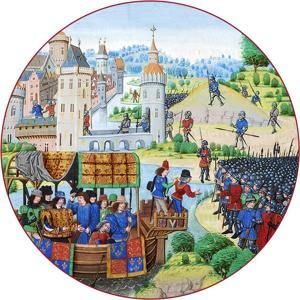
Although she was completely devoted to her husband, and staunchly defended him against the rebel Simon de Montfort, 6th Earl of Leicester, she was very much hated by the Londoners. This was because she had brought many relatives with her to England in her retinue; these were known as "the Savoyards", and they were given influential positions in the government and realm. On one occasion, Eleanor's barge was attacked by angry citizens who pelted her with stones, mud, pieces of paving, rotten eggs and vegetables.
Eleanor had at least five children, including the future King Edward I of England. She also was renowned for her cleverness, skill at writing poetry, and as a leader of fashion.
Early life Edit
Born in Aix-en-Provence, she was the second daughter of Ramon Berenguer IV, Count of Provence (1198–1245) and Beatrice of Savoy (1198–1267), the daughter of Thomas I of Savoy and his wife Margaret of Geneva. She was well educated as a child, and developed a strong love of reading. Her three sisters also married kings. After her elder sister Margaret married Louis IX of France, their uncle William corresponded with Henry III of England to persuade him to marry Eleanor. Henry sought a dowry of up to twenty thousand silver marks to help offset the dowry he had just paid for his sister Isabella, but Eleanor's father was able to negotiate this down to no dowry, just a promise to leave her ten thousand when he died.
Like her mother, grandmother, and sisters, Eleanor was renowned for her beauty. She was a dark-haired brunette with fine eyes. Piers Langtoft speaks of her as "The erle's daughter, the fairest may of life". On 22 June 1235, Eleanor was betrothed to King Henry III (1207–1272). Eleanor was probably born latest in 1223; Matthew Paris describes her as being "jamque duodennem" (already twelve) when she arrived in the Kingdom of England for her marriage.
Eleanor was married to King Henry III of England on 14 January 1236. She had never seen him prior to the wedding at Canterbury Cathedral and had never set foot in his kingdom. Edmund Rich, Archbishop of Canterbury, officiated. She was dressed in a shimmering golden dress that fitted tightly at the waist and flared out to wide pleats at her feet. The sleeves were long and lined with ermine. After riding to London the same day where a procession of citizens greeted the bridal pair, Eleanor was crowned queen consort of England in a ceremony at Westminster Abbey which was followed by a magnificent banquet with the entire nobility in full attendance. Her love for her husband grew significantly from 1236 onward.
Eleanor was a loyal and faithful consort to Henry, but she brought in her retinue a large number of uncles and cousins, "the Savoyards", and her influence with the King and her unpopularity with the English barons created friction during Henry's reign. Her uncle William of Savoy became a close advisor of her husband, displacing and displeasing English barons.
Though Eleanor and Henry supported different factions at times, she was made regent of England when her husband left for Gascony in 1253. Eleanor was devoted to her husband's cause, stoutly contested Simon de Montfort, raising troops in France for Henry's cause.
On 13 July 1263, she was sailing down the Thames when her barge was attacked by citizens of London. Eleanor stoutly hated the Londoners who returned her hatred; in revenge for their dislike Eleanor had demanded from the city all the back payments due on the monetary tribute known as queen-gold, by which she received a tenth of all fines which came to the Crown. In addition to the queen-gold other such fines were levied on the citizens by the Queen on the thinnest of pretexts. In fear for her life as she was pelted with stones.