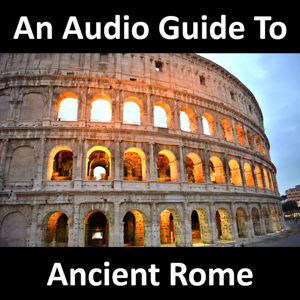
An Audio Guide to Ancient Rome

An Audio Guide to Ancient Rome

Download on the App Store

An Audio Guide to Ancient Rome episodes

  • 25: The Basilica Julia
    The Basilica Julia was dedicated by Julius Caesar in 46 BCE – the same year that his nearby Forum was completed.  Caesar funded the construction with monies taken during his highly successful campaigns in Gaul. 

    But his was not the first Basilica on this site. Over one hundred years earlier Tiberius Sempronius Graccus had bought a house from his father-in-law as well as adjacent butchers shops, tore them down and built in their place the Basilica Sempronia. This original building was smaller, covering roughly two-thirds of the site and positioned at the south east end (towards to the temple of Castor and Pollux). 

    Competing with his rival Pompey’s major Theater construction in the Fields of Mars, Caesar repaired and extended the Basilica Sempronia at the same time that he was building out the nearby Forum to the north that also bears his name.

    In 7 BCE, fire ravaged the buildings around the forum with the Basilica Julia and the Temple of Castor and Pollux being particularly badly damaged. The temple was rebuilt first and rededicated in the year 6, however it took a total of 19 years for the Basilica to be repaired. When completed, emperor Augustus dedicated the building his deceased grandchildren Gaius and Lucius however this new name didn’t find common use. 

    The Basilica consisted of a central nave and four aisles divided by square pilasters of travertine. These were all once veneered with marble.  The fronts and sides of the building were solid marble with Doric half columns projecting out of square pilasters.

    5 min
  • 24: The Temple of Vespasian and Titus
    The Temple of Vespasian and Titus sits at the north-west end of the Forum between the Temple of Saturn and the Temple of Concord and backs onto the Tabularium.  It is readily identified by the three Corinthian columns connected by a carved piece of entablature that together form a right-angle.  
    These columns establish the front-right corner of the Temple. Originally there would have been a total of 6 columns along the front and 8 running along each side.  There were originally two sets of stairs leading up through the front columns into a portico underneath a large triangular pediment.  This arrangement of steps was unusual and likely a result of the limited space available in this part of the forum.

    The pediment seems to have had an inscription across the front with a dedication that read ‘Divo Vespasiano Augusto SPQR’.

    The temple was constructed to honor the Flavian Dynasty, which comprised the emperors: Vespasian and his sons Titus and Domitian.

    6 min
  • 23: The Temple of Saturn
    The Temple, repaired and rebuilt over many centuries, is one of the most ancient buildings in the Forum.  Its construction was ordered by the last Etruscan King, Tarquin the Proud, in the late 6th or early 5th century BCE and was to be sited in front of an altar already dedicated to Saturn.

    It is easily recognized by its 8 remaining Ionic columns – six along the front and one on each side forming the front portico.  These support an entablature with an inscription that can be translated as “The Senate and People of Rome Restored what was consumed by fire”.  This evidences restoration work from the late fourth century.

    Over 500 years before this, in the early to mid-first century BCE, Lucius Munatius Plancus used his spoils of war to reconstruct the temple.  Munatius had been one of the generals successfully campaigning in Gaul alongside Julius Caesar and returned to Rome a wealthy man.  However, following Caeser’s assassination he repeatedly switched allegiances to try to remain in favor with however seemed to have the upper hand in the pursuit of overall control of the empire.

    The design of the Temple of Saturn however did not significantly change over the centuries despite being repeatedly repaired.  The portico originally had 6 columns at the front and two additional full columns on each side. There was a single main set of steps at the front that lead up to a pair of entrance doors.

    6 min
  • 22: The Temple of Concord
    The Temple of Concord is the site of a series of shrines dedicated to the Roman goddess Concordia, and erected at the western end of the Roman Forum. The earliest temple is believed to have been vowed by Marcus Furius Camillus in 367 BCE, but it may not have been built until 218 BCE.  

    The temple which had been occasionally repaired was completey rebuilt by Emperor Tiberius and dedicated in the year 10 after the original had been burnt down following a lightning strike.  Tiberius paid for the construction with the spoils of his and his brother Drusus’ highly successful campaigns conquering and pillaging across vast areas of Germania.

    The early version of the temple was similar to the nearby Temple of Castor and Pollux with steps leading up through lines of columns supporting a pediment that led to the entrance doors and a long and narrow main cella. 

    However Tiberius’ version was quite different as the temple expanded sideways with the main cella being wide rather than long – in part this was necessary because of the space limitations at the foot of the Capitoline hill and the fact that is was sited at the foot of the Tabularium. Its sideways expansion meant it ate into the space that had been occupied by the Basilica Opimia (sited to the left of the original building when looking from the path that runs in front of the Arch of Septimius Severus).

    6 min
  • 21: The Arch of Septimius Severus
    The Arch commemorates the victories of Emperor Septimius Severus and his sons, Caracalla and Geta, in the two campaigns waged against the Parthians between the years 194 and 199. 
    Before this the Romans had been in conflict with Parthia for hundreds of years with notable campaigns taking place under the command of various of its leaders including Crassus, Trajan and Hadrian spanning from 52BCE through to the early third century. In the first of these, Crassus led an invading army into Mesopotamia, with catastrophic results; at the Battle of Carrhae, Crassus and his son were defeated and killed by the Parthian army under General Surena. The bulk of Crassus’ force was either killed or captured; of 42,000 men, about half died, a quarter made it back to their base in Syria, and the remainder became prisoners of war. Rome was humiliated by this major defeat, which was made even worse by the fact that the Parthians had captured several Legionary Eagle standards. Such history made Severus’ campaigns and the eventual defeat of Parthia particularly important to Rome and worthy of memorialization.
    The arch has four carved panels that describe, in chronological sequence, the major events in the course of Severus’ campaigns.  Unfortunately some of these are in a poor state of preservation and many scenes are barely discernible. The side that faces the forum is particularly damaged because it has always been exposed to the wind and a fire in the Middle Ages. If, as we work our way around the monument, you’re having trouble making out the panel details, bear in mind that clearer modern versions of these reliefs can be seen in the Museo Nazionale della Civiltà Romana.

    10 min
  • 20: The Curia Julia
    The Curia Julia is the third building in the Forum that was purpose built as the Senate’s meeting place and each bore the name of its financial sponsor.  The custom of meeting in a Curia was believed to have begun in a temple where the warring tribes gathered and laid down their arms during the reign of Romulus. During the early monarchy, the temple was used by senators acting as council to the king. Tullus Hostilius was believed to have replaced the original structure after fire destroyed the converted temple – hence the first purpose built version is known as Curia Hostilia. 

    This curia was enlarged in 80 BCE by Lucius Cornelius Sulla during his renovations of the comitium at which time it was renamed the Curia Cornelia. 

    That building was lost in 53 BCE when the supporters of the murdered Publius Clodius Pulcher used it as the location of a funeral pyre to cremate his body and accidentally burned the whole place down.

    Subsequently, Julius Caesar’s major rebuild in 44BCE meant that the Senate sessions were temporarily convened in Pompey’s Theater located next to what is now the Campo dei Fiori.  This is why the Theater became the venue of Caesar’s assassination as Caesar made his way there to a meeting of the senate.  Caesar’s death delayed the new Curia’s construction which was eventually completed in 29 BCE by Augustus Caesar.

    This version, the Curia Julia, was remodeled by Domitian between the years 81 and 96. Then, in the year 283, it was heavily damaged by a fire. From 284 to 305, the Curia was rebuilt by Diocletian and it is the remnants of this building that we see today although it still carries the name Curia Julia. 
    6 min
  • 19: Black Stone, Rostra and Phocas
    You’re listening to an Audio Guide to Ancient Rome.  This episode is one in a series of short descriptions of monuments in the Roman Forum.  In this episode I’m describing the Black Stone, Rostra and the Column of Phocas.

    The Roman Forum sits in a saddle between the Capitoline and Palatine Hills.  Originally a marshy area, successive improvements to the land’s drainage allowed this to eventually become the center of power for the city.  

    As its armies conquered new territories and money flowed into Rome, the Forum’s original meat and produce sellers were pushed out, to be replaced by majestic temples and monumental structures that accommodated the key societal, political and judicial systems needed for the empire to function.  This area served as a central market and meeting place over many centuries although the nature of the proprietors and clientele changed significantly over time.

    The Forum and its surrounding buildings grew to be the focal point for nearly everything associated with the lives of the people of Rome including political discussions, legislative processes, civic entertainment, as well as a logical place to hold a riot or even a cremation.

    The area was first surfaced with gravel in 7th Century BCE around the time of the establishment of the Comitium and Senate House (or Curia). Although lost for many centuries and no longer recognizable other than through its archaeological footprint, the Comitium was sited in front of where you now see the meeting house of the Roman Senate (which is often called the Curia Julia). If you’re having trouble locating this, it is to the south east of the Arch of Septimius Severus and hidden underneath a low sloping temporary roof that covers ongoing excavation work.

    Also the location of the sanctuary for the fire god Vulcan, this was an important cult center from the very beginning of Rome’s development. The sanctuary consisted of an open-air U-shaped altar, a column which was probably for a cult statue, and an inscribed stela, known as the Lapis Niger (or Black Stone). 

    9 min
  • 18: The Basilica Paulli
    Before the Basilica Paulli was built, this location had already served as the site of a basilica commissioned in 179 BCE by consul Marcus Fulvius Nobilior. That building replaced a series of butchers shops that previously occupied the site.  Fulvius didn’t see the project through to completion so, after his death, his colleague and contemporary Marcus Aemilius Lepidus ensured the work was finished. For the next 125 years the building sited here was known as the Basilica Fulvia after its original sponsor.  This first version had a large and roughly rectangular main hall with 34 internal columns defining the inner apse – these were arranged in 4 columns at each end and an additional 13 on each side. Coins from the period show that it was two stories high with columns on the upper floor on the outside. The side of the Basilica that faced the Forum had a portico running along its length also supported by a set of columns.  Under the portico were a set of alcoves that housed a row of new shops – these were referred to as the Tabernae Argentariae Novae which indicates that the shops were actually silversmiths, money changers and bankers.

    A substantial refinement and upgrade of the Basilica was made by the Consul Lucius Aemilius Paullus in 55BCE using money he’d received as a bribe from Julius Caesar – the money had been given in return for political support while Caesar was vying for power with Pompey. 
    7 min
  • 17: The Temple of Castor and Pollux
    The Temple of Castor and Pollux is readily recognizable by its remaining 3 white columns standing in a line close by the Temple of Vesta.  These columns are part of the side of a much later rebuild of what was originally a 5 Century BCE temple. The original temple to the semi-divine twins Castor and Pollux was pledged just after 500 BCE by Aulus Postumius Tubertus - an early Roman military leader. 

    According to legend, Jupiter’s mortal son Castor and his immortal son Pollux came riding into battle in aid of Rome’s forces – the twins were seen by Postumius and his immediate troops. The semi-gods were carrying spears, riding white horses and helped guide an attack of the Roman troops. They were then seen again, later that same day, at the spring of Joturna where they spread news of Rome’s victory.  The Temple and Spring of Joturna are very close by.

    In the early second century BCE the temple was repaired by possibly Aemilius Paullus in celebration of his victory over the Macedonians. Further modifications and updates were made by Lucius Caecilius Metellus and then by the Emperor Augustus following the devastating fire of 14 or 9 BCE.  He used the repairs to better associate the temple and the divine twins with his own two sons - Gaius and Lucius Caesar. Sadly, both children would die before completion of the project and so, in time, the association changed to be with Tiberius and his late brother Drusus.

    In the course of all these repairs and updates the design was changed to be of a form similar to other adjacent forum temples such as that of Divus Julius.  The updated version had two sets of steps flanking the entrance, a row of 8 columns at the front and back and 11 columns on each side.  The 3 remaining columns, which have Corinthian capitals, are from the middle section of the east side.  They support a simple but elegant entablature that would have run around the entirety of the edge of the roof – most likely with a carved dedication on the front that faced North. Ascending the steps at the front one would have passed through the front columns, under a large triangular pediment and into a single main temple hall that likely contained statues of Castor and Pollux.

    Given that the temple has a raised podium fronting directly onto the Forum it also served as an orators platform. Perhaps surprisingly, the extremely solid base of the temple’s foundations was divided into chambers for various official public services - particularly those needing the protection of thick walls. 

    In addition to its civic function, the Temple was the center of annual celebrations commemorating the victory at Lake Regillus.  A major cavalry parade was held each year on July 15th and featured as many as 5,000 young men carrying shields and spears. 

    7 min
  • 16: The Temple of Divine Julius
    Little of the Temple of Divine Julius remains however a lot is known about the events that led to its construction and what it looked like.

    Julius Caesar was assassinated on the 15th March in the year 44 BCE at a session of the Senate convened in a hall that was part of the Theater of Pompey. He died as a result of 23 stab wounds inflicted by a mob of dagger wielding senators that ambushed him as he entered the hall. The mob included his ally Brutus. Brutus and the rest of the senators had grown quickly unhappy with Caesar’s move to secure power and, specifically, in establishing himself as “dictator in perpetuum” or dictator in perpetuity. 
    The temple was commissioned two years after Caesar’s death at the direction of Augustus and following Caesar’s posthumous deification. The location of his cremation was chosen very much in the spur of the moment. Mark Antony’s funeral speech had so affected the crowd that they, together with Caesar’s family and followers, took charge of the funeral service and created an impromptu funeral pyre and burned Caesar’s body here in the Forum.

    Shortly after the funeral the cremation site was marked by a column but, over time, this was replaced with a much more substantial temple that sat on a raised platform.  Set in the front of the temple was a circular sacrificial alter – this was set in a semi-circular alcove – the concrete core of the altar can be seen and is set underneath a modern covering.  The main temple building would have been accessed by steps to the right and left as you face what remains of the alter. 

    A denarius coin minted 8 years after Caesar’s death clearly shows his temple, its alter, the pediment decoration, lettering marking the temple’s dedication as well as a statue of Julius Caesar wearing a toga and holding an augur. From this we can assume that, like other Roman temples dedicated to gods, there would have been a single large statue of Caesar standing inside the Temple’s main hall. 

    The temple of Divine Julius was later sandwiched between two triumphal arches.  On the north side (that’s the left while facing the altar) Augustus erected the Actium Arch in 29 BCE further commemorating his victory over Mark Anthony and Cleopatra.  On the south side of the temple Augustus erected the Parthian Arch, celebrating the return of surrendered Roman standards that had been lost to the Parthians some 24 years earlier under Caesar’s reign.

    7 min

About An Audio Guide to Ancient Rome

From the publisher's feed

A free audio guide that helps you discover the history and context of Rome's ancient sites.

More shows like An Audio Guide to Ancient Rome

The Rest Is History by Goalhanger

The Rest Is History

15,653 Listeners

The Rest Is Politics by Goalhanger

The Rest Is Politics

3,017 Listeners

Empire: World History by Goalhanger

Empire: World History

2,463 Listeners