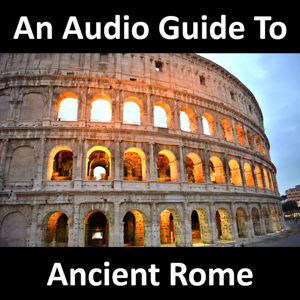
An Audio Guide to Ancient Rome

An Audio Guide to Ancient Rome

Download on the App Store

An Audio Guide to Ancient Rome episodes

  • 15: The New Basilica
    Construction of the New Basilica began under the emperor Maxentius in the year 308 but was completed by emperor Constantine in 312 after his victory over Maxentius at the Battle of the Milvian Bridge. Indeed, the change in ruler during its building means that this is sometimes referred the Basilica of Maxentius or the Basilica of Constantine. The term Basilica in modern usage suggests a large church or cathedral but in ancient Rome it was more associated with a large civic chamber or meeting hall.  It would have contained statues of gods but was not likely a place of worship. The Basilica's 3 large bays that dominate the north side of the Via Sacra faced onto a large central nave and were mirrored by another set of 3 matching bays on the South side. These bays had large windows to help light the halls and the ends each bay’s dividing support wall originally had a massive marble column 14.5 meters high and roughly 1 meter wide. All but one of these 8 columns were destroyed – the last remaining was removed by Pope Paul V in the early 1600s and placed in La Basilica di Santa Maria Maggiore where it still stands. 
    7 min
  • 14: Temple of Antoninus and Faustina
    The Temple of Antoninus and Faustina is easily recognized by the six columns that dominate its front – these are topped by an entablature that carries the dedication to “Divo Antonino et Divae Faustinae Ex S.C.” which can be translated as “To the divine Antoninus and the divine Faustina, by Senate Decree.” In fact the temple was constructed by Emperor Antoninus Pius in honor of his wife Faustina, who had died in the year 140. Antoninus had married Annia Galeria Faustina the Elder roughly thirty years earlier sometime between the 110 and 115. Faustina was a beautiful woman and Antoninus cared for her deeply. They are believed to have enjoyed a happy marriage and together had four children, two sons and two daughters. 
    Faustina died at the age of 40 and Antoninus was devastated. He asked the Senate to deify her as a goddess and authorized the construction of a temple to be built in the Roman Forum in her name. He had elaborately decorated coins with her portrait minted in her honor that were inscribed with ‘DIVA FAUSTINA’. To continue his wife’s work with the young impoverished and destitute daughters of Rome, he founded a charity called the Girls of Faustina.In the end Antoninus outlived his wife by 20 years. Upon his death, his name was added to the inscription by Emperor Marcus Aurelius who rededicated the Temple to both Antoninus and Faustina. 
    6 min
  • 13: Temple of Divus Romulus

    The Temple of Divus Romulus is recognizable as a tall round building on the North side of the Via Sacra. From the name you can be forgiven for thinking that this temple is dedicated to Romulus the legendary founder and first king of Rome. Instead the association comes from the theory that this is the temple dedicated to Marcus Aurelius Romulus co-consul who died at the age of 14 in the year 309. His father, the Emperor Maxentius, dedicated a Temple in this area and commissioned a series of commemorative coins which showed a domed shrine with one of the doors ajar, and an eagle on top. The temple was probably part of a larger rebuilding program undertaken by Maxentius following a disastrous fire in 306. The project was only partially complete when Maxentius died in the Battle of the Milvian Bridge while defending Rome against Emperor Constantine and his invading troops. 
    What remains is the main entrance to a 4th Century Temple the front of which was originally flanked by two halls who’s remnants are hinted at by the surrounding brickwork and columns. The current street level is much lower than when the temple was constructed so we can see a lot of the exposed footings. Much of the façade has gone but sufficient remains to have a sense of the curving front with niches for 2 statues on each side of the main entrance door. The columns and carvings are mostly repurposed materials from older constructions. 

    6 min
  • 12: The Temple of Vesta
    The Temple of Vesta was integrated into the adjacent House and Sanctuary of the Vestal Virgins. The only remains of the temple itself are a modest mound of concrete however there is a reconstruction of part of the circular temple wall with adjacent columns that give some sense of the shape and scale of the temple building. The area served as both accommodation and a religious site for only six vestal virgins and provided a place where they could keep the sacred fire alight – a key part of their service to Vesta. 

    Much of the underlying Sanctuary structure dates back to at least 150 BCE but it is likely that there were earlier temples and housing here as the tradition goes back to at least 400 years earlier. The area has been rebuilt and expanded multiple times over the course of the empire.  At one time the large complex housed over 60 rooms, had its own well, courtyard and altar that presumably catered to the Vestal Virgins, their religious ceremonies and their large retinue of slaves and assistants.

    Vestals entered service between the ages of 6 and 10 and remained in position for a minimum of 30 years. They had special privileges such as enjoying special seating at major events, they were able to own property, any injury to them was punishable by death, they could free condemned prisoners simply by touching them and they had complete right of way while moving around Rome and were aided in this by having a lictor walk ahead of them clearing the way.  
    5 min
  • 11: The Temple of Roma and Venus
    The Temple of Roma and Venus was designed and commissioned by the Emperor Hadrian.  Building started in the year 121 and this, the largest of Rome’s Temples, was inaugurated in the year 135. The building served two cults with a huge seated statue for each: one side was dedicated to the goddess Roma and the other to the goddess Venus.  The goddesses sat back-to-back on thrones in the middle of the temple facing outwards on the long axis of the main building.  Here Venus was also used to represent love which in Latin was written as Amor – conveniently this is Roma spelled backwards. By placing the two divinities of Venus and Rome back-to-back in a single temple Hadrian enjoyed the further symmetry of their Roman names. 
    6 min
  • 10: The Arch of Titus
    The Arch of Titus - This monument celebrates processional triumph given to Titus following his successful campaign in Judaea. 
    Titus commanded the Roman army during the siege and destruction of Jerusalem in the year 70. This was the culmination of a four-year campaign in Judaea which had been triggered by the Jewish uprising in the year 66. The end of the campaign came with the sacking of Jerusalem and the destruction of the Second Temple of which little now remains but a short section of wall – known today as The Western Wall. It has been estimated that over a million people were killed during the siege, of which a majority were Jewish and nearly 100,000 were captured and enslaved. 

    Despite the human carnage, Titus was awarded a triumph on his return to Rome in the year 71. Accompanied by both Vespasian and Domitian, he rode into the city and was enthusiastically greeted by the Roman populace as they cheered the lavish parade that openly flaunted the treasures and captives from the war. 

    The Arch memorializes both the victory and, specifically, the triumphal procession when Titus was honored by all of Rome. 

    7 min
  • 9: The Roman Forum
    You’re listening to an Audio Guide to Ancient Rome.  My name is Daron Green.

    This intro and the next 15 podcast episodes are all relatively short – typically 5-10 minutes long with each focused on a specific building or area in the Roman Forum – note that there is an interactive google map available on rome-podcast.com to help navigate you around these episodes and the other locations I cover outside of the Forum.

    You don’t have to visit these in numerical order indeed, part of the rationale for recording these separately was to let you choose the best route depending on how busy different areas are and what interests you the most.

    For me, visiting the Roman Forum is really quite special as I, when I’m there, I always feel genuinely connected to Rome’s deep history.

    From what was originally swampy marshland, the Romans drained the area and turned it into the control center of political and social activity for the most powerful society and military force in the world.

    The forum was the marketplace of Rome, and later a gathering space for triumphal processions, criminal trials and gladiatorial matches. It has also seen executions, riots, assassinations, funerals, and both inspirational speeches that changed the course of history and botched cremations (one of which got so ridiculously out of hand that it burnt down the Senate building). 

    The Roman Forum was home to some of the oldest and most important buildings in the ancient city including shrines, temples, markets, a prison for captured enemies of the state, civic meeting areas, victory monuments and the official buildings that drove the administration and governance of first the republic and then the empire.

    The Forum was largely abandoned in the Middle Ages, and over time, buried under layers of earth, some temples were transformed into Christian churches which helped significantly with their preservation while less fortunate neighboring structures were pillaged for raw materials.

    Indeed, during the Renaissance the Forum became an all-too-convenient ready source of marble and stone which meant that many of the buildings were dismantled and much of the fine details and craftsmanship of the ancient Roman builders was lost.

    As you will learn, the buildings in the forum often make statements about the people that commissioned them and the favor they wished to gain with the people of Rome, the Senate or with the gods. Some of the structures were financed by the spoils of war, others through extortion or simply from the riches of a successful family business.

    To give some perspective on the deep history, when the Forum was majorly remodeled following a major fire in the year 283 it was already 1,000 years old.

    4 min
  • 8: The Baths of Caracalla
    The Baths of Caracalla occupy a truly huge site to the south of the city.  This particular construction was likely originally commissioned by Septimius Severus; but inaugurated in the year 216 during his son Caracalla’s reign. The opening of the baths came at a time when Caracalla had serious need of a positive public relations message given he'd recently murdered his brother, Geta, and thousands of Geta's friends in Rome. In use for roughly 300 years, the baths fell into disrepair around the time of the gothic siege of Rome in 537. Second only in size to the Baths or Diocletian which were built 100 years later, these remains are the best preserved of their kind.

    17 min
  • 7: The Piazza Navona
    It’s difficult to imagine it now, but the Piazza Navona we see today sits on the footprint of what was a major sporting stadium that accommodated roughly 30,000 spectators.  Known it its day as the Circus Agonalis it was commissioned by Emperor Domitian and opened in the year 86. This tour, which starts at the south end of the piazza, gives the history of the site as well as context and explanation of the 16th and 17th century fountains.

    15 min
  • 6: The Arch of Constantine
    The arch was erected by the Roman Senate to commemorate emperor Constantine's victory over emperor Maxentius at the Battle of Milvian Bridge which had taken place on October 28 in the year 312.  This tour gives the context for the rich details shown on the arch and explores the deeper history of why two Emperors ended-up waging war on each-other.
    19 min

About An Audio Guide to Ancient Rome

From the publisher's feed

A free audio guide that helps you discover the history and context of Rome's ancient sites.

More shows like An Audio Guide to Ancient Rome

The Rest Is History by Goalhanger

The Rest Is History

15,653 Listeners

The Rest Is Politics by Goalhanger

The Rest Is Politics

3,017 Listeners

Empire: World History by Goalhanger

Empire: World History

2,463 Listeners