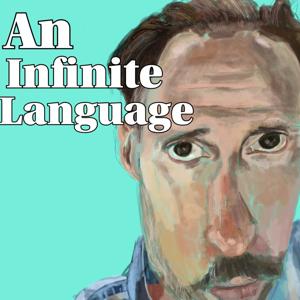
An Infinite Language

An Infinite Language

By Adam TramantanoArtsVisual Arts
Download on the App Store

An Infinite Language episodes

  • Why the self portrait?
    an exploration of the common grounds of three questions:
    Why the self portrait? Can we create art and not reveal who we are? Should we do commissioned work?
    31 min
  • How to write a love song and not really mean it
    Can you perform with just a notion of technique and without a sense of sincerity? Working with purity: either just passion or just technique… as a comparative structure to inquire into the question. Is it better to have feeling or a technical sense of the work? We can find examples of great performances of both. Sometimes as we learn more effective techniques in creation, we might get more of a reaction but we can feel more about the technique than the content. Authorial intent: can we know the intention? Do we need to? The audience’s reception: that’s the counterpart to intent of the author. And then the idea of expression. And communication.
    32 min
  • Can we separate content from technique?
    Can we separate content from technique? What is the meaning of the lighthouse? One question here is the technique. One is the content. Perhaps they are one in the same. What is the meaning of the lighthouse? Symbolism: pre-figurative plus derivation of figurative meaning. The lighthouse is a structure that allows for people navigating to know that there is a place. A lighthouse is located in public. It is a public good once it is built. Free and open to all to find their way.   In painting, the lighthouse becomes a look at painting techniques again and again. The content stays the same and the technique becomes experimental. Breaking down technique into phases and parts. This has been a technique exploration for me, as it has been a subject exploration.   It might take practice and help for audiences to understand how to begin to appreciate technique instead of content.   The meaning of the lighthouse for me is also a practice not only in technique but also in inventive rendering rather than representational rendering. Tendencies: towards rendering from representation or from imagination. This process has helped me work less referentially. And has enabled some traction with referential type of work in an imaginative way, without direct representation as a reference. The work with the lighthouse has been as an actual guide for me in expanding a particular type of painting process of representational invention.
    26 min
  • Does art mask or reveal the true face?
    What is a mask? Literally and figuratively. Do creative pursuits construct a truer self? Or do they allow for a mask to be constructed? Or perhaps another persona? What is a mask? Masks that we can see. Masks that are hidden. A mask conceals important parts that we rely on in order to identify a person from the outside. The mask hides the face but creates a new face. Recognizability is both obscured but renewed. A mask is like a key into another portal of a persona. A foundation for presenting another persona. A transformative device for understanding who someone is. Identity isn’t it necessarily it. Outside and inside might not always coincide. The features of the face converge into a whole. No particular part is more important. But once a significant portion is covered up, the recognition of the whole becomes difficult. What is a face? Explored as a portrait painter. A technique is a way for the artist to make what they’re trying to do accessible to themselves. It’s almost the opposite of what a mask is. My technique to convey the face is to start with the nose because it helps me to triangulate the face. A face is: the features converging within the margin just enough to convey a recognizability. The mask then is a cover up in part or whole of a recognizable form of communication. Well then what is the possibility for the individual to become a truer or more masked self via creative production?
    31 min
  • The strange comforts of Halloween
    We can view Halloween as a festival of creative participation. Anyone can participate to any extent or no extent. It allows for a creative way of engaging across genres. The levels of participation can be judgment free. Freedom of acquiescence It’s about the idea enacting the representation of beings that don’t exist in this world or are looking to invade the living world. And we come to this with a sense of nostalgia and joy. A wholesome scare. Sounds contradictory. Dealing in the plate tectonics of the subconscious.
    27 min
  • What is a Ghost Story?
    What is a ghost? Something that has the visual semblance of a human being, but not all aspects. Sometimes it can create sound. Not fully formed visually. A ghost can manifest as a visually present enough version of a human being. Ghost stories are often in houses. House is a central human symbol of comfort. The ghost is a disruption to the norm. Why does the ghost scare people? The ghost represents the prior existence before the current occupants. This represents a cycle of life. The ghost’s presence connotes a sense of vulnerability for the living in its appearance in less frequented places (attic, basement) and in the evening often, when the character is alone. And then the fear is premised on the question of whether the ghost is a good or evil presence. The ghost can show the dweller their own mortality. The ghost is a representation of impermanence. Or in the reverse, what’s scary about the ghost is the lack of impermanence. There are other kinds of ghost stories. A ghost story is a story in which you have a character whose placement in this world is somehow out of order. Place is important: where the ghost appears and what they’re doing. We often see ghosts looking to repeat the same thing. There is something that is not reconciled for them.  They are often held back from the completion of a reconciliation.
    26 min
  • Why are creative pursuits good for us?
    Sometimes we need to pursuit a question more within our range. Sometimes a question is too bold for the now. How is a creative question situated within a comfortable reach from where you are working from today? Shifting from one approach to another. Within creative pursuits you place yourself in control. And you are sometimes in a predicament where you choose something that enables you to get something accomplished. It would be a mistake to call this choosing the easy path. You sometimes encounter junctures of perception, of changing the dial a little bit. When we change the paradigm, then we can do some work. Creative work is good for us because we can get into the details of where we are in our work and provocations from that work. Can creativity save the world? Compelling question. Too much to take up right now. Where is the leverage for this question? Why are creative pursuits good for us? Still bold but seems navigable and challenging. We place ourselves in positions to reach beyond what we can do. And in that process, we have to decide whether we are reaching too far or within a challenging plausibility.
    26 min
  • Do we need creative mission statements?
    Consider the nature of the question. Consider what it all means. What is a mission statement or statement of purpose as a creative individual? Often with words. An articulation of where you stand and where you’re coming from in why you create what you create and what you anticipate the effects will be, perhaps. It’s another way to add a unique signature to who you are as someone who is involved in creative work. It overemphasizes a certain mapping of creative experience to advocate for just one approach. It’s good to consider what it all means. (recording contains ambient sound)
    28 min
  • The World Needs the Art You Create
    There’s so much already done, why make my art? It is possible to have a sea of doubts in the creative process. Among such doubts, are there legitimate and illegitimate ones? Whole other topic. In the life of creating, we will doubt. Why does the world need what I’m going to create? What can I possibly offer given the great works that already exist? Everyone lives in a context. In the game of human history. We are from specific contexts and categorical ones. This converges into a unique fingerprint of existence. (Episode was recorded outside and contains ambient sounds)
    37 min
  • Painting compared to illustrating
    Why we love an idea: wonderful simultaneity. We have it but don’t. What is the difference? Is there a difference between an illustrator and a painter?   Illustration: the line tells us where one thing begins and ends. Critically and extremely important… we have to know what we’re looking at. Or do we? Another topic for another day. What is painting? We do use the line in painting. Color and value are painting’s “lines.” What is value? It’s connected to saturation. Simple definition: the color itself, with gradations of white or black added to it. The mixture of black and white and the gradations of gray in the middle. This is with or without a color added. Light and dark and all in the middle are relational considerations to that which is in the picture. They are contextual in that exact picture that you are working with. Value is an explaining tool of painting. The other explaining tool is color. Cold and warm colors.   Hawthorne on painting What I said in the podcast is the idea that “It’s all color…” That was my recollection of the idea. Perhaps he does say this. Though on skimming the book, I couldn’t find that exact statement. What he says on page 26 that is pertinent to the considerations here is, “it’s the relation of one color as it comes against another that you must see correctly.” (Page 26, Hawthorne on Painting, Dover Edition 1960, ISBN: 978-0-486-20653-0). He discusses color in many ways throughout the book. The major point is that the tools of explanation in painting are color and value.   Palm cancelation not necessary as a consideration for a painter. When I was learning in eighth grade to prepare for art high school in NYC The teacher taught us to hold the charcoal with the palm facing the surface, so that we are using the forearm more so than the hand.

    43 min

About An Infinite Language

From the publisher's feed

Is it possible that creative expression is an infinite language? What are the reaches of this creative language we call the arts? This podcast navigates the intersections of literature, visual art,…