Antigone - Sophocles - Full Play

Antigone - Sophocles - Full Play

Download on the App Store

All Antigone - Sophocles - Full Play episodes

  • Antigone - Sophocles
    Antigone by Sophocles.

    This is the final installment in Sophocles' Theban Plays, following Oedipus Rex and Oedipus at Colonus. Oedipus's daughter Antigone deliberately breaks the laws of Thebes when she buries her brother's body and is sentenced to death. She clashes with Creon, the King of Thebes, over what constitutes justice and morality: the laws of the state or the laws of the individual.

    Featured on Antigone - Sophocles - Full Play.

    Public-domain recording courtesy of LibriVox (librivox.org).

    1 hr 14 min
  • Gruach-Gordon Bottomley
    Gruach by Gordon Bottomley.

    Gordon Bottomley's verse drama in two scenes is a prequel to Shakespeare's Macbeth. He provides Lady Macbeth with a name - Gruach - and imagines her family life and how she meets Macbeth.

    Featured on Antigone - Sophocles - Full Play.

    Public-domain recording courtesy of LibriVox (librivox.org).
    1 hr 14 min
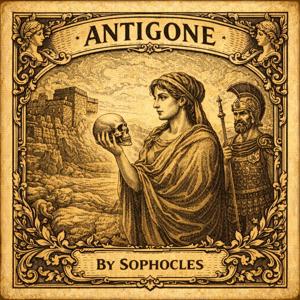
  • Antigone (Plumptre Translation)-Sophocles
    Antigone (Plumptre Translation) by Sophocles.

    A powerful artistic protest against tyranny, "Antigone" has been translated and adapted dozens of times, applied over and over through the centuries to current forms of the oppression so common to human experience. Antigone's heroic resistance to Creon's petty, capricious, and unbending law has a never-ending relevance even in the third millennium CE. The play was written at a time of national fervor. In 441 BC, shortly after the play was released, Sophocles was appointed as one of the ten generals to lead a military expedition against Samos. It is striking that a prominent play in a time of such imperialism contains little political propaganda, no impassioned apostrophe, and, with the exception of the epiklerate (the right of the daughter to continue her dead father's lineage), and arguments against anarchy, makes no contemporary allusion or passing reference to Athens.

    Featured on Antigone - Sophocles - Full Play.

    Public-domain recording courtesy of LibriVox (librivox.org).
    1 hr 18 min
  • Seven Against Thebes (Way Translation)-Aeschylus
    Seven Against Thebes (Way Translation) by Aeschylus.

    Seven against Thebes is the third play in an Oedipus-themed trilogy produced by Aeschylus in 467 BC. The trilogy is sometimes referred to as the Oedipodea. It concerns the battle between an Argive army led by Polynices and the army of Thebes led by Eteocles and his supporters. The trilogy won the first prize at the City Dionysia. The trilogy's first two plays, Laius and Oedipus, as well as the satyr play Sphinx, are no longer extant. When Oedipus, King of Thebes, realized he had married his own mother and had two sons and two daughters with her, he blinded himself and cursed his sons to divide their inheritance (the kingdom) by the sword. The two sons, Eteocles and Polynices, in order to avoid bloodshed, agreed to rule Thebes in alternate years.

    Featured on Antigone - Sophocles - Full Play.

    Public-domain recording courtesy of LibriVox (librivox.org).
    1 hr 1 min
  • Hippolytus-Euripides
    Hippolytus by Euripides.

    Eurpides' tragedy tells of Theseus' chaste son Hippolytus, who refuses to worship Aphrodite in favor of Artemis. Aphrodite gets revenge by causing Hippolytus' stepmother Phaedra to fall in love with him, unleashing a chain of tragic events.

    Featured on Antigone - Sophocles - Full Play.

    Public-domain recording courtesy of LibriVox (librivox.org).
    1 hr 38 min
  • Seven Against Thebes-Aeschylus
    Seven Against Thebes by Aeschylus.

    In this, the only extant tragedy from Aeschylus' trilogy about the House of Oedipus, Thebes is under siege from Polynices, a former prince of Thebes. After King Oedipus left his city and cursed the princes, Polynices and his brother, Eteocles, decided to rule alternately, switching at the end of every year. However, at the end of his year as king, Eteocles refused to turn power over to his brother and exiled him, fulfilling his father's curse that the two brothers could not rule peacefully. In the action of the play, Polynices and a group of Argive soldiers are attacking Thebes so that he can take his place as ruler. Eteocles must combat both the foreign forces outside the walls and the crazed, frightened women within. The lines Antigone and Ismene's entrance to the end may have been added later, either after Sophocles' Theban plays became popular or in the Middle Ages.

    Featured on Antigone - Sophocles - Full Play.

    Public-domain recording courtesy of LibriVox (librivox.org).
    1 hr 10 min
  • Bacchanals-Euripides
    Bacchanals by Euripides.

    Euripides' Bacchae is based on the Greek myth of King Pentheus of Thebes and his mother Agave and their punishment by the god Dionysus who proclaims that he has come to Thebes to avenge the slander that he is not the son of Zeus. He intends to introduce Dionysian rites into the city and to demonstrate to Pentheus that he was indeed born a god. At the end of the play Pentheus is torn apart by the women of Thebes and Agave bears his head on a pike to her father Cadmus. Bacchae is distinctive from most other Greek tragedies in that the chorus is an integral part of the plot and the God is not a distant presence but the main protagonist. This translation by Henry Hart Milman, former Professor of Poetry at Oxford University, is in the form of a dramatic poem rather than a play.

    Featured on Antigone - Sophocles - Full Play.

    Public-domain recording courtesy of LibriVox (librivox.org).
    1 hr 33 min
  • King Arthur-Joseph Comyns Carr
    King Arthur by Joseph Comyns Carr.

    A retelling of the classic legend of King Arthur, Guinevere & Sir Lancelot.

    Featured on Antigone - Sophocles - Full Play.

    Public-domain recording courtesy of LibriVox (librivox.org).
    1 hr 49 min
  • Oedipus-Lucius Annaeus Seneca
    Oedipus by Lucius Annaeus Seneca.

    Oedipus is a Latin verse tragedy written by the Roman playwright Seneca the Younger. It is based on the Greek legend of Oedipus and his marriage to his mother Jocasta. An oracle once came to Laius, king of Thebes, that he should perish by his own son's hands. When, therefore, a son was born to him, he gave the infant to his chief of shepherds to expose on Mount Cithaeron. But the tender-hearted rustic gave the babe instead to a wandering herdsman of Polybus, the king of Corinth. Years later, a reputed son of Polybus, Oedipus by name, fearing an oracle which doomed him to slay his father and wed his mother, fled from Corinth, that so he might escape this dreadful fate. As he fared northward, he met and slew an old man who imperiously disputed the narrow way with him.

    Featured on Antigone - Sophocles - Full Play.

    Public-domain recording courtesy of LibriVox (librivox.org).
    1 hr 31 min
  • Medea - Euripides
    Medea by Euripides.

    Euripides' tragedy focuses on the disintegration of the relationship between Jason, the hero who captured the Golden Fleece, and Medea, the sorceress who returned with him to Corinth and had two sons with him. As the play opens, Jason plans to marry the daughter of King Creon, and the lovesick Medea plots how to take her revenge.

    Featured on Antigone - Sophocles - Full Play.

    Public-domain recording courtesy of LibriVox (librivox.org).
    1 hr 45 min