Asian Studies Centre

Asian Studies Centre

By Oxford UniversityEducation
Download on the App Store

Asian Studies Centre episodes

  • Ambivalence, Ambiguity and Alienation: Making Sense of 'Tension' in North India
    Raphael Susewind speaks at the South Asia Seminar on 13 February 2018 How can we understand 'tension', the experience of rigidity that often underpins systemic structures of domination, epistemic violence as well as physical aggression in South Asia? Following Zygmunt Bauman, I want to suggest that 'tension' is the outcome of an overzealous pursuit of moral and categorical clarity which alienates us from the ambiguity of lived experience. At some point, alienation becomes so gross and the aspiration for clarity thus so untenable that it breaks down into ambivalence, and then violence. Deviating from Bauman and others, I however propose a heuristic vocabulary that distinguishes more clearly between ambivalence and ambiguity, building on ethnography of religion, gender and aggression in North India.

    39 min
  • Hindu Militarism, P.D. Tandon and the Politics of Scale in 1940s Uttar Pradesh
    William Gould speaks at the South Asia Seminar on 21 February 2017 There are two broad trends in historical scholarship on partition: On the one hand, older work traced high politics, and the ‘end-game’ of Empire. On the other, more recent and extensive histories recover partition experiences, refugee politics and everyday violence. Uttar Pradesh and its urban centres were not in partition’s immediate hinterland but were pivotal, this paper argues, at an alternative scale of political mobilisation around volunteer movements. Taking P.D. Tandon’s Hind Rakshak Dal as its central case study, it argues that early 1940s militaristic and drilling organisations were ideologically pivotal to the meaning of ‘Pakistan’ in UP. The paper draws some new conclusions about the significance of these movements’ ideologies of violence to India’s long partition.
    56 min
  • Subaltern Counter-Publics: Dalits and Missionary Christianity in Kerala
    Sanal Mohan speaks at the South Asia Seminar Missionary Christianity in Kerala, contrary to the received notions in social sciences, offered a new language of internal deliberations to Dalits and provided them agency different from their position in the traditional caste society. The exclusive congregations of Dalits in fact worked as a ‘subaltern counter publics’ offering them new ideas and social practices. It was in this context that ideas of salvation and liberation became significant categories of thought to engage with the caste society and structures of oppression. In the proposed paper the speaker wishes to explore the myriad ways in which Dalits productively engaged with Christianity and transformed themselves. This enables a critique of the instrumentalist interpretation of the Dalit Christianity offered by a dominant section of the historians and social anthropologists writing on Dalits and Christianity in Kerala and India.
    28 min
  • Buddhism, Politics and Political Thought in Myanmar
    Matthew J Walton (St Antony's) in discussion with Gustaaf Houtman (Mandalay) In Buddhism, Politics and Political Thought in Myanmar, the first book to provide a broad overview of the ways in which Buddhist ideas have influenced political thinking and politics in Myanmar, Matthew Walton draws extensively on Burmese-language sources from the last 150 years to describe the 'moral universe' of contemporary Theravada Buddhism that has anchored most political thought in Myanmar. In explaining multiple Burmese understandings of notions such as 'democracy' and 'political participation', the book provides a conceptual framework for understanding some of the key dynamics of Myanmar's ongoing political transition. Some of these ideas help to shed light on restrictive or exclusionary political impulses, such as anti-Muslim Buddhist nationalism or scepticism towards the ability of the masses to participate in politics.
    1 hr 7 min
  • Hindu Militarism, P.D. Tandon and the Politics of Scale in 1940s Uttar Pradesh
    William Gould speaks at the South Asia Seminar on 21 February 2017 There are two broad trends in historical scholarship on partition: On the one hand, older work traced high politics, and the ‘end-game’ of Empire. On the other, more recent and extensive histories recover partition experiences, refugee politics and everyday violence. Uttar Pradesh and its urban centres were not in partition’s immediate hinterland but were pivotal, this paper argues, at an alternative scale of political mobilisation around volunteer movements. Taking P.D. Tandon’s Hind Rakshak Dal as its central case study, it argues that early 1940s militaristic and drilling organisations were ideologically pivotal to the meaning of ‘Pakistan’ in UP. The paper draws some new conclusions about the significance of these movements’ ideologies of violence to India’s long partition.
    56 min
  • Positioning Myanmar as an attractive new investment destination in Southeast Asia
    Sufian Jusoh speaks at the Southeast Asia Seminar. Myanmar or Burma has had its first fully contested general election in 2016, leading the formation of a democratically elected government which has taken steps to reform the governance of the country. The reform of the investment policy received a much-needed boost when the United States of America agreed to uplift economic sanctions imposed on Myanmar. However, the enactment of a new Myanmar Investment Law is only one piece of the larger puzzle of how to make Myanmar a new attractive investment destination in the ASEAN region. Myanmar is located between China and India, but is also a member of ASEAN, a grouping of economically dynamic Southeast Asian countries with its own recent economic challenges. This paper will discuss steps that Myanmar needs to take to make it an attractive investment destination, taking into account the existence of two major economic neighbours and the formation of the ASEAN Economic Community in 2015. The paper will also discuss the constraints and challenges that Myanmar has to overcome in order to attract investments into the country.
    58 min
  • The Colloquy between Muhammad and Saytan: The 18th-century Bangla Iblichnama of Garibulla
    Tony K Stewart (Vanderbilt) give the 2017 Majewski Lecture. In 1287 b.s. (=1879/80 c.e.) a short Bangla work was published in Calcutta under the title of Iblichnamar punthi by the highly productive scholar Garibulla, who had composed the text about a century earlier. This somewhat unusual text is a colloquy between the Prophet Muhammad and the fallen Iblich (Ar. Iblis), also called Saytan. The reader is offered humorous, often naughty descriptions of the depraved and licentious acts of Saytan's lackeys, parodies of the standard 'aḥadith literatures regarding proper conduct-everything a good practicing Muslim is not! This fictional inversion of all that is good and proper titillates the reader in its mad escape from the Bakhtinian monologic of theology, history, and law that governs the discourse of the conservative Sunni mainstream. It is the exaggerated negative image of the law as seen from the imagined squalid underbelly of Bengali society.
    50 min
  • Britain's Anglo-Indians: The Invisibility of Assimilation
    Rochelle Almeida speaks at the South Asia Seminar on 24 January 2017. Despite the fact that India's Anglo-Indians migrated en masse following Independence in 1947 and have spent almost 70 years as a settler-community, they remain relatively unknown in the United Kingdom and rarely counted among South Asia’s diaspora. This seminar will address their trajectory from immigrants who faced hostility and rejection in the Post-World War II era to a well-established and well-accepted ethnic minority in the multi-cultural environment of contemporary Britain. It will also analyse reasons for their 'invisibility' and the cultural erasure this assimilation has engendered.
    48 min
  • Gandhi's Inspiration
    A Panel Discussion with Professor Ruth Harris, Shrimati Kajal Sheth and Professor Sir Richard Sorabji. This event marks the UK-India Year of Culture, which will be celebrated in the Oxford Town Hall on 24 January with the award-winning Indian play, Yugpurush: Mahatma's Mahatma, on the relationship between Mahatma Gandhi and his mentor, Shrimad Rajchandra.
    53 min

About Asian Studies Centre

From the publisher's feed

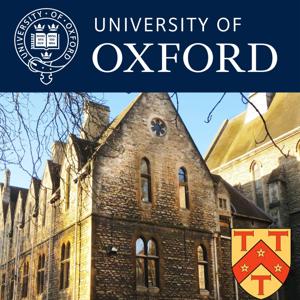
The Asian Studies Centre was founded in 1982 at St Antony's College and is primarily a co-ordinating organisation which exists to bring together specialists from a wide variety of different…

More shows like Asian Studies Centre

TED Talks Daily by TED

TED Talks Daily

10,868 Listeners

Philosophy for Beginners by Oxford University

Philosophy for Beginners

330 Listeners

Approaching Shakespeare by Oxford University

Approaching Shakespeare

331 Listeners

John Locke Lectures in Philosophy by Oxford University

John Locke Lectures in Philosophy

35 Listeners

General Philosophy by Oxford University

General Philosophy

70 Listeners

Anthropology by Oxford University

Anthropology

72 Listeners

Aesthetics and Philosophy of Art lectures by Oxford University

Aesthetics and Philosophy of Art lectures

77 Listeners

Theoretical Physics - From Outer Space to Plasma by Oxford University

Theoretical Physics - From Outer Space to Plasma

58 Listeners

Critical Reasoning: A Romp Through the Foothills of Logic by Oxford University

Critical Reasoning: A Romp Through the Foothills of Logic

37 Listeners

The Secrets of Mathematics by Oxford University

The Secrets of Mathematics

42 Listeners

Critical Reasoning for Beginners by Oxford University

Critical Reasoning for Beginners

30 Listeners