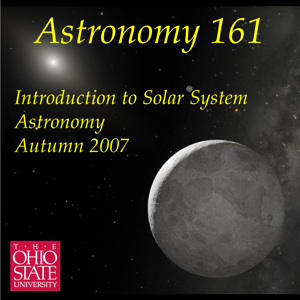
Astronomy 161 - Introduction to Solar System Astronomy - Autumn 2007

Astronomy 161 - Introduction to Solar System Astronomy - Autumn 2007

Download on the App Store

Astronomy 161 - Introduction to Solar System Astronomy - Autumn 2007 episodes

  • Lecture 08: The Phases of the Moon
    What are the Phases of the Moon? This lecture introduces the Moon and
    describes the monthly cycle of phases. Topics include synchronous
    rotation, apogee and perigee, the cycle of phases, and the sidereal and
    synodic month. Recorded 2007 Sep 28 in 1000 McPherson Lab on the
    Columbus campus of The Ohio State University.
    0 min
  • Lecture 07: The Four Seasons
    Why do we have different seasons? This lecture explores the
    consequences of the tilt of the Earth's rotation axis relative to its
    orbital plane combined with the apparent annual motions of the Sun
    around the Ecliptic. The most important factor for determining whether
    it is hot or cold at a given location at different times in the year is
    "insolation": how much sunlight is spread out over the ground. This,
    combined with the different length of the day throughout the year,
    determines to total solar heating per day and so drives the general
    weather. It has nothing to do with how far away we are from the Sun at
    different times of the year. Finally, the direction of the Earth's
    rotation axis slowly drifts westward, taking 26,000 years to go around
    the sky. This "Precession of the Equinoxes" represents a tiny change
    that is still measureable by pre-telescopic observations, and means that
    at different epochs in human history there is a different North Pole
    star, or none at all! Recorded 2007 Sep 27 in 1000 McPherson Lab on the
    Columbus campus of The Ohio State University.

    0 min
  • Lecture 06: Daily and Annual Motions
    Why do celestial objects appear to rise and set every day? How does this
    depend on where you are on the Earth, or the time of year? In today's lecture
    we we set the heavens into motion and review the two most basic
    celestial motions. Apparent Daily Motion reflects the daily rotation of
    the Earth about its axis. Apparent Annual Motion reflects the Earth's
    annual orbit around the Sun. We introduce the Ecliptic, the Sun's
    apparent annual path across the Celestial Sphere, and note four special
    locations along the Ecliptic: the Solstices and Equinoxes. This sets
    the stage for many of the topics of the rest of this section. Recorded
    2007 Sep 26 in 1000 McPherson Lab on the Columbus campus of The Ohio
    State University.
    0 min
  • Lecture 05: Mapping Earth & Sky
    Where are we? Where is someplace else? And how do I get there from
    here? These are questions we need to answer both on the Earth and in
    the sky to assign a location to a place or celestial object on the
    surface of a sphere. This lecture includes a review of angular units
    and the terrestrial system of latitude and longitude on the spherical
    Earth. We then define the Celestial Sphere, with its Celestial Equator
    and Poles, and begin to define an analogous coordinate system on the
    sky. An important wrinkle is that what part of the sky we see at any
    given time depends on both where we are on the Earth, and what date/time
    it is. This gives us the elements of the coordinate system we will need
    to begin our exploration of motions in the sky in the next lectures.
    Recorded 2007 Sep 25 in 1000 McPherson Lab on the Columbus campus of The
    Ohio State University.
    0 min
  • Lecture 04: Measuring the Earth
    What is the shape and size of the Earth? This lecture traces historical
    ideas about the shape of the Earth, from ancient ideas of a Flat-Earth
    to Aristotle's compelling demonstrations in the 3rd century BC that the
    Earth was a sphere. We then discuss two famous classical measurements
    of the circumference of the Earth by Eratosthenes of Cyrene in the 3rd
    century BC and Claudius Ptolemy in the 2nd century AD. Recorded 2007
    Sep 24 in 1000 McPherson Lab on the Columbus campus of The Ohio State
    University.

    0 min
  • Lecture 03: The Starry Night
    What are the constellations? We will review the most basic feature of
    the night sky, the 6000 visible stars sprinkled about the sky, and
    introduce the idea of constellations, reviewing their history and uses
    by various cultures. Recorded 2007 Sep 21 in 1000 McPherson Lab on the
    Columbus campus of The Ohio State University.

    0 min
  • Lecture 02: Astronomical Numbers
    What are our units of measure in astronomy? To begin our exploration of
    astronomy, we first need to develop a common language for notating large
    numbers, and introduce the basic units of length, mass, and time that we
    will use throughout the quarter. This lecture is a quick review of
    scientific notation and the metric system. For measuring the vast
    distances in astronomy, we need to introduce two special units: the
    Astronomical Unit for interplanetary distances, and the Light Year for
    interstellar distances. We end with a discussion of mass and weight,
    and the distinction drawn in physical measurements that differs (a
    little) from everyday usage. Recorded 2007 Sep 20 in 1000 McPherson Lab
    on the Columbus campus of The Ohio State University.
    0 min
  • Lecture 01: Introduction to Astronomy 161
    What is Astronomy? What is Science? What is the course all about?
    Brief introductory remarks after going over course mechanics on the
    first day of Astronomy 161 for Autumn Quarter 2007. Recorded 2007 Sep
    19 in 1000 McPherson Lab on the Columbus campus of The Ohio State
    University.

    0 min
  • Welcome to Astronomy 161 for Autumn Quarter 2007
    Welcome to the Astronomy 161 Lecture Podcasts. This is a brief message
    from me explaining the podcasts, and welcoming new and old listeners.
    University. Lectures will begin on Wednesday, 2007 Sept 19, and run
    through Friday, 2007 Nov 30. New lectures will appear shortly before
    6pm US Eastern Time each day there is a regular class. Recorded 2007
    Sep 19 in 4037 McPherson Lab on the Columbus campus of The Ohio State
    University.
    0 min

About Astronomy 161 - Introduction to Solar System Astronomy - Autumn 2007

From the publisher's feed

Astronomy 161, Introduction to the Solar System, is the first quarter of

More shows like Astronomy 161 - Introduction to Solar System Astronomy - Autumn 2007

Planetary Radio: Space Exploration, Astronomy and Science by The Planetary Society

Planetary Radio: Space Exploration, Astronomy and Science

1,339 Listeners

The Daily by The New York Times

The Daily

111,845 Listeners

Unexplainable by Vox

Unexplainable

2,316 Listeners

Crash Course Pods: The Universe by Crash Course Pods, Complexly

Crash Course Pods: The Universe

573 Listeners