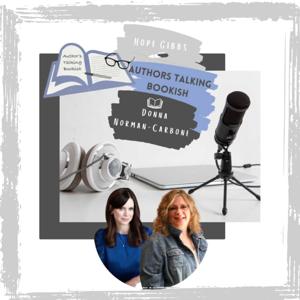
Authors Talking Bookish

Authors Talking Bookish

By Donna Norman-Carbone and Hope GibbsArtsBooks
Download on the App Store

Authors Talking Bookish episodes

  • 2023 Recap of Top Industry Stories: A Look Back and Forward

    Donna and Hope take a look at some of the top industry newsworthy topics of 2023 and make some predictions for the upcoming year. The recap includes Tik Tok fame, cancel culture, book banning, ghostwriting and AI.

    SHOW NOTES:

    The articles referenced are taken from Lit Hubs “The 10 Biggest Literary Stories of the Year: At Least 2023 is Over Now”

    The CoHo Obsession and Tik Tok Fame

    Cancel Culture

    Colleen Hoover’s coloring book

    Elizabeth Gilbert’s novel The Snow Forest postponement

    Ron DeSantis and book banning

    • Reader sensitivities
    • Trigger Warnings

    Ghostwriting

    • Prince Harry’s Spare
    • Millie Bobby Brown’s Nineteen Steps: A Novel

    AI

    • 2 sides
    • Creativity
    • Book Narration

    SOURCES:

    “The 10 Biggest Literary Stories of the Year: At Least 2023 is Over Now,” LitHub. 23 DEC 23.

    https://lithub.com/the-10-biggest-literary-stories-of-the-year-3/

    “Get Started with Digital Narration,” https://authors.apple.com/support/4973-get-started-digital-narration

    “I tried to guess if Apple audiobooks were narrated by AI or real people. It was harder than you'd think,”

    https://www.businessinsider.com/apples-ai-narrated-audiobooks-i-listened-apple-books-ai-narrator-2023-1?amp

    Publisher’s Marketplace, https://www.publishersmarketplace.com/

    DO NOW:

    Keep an eye on the topics that affect you directly. See how they develop over the course of the next year. How do you feel about them? Is there any action you can take to support the issues you are passionate about?

    Authors Talking Bookish https://www.authorstalkingbookish.comHope Gibbs, author of Where the Grass Grows Blue https://www.authorhopegibbs.com/Donna Norman-Carbone, author of All That is Sacred https://www.donnanormancarbone.com

    26 min
  • A Realistic Timeline for a Book Launch and a To Do List to Get You There: Episode 012

    Whether you’ve signed a publishing contract or are self-publishing, you need a launch plan. From author brand to gaining an audience, to release day and beyond, we’ve tracked our own journeys in order to provide you with a realistic timeline to follow for your own launch.

    SHOW NOTES:

    Your launch plan might look different based on how you are publishing your book:

    Big 5

    Small Press

    Self-publishing

    How to figure out your ducks (To Dos) before you can get them in a row

    Three phases of launching:

    Before (18-12 month prior to launch)

    During (6-1 month before launch)

    After (3-6 months after launch)

    SOURCES:

    Before and After the Book Deal by Courtney Maum

    Launch Pad: The Countdown to Marketing Your Book, Mary Helen Sheriff & Grace Sammon, EDs.

    Jane Friedman https://janefriedman.com/

    David Gaughran https://davidgaughran.com/

    We Grow Media, Dan Blank https://wegrowmedia.com/about/

    Book Marketing with Mary, Mary Helen Sheriff https://maryhelensheriff.com/marketing/

    DO NOW:

    Download your free READY TO LAUNCH timeline and get to work!

    We are taking a break in December to spend time with family. Yes, writers need a break and we hope you’ll take one too. We’ll be back in January with an added feature to our podcast that we’re excited to unveil, so stay tuned for our first episode of 2024 on January 10th

    Authors Talking Bookish https://www.authorstalkingbookish.comHope Gibbs, author of Where the Grass Grows Blue https://www.authorhopegibbs.com/Donna Norman-Carbone, author of All That is Sacred https://www.donnanormancarbone.com

    30 min
  • Reviews: How to get them, when to listen to them and how to let go? Episode 011

    When an author/writer writes a book, they invest not just their time and effort but a piece of their soul. Their hearts.They pour their thoughts, emotions, and creativity into the pages, and when that book is finally out in the world, it becomes vulnerable to the opinion of readers. And this is where book reviews come into play. They serve as the bridge between the book and its readers, helping prospective readers decide whether or not a book is worth their time and money. But why are these reviews so crucial?What are book reviews?Why are they important?Are all reviews created equal?

    • The hierarchy of reviews
      • Goodreads
      • Amazon
      • BookBub
      • Kirkus and other industry standards
      • Blurbs
      • Readers
    • The pros and cons of reviews

    How does an author get reviews?

    • The old fashioned way: ask, query, create a street team
    • Look at reviewers of book comps

    Book Review Platforms

    • Suzy Approved Book Tours
    • Kate Rock Tours

    DO NOW:Make a list of comps. Look on Amazon, Goodreads (on the author’s page for each). Read their reviews. Notice who has reviewed their books. Make a list. Take a look at Bookstagrammars pages to notice who reviews books like yours, follow them, add their names to a list. This take a lot of time, but time well spent.Join us for our next episode: Book Launch TimelineAuthors Talking Bookish https://www.authorstalkingbookish.comHope Gibbs, author of Where the Grass Grows Blue https://www.authorhopegibbs.com/Donna Norman-Carbone, author of All That is Sacredhttps://www.donnanormancarbone.com

    28 min
  • Writer’s Block: Is it real? Episode 010

    Is writer’s block a real phenomenon? Or is it a story you tell yourself when you aren’t writing?In this episode, we’ll discuss our thoughts and experiences surrounding writer’s block, what others say, and provide you with some tips to keep the words flowing.SHOW NOTES:According the the New York Times article “How to Beat Writer’s Block,” by Maria Konnikova,psychologists deem it a real phenomenon. The term was introduced in the 1940s by a psychiatrist named Edmund Bergler who claims writers are blocked psychologically and need therapy to become unblocked. In the 1970s, two Yale professors Jerome Singer and Michael Barrios did a study that showed anxiety, depression, perfectionism, OCD, and self-doubt were the result of blocks to writing.Not all blocked writers fit into these categories, however.What are some characteristics of Writer’s Block?

    • feeling unmotivated
    • feeling uninspired
    • staring at a blank page
    • lack of ideas
    • writing below one’s standards

    What are some tips to combat Writer’s Block?

    • determine the cause if you can
    • establish a writing routine and stick to it
    • word sprints
    • join the NaNoWriMo challenge
    • assess how you’ve prepared/outlined a work
      • it may simply lack planning or be too rigid of a plan
    • write through the crap & come back to it later to make it shine
    • refrain from ending a writing session at the end of a scene or chapter
      • instead, stop in the middle when you already know where the scene is headed
    • work with writing prompts to get the juices flowing
    • brainstorm with a writing group or critique partner
    • write in a different locale
    • work on a new project
    • journal
    • take a writing break (go for a walk, shop, meet a friend for coffee…)
    • work with a book coach

    SOURCES & LINKS:“How to Beat Writer’s Block,” Maria Konnikova“How to Overcome Writer’s Block: Get Your Groove Back,” Reedsy BlogWriting Down the Bones, Natalie GoldbergJuicy Pens, Thirsty Paper, SarkWrite for Your Life, Anna Quindlenhttps://nanowrimo.org/DO NOW:Make a list of what you could do IF you encounter writer’s block. What are the fixes you will try?Join us for our next episode: Reviews: How to get them, when to listen to them and how to let go?Joins us for our next episode: Reviews: How to get them, when to listen to them and how to let go?Authors Talking Bookish https://www.authorstalkingbookish.comHope Gibbs, author of Where the Grass Grows Blue https://www.authorhopegibbs.com/Donna Norman-Carbone, author of All That is Sacred https://www.donnanormancarbone.com

    24 min
  • Showing vs. Telling: When are they appropriate? Episode 9
    You’ve heard the old adage: Show NOT Tell. Is it true? What are the benefits to showing not telling in writing and when it is appropriate to tell? We’ll provide insight into the differences between showing vs. telling and advice regarding when one is most appropriate.SHOW NOTES:Showing- when a writer slows down a scene to provide clues as to action and concrete descriptionTelling- providing exposition by abridging time or details thus providing a summaryExamples of eachWhat matters most to the story?
    • The benefits of showing
    • The benefits of telling
    • Effects of showing vs. telling
    LINKS & SOURCES:“Show and Tell: The Key to Engaging Meaningful Storytelling,” Heather Davis, Launch Pad: The Countdown to Writing Your Book, ED. Emma Dhesi and Grace Sammon“Don’t Tell, But Show” and “Be Specific,” Writing Down the Bones, Natalie Goldberg“Show Don’t Tell,” Everybody Writes, Ann HandleyDO NOW:Take a piece of writing you’ve done and two highlighters (3-5 pages for this exercise, anywhere in your draft). Highlight where you show with one color and highlight where you tell with the other color. Think about the goals for this scene and what really matters.Is there something you should have shown instead of told? Is there something you should have told instead of shown? Take a look at the balance of both within the scene. How does it affect the pacing?
    29 min
  • Plotter or Panster or Something In-between? Episode 8
    Have you heard the terms plotter and panster? What about a planster? They refer to the level or lack thereof of planning that goes into storytelling before the story is told. We’ll talk about the characteristics and benefits of each, so that you may determine your organizational style in your approach to writing a novel.SHOW NOTES:Plotter- someone who outlines their work fully before any writing takes placePanster- someone who starts with an idea and begins writing without a planPlanster- a combination of the two: generally one who creates a broad outline, then allows the story to take them where they need to goWhat are the benefits and drawbacks to each?Types of Outlines:
    • Timeline
    • Chapter by Chapter
    • Acts (3-5 acts)
    • Character Arcs
    • Character Bios
    How do you know which you are? Are you right brained or left brained?LINKS & SOURCES:“Pantser or Plotter? Deciding Which Can Save Your Writing Life” Jane Friedman Blog https://janefriedman.com/panster-or-plotter/“Outlining a Novel for Plotters, Pansters, and Puzzlers Alike,” Lewis Jorstad, Launch Pad: Countdown to Writing Your Book, ED. Emma Dhesi and Grace SammonSave the Cat: Writes a Novel,Jessica Brody“Writing Quiz: Are You a Plotter or a Pantser?” Kate Sullivan https://www.tckpublishing.com/writing-quiz-plotter-or-pantser/DO NOW: Take the quiz. Experiment. You won’t find your groove until you try both methods and somewhere in-between to figure out where you lean. Do what works for you!
    21 min
  • Exploring Author Spaces: From Writing Nooks to Creative Havens, Episode 7

    Have you ever considered designating a dedicated writing space in your life? Whether it’s a tranquil corner adorned with books and soft lighting, a bustling café fostering an ambiance of creative energy, or a minimalist desk that evokes focus, your environment can affect your creativity and productivity.

    SHOW NOTES:

    Famous Author’s Writing Spaces

    ‘A woman must have money and a room of her own if she is to write fiction,’ Virginia Woolf famously says in A Room of One’s Own.

    • Roald Dahl’s – writing hut
    • Stephen King’s – Maine house the Sanctuary of Scares
    • Charles Dickens – special desk and chair
    • Edith Wharton – writing in bed
    • J.D. Salinger - a shed
    • Virginia Woolf - a room, (then) the OG She-Shed

    Writing Spaces:

    • “writing space” and its significance for writers
    • How can the physical environment around you influence your writing style and productivity?
    • Types of writing spaces: home office, dining room table, shed, cloffice
    • Tips for creating an inspiring work space, regardless of budget
    • Sensory elements (color, scents, sounds, music)

    Different Spaces for the Writing Process and Stages

    • Tailor your space to the different stages of the writing process (brainstorming, drafting, editing, marketing)
    • Change the setting – how mixing up your writing spaces can help you overcome writer’s block and stimulate fresh ideas
    • Benefits of writing in public: A coffee shop. Park. On vacation.
    • Retreats

    Writing in a Digital Age:

    • Virtual writing spaces, online writing communities. How they can impact your writing by collaborative creativity.
    • Balancing your writing time with constant distractions from the internet being at your fingertips.

    LINKS & SOURCES:

    “Where writers write: Virginia Woolf’s writing room,” Charlotte Peacock

    https://charlottepeacock.co.uk/2021/01/02/where-writers-write-virginia-woolfs-writing-room/

    Donna’s Home Office Pinterest Board https://pin.it/7IA1769

    DO NOW: Put together a list of what inspires you—music, favorite colors, books, aromas, authors. Make a mood board of the spaces that speak to you. Decide if you would work best at home, your local coffee shop, or even outdoors.

    Remember, your writing space should be a reflection of your unique personality and style that should fuel your imagination and help you craft your novel.

    24 min
  • Navigating Social Media: Tips for Writers
    In a sea full of social media platforms, how do you choose the right one for you? Once you choose a platform, how do you establish a community? Join us in an overview of the major social media platforms as we reveal our best social media navigation tips. And as a bonus, we’ll address how to maintain a healthy “writing/life” balance while you are juggling social media marketing.SHOW NOTES:The Power of Social Media for Authors and Writers
    • How has social media has transformed the role of the writer/author?
    • Benefits of using platforms to build your audience and establish your brand
    How do you choose which Social Media Platform is right for you and your brand?
    • Overview of each (Instagram, Facebook, Twitter, Threads, TikTok)
    • Demographics
    Building a Social Media Community – It’s not all about followers, it’s about engagement
    • How do you build a community?
    • Interacting with followers
    • Supporting other writers and authors in the community
    Content ideas – How to use social media to market you and your book/work?
    • Content buckets
    • Varying your posts
    Tools (APPS) to Make your Social Media Shine
    • Canva: Design, Photo & Video
    • InStories: Reels and Story Maker
    • Scrl: Photo Collage Maker
    • RePost: For Posts, Stories
    How does one maintain a healthy “writing/life” balance on social media?
    • Set boundaries (time limits)
    • Consistently of posts
    • Take “mental” breaks
    • Remain professional in a world of trolls and negative comments
    SOURCES & LINKS:Launch Pad: Countdown to Marketing Your Book, ED. Mary Helen Sheriff and Grace SammonMary Helen Sheriff, author marketing coach, https://maryhelensheriff.com/marketing/Follow @maryhelensheriff on InstagramWe Grow Media, Dan Blank https://wegrowmedia.com/follow @danblank on InstagramJenn Hanson dePaula @JennBookMarketing on Tik Tok or @mixtusmedia on InstagramShelby Leigh @shelbybookmarketing on Tik Tok or @writers.poets on InstagramJane Friedman https://janefriedman.com/Social Media Today https://www.socialmediatoday.com/Reedsy https://reedsy.com/Hootsuite https://www.hootsuite.com/Canva https://www.canva.comDO NOW:Study the social media platforms you feel are a right fit for you. Choose one or two to start out. Find accounts that you’d like to model your account after. Follow these accounts. Interact with people. Start engaging. Once you feel you are comfortable with one platform, repeat the same process with another.Authors Talking Bookish https://www.authorstalkingbookish.comHope Gibbs, author of Where the Grass Grows Blue https://www.authorhopegibbs.com/Donna Norman-Carbone, author of All That is Sacred https://www.donnanormancarbone.com
    25 min
  • What’s an Author Brand and How Do You Get One?
    Have you heard the term “brand”? As an author, you’ll need one. This episode addresses what a brand is, what you need to think about to develop one and steps to take to create an author brand that is unique to you.SHOW NOTES:How is the brand of an author defined?
    • Aesthetics
    • Message
    Aesthetics: What is the “look” you want to achieve to represent your essence?
    • Color scheme
    • Fonts
    • Logo
    • Symbols
    • Headshot
    Message: What is the unifying message in your work?
    • Tagline
    • Mission Statement
    • Genre
    • Unique characteristics
    • Recurring themes/motifs
    AudienceHow do you implement your brand?Look for apps like Canva, Fotor, Adobe, PhotoshopWhere do you implement your brand?SOURCES & LINKS:Launch Pad: Countdown to Marketing Your Book, Grace Sammon & Mary Helen Sheriff“Your Guide to Branding Yourself as an Author,” NY Book Editorshttps://nybookeditors.com/2016/09/guide-branding-author/“Seven Author Branding Tips,” Mark Coker, Publishers Weeklyhttps://www.publishersweekly.com/pw/by-topic/authors/pw-select/article/78616-seven-author-branding-tips.htmlAuthor Marketing Coach, Mary Helen Sheriff, https://maryhelensheriff.com/marketing/Follow Mary on Instagram @maryhelensheriff We Grow Media, Dan Blank https://wegrowmedia.com/Follow Dan on Instagram @danblank Examples of Instagram Accounts: Look for the consistencies throughout the following feeds.@authorhopegibbs@donnanormancarbone@zibbyowens@bradeighgodfrey@realbethweg@joannamonahanauthor@bestofwomensfiction@pieladybooks@rozierreadsandwineDO NOW: Create a brainstorm list addressing the characteristics above you want to embody as an author and present to your audience. What are common messages in your work? How will you present these visually? Use the (FREE download) Episode 005- Branding Brainstorm.pdf Study the brands of others on social media. Begin creating your brand.Authors Talking Bookish https://www.authorstalkingbookish.comHope Gibbs, author of Where the Grass Grows Blue https://www.authorhopegibbs.com/Donna Norman-Carbone, author of All That is Sacred https://www.donnanormancarbone.com
    26 min
  • You’ve Written a first draft. NOW what?

    So, you have a complete first draft of a novel. Congratulations, first of all, you’ve written a novel; that is an accomplishment unto itself. Now what? Is it ready for publication? Probably not yet. This episode addresses next steps after you complete that first draft.SHOW NOTES:You need eyes on your work for unbiased feedback. What are some options?

    • Writing group

    • Critique partners

    • Content editors

    • Writing coaches

    What’s the difference between alpha readers and beta readers? And at what stage do you need them?

    Creating a guide for the kinds of feedback you are looking for on your novel: Sample (FREE DOWNLOAD) Alpha/Beta Reader, CP Questions

    Where do you find people to review your book?

    LINKS:

    Critique Circle https://www.critiquecircle.com/Megan Lally’s CP Match https://www.meganlallywrites.com/cpmatchmakerWomen’s Fiction Writers Association (WFWA) https://www.womensfictionwriters.org/Reedsy https://reedsy.com/write-a-bookFiverr https://www.fiverr.com/categories/writing-translation/book-editing?source=category_tree

    DO NOW:Research some of the links we’ve provided. See what is the best fit for you. Create your own list of Desired Feedback. Reach out & share your work.

    Hope Gibbs, author of Where the Grass Grows Blue https://www.authorhopegibbs.com/

    Donna Norman-Carbone, author of All That is Sacred https://www.donnanormancarbone.com

    25 min

About Authors Talking Bookish

From the publisher's feed

At Authors Talking Bookish, our mission is to dedicate ourselves to inspiring writers and readers by providing the-road-to-publishing insights from two debut novelists who learned the hard way and…