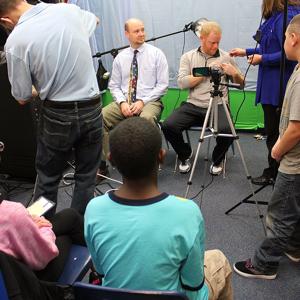
This digital story recording was created in conjunction with the Smithsonian's Museum on Main Street program and its Stories from Main Street student digital storytelling initiative. The project encourages students and their mentors to research and record stories about small-towns and rural neighborhoods, waterways, personal memories, cultural traditions, work histories, as well as thoughts about American democracy. These documentaries, websites, and interviews are then shared on Smithsonian websites and social media.
Seventh grade students in Marshall, Texas, worked in coordination with the Texas State Historical Association and National History to create multimedia websites that includes interviews with family, friends, and local residents. The work was supported by Museum on Main Street's Youth Access Grants in 2013-2014. In this project, a student interviews his great grandfather about World War II and his life thereafter.
Fisher (00:00): When were you born?
Earnest Marshall (00:02): When was I born?
Fisher (00:03): Yeah.
Earnest Marshall (00:04): 1918. August the 26th, 1918.
Fisher (00:10): Where were you born?
Earnest Marshall (00:12): Born in Beaumont.
Fisher (00:15): Okay. So what did you do after junior college? Did you go to college or did you try to find a job?
Earnest Marshall (00:24): No, I had a ... The basketball coach at Baylor offered me a scholarship. So I went to Baylor. After junior college I went to Baylor for two years.
Fisher (00:43): Okay.
Earnest Marshall (00:43): And then when I got to Baylor, I decided I wanted to go out for football, too.
Fisher (00:50): Were you good at football?
Earnest Marshall (00:51): Huh?
Fisher (00:52): Were you good at football?
Earnest Marshall (00:54): What? What?
Fisher (00:54): Were you good at football?
Earnest Marshall (00:57): I played football and basketball. The basketball coach didn't much like it because I's going after football when the basketball team was working out. So he didn't like it much.
Fisher (01:11): Did you meet someone at Baylor?
Earnest Marshall (01:14): Oh, yeah. I met my wife in Baylor.
Fisher (01:20): Mm-hmm. What was her name?
Earnest Marshall (01:21): [inaudible 00:01:25]
Fisher (01:25): Okay.
Speaker 3 (01:25): Where was she from?
Fisher (01:27): Where was she from?
Earnest Marshall (01:29): She was from Marshall.
Fisher (01:31): This town.
Earnest Marshall (01:32): Huh?
Fisher (01:33): This town.
Earnest Marshall (01:34): Yeah. I think I got out in 1940.
Fisher (01:41): 1940? That was when-
Earnest Marshall (01:44): But let me go just a little further.
Fisher (01:46): Okay.
Earnest Marshall (01:48): In the fall of 1940, I graduated, but I was drafted into the service.
Fisher (01:56): As a clerk?
Earnest Marshall (01:57): In March of '41.
Fisher (01:58): March 40?
Earnest Marshall (01:59): March of 1941.
Fisher (02:03): So when the president declared war on Japan and Germany and all the Axis powers-
Earnest Marshall (02:12): Well, in other words, instead of getting out in March, I had to stay in.
Fisher (02:20): The remainder of the war?
Earnest Marshall (02:23): Remained in the service, yeah.
Fisher (02:25): What did you do?
Earnest Marshall (02:27): I was in the finance department.
Fisher (02:29): You were supposed to get people paid and?
Earnest Marshall (02:32): Right. And in early '41, after Pearl Harbor, I was transferred to Phoenix, Arizona, to Luke Field. Me and two or three other boys out there to open up a finance department at Luke Field Arizona, Phoenix. My father, though, was vested in a soap plant, laundry soap plant, and he wanted me to come to Marshall to manage the plant.
Fisher (03:18): And since your wife's in Marshall, she must have urged you to do it.
Earnest Marshall (03:22): Huh?
Fisher (03:23): Since your wife was in Marshall, she must have wanted you to do that, right?
Asset ID: 2022.32.12
Find a complete transcript at www.museumonmainstreet.org