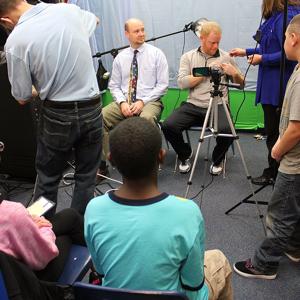
This digital story recording was created in conjunction with the Smithsonian's Museum on Main Street program and its Stories from Main Street student documentary initiative, called "Coming Home." The project encourages students and their mentors to research and record stories about small-towns and rural neighborhoods, waterways, personal memories, cultural traditions, work histories, as well as thoughts about American democracy. These documentaries are then shared on Smithsonian websites and social media.
In collaboration with Arthurdale Heritage in Arthurdale, West Virginia, fourth and fifth graders from West Preston School and a group of local homeschool students developed five videos that explore the history, tourism, nature, and agriculture of Arthurdale, WV. Students learned to conduct oral history interviews, draft scripts, along with taping and editing a video.
Speaker 1 (00:01): The history of Arthurdale, West Virginia.
Speaker 1 (00:03): Welcome to the history community of Arthurdale, located in Preston County, West Virginia. Arthurdale was founded during the Great Depression as the first homestead community in the country. Arthurdale was founded in 1934, by the First Lady Eleanore Roosevelt after she visited Scott's Run, a mining town that was hit hard by the Depression.
Speaker 2 (00:25): Helped from the federal government, the Quakers in West Virginia University, 165 families found new lives in Arthurdale. Each man had to pass a homesteader test to prove they could farm. They even had to trace their hands to show that they did not have any missing fingers.
Speaker 3 (00:47): Each family received a brand-new house with a refrigerator, washing machine, indoor plumbing and heating. They also had a root cellar, smokehouse, chicken coop, barn, and two to five acres that they had to farm.
Speaker 4 (00:59): Besides farming, homesteaders were expected to work other jobs to raise money. Women learn to weave and sold their woven goods in the stores as far as New York City. Men worked in factories, building vacuums, tractors, and radios. Some were skilled carpenters and blacksmiths who created beautiful pieces still used today.
Speaker 4 (01:26): Children went to school in the community. They followed a model called Progressive Education, which focused on hands on education. For example, boys and girls were to do woodworking and surveying, as well as weaving and basic home making skills.
Speaker 4 (01:49): The original schools still stand today and are owned by Arthurdale Heritage.
Speaker 5 (01:55): We spoke to Elizabeth Satterfield, the curator and director of Education at Arthurdale Heritage about how they preserve Arthurdale's history.
Elizabeth Satterfield (02:05): Arthurdale is important because it was the first new deal homestead community, and this means that out of 99 communities that were founded across the country during the New Deal, So that was between 1932 and 1940, that Arthurdale was the very first one. And it's still preserved today. 160 of the original 165 houses are still standing.
Elizabeth Satterfield (02:39): The most important part of my job is being able to preserve our history and tell stories, and that can look a lot of different ways. So that includes I get to work with collections all the time and make sure all of our artifacts are taken care of. I get to make sure our historic buildings are taken care of. I write lots of grants, which is how you apply for money from the government to try to work on your buildings and take care of your collection and do other important work. And then my favorite part is getting to do things in the community and coming out and doing work in the schools and with kids like you.
Asset ID: 2022.28.01
Find a complete transcript at www.museumonmainstreet.org