beaescribe 3Speak Podcast

beaescribe 3Speak Podcast

By Beatriz Alicia García Naranjo
Download on the App Store

beaescribe 3Speak Podcast episodes

  • TALLER DE CUENTO Los personajes y sus roles
    https://3speak.tv/watch?v=beaescribe/rfknkuaf

    Este es mi primer post en la comunidad @spavlog Mi nombre es Beatriz Alicia García, soy una escritora, docente y editora venezolana y quiero compartir con esta comunidad una serie de videos sobre diversos aspectos de la escritura narrativa y orientar a quienes deseen participar y hagan los ejercicios que propondré cada semana para que puedan mejorar su escritura.

    En el video de esta semana hablo sobre los personajes ficticios y sus roles.

    ![3 SEPARADOR PLANIFICACIÓN.png](https://files.peakd.com/file/peakd-hive/beaescribe/23uaeJxiCRsdgCgsBsv7wM2rrss3cwgGBwsky2JdpP4ASrzTwZyKxiKjPoRAxcNWUTzM7.png)

    **¿QUÉ ES UN PERSONAJE?**
    El personaje es un ser ficticio, es decir, es una creación de la fantasía que, sin embargo, debe dar la impresión de ser real. Por ello toma rasgos, características de las personas. Al igual que las personas el personaje contemporáneo presenta dos aspectos:

    CONFIGURACIÓN EXTERNA: Dominio finito, descripción física del personaje: sus rasgos físicos, su vestimenta, sus gestos. (Caracterización directa).

    CONFIGURACIÓN PSICOLÓGICA Esta configuración se infiere a partir de su comportamiento en situaciones concretas y cuando el personaje o el narrador expresan sus sentimientos, pensamientos. Este aspecto permite observar y explicar la motivación de las acciones del personaje, su papel en relación con otros personajes, su mundo interior. (Caracterización indirecta).

    Según su relevancia en la trama los personajes pueden ser:

    -Principales o protagonistas
    -Secundarios
    -Episódicos o incidentales.

    Según su evolución en el texto los personajes pueden ser:

    1) Redondo: Sufre cambios en el transcurso de la historia. Son complejos, sorprenden al lector.

    2) Plano: Es estable, estereotipado, no sufre cambios. Personajes tipo del relato clásico y costumbrista: la bruja, el cura, el doctor.

    Según su competencia para llevar a cabo las acciones que se propone:
    1) Determinación o voluntad para proceder a la acción.
    2) Posibilidad real de llevarla a cabo.
    3) Conocimiento que tiene para llevarla a cabo.

    Según la Noción de verdad:
    1) Si el actor es lo que parece: responde a la verdad.
    2) Esconde lo que es: identidad oculta.
    3) Parece lo que no es: no responde a la verdad en el texto.

    Los personajes según las relaciones entre la gente y el mundo:
    Aparecen en el texto como relaciones psicológicas, corresponden a paradigmas psíquicos: el malvado, el bueno, etc.

    Relaciones ideológicas: Los cambios de función de los actores dentro del texto pueden estar vinculados a relaciones ideológicas: decir la verdad u ocultarla, actuar honesta o deshonestamente, defender valores como la libertad, la democracia, la justicia.

    Variables sociales que pueden determinar a los personajes: sexo, edad, clase social, nivel educativo, ocupación, vicios y virtudes, lugar o ambiente al que pertenece, en qué situación se encuentra en el momento de los hechos relatados.

    ¿De qué manera una narración nos permite configurar el perfil de un personaje?:

    -A través de la descripción realizada por el narrador.
    -Las acciones y pensamientos del personaje.
    -De qué manera se vincula con los otros personajes de la trama.
    -Su manera de expresarse y lo que dice.
    -Lo que otros personajes dicen de él.
    Su oposición a otros personajes (por contraste generalmente): La valentía frente a la cobardía o viceversa; la honestidad o fidelidad frente a la traición; la bondad frente a la crueldad o la avaricia.

    LOS MARCOS REFERENCIALES: Las expectativas del lector o la audiencia frente al personaje se construye de acuerdo a referencias previas basadas en personas y personajes conocidos. Los personajes referenciales, tales como personajes históricos, míticos, legendarios o populares, deben configurarse según sus rasgos ya conocidos. No es verosímil un San Nicolás que hiciera daño a los niños, o un superhéroe cobarde o una barbie desgreñada y fea. La parodia, generalmente, juega con los estereotipos y los quebranta. Pero usualmente el quebrantar los marcos referenciales colectivos puede poner en juego la verosimilitud del relato. Por otra parte, al configurar un personaje toda mención a la identidad contiene información que limita otras posibilidades: Una mujer joven y soltera se comporta de una determinada manera. Si un personaje es atractivo y rico no actuará igual que uno que sea pobre y feo. Un soldado probablemente morirá en el frente de batalla o se lo describirá dentro del ámbito de la disciplina militar.

    Espero que este post te sea útil. Si tienes alguna duda o pregunta por favor déjala en los comentarios. Gracias por tu lectura.

    Para elaborar este post he consultado los siguientes libros:

    Mieke Bal. Teoría de la narrativa. Una introducción a la narratología.Madrid,Ediciones Cátedra, 2006.
    Antonio Cándido, A personagem do romance. En: Antonio Cándido y otros. A personagem de ficcao. Sao Paulo, Ed. Perspectiva, 1981.
    O. Belic/F. Vodicka, La estructura de la obra literaria. En:O. Belic/F. Vodicka. El mundo de las letras. Valparaíso, Ediciones Universitarias de Valparaíso, 1971.

    *English version*

    This is my first post in the community @spavlog My name is Beatriz Alicia García, I am a Venezuelan writer, teacher and editor and I want to share with this community a series of videos on various aspects of narrative writing and guide those who wish to participate so they can improve their writing.

    In this week's video I talk about fictional characters and their roles.

    ![3 SEPARADOR PLANIFICACIÓN.png](https://files.peakd.com/file/peakd-hive/beaescribe/23uaeJxiCRsdgCgsBsv7wM2rrss3cwgGBwsky2JdpP4ASrzTwZyKxiKjPoRAxcNWUTzM7.png)

    **WHAT IS A CHARACTER?**

    The character is a fictitious being, that is to say, it is a creation of fantasy that, nevertheless, must give the impression of being real. For this reason, it takes traits, characteristics of people. Like people, the contemporary character has two aspects:

    EXTERNAL CONFIGURATION: Finite domain, physical description of the character: physical features, clothing, gestures (direct characterization).
    PSYCHOLOGICAL CONFIGURATION This configuration is inferred from his behavior in concrete situations and when the character or the narrator expresses his feelings, thoughts. This aspect allows us to observe and explain the motivation of the character's actions, his role in relation to other characters, his inner world (Indirect characterization).

    According to their relevance in the plot the characters can be:
    -Principal or main characters
    -Secondary characters
    -Episodic or incidental.
    According to their evolution in the text, characters can be:
    1) Round: They undergo changes in the course of the story. They are complex, they surprise the reader.
    2) Flat: They are stable, stereotyped, they do not undergo changes. Typical characters of the classic and costumbrista story: the witch, the priest, the doctor.
    According to their competence to carry out the actions proposed:
    Determination or will to proceed with the action.
    Real possibility of carrying it out.
    Knowledge he has to carry it out.
    According to the Notion of truth:
    If the actor is what he appears to be: he responds to the truth.
    He hides what he is: hidden identity.
    He seems what he is not: he does not respond to the truth in the text.
    The characters according to the relationships between people and the world:
    They appear in the text as psychological relations, they correspond to psychic paradigms: the evil one, the good one, etc.
    Ideological relations: Changes in the role of the actors within the text may be linked to ideological relations: telling the truth or hiding it, acting honestly or dishonestly, defending values such as freedom, democracy, justice.
    Social variables that can determine the characters: sex, age, social class, educational level, occupation, vices and virtues, place or environment to which he/she belongs, in what situation he/she is at the time of the events narrated.
    How does a narrative allow us to configure the profile of a character?
    -Through the description made by the narrator.
    -The actions and thoughts of the character.
    -The way he/she is linked to the other characters in the plot.
    -The way he expresses himself and what he says.
    -What other characters say about him.
    His opposition to other characters (usually by contrast): Bravery versus cowardice or vice versa; honesty or faithfulness versus betrayal; kindness versus cruelty or greed.
    REFERENTIAL FRAMES: The reader's or audience's expectations of the character are constructed according to previous references based on known people and characters. Referential characters, such as historical, mythical, legendary or popular characters, must be configured according to their already known traits. A St. Nicholas who would harm children, or a cowardly superhero or a shaggy and ugly barbie is not plausible. Parody, generally, plays with stereotypes and breaks them. But usually the breaking of collective referential frames can put at stake the verisimilitude of the story. On the other hand, when configuring a character, any mention of identity contains information that limits other possibilities: A young, unmarried woman behaves in a certain way. If a character is attractive and rich, he will not act the same as one who is poor and ugly. A soldier will probably die on the front lines or be described within the scope of military discipline.
    I hope you find this post useful. If you have any questions please leave them in the comments. Thank you for reading.
    To compile this post I have consulted the following books:
    Mieke Bal. Teoría de la narrativa. Una introducción a la narratología.Madrid,Ediciones Cátedra, 2006.
    Antonio Cándido, A personagem do romance. En: Antonio Cándido y otros. A personagem de ficcao. Sao Paulo, Ed. Perspectiva, 1981.
    O. Belic/F. Vodicka, La estructura de la obra literaria. En:O. Belic/F. Vodicka. El mundo de las letras. Valparaíso, Ediciones Universitarias de Valparaíso, 1971.

    Translation to english by Deepl.com
    ![Gracias por leerme.gif](https://files.peakd.com/file/peakd-hive/beaescribe/23u6WhKHUDDM6aQvrfeWPHuqy4S98MmdnoUVQgGzXnZgfxNj81735q3naiTPLSeKA83nQ.gif)

    13 min
  • Taller de cuento Inspírate en recuerdos felices
    https://3speak.tv/watch?v=beaescribe/xdqivyjr

    Con este post, como lo digo en el video, inicio mi Taller de cuento para hivers que estén buscando herramientas e inspiración para escribir textos narrativos. Para quienes no me conocen, mi nombre es Beatriz Alicia García, mi usuario en Hive es @beaescribe soy una escritora y docente venezolana, tengo 30 años dando talleres de escritura y a sugerencia del hiver amigo @germanandradeg voy a compartirte algunas de esas ideas que doy a mis alumnos de mi taller de Escritura Creativa.

    Si vives en Caracas, aprovecho para invitarte a participar en mi próximo taller de Escritura e Imagen Creativa que iniciaré el próximo 19 de agosto, los sábados de 3 a 5 pm, en Hacienda La Trinidad, una antigua hacienda de cacao y caña de azúcar que desde 2010 se transformó en un parque cultural donde podrás visitar exposiciones de arte, tomarte un café, visitar la librería Sopa de Letras, comprar un sabroso chocolate en la tienda Kakao o sencillamente descansar disfrutando los gratos jardines del parque.

    ![SEPARADOR PLANIFICACIÓN !.png](https://files.peakd.com/file/peakd-hive/beaescribe/244ovTE1Yr6VB94ZADo4mmdiPZwsmhNd2uLnMPcV9ouPP96t1sxAm7PdQW1HUuYc3SkxA.png)

    Este primer ejercicio que te propongo consiste en escribir una historia ficcional, a partir de una foto que te lleve a un recuerdo feliz. Intenta evocar el lugar, ¿cómo era ese lugar?, ¿dónde estabas?, ¿estabas en la ciudad?¿En qué parte?¿Estabas en la montaña?¿Estabas en la playa?¿A qué olía?¿Estabas con alguien especial para ti? Transforma esas personas en personajes e imagina algo extraordinario que puede haber ocurrido allí.

    ![entrepreneur-gd7ddf08e9_640.jpg](https://files.peakd.com/file/peakd-hive/beaescribe/243g1JREYAauA81AATBfgiMQkjRrQTsSZDiqUmsc7E9aq7VSeWsAouPPanp4BwYo516JP.jpg)
    [Fuente](https://pixabay.com/es/photos/empresario-puesta-en-marcha-hombre-593378/)

    Luego de que escribas tu cuento con estas indicaciones y lo publiques, por favor comparte el link en los comentarios de este post. Para leer tu cuento y poderlo comentar. Espero que te sean útiles este y los próximos tips de escritura que te voy a compartir. La próxima semana hablaré sobre los personajes y roles en la escritura narrativa. Y recuerda, en la medida que seas un observador atento de la realidad, te será más fácil escribir buenas historias.Gracias por tu lectura.

    A continuación te dejo una minificción inspirada en la foto que ves.

    ![foto Chirimena.jpg](https://files.peakd.com/file/peakd-hive/beaescribe/23xKrPpLJ6ivUuviH6oQQ3Jo2GavgGzht3sE6WUN7k2y6K6ZDSgfcSE57mnoVoAtWStdE.jpg)

    **VACACIONES EN LA PLAYA**
    Esa mañana Bea se despertó temprano, Luis y sus amigos la pasarían buscando para pasar unos días en Chirimena, la casa de la playa de la familia de Luis. Qué sabroso, pensó. Qué bueno tener amigos tan increíbles con los que la paso tan rico. No veo la hora de que lleguen.

    Bea se paró, se cepilló los dientes, preparó un desayuno frugal, se puso el traje de baño, una franela, unas bermudas beige, y empezó a revisar que tenía listo todo lo que necesitaba para estar unos días en la playa, varias franelas, otro traje de baño, algo cómodo para dormir, la toalla para bañarse, la toalla para la playa, el bronceador, el repelente para los mosquitos, quema para hidratar la piel, un cuaderno para escribir, uno o dos libros para leer. Cuando uno sale de casa de vacaciones, siempre se te olvida algo.

    Bea tuvo que esperar por lo menos tres horas a que la pasaran buscando. Luis y José, quien era el que tenía carro, pasaron buscando primero a Marisela, Daniel también se había unido a última hora. El viaje por carretera duró más de dos horas, pero no se les hizo largo porque iban escuchando buena música y conversando. Cuando ya se iban acercando al pueblo, sintieron la brisa marina, y vieron los colores vibrantes de los habitantes y las tiendas donde vendían coloridos atuendos de playa, salvavidas y pelotas de plástico.

    Los padres de Luis ya estaban en la casa y la hermana mayor de Luis, María. El padre estaba buscando guacucos en la playa con la hermana, Manuela se había quedado en la casa para esperar a Luis y sus amigos. Era una casa pequeña, que ellos mismos habían construido, tenía dos habitaciones y la sala, pero cuando llegaban invitados se colgaban las hamacas, se ponían colchonetas. Manuela siempre se alegraba de recibir a los amigos de su hijo, que llenaban todo con su vitalidad y su alegría caribeña. Ellos habían llegado hacía más de veinte años de España y se habían establecido en Venezuela, primero en la ciudad de Mérida, donde nació Luis, y luego definitivamente en Caracas.

    Luego de dejar sus morrales, Bea, Luis y sus invitados se fueron a la playa, a disfrutar del mar, y del buen tiempo. Cuando regresaron, después de las 2 pm, ya el padre de Luis y su hermana habían regresado, y Manuela ya había preparado una olla grande de pasta con guacuco. También habían llegado Ken, Susana y María Esther. Todos se saludaron, se abrazaron y se fueron sentando donde pudieron para comerse la pasta con guacuco, la casa se había impregnado del sabroso aroma de la salsa. Al anochecer, llegaron otros amigos de María, la hermana de Luis.

    Al mediodía del día siguiente llegó Loli, la otra hermana de Luis, con su esposo, su hijo, su suegra y la hijastra de su esposo que había venido desde Chile. Al día siguiente, algunos de los amigos, que tenían que trabajar el lunes se fueron, pero llegaron otros, José Esteban, Carlos Eduardo y Adela. Los amigos seguían llegando sin parar, la casa y su jardín lleno de flores no podía crecer, pero parecía hacerlo para albergar a quienes llegaban, que siempre cabían, dentro o fuera de la casa, en las hamacas. Bea pensó sonriendo: “Así debió ser Woodstock”.

    ![English version.png](https://files.peakd.com/file/peakd-hive/beaescribe/23zSNWSw8cSeAij4jZ7cU8LtYr8Uv6pZxEJAEKQ2nfkNLyu3owsU4gnJL4z7bzEiUSR4o.png)

    With this post, as I say in the video, I start my Story Workshop for hivers who are looking for tools and inspiration to write narrative texts. For those who don't know me, my name is Beatriz Alicia García, my user on Hive is @beaescribe I am a Venezuelan writer and teacher, I have 30 years giving writing workshops and at the suggestion of hiver friend @germanandradeg I am going to share with you some of those ideas that I give to my students in my Creative Writing workshop.

    If you live at Caracas, I take this opportunity to invite you to participate in my next Creative Writing and Image workshop that I will start next August 19, Saturdays from 3 to 5 pm, at Hacienda La Trinidad, a former cocoa and sugar cane plantation that since 2010 has been transformed into a cultural park where you can visit art exhibitions, have a coffee, visit the Sopa de Letras bookstore, buy a tasty chocolate at the Kakao store or simply relax and enjoy the pleasant gardens of the park.

    ![SEPARADOR PLANIFICACIÓN !.png](https://files.peakd.com/file/peakd-hive/beaescribe/244ovTE1Yr6VB94ZADo4mmdiPZwsmhNd2uLnMPcV9ouPP96t1sxAm7PdQW1HUuYc3SkxA.png)

    This first exercise that I propose to you consists of writing a fictional story, starting from a photo that takes you to a happy memory. Try to evoke the place, what was the place like, where were you, were you in the city, where were you, were you in the mountains, were you on the beach, what did it smell like, were you with someone special to you? Transform these people into characters and imagine something extraordinary that might have happened there.

    ![entrepreneur-gd7ddf08e9_640.jpg](https://files.peakd.com/file/peakd-hive/beaescribe/243g1JREYAauA81AATBfgiMQkjRrQTsSZDiqUmsc7E9aq7VSeWsAouPPanp4BwYo516JP.jpg)
    [Source](https://pixabay.com/es/photos/empresario-puesta-en-marcha-hombre-593378/)

    After you write your story with these instructions and publish it, please share the link in the comments of this post. So I can read your story and comment on it. I hope you find this and the next writing tips I will share with you useful. Next week I'll talk about characters and roles in narrative writing. And remember, as long as you are an attentive observer of reality, it will be easier for you to write good stories.Thanks for reading.

    Below is a mini-fiction inspired by the photo you see.

    ![foto Chirimena.jpg](https://files.peakd.com/file/peakd-hive/beaescribe/23xKrPpLJ6ivUuviH6oQQ3Jo2GavgGzht3sE6WUN7k2y6K6ZDSgfcSE57mnoVoAtWStdE.jpg)
    Photo from my personal album

    **VACATION AT THE BEACH **

    That morning Bea woke up early, Luis and his friends would be looking for her to spend a few days at Chirimena, Luis' family's beach house. How tasty, she thought. How nice to have such incredible friends with whom I have such a great time. I can't wait for them to arrive.

    Bea stood up, brushed her teeth, prepared a frugal breakfast, put on her bathing suit, a flannel, some beige shorts, and began to check that she had everything she needed to spend a few days at the beach, several flannels, another bathing suit, something comfortable to sleep in, a towel for bathing, a towel for the beach, suntan lotion, mosquito repellent, sunburn to moisturize the skin, a notebook to write in, one or two books to read. When you leave home on vacation, you always forget something.

    Bea had to wait at least three hours to be picked up. Luis and José, who was the one with the car, passed by looking for Marisela first, Daniel had also joined them at the last minute. The road trip lasted more than two hours, but it was not long because they were listening to good music and talking. As they approached the town, they felt the sea breeze, and saw the vibrant colors of the inhabitants and the stores where they sold colorful beach attire, life jackets and plastic balls.

    Luis' parents were already in the house and Luis' older sister, Maria. The father was looking for guacucos on the beach with his sister, Manuela had stayed in the house to wait for Luis and his friends. It was a small house, which they had built themselves, it had two rooms and the living room, but when guests arrived, hammocks were hung, mats were put up. Manuela was always happy to receive her son's friends, who filled everything with their vitality and Caribbean joy. They had arrived more than twenty years ago from Spain and had settled in Venezuela, first in the city of Mérida, where Luis was born, and then definitively at Caracas.

    After leaving their backpacks, Bea, Luis and their guests went to the beach to enjoy the sea and the good weather. When they returned, after 2 pm, Luis' father and sister had already returned, and Manuela had already prepared a big pot of pasta with guacuco. Ken, Susana and Maria Esther had also arrived. They all greeted each other, hugged and sat down wherever they could to eat the pasta with guacuco, the house was impregnated with the tasty aroma of the sauce. In the evening, other friends of Maria, Luis' sister, arrived.

    At noon the next day Loli, Luis' other sister, arrived with her husband, her son, her mother-in-law and her husband's stepdaughter who had come from Chile. The next day, some of the friends, who had to work on Monday, left, but others arrived, José Esteban, Carlos Eduardo and Adela. The friends kept arriving non-stop, the house and its flower-filled garden could not grow, but seemed to do so to accommodate those who arrived, who always fit, inside or outside the house, in the hammocks. Bea thought with a smile, "This must have been what Woodstock must have been like."

    Translation to english by Deepl.com

    https://files.peakd.com/file/peakd-hive/beaescribe/23z7UoRXSjKzxqDQcDZasKjMuwUsNmMdrf8sXy4PEjDasYFRpgkygoyhgJvqkNfwzR9zT.png

    3 min
  • Homenaje a mi querida maestra Hanni Ossott al cumplirse 20 años de su muerte
    https://3speak.tv/watch?v=beaescribe/qehatpce
    ¿Quién soy?... “¿La luz que ilumina esta verja, esta tierra?”
    ¿Soy los árboles y las plantas?¿Acaso el mar?
    Soy colinas, riberas, agua bañada de luz
    Soy un cuerpo cansado de tanta errancia
    un cuerpo y un alma cansados del miedo
    Soy el temor. (...)
    “El país de la pena”, Hanni Ossott
    ![EL REINO DONDE LA NOCHE SE ABRE portada.jpg](https://files.peakd.com/file/peakd-hive/beaescribe/23tS12j9QbvpLodt5i9RiKRrAANrfsW2fJ3bzqhhKiEh2utphiGBQK7vg75wNyAQfzdVJ.jpg)
    foto de la portada del libro "El reino donde la noche se abre" fue tomada con la cámara de mi teléfono móvil
    ![DEDICATORIA EL REINO DONDE LA NOCHE SE ABRE.jpg](https://files.peakd.com/file/peakd-hive/beaescribe/23uR3EwtFUMBi6DKtAMNmk4KKoSANK5JYYK2Wk2gKrik2TkcKdQL1YvBXykRJ2N2j7wjn.jpg)
    Dedicatoria manuscrita de Hanni Ossott del libro "El reino donde la noche se abre"
    Handwritten dedication by Hanni Ossott from the book "The kingdom where the night opens".

    Han pasado 20 años de su desaparición física, pero Hanni Ossott sigue presente en mi vida como si estuviera viva. Su desaparición prematura me hace preguntarme, ¿qué nos hace amar la vida?¿Qué nos hace rendirnos sin vuelta atrás?¿Qué puede llevarnos a la autodestrucción? Recuerdo aún la mirada triste de sus ojos azules, su voz ronca, cavernosa de fumadora, su elegancia, la hondura de sus palabras, su vida enteramente dedicada a la poesía, su honda soledad que nada ni nadie pudo mitigar.

    Tenía 17 años cuando conocí a Hanni, a comienzos de la década del 80, mi profesor de literatura de bachillerato me había prestado las obras completas de Rainer Maria Rilke, el gran poeta místico checo, yo estaba decidiendo que carrera iba a estudiar en la universidad, inicialmente había pensado estudiar psicología o antropología, por eso había escogido ser bachiller en ciencias, pero el profesor Mario me envió a la Escuela de Letras de la Universidad Central de Venezuela a entrevistar al poeta Rafael Cadenas, y me sugirió fuese a algunas clases allí, porque si escribía y amaba tanto los libros tal vez debía estudiar Letras.

    Cuando fui a la Escuela de Letras y vi el programa de estudios de ese semestre, Hanni estaba dando un curso sobre Rilke, el escritor que yo estaba leyendo, un autor que la apasionaba. Le pedí permiso para asistir a su clase como oyente, es decir, sin estar inscrita, y ella me dio el permiso para asistir. Yo no le dije que era aún estudiante de bachillerato. Un año después, ya inscrita como estudiante en la Escuela de Letras, tomé con ella el curso “Poesía y Poetas”, y me atreví a comentarle que escribía poemas, para mi sorpresa me preguntó si me gustaría ir a su casa a leerle mis poemas.

    Así lo hice, llegué una tarde a su casa con algunos de mis primeros poemas, y con mucha paciencia y respeto, me enseñó el trabajo de orfebrería del poemas, qué versos había que mejorar, qué versos era mejor quitar, dón de había un error ortográfico que no había visto. Recuerdo que en esos primeros días que la visité me habló de su libro dedicado a su infancia, a la muerte de su madre cuando ella tenía tres años, “Casa de aguas y de sombras”, me dijo que no quería publicarlo en vida, que para ella era un libro muy especial, pero algunos años después su esposo, el historiador Manuel Caballero y Rafael Arráiz Lucca, que entonces era presidente de Monte Ávila Editores, una importante editorial del Estado, la convencieron para publicarlo.

    Durante 10 años asistí a los cursos que daba en la Escuela de Letras de la Universidad Central y seguí viéndola hasta pocas semanas antes de su muerte, cuando ya estaba internada en la Casa de Reposo San José, un psiquiátrico privado donde vivió en los últimos 10 años de su vida. Hanni, infelizmente, murió a los 56 años, desde muy joven había tenido problemas con el alcohol, a esto se unió la adicción a los psicofármacos, y el consumo excesivo del cigarrillo. Era una mujer brillante, que dominaba varios idiomas, el español, el inglés, el francés, el alemán, el italiano, el griego y el latín. Poeta, ensayista, traductora y docente universitaria, publicó más de diez libros de poesía y ensayo, algunos de los más importantes son: “Hasta que llegue el día y huyan las sombras” , “El reino donde la noche se abre”, “Imágenes, voces y visiones”, “El circo roto”, “Cómo leer la poesía”.

    ![EL CIRCO ROTO 2.jpg](https://files.peakd.com/file/peakd-hive/beaescribe/23tmFiKnA6z4Z6fUgEF6zz8m2LySPhVa7Cm7ifpv992rYHxbvpHuhZ8WYPyABGXcpEkB9.jpg)
    foto de la portada del libro "El circo roto" fue tomada con la cámara de mi teléfono móvil
    ![blancoynegro.png](https://files.peakd.com/file/peakd-hive/beaescribe/23vsqueDeqMiXPMy19iWN6mH3SxmnfhavaLFeZiptP54FLq86pSU9amnAZoHRV7XFnXpn.png)

    ![Foto mía Homenaje a Hanni.jpg](https://files.peakd.com/file/peakd-hive/beaescribe/23wgKyqbDzS7aTaqbBK6DpPKjT9GZey6shz7Juin9Z2TZc5EzTHMLyKVtov5zT9G9gzsJ.jpg)
    Foto de mi álbum personal

    ![foto Ana María Hurtado y yo Homenaje a Hanni Ossott.jpg](https://files.peakd.com/file/peakd-hive/beaescribe/Eoke9aiK4bfBjp54x9ZBasBhD495C3gaYwYs41t78x1SccvV9VfpfsgPg5ATZUNWRKv.jpg)
    Con la doctora Ana María Hurtado, foto de mi álbum personal
    Hace pocos meses organicé un homenaje para Hanni Ossott, por cumplirse 20 años de su muerte, en la Poeteca de Caracas, un hermoso espacio en mi ciudad, enteramente dedicado a la poesía y a los poetas. Invité a la destacada psiquiatra y poeta Ana María Hurtado y a varios jóvenes poetas amigos, Zorian Ramírez, Felipe Ezeiza, quien acaba de ganar el Premio Nacional de Poesía Joven Rafael Cadenas, Eloísa Soto y María José Escobar, a quienes les pedí que leyeran poemas de Hanni Ossott que les gustaran. También leí a los asistentes el prólogo que escribí para la antología de Hanni que compilé para Monte Ávila Editores, la cual fue publicada en 2006.

    ![Zorian Ramírez Homenaje a Hanni Ossott.jpg](https://files.peakd.com/file/peakd-hive/beaescribe/23uQnR2jFyCWbVm9h3SgPFPVSe9Wk1UN5iSBuUxet9CWefJ6QgKvAoXJVZL8KZBqZEW7z.jpg)
    Zorian Ramírez, foto tomada con la cámara de mi teléfono móvil

    ![Eloisa Soto Homenaje a Hanni Ossott.jpg](https://files.peakd.com/file/peakd-hive/beaescribe/23vsLX94cBSH1PsBbNVQ5SiNEU9oQGeVFFKPC6k1amPZsi6PeJFwuBZLkAYbs6N2Dz5tC.jpg)
    Eloísa Soto, foto tomada con la cámara de mi teléfono móvil
    La sala principal de la Poeteca de Caracas estuvo llena. Me alegró confirmar que sus hondos versos dedicados a la condición humana, al amor, a la enfermedad, a la muerte, siguen teniendo nuevos lectores que los leen y los releen. Cuando conocí a Hanni yo no sabía que era fundamentalmente una poeta, pero ella apoyó con generosidad esa vocación que apenas nacía.

    ![separador morado fondo blanco.png](https://files.peakd.com/file/peakd-hive/beaescribe/23w3GeXoW4MxbiF9PxLktELrQRDZLpWSjTC5zsQy27gDdatYLDE6gu65iYnmbKiQ3d9Cv.png)

    *English version*

    TRIBUTE TO MY DEAR TEACHER HANNI OSSOTT ON THE 20TH ANNIVERSARY OF HER DEATH
    Who am I... "The light that illuminates this gate, this land?
    Am I the trees and the plants? Am I the sea?
    I am hills, banks, water bathed in light.
    I am a body tired of so much wandering
    a body and a soul tired of fear
    I am fear (...)
    "The land of sorrow", Hanni Ossott

    ![EL REINO DONDE LA NOCHE SE ABRE portada.jpg](https://files.peakd.com/file/peakd-hive/beaescribe/23tS12j9QbvpLodt5i9RiKRrAANrfsW2fJ3bzqhhKiEh2utphiGBQK7vg75wNyAQfzdVJ.jpg)
    cover photo of the book "The kingdom where the night opens" was taken with the camera of my cell phone.

    ![DEDICATORIA EL REINO DONDE LA NOCHE SE ABRE.jpg](https://files.peakd.com/file/peakd-hive/beaescribe/23uR3EwtFUMBi6DKtAMNmk4KKoSANK5JYYK2Wk2gKrik2TkcKdQL1YvBXykRJ2N2j7wjn.jpg)
    Handwritten dedication by Hanni Ossott from the book "The kingdom where the night opens".

    Twenty years have passed since her physical disappearance, but Hanni Ossott is still present in my life as if she were alive. Her untimely passing makes me wonder, what makes us love life, what makes us give up without turning back, what can lead us to self-destruction? I still remember the sad look in her blue eyes, her hoarse, cavernous, smoker's voice, her elegance, the depth of her words, her life entirely dedicated to poetry, her deep loneliness that nothing and no one could mitigate.

    I was 17 years old when I met Hanni, in the early 80's, my high school literature teacher had lent me the complete works of Rainer Maria Rilke, the great Czech mystic poet, I was deciding what career I was going to study at the university, initially I had thought to study psychology or anthropology, But Professor Mario sent me to the School of Letters of the Central University of Venezuela to interview the poet Rafael Cadenas, and he suggested that I go to some classes there, because if I wrote and loved books so much, maybe I should study Letters.

    When I went to the School of Letters and saw the syllabus for that semester, Hanni was teaching a course on Rilke, the writer I was reading, an author she was passionate about. I asked her permission to attend her class as a listener, that is, without being enrolled, and she gave me permission to attend. I did not tell her that I was still a high school student. A year later, already enrolled as a student in the School of Letters, I took with her the course "Poetry and Poets", and I dared to tell her that I wrote poems, to my surprise she asked me if I would like to go to her house to read her my poems.

    So I did, I arrived one afternoon at her house with some of my first poems, and with much patience and respect, she showed me the goldsmith work of the poems, which verses had to be improved, which verses were better to remove, where there was a spelling mistake that I had not seen. I remember that in those first days I visited her, she told me about her book dedicated to her childhood, to the death of her mother when she was three years old, "Casa de aguas y de sombras", she told me that she did not want to publish it during her lifetime, that for her it was a very special book, but some years later her husband, the historian Manuel Caballero and Rafael Arráiz Lucca, who was then president of Monte Ávila Editores, an important publishing house of the State, convinced her to publish it.

    For 10 years I attended the courses she gave at the School of Letters of the Central University and I continued to see her until a few weeks before her death, when she was already hospitalized in the San José Rest Home, a private psychiatric hospital where she lived for the last 10 years of her life. Hanni, unhappily, died at the age of 56, since she was very young she had had problems with alcohol, to this was added the addiction to psychotropic drugs, and the excessive consumption of cigarettes. She was a brilliant woman, fluent in Spanish, English, French, German, Italian, Greek and Latin. Poet, essayist, translator and university professor, she published more than ten books of poetry and essays, some of the most important of which are: "Hasta que llegue el día y huyan las sombras" ("Until the day comes and the shadows flee"), "El reino donde la noche se abre" ("The kingdom where the night is night,"), "Imágenes, voces y visiones" ("Images, voices and Visions"), "El circo roto" ("The broken circus"), "Cómo leer la poesía"("How to read poetry").

    ![EL CIRCO ROTO 2.jpg](https://files.peakd.com/file/peakd-hive/beaescribe/23tmFiKnA6z4Z6fUgEF6zz8m2LySPhVa7Cm7ifpv992rYHxbvpHuhZ8WYPyABGXcpEkB9.jpg)
    cover photo of the book "The broken circus" was taken with the camera of my cell phone.

    ![blancoynegro.png](https://files.peakd.com/file/peakd-hive/beaescribe/23vsqueDeqMiXPMy19iWN6mH3SxmnfhavaLFeZiptP54FLq86pSU9amnAZoHRV7XFnXpn.png)

    ![Foto mía Homenaje a Hanni.jpg](https://files.peakd.com/file/peakd-hive/beaescribe/23wgKyqbDzS7aTaqbBK6DpPKjT9GZey6shz7Juin9Z2TZc5EzTHMLyKVtov5zT9G9gzsJ.jpg)
    Photo from my personal album

    ![foto Ana María Hurtado y yo Homenaje a Hanni Ossott.jpg](https://files.peakd.com/file/peakd-hive/beaescribe/Eoke9aiK4bfBjp54x9ZBasBhD495C3gaYwYs41t78x1SccvV9VfpfsgPg5ATZUNWRKv.jpg)
    With Dr. Ana María Hurtado, photo from my personal album

    A few months ago I organized a tribute to Hanni Ossott, on the 20th anniversary of his death, at the Poeteca de Caracas, a beautiful space in my city, entirely dedicated to poetry and poets. I invited the outstanding psychiatrist and poet Ana María Hurtado and several young poet friends, Zorian Ramírez, Felipe Ezeiza, who just won the Rafael Cadenas National Youth Poetry Prize, Eloísa Soto and María José Escobar, whom I asked to read poems by Hanni Ossott that they liked. I also read to the audience the prologue I wrote for the Hanni anthology I compiled for Monte Avila Editores, which was published in 2006.

    ![Zorian Ramírez Homenaje a Hanni Ossott.jpg](https://files.peakd.com/file/peakd-hive/beaescribe/23uQnR2jFyCWbVm9h3SgPFPVSe9Wk1UN5iSBuUxet9CWefJ6QgKvAoXJVZL8KZBqZEW7z.jpg)
    Zorian Ramírez, photo taken with my cell phone camera

    ![Eloisa Soto Homenaje a Hanni Ossott.jpg](https://files.peakd.com/file/peakd-hive/beaescribe/23vsLX94cBSH1PsBbNVQ5SiNEU9oQGeVFFKPC6k1amPZsi6PeJFwuBZLkAYbs6N2Dz5tC.jpg)
    Eloísa Soto, photo taken with my cell phone camera

    The main hall of the Poeteca de Caracas was full. I was happy to confirm that her profound verses dedicated to the human condition, to love, to illness, to death, continue to have new readers who read and reread them. When I met Hanni I did not know that she was fundamentally a poet, but she generously supported that vocation that was barely born.

    Translation to english by Deepl.com

    ![Gracias por tu lectura rosa.png](https://files.peakd.com/file/peakd-hive/beaescribe/23viAPBmDBva6MVbq8K4iiYZJoxN2X1wtjn4qodT17X1i7c7umM8EZyzkZ3445ukiGqNR.png)
    1 min
  • CLUB DE POESÍA Un largo viaje en contra del viento
    https://3speak.tv/watch?v=beaescribe/ewzqaryc

    Hola, amigos lectores, con el texto que les comparto estoy participando en el Club de poesía de esta semana, cuyo tema es "Un largo viaje en contra del viento". Gracias a los amigos de @freewritehouse que cada semana nos convocan con interesantes propuestas. Espero que les guste mi texto.

    *Hello, fellow readers, with the text I am sharing with you I am participating in this week's Poetry Club, whose theme is "A long journey against the wind". Thanks to the friends of @freewritehouse who every week summon us with interesting proposals. I hope you like my text.*
    ![separador colores poema.jpg](https://files.peakd.com/file/peakd-hive/beaescribe/244KR47PA8hYhY1RcQtKnR7PSjjNMtwG3JaJPJN1bATUxTBMLGmTjJpGH3N7Fo1D5TyC9.jpg)

    Vine al mundo a disfrutarlo
    a bebérmelo
    con el entusiasmo de los visitadores de tabernas
    Quiero beberme la luz en todas
    las cosas
    Quiero beberme la luz en las pupilas
    del amado
    quiero beberme la belleza
    donde la encuentre
    Quiero beberme aún las lágrimas
    que también son signo
    de mi entusiasmo de mi deseo
    Aunque mi vida haya sido
    un largo viaje en contra del viento
    Vine al mundo a disfrutarlo.
    Beatriz Alicia García N.
    I came into the world to enjoy it
    to drink it
    with the enthusiasm of the tavern goers
    I want to drink the light in all of them
    things
    I want to drink the light in the pupils
    of the beloved
    I want to drink the beauty
    wherever I find it
    I want to drink even the tears
    that are also a sign
    of my enthusiasm of my desire
    Although my life has been
    a long journey against the wind
    I came into the world to enjoy it.
    Beatriz Alicia García N
    1 min
  • MAIGUALIDA ESPINOZA: UNA ARTISTA EXTRAORDINARIA (Spanish-English)
    https://3speak.tv/watch?v=beaescribe/ikvuqhok
    ![Maigualida Espinoza Una artista extraordinaria.png](https://files.peakd.com/file/peakd-hive/beaescribe/23wqnNGFx2JyjmdeYN9MqrV1CNGoJHHkj7Zf6BnMo4SKPLpLojKCUTbB68SWmt3sp42nv.png)
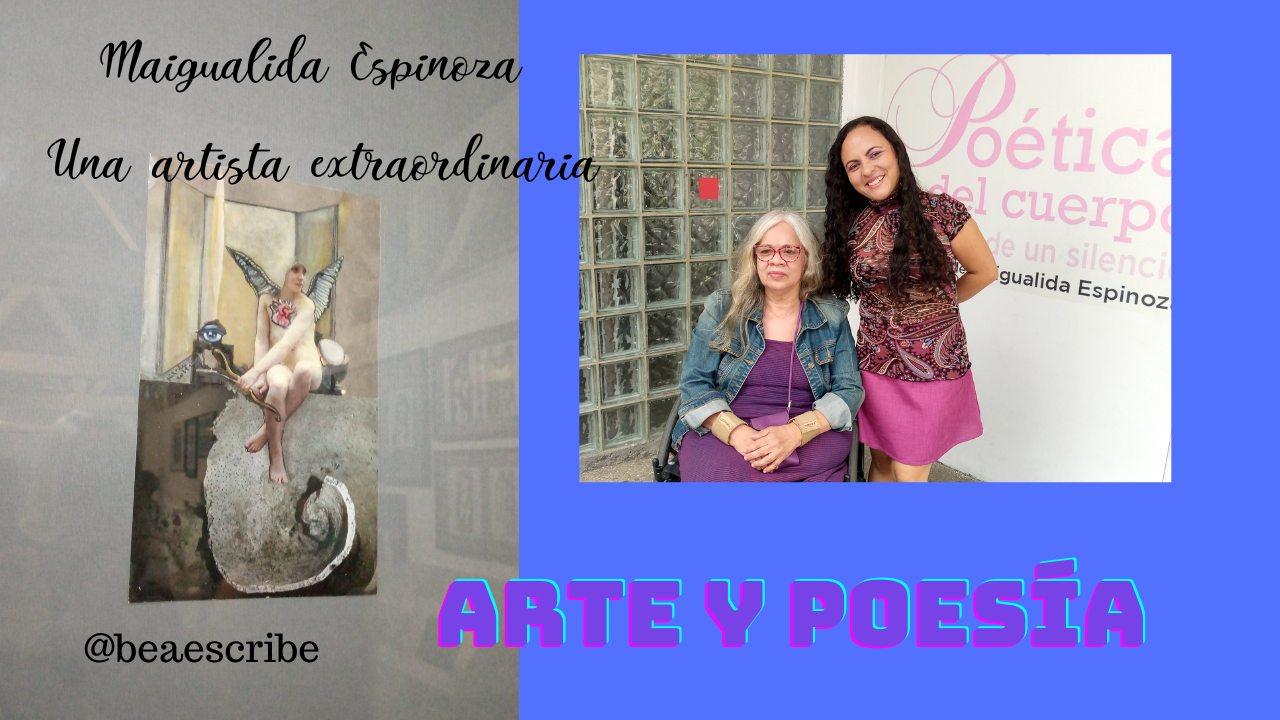
    banner diseñado por mí en canva.com En la foto que tomé con la cámara de mi teléfono móvil está la artista Maigualida Espinoza con la joven poeta María José Escobar
    banner designed by me on canva.com In the photo I took with my cell phone camera is the artist Maigualida Espinoza with the young poet María José Escobar.
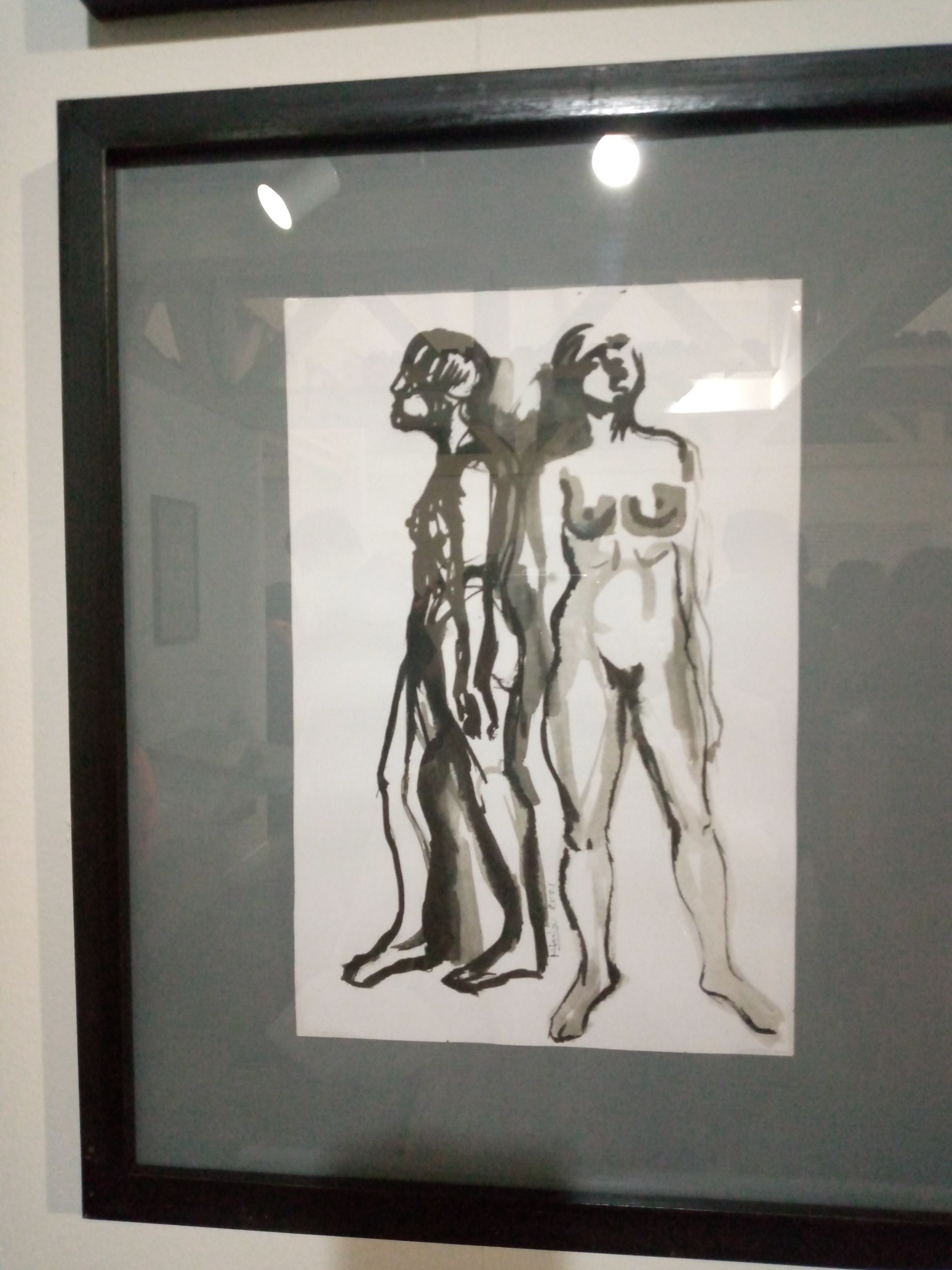
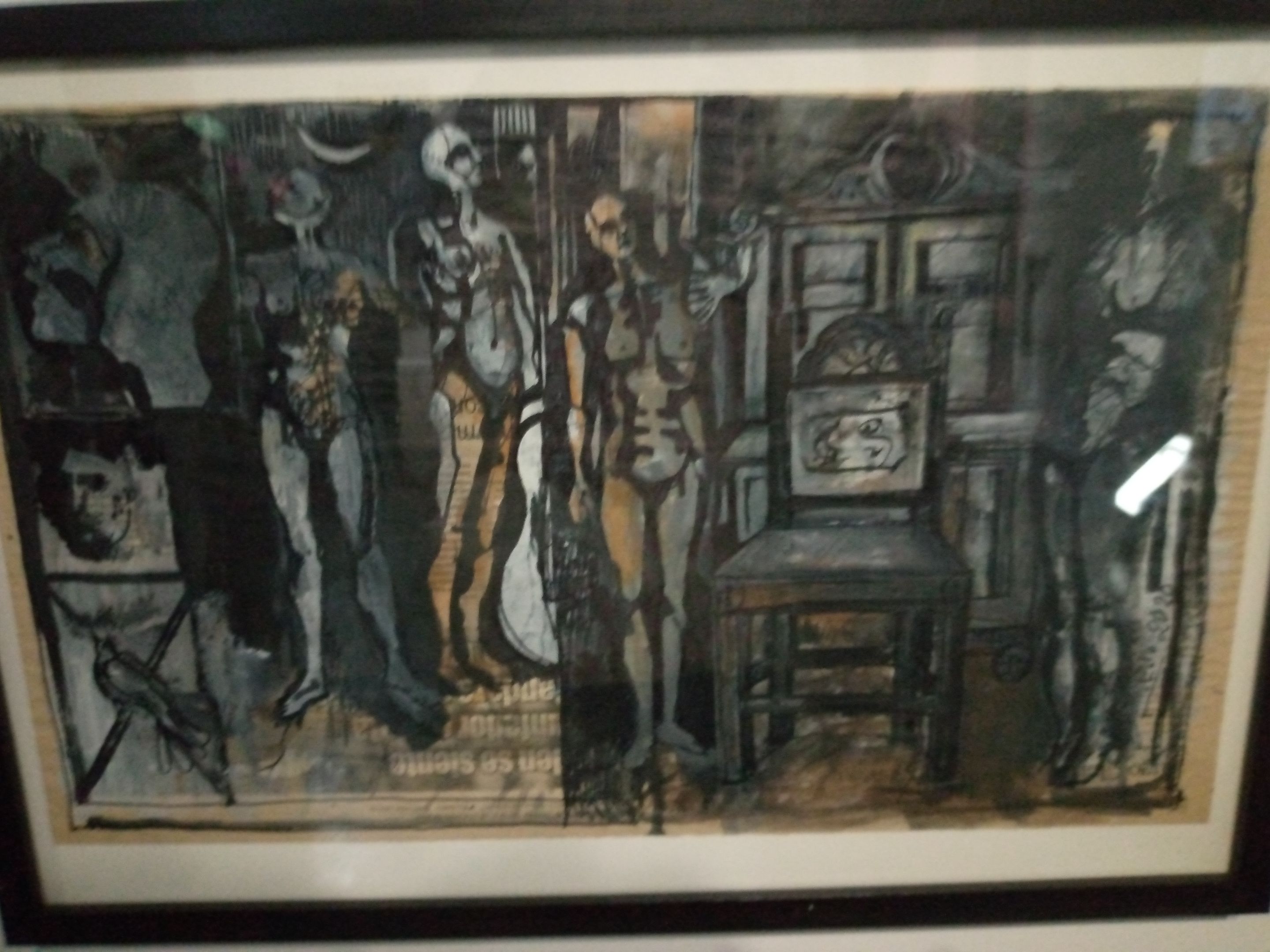
    Conocí a la artista venezolana Maigualida Espinoza el año pasado, cuando inauguró la exposición “Poética del cuerpo. Mitos de un silencio”, en el Museo del Dibujo y La Estampa Carlos Cruz Diez, la exposición reunió 40 obras con la técnica de collage y tinta china que realizó en los últimos tres años, durante la pandemia del Covid-19. La curadora de la exposición fue Jeanette Rodríguez Herrera. Las obras tienen como tema central el cuerpo femenino. En algunos de ellos predomina el blanco y negro, y parecen figuras agobiadas por la soledad y el encierro.
    ![fotos expo Maigualida Espinoza 7.jpg](https://files.peakd.com/file/peakd-hive/beaescribe/23w2qGwQVvFeULxSwK1beezWmxqArGUZdYq2ShkvA5W2M6WJc7EBGxuaMvJrqurrG7yk7.jpg)

    ![Fotos expo Maigualida Espinoza 12.jpg](https://files.peakd.com/file/peakd-hive/beaescribe/EogLTaAkqYQdyriysE4krTTeSQ3BEqcn1dmwiH2apGwVx6fPLGJd45D8YNYKT5jLMpf.jpg)

    I met Venezuelan artist Maigualida Espinoza last year, when she inaugurated the exhibition "Poetics of the body. Mitos de un silencio", at the Museo del Dibujo y La Estampa Carlos Cruz Diez, the exhibition gathered 40 works with the collage and Chinese ink technique that she made in the last three years, during the Covid-19 pandemic. The curator of the exhibition was Jeanette Rodríguez Herrera. The central theme of the works is the female body. In some of them, black and white predominates, and they look like figures overwhelmed by loneliness and confinement.

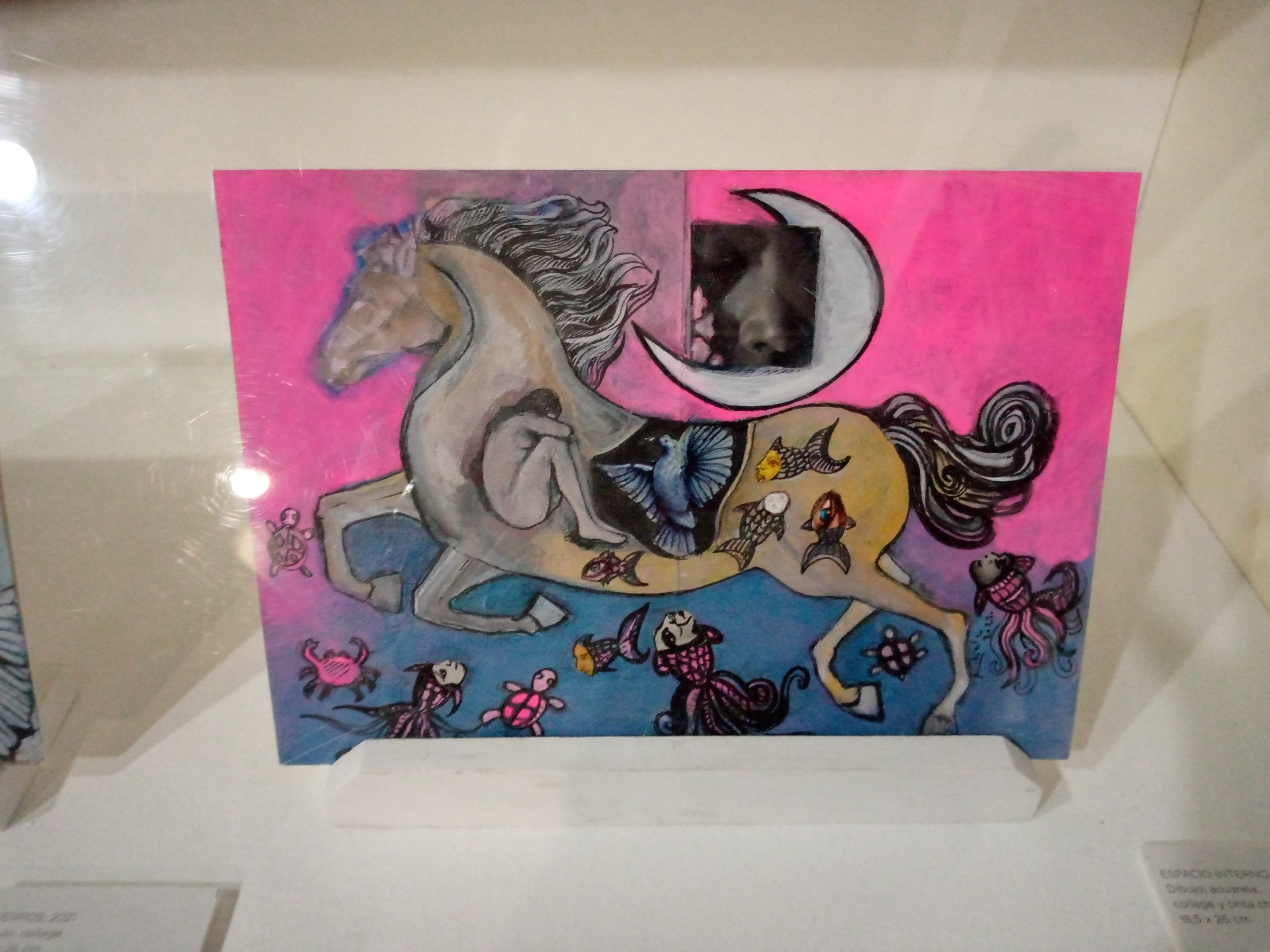
    En otras de las obras se veían figuras en colores de personas en recogimiento o también figuras en colores vibrantes, y en ellas la imaginación parece tomar el protagonismo, un ángel, un caballo que parece volar. Pero siempre está presente la figura femenina.
    ![fotos expo Maigualida Espinoza 5.jpg](https://files.peakd.com/file/peakd-hive/beaescribe/Ep3gJcAr41FxgZTt3jzL13JcG1G5CLJRDTBZE9REkh4SwcUJJgT8kFmkfoNrVihtj49.jpg)

    In other works, colorful figures of people in recollection or figures in virant colors were seen, and in them the imagination seems to take the lead, an angel, a horse that seems to fly. But the female figure is always present.
    Varios meses antes su hijo Zorian me había enviado por correo las obras de la exposición para que escribiese un texto poético inspirado en alguna de las obras. Luego, Zorian hizo un video que reúne varias voces de poetas venezolanos que escribieron inspirándose en las obras de la artista: Silvia Goldman, Cristina Galvez Martos, Mariajosé Escobar, Felipe Ezeiza, Joan Manuel García, Zorian Ramírez Espinoza, Milagros Melean, Liwin Acosta, Beatriz Alicia García, Pamela Rahn Sánchez, Paola De Andrade y Andrés Royer, el cual cuenta como fondo musical performance de la percusionista venezolana Diana Montoya López. Yo les compartí al inicio el video con el cual participé con mi poema “Ángeles Rotos”, en el cual pueden escuchar en el video que realizó Zorian con mi voz y el cuadro de Maigualida.
    ![Foto exposición Maigualida Espinoza poetas 2.jpg](https://files.peakd.com/file/peakd-hive/beaescribe/23xKzvpEnTMW9vrRtBTHAZ5ek1nDBp4sSr1yzkTjM2535b3Lmz6E1cy86yC3EuiATmy1e.jpg)
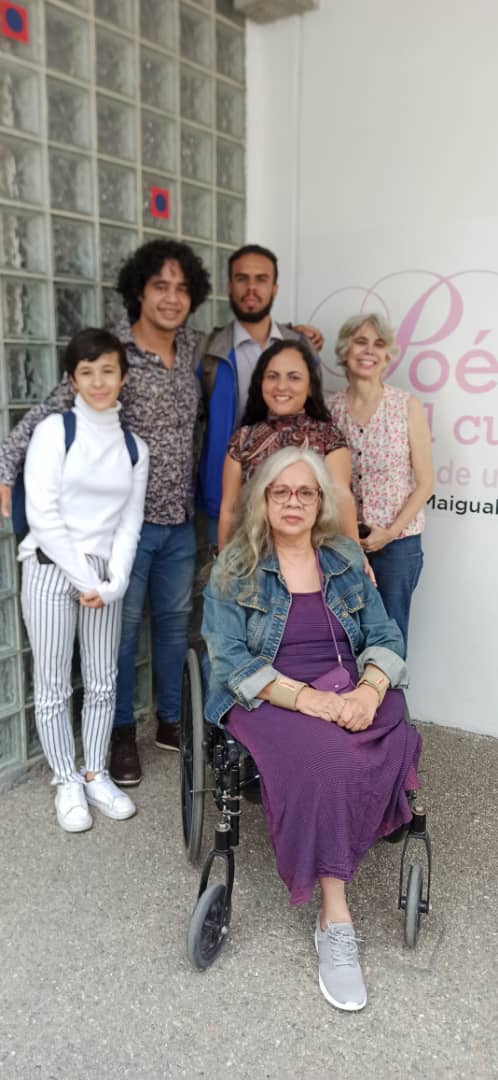
    La artista Maigualida Espinoza con varios de los poetas que participamos en la exposición escribiendo versos inspirados en sus obras.
    The artist Maigualida Espinoza with several of the poets who participated in the exhibition by writing verses inspired by her works.

    Several months earlier, her son Zorian had mailed me the works in the exhibition so that I could write a poetic text inspired by one of the works. Then, Zorian made a video that brings together several voices of Venezuelan poets who wrote inspired by the works of the artist: Silvia Goldman, Cristina Galvez Martos, Mariajosé Escobar, Felipe Ezeiza, Joan Manuel García, Zorian Ramírez Espinoza, Milagros Melean, Liwin Acosta, Beatriz Alicia García, Pamela Rahn Sánchez, Paola De Andrade and Andrés Royer, which has as musical background a performance by the Venezuelan percussionist Diana Montoya López. I share with you the video with which I participated with my poem "Broken Angels", in which you can listen to the video made by Zorian with my voice and Maigualida's painting.

    Quiero compartirles una entrevista que le hice a Maigualida Espinoza, porque quería indagar en su historia, en lo que la inspira a pintar, a pesar de que tuvieron que amputarle sus piernas, esta artista extraordinaria no ha dejado de pintar. Para mí ha sido un honor poder conocerla, poder conocer su obra y participar en el video que une su obra con la expresión poética. Admiro su gran fortaleza, su motivación para seguir creando. Maigualida nació en La Guaira en 1959, es artista plástica, pero también ilustradora, realizó estudios en el ya desaparecido Centro de Enseñanzas Gráficas (Cegra) y en la Escuela de Artes Cristóbal Rojas. Entre sus maestros se destacan Luis Guevara Moreno, quien la guió en la pintura y el dibujo; Edgar Sánchez, quien la formó en el aprendizaje de la litografía, y Zacarías García y Rafael Bogarín fueron sus mentores en la serigrafía; mientras que Luis Adrián León fue su guía en las técnicas del grabado y Antonio Lazo en el dibujo.

    I want to share with you an interview I did with Maigualida Espinoza, because I wanted to investigate her story, what inspires her to paint, despite the fact that her legs had to be amputated, this extraordinary artist has not stopped painting. For me it has been an honor to meet her, to get to know her work and to participate in the video that unites her work with poetic expression. I admire her great strength, her motivation to continue creating. Maigualida was born in La Guaira in 1959, she is a plastic artist, but also an illustrator, she studied at the now defunct Centro de Enseñanzas Gráficas (Cegra) and at the Escuela de Artes Cristóbal Rojas. Among her teachers are Luis Guevara Moreno, who guided her in painting and drawing; Edgar Sánchez, who trained her in lithography, and Zacarías García and Rafael Bogarín were her mentors in serigraphy; while Luis Adrián León was her guide in engraving techniques and Antonio Lazo in drawing.

    **Entrevista**
    ¿Cuándo comenzaste a pintar?
    -Comencé a pintar desde muy temprana edad representando las vivencias cotidianas y mi mundo imaginario. En la escuela elaboraba carteleras, ilustraba mis cuentos,diseñaba muñecas de papel con sus trajes; siempre interesada en las actividades artísticas.

    La llegada del hombre a la luna fue un acontecimiento que me impactó y generó gran curiosidad.
    Recuerdo que se realizaban actividades de pinturas los fines de semana en los parques, especialmente en el Planetario Humboldt, mi espacio preferido, donde descubría una nueva visión del mundo, el universo, los astros, planetas cometas,en fin un mundo fascinante que en lo personal me emocionaba.
    Así surgen mis seres, los pequeños astronautas a los que le dibujaba rostros en sus cascos. Del mismo modo nacen mis primeros autorretratos: "Yo, Astronautas". Pienso que estos detalles se extendieron para que muchos años después influyeran en mi decisión y formación artística.
    ¿Por qué?
    Pienso que era el espacio que me permitía construir lo que me gustaba crear y me permitía sentir la armonía que genera indagar entre el mundo real y la imaginación.
    ¿Qué te gustaba de pintar?
    Las gamas de colores, crear personajes, imaginar, ilustrar mis propios cuentos. Me gustaba experimentar con diversas técnicas.También, el poder mancharme de colores las manos, la cara, ese contacto directo con la pintura me hacía feliz.
    ¿Cuándo el gusto por pintar se convirtió en destino?
    Pienso que tiene su origen en la infancia donde fui tejiendo a través del tiempo, las vivencias, los sueños y la espiritualidad; incursionando en expresiones artísticas como la danza y el teatro.
    Cuando se es joven te atrapa el alma de la creación que invitan a indagar, a descubrir, a encontrar nuevas formas de conectarme con la vida. Actitud que definió mi destino hacia las artes.
    ¿Quiénes fueron tus Maestros más importantes? En mi formación académica, lo digo con humildad, tuve la dicha de formarme con grandes maestros del arte en Venezuela. Entre ellos:
    •Luis Guevara Moreno (Escuela de Artes Plásticas Cristóbal Rojas)
    •Antonio Lazo profesor de dibujo
    (Cegra)
    •Edgar Sánchez
    profesor de Dibujo y Litografía (Cegra)
    •Luis Adrián León
    Profesor de Grabado (Cegra)
    •Zacarías García
    Profesor de Serigrafía
    (Cegra)
    ¿Qué aprendiste de ellos?
    Aprendí de ellos la humildad, su visión de la vida y a ver el arte como medio transformador.
    También aprendí la constancia y la disciplina para lograr los objetivos, así como a entender la poesía como fuente inspiradora.
    ¿Qué te lleva a pintar aún hoy?
    Crear es mi razón de vida, la constante comunicación con mi mundo interior, el alma que descubre y expresa emociones transformadas en color, línea y forma. Mi obra y yo estamos en constante sincronía formamos un solo discurso de vida.
    ¿Cuáles han sido los temas o formas que se han reiterado en tu pintura?
    Siempre me interesó la figura humana especialmente la figura femenina. Discurso que hasta hoy se mantiene presente expresando la sutileza, la melancolía, dolor que evoca e indaga dentro de las profundas vivencias del sentir femenino.
    ¿Por qué el cuerpo fue el tema de tu más reciente exposición?
    Los cuerpos que forman parte de "Poética del Cuerpo, Mitos de un Silencio" son el reflejo del ser humano y su sentir en tiempos de ausencia ,pérdida, aislamiento e incertidumbre. Mi propuesta es una invitación a reencontrarnos con la belleza y la poesía en medio de la adversidad.
    ¿Por qué la titulaste "Poética del Cuerpo"?
    Definí de esta manera a la búsqueda de un lenguaje que nace y se desarrolla en el cuerpo , dando como resultado un discurso donde se fusiona el lenguaje plástico con el lenguaje poético y la unión de ambos forman el alma de mi obra llena de significados.
    English version
    **Interview**
    When did you start painting?-I started painting at a very early age, representing my daily experiences and my imaginary world. At school I made posters, illustrated my stories, designed paper dolls with their costumes; I was always interested in artistic activities.
    The arrival of man on the moon was an event that shocked me and generated great curiosity.
    I remember that there were painting activities on weekends in the parks, especially in the Humboldt Planetarium, my favorite space, where I discovered a new vision of the world, the universe, the stars, planets, comets, in short, a fascinating world that personally excited me.This is how my beings were born, the little astronauts whose faces I drew on their helmets. In the same way my first self-portraits were born: "I, Astronauts". I think that these details spread so that many years later they influenced my decision and artistic formation.
    Why?
    I think it was the space that allowed me to build what I liked to create and allowed me to feel the harmony that comes from exploring between the real world and the imagination.
    What did you like about painting?
    I liked to experiment with different colors, to create characters, to imagine, to illustrate my own stories. I liked to experiment with different techniques, also, being able to stain my hands and face with colors, that direct contact with paint made me happy.
    When did the taste for painting become a destiny?
    I think it has its origins in childhood where I was weaving through time, experiences, dreams and spirituality; dabbling in artistic expressions such as dance and theater.
    When you are young you are caught by the soul of creation that invites you to investigate, to discover, to find new ways to connect with life. This attitude defined my destiny towards the arts.
    Who were your most important teachers?
    In my academic training, I say this with humility, I had the joy of training with great masters of art in Venezuela. Among them:
    •Luis Guevara Moreno (Escuela de Artes Plásticas Cristóbal Rojas)
    •Antonio Lazo drawing teacher
    (Cegra)
    •Edgar Sánchez
    Drawing and Lithography teacher (Cegra)
    •Luis Adrián León
    Profesor de Grabado (Cegra)
    •Zacarías García
    Silkscreen Printing Teacher
    (Cegra)

    What did you learn from them?
    I learned from them humility, their vision of life and to see art as a transformative medium.

    I also learned perseverance and discipline to achieve my goals, as well as to understand poetry as a source of inspiration.

    What drives you to paint even today?
    Creating is my reason for living, the constant communication with my inner world, the soul that discovers and expresses emotions transformed into color, line and form. My work and I are in constant synchrony, we form a single discourse of life.

    What have been the themes or forms that have been reiterated in your painting?
    I have always been interested in the human figure, especially the female figure. This discourse is still present today, expressing the subtlety, melancholy, pain that evokes and investigates the deep experiences of the feminine feeling.

    Why was the body the theme of your most recent exhibition?
    The bodies that are part of "Poetics of the Body, Myths of a Silence" are a reflection of human beings and their feelings in times of absence, loss, isolation and uncertainty. My proposal is an invitation to rediscover beauty and poetry in the midst of adversity.

    Why did you title it "Poetics of the Body"?
    I defined in this way the search for a language that is born and developed in the body, resulting in a discourse where the plastic language merges with the poetic language and the union of both form the soul of my work full of meanings.
    ![Gracias por leerme multicolor.png](https://files.peakd.com/file/peakd-hive/beaescribe/23ywsPFQiivH7viHh1qecMNWmooAVZz9Tbvkoiew2hJXXU7DHxgF8nutDMfXFd8ifWMdd.png)
    1 min

About beaescribe 3Speak Podcast

From the publisher's feed

Listen and watch the latest videos from beaescribe. Hosted by 3Speak.tv, the free speech video platform.