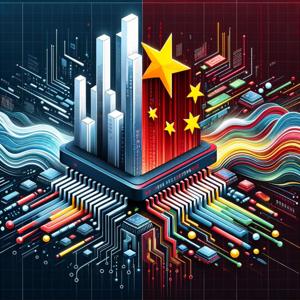
Beijing Bytes: US-China Tech War Updates

Beijing Bytes: US-China Tech War Updates

By Inception Point AINewsTechnologyPoliticsTech News
Download on the App Store

Beijing Bytes: US-China Tech War Updates episodes

  • Hacked! US-China Tech War Heats Up with Cyber Attacks, Chip Crackdowns, and an Antitrust Twist
    This is your Beijing Bytes: US-China Tech War Updates podcast.
    Hey there, I'm Ting, and let's dive right into the latest updates on the US-China tech war. Over the past two weeks, we've seen some significant developments that are shaping the future of this high-stakes competition.
    First off, cybersecurity incidents have been making headlines. Just last week, the White House confirmed that at least eight US telecom firms were hit by a Chinese hacking campaign, giving Beijing access to private texts and phone conversations of an unknown number of Americans, including senior government officials and prominent political figures[1]. This is a stark reminder of the persistent threat posed by malicious cyber actors operating in China.
    In response to these threats, the US has been tightening its tech restrictions. The National Defence Authorisation Act unveiled recently would effectively bar contractors from selling chips or tools to Huawei or its affiliates, further squeezing the Chinese tech giant[3]. Additionally, the Treasury Department sanctioned Sichuan Silence Information Technology Company and one of its employees for their roles in compromising tens of thousands of firewalls worldwide, including those of US critical infrastructure companies[4].
    These moves are part of a broader strategy to curb China's technological advancements. The US has also stepped up export controls on the semiconductor industry, which has led to Chinese chip tool maker Empyrean Technology handing control of its board to a state-owned enterprise after being blacklisted by Washington[3].
    But China isn't taking these restrictions lying down. In an apparent response to the tightened chip restrictions, China launched an antitrust probe into US chip giant Nvidia, marking an escalation in the tech war[3]. This move underscores the complex interplay between economic and security interests in this competition.
    Expert analysis suggests that while the US-China tech war is intensifying, there are also underappreciated sources of structural stability that could keep relations from further deteriorating. Scott Kennedy of CSIS notes that the recent summit meeting between Presidents Joe Biden and Xi Jinping has created guardrails that reduce the likelihood of the most disastrous outcomes[2].
    Looking ahead, it's clear that the US-China tech war will continue to shape the global tech landscape. As we move into 2025, expect more strategic maneuvering from both sides, with cybersecurity, semiconductors, and artificial intelligence remaining key battlegrounds. That's all for now from Beijing Bytes. Stay tuned for more updates on this ever-evolving tech war.
    For more http://www.quietplease.ai
    Get the best deals https://amzn.to/3ODvOta
    This content was created in partnership and with the help of Artificial Intelligence AI.
    3 min
  • Beijing's Hacking Scandal: Texts, Calls, and Cyberspies Oh My!
    This is your Beijing Bytes: US-China Tech War Updates podcast.
    Hey there, I'm Ting, and welcome to Beijing Bytes, your go-to source for the latest on the US-China tech war. Let's dive right in because the past two weeks have been anything but quiet.
    First off, cybersecurity has been a hot topic. The White House recently revealed that at least eight U.S. telecom firms were hit by a Chinese hacking campaign. Deputy National Security Adviser Anne Neuberger shared that this campaign gave Beijing access to private texts and phone conversations of an unknown number of Americans, including senior U.S. government officials and prominent political figures[1]. The FBI and the Cybersecurity and Infrastructure Security Agency have issued guidance to help root out these hackers and prevent similar cyberespionage in the future.
    But that's not all. The U.S. Department of the Treasury's Office of Foreign Assets Control sanctioned Sichuan Silence Information Technology Company, Limited, and one of its employees, Guan Tianfeng, for their roles in the April 2020 compromise of tens of thousands of firewalls worldwide, many of which belonged to U.S. critical infrastructure companies[4].
    On the tech restriction front, the U.S. Department of Commerce's Bureau of Industry and Security announced new rules to further restrict China's capability to produce advanced-node semiconductors for military applications. These rules include new controls on 24 types of semiconductor manufacturing equipment and 3 types of software tools, as well as additions to the Entity List[5].
    China hasn't taken these moves lightly. In response to the U.S. export controls, China has launched investigations into Nvidia and restricted the export of critical materials, escalating the tech war[3].
    Looking at the bigger picture, National Security Advisor Jake Sullivan recently discussed the future of U.S.-China relations, emphasizing the importance of military-to-military communication and the need to manage the risks of artificial intelligence. He noted that while there will be times of tension, the U.S. is ready to coordinate on various global issues, including climate, health security, and macroeconomic stability[2].
    So, what does this mean for both nations? The tech war is heating up, with cybersecurity incidents and new tech restrictions at the forefront. The strategic implications are significant, as both countries jockey for dominance in advanced technologies. As we move forward, expect more tension and more surprises. But for now, that's all for Beijing Bytes. Stay tuned for more updates on this ever-evolving tech landscape.
    For more http://www.quietplease.ai
    Get the best deals https://amzn.to/3ODvOta
    This content was created in partnership and with the help of Artificial Intelligence AI.
    3 min
  • Salty Typhoons, AI Chips, and a Sino-American Showdown: The Tech War Heats Up!
    This is your Beijing Bytes: US-China Tech War Updates podcast.
    Hey there, I'm Ting, and welcome to Beijing Bytes, your go-to source for the latest on the US-China tech war. Let's dive right in.
    Over the past two weeks, we've seen some major developments that are heating up the competition between these two tech giants. First off, cybersecurity incidents have been making headlines. The FBI just revealed that a China-linked threat group, known as Salt Typhoon, has been infiltrating US telecom networks, stealing a massive amount of data, including private communications of targeted individuals involved in government or political activities[3]. This is a big deal, folks, and it's clear that China's cyber espionage efforts are getting more sophisticated.
    But the US isn't taking this lying down. The Biden administration has imposed new restrictions on China's access to vital components for AI chips, which has provoked Beijing into showcasing its own tools for a potential trade war[2]. President Xi Jinping has opened a probe into Nvidia Corp. and banned the export of several rare materials with military applications. This is a classic tit-for-tat move, and it's clear that both sides are gearing up for a long fight.
    In terms of policy changes, the US has been tightening its export controls on China, particularly when it comes to AI technologies. The latest update bans the sale of high-bandwidth memory (HBM) chips to China, which is a key component for leading-edge GPUs[4]. This move is designed to keep China at least two generations behind the curve in AI development.
    But here's the thing: China's not going down without a fight. Beijing has been working to develop its own indigenous chip industry, and it's making some serious strides. Companies like Huawei are still dependent on foreign suppliers, but they're getting closer to mastering key technologies like HBM2E.
    So what does this all mean? Well, for one, it's clear that the US-China tech war is heating up, and it's going to have some serious implications for both nations. As Claus Soong noted, Taiwan's new president is even countering Beijing's "one China" narrative with a bold new approach, which could further complicate the situation[1].
    In terms of industry impacts, we're already seeing some major players getting caught in the crossfire. Nvidia Corp. is facing a probe in China, and companies like Huawei are struggling to access key components. This is going to have some serious ripple effects throughout the global supply chain.
    So what's next? Well, it's clear that both sides are digging in for a long fight. The US is going to keep tightening its export controls, and China is going to keep pushing to develop its own indigenous chip industry. As Grzegorz Stec and Helena Legarda noted, Europe's resilience vis-à-vis China is going to be a key factor in this conflict[1].
    That's all for now, folks. Stay tuned for more updates on the US-China tech war, and remember: in the world of cybersecurity
    This content was created in partnership and with the help of Artificial Intelligence AI.

    4 min

About Beijing Bytes: US-China Tech War Updates

From the publisher's feed

This is your Beijing Bytes: US-China Tech War Updates podcast.