
Sign up to save your podcasts
Or



It’s hard for people to feel hopeful in these uncertain times. But having hope for the future helps to build resilience and gives people the will, determination, and sense of empowerment to tackle their mental health challenges. I talk to Jonny Benjamin, a mental health campaigner, about his truly extraordinary story and new book, ‘The Book Of Hope’. Jonny was 20 and standing on the edge of Waterloo bridge about to jump. A passer-by, a stranger, noticed his distress and took the time to talk to him. It was a moment of kindness and compassion that change the course of his life. His new book, which brings together 101 different voices on overcoming adversity, similarly aims to inspire acceptance, compassion, courage, resilience, kindness and, most importantly, hope in people facing their own mental health challenges.
You probably expected to get some attitude when your child arrived in the teenage years. But the constant eye-rolling, emotional outbursts and “You are so embarrassing” comments may be harder to handle than you imagined. In this episode, I discuss why a teenager’s life is so full of emotions and angst and how to cope with their emotional highs and lows.
Do you enjoy a glass of wine to wind down after work or a cocktail (or four) to loosen you up in social situations? You’re not alone! Last year, more than 80% of us reported that we drink alcohol on a regular basis with heavy drinking increasing by more than 40% in women. I discuss the impact that alcohol can have on your brain and mental health, and how to manage your relationship with the most socially acceptable and accessible drug on the market.
Imagine it was possible to successfully treat depression without needing to take any form of antidepressant drug. Today I talk to therapist, Nic Saluppo, about his incredible journey to heal his own depression without using medication. Nic experienced psychological trauma as a child that led to severe depression as an adult. But he has managed to cure his depression for good - naturally, and after 9 years - by learning to experience the feelings he had been suppressing from his childhood.
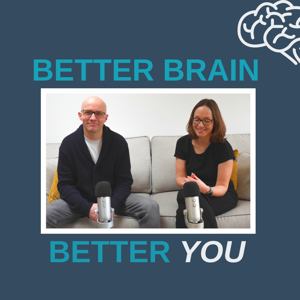
Welcome to Better Brain, Better You. We are neuroscientist Dr Ben Webb and clinical psychologist Dr Zoe Webb. On this podcast we help people of all ages to cultivate a healthy brain for a mentally healthy and happy life. So come and join us to build a Better Brain, for a Better You. We release weekly episodes for brains of all ages.
From getting drunk at a party, to stealing your clothes, to Xbox gaming into the early hours, teenagers often make bad decisions. I breakdown why teenagers make misguided decisions and how parents can help them to learn good decision-making skills. Teenagers will often express quite clearly why certain behaviours and actions are not desirable. But put them in a situation where they feel pressure, stressed, or are seeking attention from their peer group, they will start to make poor decisions. And to make matters worse, teenagers are guided by a brain that can’t access information that could improve these decisions.
Why are women twice as likely as men to develop Alzheimer’s disease? I discuss some important differences in the way women's brains age and how this increases their risk of developing Alzheimer’s disease. It’s not that a female brain is fundamentally different to a male brain. But there are some really important differences in the way a female brain responds to hormonal changes at different stages of life that drives brain ageing in women, significantly increasing their risk of developing Alzheimer’s.
Ever wondered why you feel low or lethargic after eating certain foods and invigorated and energised after eating others? I breakdown why certain foods affect your mood and how simple changes to diet can improve your mental health. When we eat foods high in refined carbohydrates and trans fats and don’t look after our gut health it has detrimental effects on our mood and mental health. Whereas traditional diets high in vegetables, fruits, unprocessed grains, fish and seafood lower the risk of developing depression and enhance mental wellbeing.
podcast website: https://www.ologyonlinecourses.com/podcast; follow us @ologyonline on facebook, twitter and instagram
Ever offered up what you thought was an inspirational solution to you teenager’s problem, only for it to be dismissed as annoying, irrelevant or even stupid. I breakdown why teenagers don’t want parents' advice and prefer a sounding board not a solution. When we offer a solution too quickly, teenagers often feel like we’re not really listening to them or understanding what they’re going through. And it turns out that listening and understanding is what teenagers really want.
Podcast website: https://www.ologyonlinecourses.com/podcast; follow us @ologyonline on facebook, twitter and instagram
We often give teenagers a hard time for being impulsive, emotional outbursts, taking risks, too much screen time, or just because they can’t get out of bed in the morning. Today I want to talk about a teenage super-power: their extraordinary capacity for learning. The growth of new brain connections and shedding of unused ones make teens sensation-seeking, learning machines. They learn much faster than adults and what they learn is retained for longer. This make the teen years the ideal time to identify a child’s strengths, invest in them, and support their emerging talents.
From the publisher's feed

3 Listeners