
Sign up to save your podcasts
Or



Hey! I'd love to hear your thoughts, send me a voice note.
Three separate stories hit the same session, and one closing number can't hold all of them. Intel jumped nine percent on a pricing report and an analyst upgrade. Qualcomm signed a real deal with Amazon. Software stocks fell on fears that a new AI model could replace what they sell. And oil climbed for a sixth straight session after Houthi forces struck Saudi Arabia's own energy infrastructure directly, for the first time in this war — not a ship in the strait this time, a refinery inside a country that had spent months trying to stay out of the fight.
WHAT'S IN THIS EPISODE
On This Date in History — September 8, 2008: the day markets celebrated the Fannie Mae and Freddie Mac bailout while their own shareholders lost nearly everything, and the London Stock Exchange went dark for seven hours for a completely unrelated reason.
Market Recap — A second straight losing session, oil at a six-week high, yields near 4.8% days before the Fed's last inflation read before its September meeting.
Biggest Movers — Intel's crowded morning (a pricing report, an analyst upgrade, and an unplanned windfall for the U.S. government's own stake), Qualcomm's real AI-infrastructure deal with Amazon, and a software selloff driven by fear of AI replacing specialized tools.
Checklist-Specific Movers — Testing how far the day's two dominant trades actually reached: Nvidia and Micron didn't join the chip rally, Oracle didn't join the software selloff, and Apple's small decline turned out to be about something else entirely.
Deep Dive — Why an attack on Saudi soil is a fundamentally different problem than an attack on a ship in the strait, and five concrete things worth watching to know whether this week's oil premium is temporary or the start of something wider.
DISCLOSURE
Nothing in this episode is financial advice. If either host ever tells you to buy a specific stock, assume the model hallucinated and go find an actual licensed human.
Questions for The Mailbag: [email protected] If this was worth your time, subscribe — costs nothing.
Hey! I'd love to hear your thoughts, send me a voice note.
Daily Reading
1 CORINTHIANS 7:25-31 PSALM 45:11-12, 14-15, 16-17 LUKE 6:20-26
Taken together, that's an argument that the ordinary comforts of this world — marriage, wealth, a full stomach, a good reputation — aren't the actual point of anything, and a warning not to build a life as though they were. Paul isn't condemning marriage itself; he's naming how short the time is and asking people not to organize their whole identity around something that, however good, isn't final. The Psalm complicates that a little, since it lingers approvingly over royal beauty and rich gifts — a reminder that Scripture doesn't always speak in one register, and this reading sits closer to celebration than warning. Luke settles the tension by inverting the expected order outright: it's the poor, the hungry, and the grieving who are called blessed, and the comfortable who are told to watch out, precisely because comfort has a way of feeling like the whole story when it isn't.
Made by AI.
Hey! I'd love to hear your thoughts, send me a voice note.
Daily Reading
MICAH 5:2-4 PSALM 13:6 MATTHEW 1:1-16, 18-23
Taken together, that's the story of a small town, a small offering of gratitude, and a long list of names ending in a single birth — three ways of saying that greatness in this account rarely starts out looking like greatness at all. Micah doesn't promise Bethlehem will become important; he says the ruler comes out of it precisely because it was never important to begin with. The Psalm's gratitude isn't for anything dramatic either — one line, sung because good was done, with no larger occasion attached. And the genealogy spends dozens of names getting somewhere, through kings and exiles and forgotten men, before it finally arrives at a birth that looked, from the outside, like nothing more than a betrothed couple's complicated year.
Made by AI.
Hey! I'd love to hear your thoughts, send me a voice note.
No bell today — U.S. markets were closed for Labor Day. So instead of a session recap, one question: why does the government close the exchange to honor labor, when the actual history of that honor is considerably more complicated than a long weekend suggests?
WHAT'S IN THIS EPISODE
On This Date in History — John Merrick, born into slavery in 1859, who built barbershops into North Carolina Mutual Life Insurance — at its peak, the largest Black-owned business in America.
Closed-Market Deep Dive — Labor Day's actual origin: a march organized by workers themselves in 1882, a federal holiday signed into law in 1894 — four days before the same president sent troops to crush the Pullman Strike. Why the eight-hour day workers were fighting for didn't become federal law for another 44 years, and what the holiday actually did and didn't accomplish in between.
DISCLOSURE
Nothing in this episode is financial advice. If either host ever tells you to buy a specific stock, assume the model hallucinated and go find an actual licensed human.
Questions for The Mailbag: [email protected] If this was worth your time, subscribe — costs nothing.
Hey! I'd love to hear your thoughts, send me a voice note.
Daily Reading
1 CORINTHIANS 5:1-8 PSALM 5:5-6, 7, 12 LUKE 6:6-11
Taken together, that's a warning about tolerating what shouldn't be tolerated, a reminder that God has no patience for deceit, and a picture of what happens when rule-keeping gets valued over an actual, present need.
Made by AI.
Hey! I'd love to hear your thoughts, send me a voice note.
Apple changed chief executives. Two tech giants beat every published number and got punished anyway. Nvidia bought a platform whose entire value depends on staying open. A blowout jobs report hid a far more concentrated story underneath it. Four separate events — one shared question: when does something become evidence, and when are we mistaking the first visible result for the final verdict?
WHAT'S IN THIS EPISODE
Proverb of the Week — Proverbs 24:27 and the discipline of distinguishing a prepared field from a well-described house.
The Reckoning — Both hosts' predictions from last week actually landed correct — and both grade their own reasoning as wrong anyway, for very different reasons.
The Week Ahead — What Thursday's PPI and Friday's CPI can and can't tell us before the Fed meets September 15-16, plus two new predictions built the hard way this time.
The Nuts and Bolts — Apple's succession, the Palo Alto/Broadcom earnings pattern, Nvidia's Hugging Face bet, and the jobs report's real composition — four stories, one throughline.
Sports — The NFL's opening week built for two different buyers, the US Open's redesigned prize structure, and a wild-card race that's tighter than the headlines suggest.
Trending Roundup — The argument over what to call six months of conflict with Iran, a foodborne outbreak that tested public health infrastructure, and four separate court rulings quietly shaping the November election before a single vote is cast.
DISCLOSURE
Nothing in this episode is financial advice. If either host ever tells you to buy a specific stock, assume the model hallucinated and go find an actual licensed human.
Questions for The Mailbag: [email protected] If this was worth your time, subscribe — costs you nothing.
Hey! I'd love to hear your thoughts, send me a voice note.
Daily Reading
EZEKIEL 33:7-9
PSALM 95:1-2, 6-7, 8-9
ROMANS 13:8-10
MATTHEW 18:15-20
Taken together, that’s a plain charge: hear God, warn people honestly, correct them privately, and do all of it out of love—not pride.
Made by AI.
Hey! I'd love to hear your thoughts, send me a voice note.
For the first time, Boujie crashes Wade's show. Boujie gave the memory chip rally fifteen seconds on Friday. This week he came back to make Wade defend it for an hour — and to ask the question Wade doesn't usually ask: has the market already priced a recovery faster than the physical world can actually deliver one?
WHAT'S IN THIS EPISODE
The Handoff — Boujie's fifteen-second Friday mention (Sandisk, Micron, "renewed AI infrastructure enthusiasm") becomes the episode's starting question.
The Question — Why the memory shortage isn't a repeat of the 2021 auto-chip crunch: that one was a pileup of logistics and bad forecasting; this one is an industry deliberately steering capacity toward its most profitable product.
The Machine — What HBM actually is, why it eats a disproportionate share of wafer capacity relative to what it produces, and the real manufacturing journey from silicon wafer to qualified, stacked chip. Boujie pressure-tests every number against what the market is actually pricing.
Second-Order Effects — Who pays and who profits, the CHIPS Act's real tradeoff between efficiency and security, and why "bringing chip manufacturing home" is true on a timeline most press releases don't picture.
Request vs. Reality — The signature move, argued from both sides: Wade lays out what's actually under construction and when it ships; Boujie defends the market's right to price the future before the concrete exists — then names the specific bets hidden inside a bullish stock chart.
The Larger Principle — A scoreboard for watching whether the wall actually comes down, and the line the whole episode earns: "the market isn't required to wait for the concrete — but the concrete is eventually required to hold up the earnings."
DISCLOSURE
Nothing in this episode is financial advice. If either host ever tells you to buy a specific stock, assume the model hallucinated and go find an actual licensed human.
Questions for The Mailbag: [email protected] If this was worth your time, subscribe — doesn't cost you a thing.
Hey! I'd love to hear your thoughts, send me a voice note.
A blowout jobs report should have been the best news of the week. Instead it closed out five straight days of the market moving on speeches, earnings calls, and a Vice President's press conference — and it barely moved the needle more than any of them.
WHAT'S IN THIS EPISODE
On This Date in History — 1998: Andy Bechtolsheim writes a hundred-thousand-dollar check to "Google Inc.," a company that doesn't legally exist yet. Larry Page and Sergey Brin have to incorporate the business and open a bank account before they can cash it. Conviction arrived first. The paperwork caught up later — a pattern that shows up again and again this week.
Market Recap — August payrolls come in at 162,000, nearly triple the consensus estimate, with June and July both revised up. Good news for the labor market is bad news for stocks: a resilient jobs report gives the Fed less reason to worry about employment and more room to focus on inflation. S&P, Nasdaq, and Dow all close lower. One striking detail buried in the report: of the 162,000 jobs added, roughly 158,000 went to women — verified directly against BLS's own tables, industry by industry.
Biggest Movers — Lululemon craters 17.4% on a third guidance cut this year. Tesla falls on rate pressure and a Cybercab launch that left more questions than answers. And on the other side: Sandisk, Micron, AMD, and Nvidia all rally hard — an AI-infrastructure story that runs directly against the day's own rate logic.
Checklist-Specific Movers — Splitting Friday into three groups: names that confirm the rate-sensitive story, names that complicate it (the chip rally), and names that are just their own thing (Lululemon).
Deep Dive — Walking the whole week's Fed-odds arc, from Tuesday's oil shock to Thursday's political pressure campaign to Friday's actual data — and why the data barely moved the number more than any of the four days that came before it, when nobody had any data at all.
DISCLOSURE
Nothing in this episode is financial advice. If either host ever tells you to buy a specific stock, assume the model hallucinated and go find an actual licensed human.
Questions for The Mailbag: [email protected] If this was worth a few minutes of your evening, subscribe — costs nothing.
Hey! I'd love to hear your thoughts, send me a voice note.
Nvidia just spent $12.9 billion on a website. Boujie explains why that website is actually the most valuable piece of real estate left in AI — and why "we promise to keep it open" is doing a lot of work in that sentence.
WHAT'S IN THIS EPISODE
On This Date in History — 1929: The Dow closes at 381.17, the top of the entire 1920s bull market. Nobody rang a bell. Rallies kept interrupting the decline through September, making every confident call look premature — right up until the market lost half its value and didn't reclaim that high again for 25 years.
Market Recap — A strong rally (S&P +1.06%, Nasdaq +1.4%, Dow +1.18%, best day in a stretch) after VP Vance calls the Fed's posture "monetary malpractice" and Fed Governor Waller signals he'd back holding rates steady. September hike odds fall from 63% to roughly a coin flip — moved more by a political statement and one governor's comments than by any new data.
Biggest Movers — Snowflake +16.5% on a genuine AI-driven beat. Palantir and Oracle ride along. On the losing side: Victoria's Secret, Ciena, and Campbell's all get punished despite decent-to- strong quarters — a pattern that's becoming hard to ignore.
Checklist-Specific Movers — HPE beats and rallies 5%. Broadcom beats the quarter and falls anyway, for the second straight session, on a guidance number $200 million below consensus — a direct test of Tuesday's exact thesis, one company later.
Deep Dive — Why does a chip company need to own an open-source AI community platform? Nvidia's $12.9 billion bet on Hugging Face, explained: the strategic logic, the neutrality problem, the security incident nobody should over-read, and the five things worth watching before deciding if this was a smart trade.
DISCLOSURE
Nothing in this episode is financial advice. If either host ever tells you to buy a specific stock, assume the model hallucinated and go find an actual licensed human.
Questions for The Mailbag: [email protected] If this was worth a few minutes of your evening, subscribe — costs nothing.
From the publisher's feed
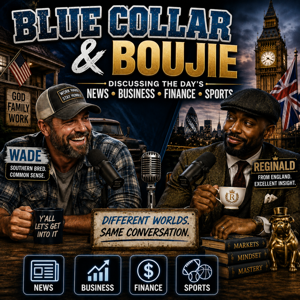
Blue Collar and Boujie
Wade sees it from the jobsite. Reginald “Boujie” Ashworth-Pryce sees it from the market.
Together, they follow the news, business,…
After the Bell puts Boujie behind the microphone after the market closes to explain what actually moved, why it moved, and what Wall Street may be missing.
Ground Truth gives Wade one consequential idea, number or claim from the week and lets him take the machine apart — the physical infrastructure, labor, incentives, regulations and real-world constraints hiding underneath the headline.
Then The Week brings them back together to work through the stories that mattered most, with enough time to disagree, follow the argument wherever it goes, and occasionally discover that both of them were looking at only half the picture.
Blue Collar and Boujie. Different worlds. Same conversation.
DISCLAIMER: Though they are both more intelligent than you, their intelligence is artificial.