
Sign up to save your podcasts
Or



Hey! I'd love to hear your thoughts, send me a voice note.
A cybersecurity company beat revenue, beat earnings, beat its own guidance — and still lost tens of billions of dollars in an afternoon. Boujie explains why, and what a 1998 hedge fund collapse and this month's Fed odds have to do with it.
WHAT'S IN THIS EPISODE
On This Date in History — 1998: On September 2nd, John Meriwether tells Long-Term Capital Management's investors the fund is down 44% for the month and 52% for the year. Run by two Nobel laureates, leveraged roughly 30-to-1, LTCM didn't fail because its models were wrong — it failed because liquidity vanished and every "diversified" trade became the same trade at once. Three weeks later, the New York Fed organizes a $3.6 billion rescue from fourteen banks.
Market Recap — Stocks snap a three-session losing streak (S&P +0.46%, Nasdaq +0.45%, Dow +0.56%), but the relief is partial: the 10-year Treasury hit a fresh multi-year high before pausing just below 4.8%, not because of any good news, but because a five-session climb simply couldn't hold there. A weak ADP jobs report (38K vs. ~48K expected) complicates the "strong economy" story underneath it all.
Biggest Movers — Dell +15.8% on a record AI backlog. GitLab's premarket pop cut in half by the actual close. And on the other side: Palo Alto Networks down over 9% despite beating on revenue, earnings, AND its own forward guidance — done in by a single unofficial benchmark almost nobody outside Wall Street had heard of.
Checklist-Specific Movers — Testing the "hardware good, software skeptical" split across the working roster, and what would prove that read wrong.
Deep Dive — What does "the company beat expectations" actually mean when there are at least four different numbers a stock could be judged against? Palo Alto's whisper-number miss, the market's Fed-hike odds nobody at the Fed has actually confirmed, and LTCM's 1998 collapse all turn out to be the same story: an unofficial threshold that becomes real the moment enough money organizes around it.
DISCLOSURE
Nothing in this episode is financial advice. If either host ever tells you to buy a specific stock, assume the model hallucinated and go find an actual licensed human.
Questions for The Mailbag: [email protected] If this was worth a few minutes of your evening, subscribe — costs nothing.
Hey! I'd love to hear your thoughts, send me a voice note.
The tape fell today. Apple didn't. Boujie breaks down a session driven by an oil shock in the Strait of Hormuz and a Fed that never said "hike" but got priced for one anyway — then spends the back half on the one stock that ignored all of it: the day John Ternus actually became Apple's CEO.
WHAT'S IN THIS EPISODE
On This Date in History — 1976: Mexico lets the peso float after twenty-two years pegged to the dollar, and loses roughly 40% of its value overnight. The same year, eighty kilometers off the coast in the Bay of Campeche, a fisherman's ruined nets lead to the discovery of Mexico's largest oil field. Two true things, arriving on completely different clocks.
Market Recap — Indices close lower across the board (S&P -0.7%, Nasdaq -1%, Dow -0.8%) as renewed conflict near the Strait of Hormuz sends Brent to $94.65 and WTI to $90.22. The 10-year Treasury hits its highest level since January 2025, and the market's odds of a September rate hike climb from 35% to 66% since Friday's Jackson Hole remarks — even though Fed Chair Warsh never actually said the word.
Biggest Movers — Energy up on the oil spike (Exxon, Chevron). CrowdStrike down almost 7.5% on Fal.Con commentary, not earnings. Palo Alto down just over 5% ahead of an earnings beat it hadn't reported yet. Apple up 2.6% against a falling tape.
Checklist-Specific Movers — Testing the day's "duration" thesis against the working roster: does the mechanism actually hold up where it should, or just in the two or three loudest names?
Deep Dive — Tim Cook's fifteen-year run as Apple CEO ends; John Ternus takes over. What the board's choice of a career hardware engineer signals, what Reuters and Zacks Investment Management say is actually the hardest problem on his desk (AI, Siri, Vision Pro, China manufacturing), what Apple's own SEC filing says he and Cook are actually being paid, and why a first-day stock pop proves a lot less than it looks like it does.
DISCLOSURE
Nothing in this episode is financial advice. If either host ever tells you to buy a specific stock, assume the model hallucinated and go find an actual licensed human.
Questions for The Mailbag: [email protected] If this was worth a few minutes of your evening, subscribe — costs nothing.
Hey! I'd love to hear your thoughts, send me a voice note.
BLUE COLLAR AND BOUJIE — AFTER THE BELL Monday, August 31, 2026
Boujie asks whether Kevin Warsh changed his tone over a single weekend. Then he goes back and checks the transcript. The answer changes everything that follows.
WHAT'S COVERED
History — Fifty years ago this week, Vanguard raised $11 million against a $150 million target and got called un-American for the trouble. Turns out betting against Wall Street's fee structure ages pretty well.
Market Recap — Stocks close out a green August on a red note, as renewed US-Iran strikes send oil and yields higher while gold and the dollar, oddly, don't move like it's a real panic.
Movers — Edison and PG&E get repriced by a state legislature, not an earnings report. Aon pays $17 billion and gets punished the same afternoon. And somehow GameStop delivers the most boring, sensible piece of corporate finance in the whole episode.
The Checklist — Higher yields should have punished every growth name equally. They didn't. Nvidia, CrowdStrike, and Tesla all had a stronger argument than the interest rate did.
Deep Dive — Warsh says growth is stronger than people think. Warsh also says inflation isn't beaten. Boujie works out how both are the same sentence, not a contradiction — and what would have to happen for him to be wrong about it.
P.S. — Made with AI. Nothing here is financial advice. If we ever tell you to buy a specific stock, assume the model hallucinated and go find an actual licensed human.
Hey! I'd love to hear your thoughts, send me a voice note.
BLUE COLLAR AND BOUJIE — THE WEEK Sunday, August 30, 2026
Wade says announcements aren't evidence of delivery. Boujie says evidence only matters relative to what was already priced in. They're not saying the same thing — and neither one fully wins.
WHAT'S COVERED
The Proverb — Wade takes the pulpit this week: "Do not boast about tomorrow." Where does reasonable planning end and outright presumption begin?
History — Warren Buffett was born this week in 1930. Six months later, Hoover stood in front of the Chamber of Commerce and declared the danger behind the country. The Dow fell 3% the very next day.
The Reckoning — Both hosts graded themselves on last week's predictions. Both lost. This time, they don't let each other off easy about why.
The Nuts and Bolts — Kevin Warsh's real debut as Fed chair, the Nvidia-Marvell-Rubrik expectations problem, Meta's $18B settlement mechanics, and the biggest story of the week: who's actually financing the AI buildout, and what happens if everyone was right about the technology but wrong about the timeline.
What Did This Week Actually Prove? — A new segment. Wade and Boujie each name the one thing they believe more strongly this Sunday than they did last Sunday — and defend it against each other.
Sports — NFL cutdown day's real economics, a Wild-Card race gone chaotic, and a fight over what college football's playoff expansion actually does to the players it claims to help.
Trending — Ten stories, deliberately away from anything already covered: a vaccine linked to lower dementia risk, Xi's Egypt trip and the myth everyone gets wrong about it, Saks' long fall, a pumpkin the size of a compact car, and more.
P.S. — Made with AI. If we got something wrong, blame the robot. Nothing here is financial, legal, or Fed-policy advice — for that last one, we hear there's an actual chair for it now.
Hey! I'd love to hear your thoughts, send me a voice note.
BLUE COLLAR AND BOUJIE — GROUND TRUTH Episode 1: The Interconnection Queue
Boujie mentioned a number this week — 474 gigawatts of large-load connection requests backed up in Texas, roughly 90% of it tied to data centers. Wade takes it apart.
WHAT'S COVERED
The Number — Why "474 gigawatts" isn't the number you think it is, and what ERCOT itself is actually tracking versus what got audited, paused, and questioned along the way.
The Machine — What an interconnection queue actually is, why "driveway vs. highway" explains more than most headlines do, and why a request and a delivery can share the same units and still not be the same thing.
The Bottleneck — Why this isn't just a paperwork problem. A real look at the specialized labor shortage nobody mentions, and the difference between a money wall and a people-and-process wall — a distinction worth keeping for literally any ambitious plan you'll ever hear about.
The History — Why Texas built its grid the way it did in the 1930s, what that decision has to do with a data center in 2026, and how the exact same independence that's pulling companies to Texas also nearly took the whole grid down in 2021.
The Actual Lesson — The number is never the lie. The silence about which stage it's describing usually is.
P.S. — Made with AI. Wade did the reading so you don't have to, though if you actually want to read ERCOT's own filings for fun, no judgment, but maybe talk to someone. Nothing here is financial, legal, or grid-engineering advice — for that last one, ERCOT genuinely does have people whose whole job this is.
Hey! I'd love to hear your thoughts, send me a voice note.
BLUE COLLAR AND BOUJIE — AFTER THE BELL
Friday, August 28, 2026
In 1907, two teenagers borrowed $100 and started delivering packages on foot. It took UPS 92 years to face its first public vote. Marvell got one evening — and reported one day too late.
WHAT'S COVERED
The Session — Large caps closed the week quietly; small caps didn't. The Russell 2000 had its worst day of the week while the S&P and Dow shrugged. Same week, two very different verdicts.
The Fed — Chair Kevin Warsh's first Jackson Hole speech as chair, and it wasn't the dovish signal some expected. Rates, yields, gold and the dollar all moved on it.
The Movers — Elastic, Gap, and Workday all delivered and got rewarded. PayPal lost its takeover premium overnight. And Marvell — despite record revenue and raised guidance — kept falling anyway.
THE ACTUAL LESSON
Nvidia didn't just beat expectations this week. It reset them for everyone reporting after it. Marvell told nearly the same story one day later and got cross-examined for it instead of believed. Good evidence doesn't get judged in a vacuum — it gets judged against whatever the last big report already convinced everyone to expect.
P.S. — Made with AI. If we got something wrong, blame the robot — Reginald's confidence is real, his track record is not (he's also AI, so neither one of us has actually made a trade in our lives). Nothing here is financial advice. Please go talk to an actual licensed human before doing anything with your money based on two AI hosts arguing about a stock chart.
Hey! I'd love to hear your thoughts, send me a voice note.
BLUE COLLAR AND BOUJIE — AFTER THE BELL
Thursday, August 27, 2026
In 1957, Ford spent two years building hype for the Edsel. It flopped the moment the car actually had to stand on its own. This week did the opposite three times — and then Marvell proved good evidence still isn't enough on its own.
THE SESSION
Markets rallied hard, but it was concentration, not breadth — only about 150 S&P 500 names actually finished higher while three companies did nearly all the lifting.
THE EARNINGS
Nvidia, Salesforce, and CrowdStrike all delivered real evidence that AI spending is turning into real revenue — though Salesforce's headline beat comes with a genuine asterisk once you look at where the number actually came from. Then, after the close, Marvell beat, raised its long-term guidance, and still fell hard anyway, because the market had already priced in something even bigger. Workday told a messier version of the same story.
THE COMPLICATION
A Cleveland Fed president used Jackson Hole to argue, bluntly, that rates should be going up — on the same day oil reversed course entirely on a single headline. Good company evidence doesn't settle a macro question, and this week made the distance between those two things very hard to ignore.
THE ACTUAL LESSON
Evidence isn't judged by itself. It's judged against whatever expectation was already sitting in the price before the evidence arrived.
P.S. — Made with AI. Nothing here is financial advice — talk to a licensed human before you act on any of it.
Hey! I'd love to hear your thoughts, send me a voice note.
BLUE COLLAR AND BOUJIE — AFTER THE BELL
Wednesday, August 26, 2026
In 1983, Berkshire Hathaway closed above $1,000 a share for the first time — 21 bumpy years in the making. Wednesday, Nvidia compressed a version of that same argument into about 48 hours.
WHAT'S COVERED
History — August 26, 1983: Berkshire Hathaway's first close above $1,000/share, and the 50%+ drawdown almost nobody remembers on the way there.
The Session — A quiet, waiting day. All four major indexes essentially flat, Fed odds quietly sliding from a September hike to a December one, everyone parked ahead of one number.
The Movers — Abercrombie & Fitch's huge earnings beat, J.M. Smucker's raised guidance, and Meta settling a massive youth-safety case for up to $18 billion — plus why the stock went up anyway. On the downside: Snap, Zoom, and Intuit all had real, separate reasons for a rough day.
The Checklist — Why the market couldn't afford for its biggest name to miss tonight, and what Broadcom and AMD had already been quietly saying about AI demand all month.
The Verdict — Nvidia's actual numbers, why the stock dipped before it didn't, and what changed the moment Jensen Huang started talking. Plus: the three-day arc finally resolved — Monday's doubt, Tuesday's countermove, and Wednesday's actual evidence.
P.S. — Made with AI, so if we said something wrong, blame the robot and not Reginald's decades of Wall Street wisdom (he has none — he's also AI). Nothing here is financial advice. Please, for the love of all that is holy, talk to a licensed human before betting your kid's college fund on a chip stock because a couple of AI podcast hosts sounded confident about it.
Hey! I'd love to hear your thoughts, send me a voice note.
BLUE COLLAR AND BOUJIE — AFTER THE BELL
Tuesday, August 25, 2026
On this day in 1987, the Dow closed at an all-time high. Two months later came Black Monday. Tuesday's market gave us a much smaller version of the same lesson — twice in one week.
THE SESSION
A genuinely broad rebound — the Dow, S&P, and Nasdaq all higher, breadth healthy across both exchanges, yields easing for a second straight day. Almost the exact mirror image of Monday.
THE BIG STORY
The same chip stocks that got hit hard Monday came roaring back Tuesday. Nvidia ended a seven-session losing streak heading into Wednesday's earnings — the actual test everything this week has been positioning around.
THE MOVERS
Dick's Sporting Goods had its worst day in years — down roughly 31% after its Foot Locker bet went sideways, even as its core business kept growing. AMD and Moderna both had real days for real reasons. And Canada didn't just object to new U.S. tariffs — it built a list.
THE QUESTION WE ACTUALLY ASK
Monday's selloff made sense. Tuesday's rebound also made sense. Which means neither one was really a verdict — just two rational reactions to incomplete information, with the real answer landing after tomorrow's close.
P.S. — Made with AI. Nothing here is financial advice — talk to a licensed human before you act on any of it.
Hey! I'd love to hear your thoughts, send me a voice note.
BLUE COLLAR AND BOUJIE — AFTER THE BELL
Monday, August 24, 2026
In 1995, Windows 95 turned Microsoft from a software supplier into the layer everyone else had to build around. Thirty-one years later, Nvidia tried the same move — and the market sold the chip company anyway.
THE SESSION
A genuinely mixed day: the Dow edged up while the S&P and Nasdaq slipped, dragged down almost entirely by semiconductors and AI hardware. Yields eased, oil dropped sharply after Iran sanctions landed softer than the market had priced in, and the VIX ticked higher without anything close to disorder.
THE MOVERS
A trade-policy story split the tape in two. Steelmakers — Cleveland-Cliffs, Steel Dynamics, Nucor — rallied on the collapse of US-Canada trade talks, while J.B. Hunt, Ford, and GM fell on the threat of 50% tariffs on Canadian autos. Same dispute, opposite sides of the invoice. Visa quietly pushed toward a record close.
THE DEEP DIVE
Nvidia unveiled its new Groq 3 LPX accelerator — four times faster than its nearest alternative — and fell nearly 3% anyway. The real story isn't the chip. It's Texas: 474 gigawatts of proposed data-center connections sitting in a grid queue five times the state's peak demand, with the governor now auditing every project before it can proceed. The bottleneck on the AI trade may not be silicon anymore. It might be electricity.
P.S. — Made with AI. Nothing here is financial advice — talk to a licensed human before you act on any of it.
From the publisher's feed
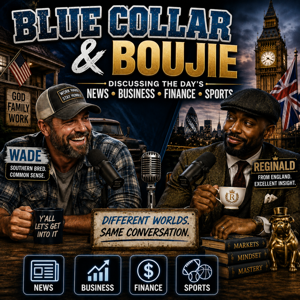
Blue Collar and Boujie
Wade sees it from the jobsite. Reginald “Boujie” Ashworth-Pryce sees it from the market.
Together, they follow the news, business,…
After the Bell puts Boujie behind the microphone after the market closes to explain what actually moved, why it moved, and what Wall Street may be missing.
Ground Truth gives Wade one consequential idea, number or claim from the week and lets him take the machine apart — the physical infrastructure, labor, incentives, regulations and real-world constraints hiding underneath the headline.
Then The Week brings them back together to work through the stories that mattered most, with enough time to disagree, follow the argument wherever it goes, and occasionally discover that both of them were looking at only half the picture.
Blue Collar and Boujie. Different worlds. Same conversation.
DISCLAIMER: Though they are both more intelligent than you, their intelligence is artificial.