
Sign up to save your podcasts
Or



Got something to say to this podcast? Send a voicemail, and you might hear yourself on the next episode!
l
Got something to say to this podcast? Send a voicemail, and you might hear yourself on the next episode!
David Armstrong and Richie Abel recorded brand new interviews at ASBMR 2026 in Boston, Massachusetts. In this seventh episode the lads chatted to three more guests.
Professor Ron Kwon (University of Washington) explains why his lab uses zebrafish to study genetic risk for osteoporosis. Ron describes a screen of more than 70 candidate genes in over 1,400 fish, and how a shared evolutionary history makes fish a useful model for human bone.
Associate Professor Monica Fornier (Memorial Sloan Kettering Cancer Center and Weill Cornell Medical College, New York) talks about receiving an ASBMR Travel Award. Monica describes a study of women with breast cancer who stopped aromatase inhibitors and denosumab together. Bone turnover markers and osteoclast precursor cells rose after stopping, then fell back towards baseline, with no spontaneous vertebral fractures so far.
Dr Aijaz Ahmad John (UMass Chan Medical School) talks about receiving an ASBMR Mid-Career Travel Award. Aijaz describes a novel microRNA that increased bone formation and reversed bone loss in mouse models of postmenopausal and age-related osteoporosis.
Join us for more interviews from the conference in the next part.
Got something to say to this podcast? Send a voicemail, and you might hear yourself on the next episode!
David Armstrong and Richie Abel recorded brand new interviews at ASBMR 2026 in Boston, Massachusetts. In this sixth episode the lads chatted to three more guests.
Professor Julien Paccou (University of Lille) presents a Bayesian meta-analysis of fracture risk with anti-obesity medications. Julien explains that the effect on bone depends on diabetes status, the type of drug and how much weight is lost. Losing more than about 7–10% of body weight may affect bone.
Dr Jackie Fretz (Yale School of Medicine) talks about receiving an ASBMR Mid-Career Travel Grant. Jackie describes how blood vessel cells in the bone marrow make FGF23 during anaemia, and how removing this source preserved bone mass.
Dr Tor Hildebrand (Lucid Concepts AG, Zurich, and INAM Forchheim) describes the sphere-fitting method for measuring trabecular thickness that he developed during his PhD at ETH Zurich. The paper has now been cited around 2,000 times. Tor also introduces XamFlow, a new platform for analysing large sets of images.
Join us for more interviews from the conference in the next part.
Got something to say to this podcast? Send a voicemail, and you might hear yourself on the next episode!
David Armstrong and Richie Abel recorded brand new interviews at ASBMR 2026 in Boston, Massachusetts. In this fifth episode the lads chatted to three more guests.
Professor Peter Ebeling (University of Toronto) reflects on the ASBMR pre-meeting session on bone quality, held 25 years after the 2001 NIH definition. Peter discusses evidence that exercise may improve bone quality and how 3D ultrasound may allow bone quality to be measured in patients.
Associate Professor Erica Scheller (Washington University in St. Louis) talks about receiving the 2026 Fuller Albright Award. Erica describes a newly discovered brain-to-bone pathway that removes all body fat, including the stable bone marrow adipocytes, within about nine days.
Dr Gillian Choquette (University of Maryland, Baltimore) explains how romosozumab had a blunted bone-forming effect in obese mice.
Join us for more interviews from the conference in the next part.
Got something to say to this podcast? Send a voicemail, and you might hear yourself on the next episode!
David Armstrong and Richie Abel recorded brand new interviews at ASBMR 2026 in Boston, Massachusetts. In this fourth episode the lads chatted to three more guests.
Dr Jude Bubbear (Royal National Orthopaedic Hospital) describes real-world data from the UK early access programme for burosumab in X-linked hypophosphataemia. Ten patients over 65 had reductions in pain and stiffness and improvements in quality of life.
Associate Professor Guillaume Mabilleau (Université d’Angers) explains how GLP-1 receptor agonists act on bone mainly through enzymatic collagen cross-linking. In animal models semaglutide also reduced grip strength even after adjusting for weight loss.
Nour El Houda Goucem (Professional Research Assistant, University of Colorado Anschutz) describes the genotyping, histology, DEXA and micro-CT work behind mouse studies of bone. Nour also explains how research experience is preparing her for medical school.
Join us for more interviews from the conference in the next part.
Got something to say to this podcast? Send a voicemail, and you might hear yourself on the next episode!
David Armstrong and Richie Abel recorded brand new interviews at ASBMR 2026 in Boston, Massachusetts. In this third episode the lads chatted to three more guests.
Professor Tony Keaveny (University of California, Berkeley, and O.N. Diagnostics) explains how biomechanical CT uses finite element analysis of existing CT scans to estimate bone strength and fracture risk.
Olivia White (PhD Candidate, Purdue University) describes how alcohol use disorder and type 2 diabetes combined produced the lowest bone mineral density and bone strength in a mouse model.
Gabrielle Dudek (PhD Student, University of Colorado Anschutz) discusses how formate and taurine supplementation improved bone size and structure in a mouse model of homocystinuria.
Join us for more interviews from the conference in the next part.
Got something to say to this podcast? Send a voicemail, and you might hear yourself on the next episode!
David Armstrong and Richie Abel recorded brand new interviews at ASBMR 2026 in Boston, Massachusetts. In this second episode the lads chatted to three more guests.
Professor Lora Giangregorio (University of Waterloo) gives practical advice on resistance, balance and impact exercise for bone health and on returning to exercise safely after a fracture.
Dr Prem Swaroop Yadav (Massachusetts General Hospital and Harvard Medical School) describes how activating PTH1R signalling improved bone growth in a mouse model of achondroplasia.
Yichi (Ella) Chen (PhD Candidate, University of Colorado Anschutz) explains how genetic studies in humans and mice suggest that early onset and age-related intervertebral disc degeneration have distinct genetic causes.
Join us for more interviews from the conference in the next part.
Got something to say to this podcast? Send a voicemail, and you might hear yourself on the next episode!
For the first time, BoneUP crosses the Atlantic.
David Armstrong and Richie Abel recorded brand new interviews at ASBMR 2026 in Boston, Massachusetts. In this first episode the lads chatted to three guests.
Professor Christopher Hernandez (University of California, San Francisco) explains how the gut microbiome influences the material properties of bone matrix in mice.
Dr Marie-Eva Pickering (University Hospital of Clermont-Ferrand) discusses how pain is phenotyped in fibrous dysplasia.
Melissa Cuevas (PhD Student, University of Colorado Anschutz) presents her work on the genetics of adolescent idiopathic scoliosis.
Join us for more interviews from the conference in the next part.
Got something to say to this podcast? Send a voicemail, and you might hear yourself on the next episode!
The lads sit down together and Richie interviews David about a career in osteoporosis care. David describes his move from lupus research to setting up the Fracture Liaison Service at the Western Trust in 2008. He explains how the service works and why advice to GPs, pharmacists and other specialists takes up much of a bone specialist's week. He also discusses the very high risk category in the National Osteoporosis Guideline Group guidance. David explains why romosozumab would be his first choice for these patients and why teriparatide is less convincing at the hip.
Prof David Armstrong is a Consultant Rheumatologist at the Western Trust in Londonderry and Visiting Professor at the Nutrition Innovation Centre for Food and Health at Ulster University. He built the Trust's Fracture Liaison Service in 2008 and still runs it. He is also a member of the National Osteoporosis Guideline Group.
Got something to say to this podcast? Send a voicemail, and you might hear yourself on the next episode!
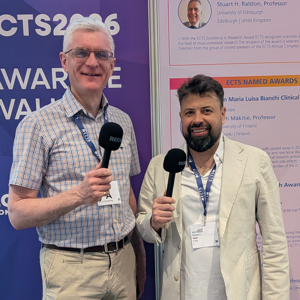
The lads jetted off to sunny Girona for the European Calcified Tissue Society Congress, where they caught up with some brilliant boneheads about the latest in bone research.
In Part 2, we chat to Stuart Ralston about the TOPAZ trial for Brittle Bone Disease, Emma Duncan about the ASBMR and ECTS Societies and Kass Javaid about his conference highlights.