
Sign up to save your podcasts
Or



A biography of Albert Einstein, focusing on his life and work, particularly his revolutionary theories of relativity. This book highlights the impact of Einstein's theories on our understanding of the world and universe. The book also explores the development of his groundbreaking theories, including special relativity, general relativity, and the famous equation E=mc², while discussing the scientific and personal challenges he faced throughout his life.
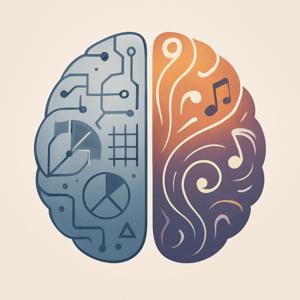
The Master and His Emissary by Iain McGilchrist argues that the human brain's two hemispheres operate in fundamentally different ways, with the left hemisphere favouring logic, language, and analysis, and the right hemisphere favouring intuition, emotion, and wholistic understanding. McGilchrist presents evidence from neuroscience and cultural history to support his thesis, suggesting that the Western world has become excessively reliant on the left hemisphere, leading to imbalances in the way we think, perceive, and interact with the world.
A book entitled "Hawking and Black Holes" by Paul Strathern. It is a biography of Stephen Hawking that explores his life and scientific work. The book focuses on Hawking’s early life, his diagnosis with Amyotrophic Lateral Sclerosis (ALS), his groundbreaking discoveries in cosmology and black hole theory, and the impact of his work on the scientific community. It also examines the ongoing pursuit of a "Grand Unified Theory" that would unify the fundamental forces of nature. The author highlights the complexities of Hawking’s scientific explorations and his ability to make significant contributions despite his physical limitations.
An in-depth biography of Archimedes that covers his life, education, scientific discoveries, and lasting impact on the world of mathematics and science. This book by Paul Strathern emphasise Archimedes' genius, his ability to combine theoretical knowledge with practical application, and the enduring importance of his work.
A detailed exploration of the historical journey leading to the discovery of DNA's structure by Francis Crick and James Watson, highlighting the key individuals and events that contributed to this breakthrough. Paul Strathern book begins by examining the earlier stages of genetic research, starting with ancient observations and culminating with Gregor Mendel's groundbreaking work on inheritance. It then dives into the complex interplay of scientific contributions, rivalries, and individual personalities that shaped the race to discover DNA's structure, culminating in Crick and Watson's triumph in 1953. The text concludes with a reflection on the profound implications of this discovery for our understanding of life and the ethical dilemmas that arise from our growing ability to manipulate the very building blocks of life.
Isaac Asimov’s The Golden Door, the last episode in the series, chronicles the history of the United States from the end of the American Civil War to the outbreak of World War I. Asimov explains the turbulent period of Reconstruction and the various challenges facing the nation, including the struggles for civil rights for newly freed slaves, the rise of corruption and industrialisation, and the emergence of a powerful nation on the global stage. The text further details the development of US foreign policy, examining key events such as the purchase of Alaska and the Spanish-American War. The author concludes by exploring the rise of progressivism and the challenges of integrating large numbers of immigrants into American society.
Isaac Asimov's Our Federal Union explores the political and social landscape of the United States between 1816 and the outbreak of the Civil War. Asimov details the growing tensions between the North and South, particularly concerning slavery and the expansion of the Union. He examines crucial events such as the founding of the Second Bank of the United States, the Nullification Crisis, the annexation of Texas, and the Mexican-American War. Asimov highlights key figures of the period, including Andrew Jackson, John C. Calhoun, Henry Clay, and Daniel Webster, and describes the rise of Abraham Lincoln as a national figure. Ultimately, the book explains the seeds of conflict that eventually led to the American Civil War, emphasising the irresolvable differences between the North and South on the question of slavery.
Isaac Asimov's The Birth of the United States, which explores the period from 1763 to 1816, details the events leading to the American Revolution and the formation of the United States as a nation. The text chronicles the growing tension between the British colonies and the British crown over taxation and representation, culminating in the American Revolution. Asimov further describes the early years of the United States under its new constitution, focusing on key figures, landmark events, and the formation of political parties. He concludes by discussing the War of 1812, which reaffirmed the independence of the United States.
A historical account of the colonisation of North America, from the arrival of the first native peoples through to the French and Indian War. The text focuses on the motivations and actions of various European powers, including the Vikings, the Spanish, the Portuguese, the Dutch, the English, and the French, as they explored and established colonies across the continent. The text highlights the impact of religious conflict, economic competition, and shifting power dynamics on the development of North America during this crucial period.
From the publisher's feed
If you enjoy this podcast and would like to support its production, you can contribute via PayPal at: paypal.me/AVillavicencioUsbeck