Breaking Walls

Breaking Walls

By James ScullyHistory
Download on the App Store

Breaking Walls episodes

  • BW - EP125—009: March 1954—The 1954 Tony Awards on NBC with Audrey Hepburn
    The eighth-annual Antoinette Perry Awards for Excellence in Broadway Theatre were held at the Plaza Hotel’s Grand Ballroom on March 28th, 1954. Broadcast on radio by NBC, it was emceed by Ben Grauer and Faye Emerson.
    ____________
    The entire post-dinner awards ceremony took thirty minutes. Some of the plays and musicals of note that season were Ondine, Kismet, Can-Can, The Teahouse of The August Moon, and John Murray Anderson's Almanac.
    ____________
    Dolores Grey won a Tony for Carnival in Flanders, even though this Broadway musical ran for only six performances. It’s a still-standing record for the briefest run by a Tony winner.
    ____________
    This was David Wayne's second and final Tony award. He would appear in numerous films and TV, including starring alongside Paul Muni in the 1959 film, The Last Angry Man.
    ____________
    1954 was a banner year for the twenty-five year old Audrey Hepburn. Three days earlier she won a Best Actress Oscar for her starring role in Roman Holiday. She’d also won a Golden Globe for the same film. In September, Sabrina would premiere, for which she was again Oscar nominated the following year.
    14 min
  • BW - EP125—008: March 1954—Frank And Bing Sing After Frank's Oscar Win
    By March of 1954 Bing Crosby’d been in the public eye for more than two decades. He had numerous hit records, and won an Oscar for best actor in Going My Way in 1944.
    On Radio, Bing helped usher in primetime transcription with Philco in 1946. Crosby had been on CBS radio since 1949 and sponsored by General Electric since 1952. He was reluctant to star in a regular TV show, fearing overexposure.
    The 1954 Academy Awards were held on March 25th. That same day, RCA announced the first color television set. It was a twelve-inch screen, priced at one-thousand dollars, or roughly ten grand today.
    On the Sundays bookending those awards, Frank Sinatra was a guest on Bing’s program. Frank would win a Best Supporting Actor Oscar for Maggio in From Here to Eternity. On this latter program from March 28th, Frank talks and jokes about his experience. The two are in rare form, especially with a trio of songs.
    The series ended on May 30th, 1954. With radio audiences in steep decline, Crosby decided against a weekly radio show with expensive guest stars and a twenty-two piece orchestra.
    Bing’s son Gary took over the timeslot in June for thirteen weeks. In November 1954, Bing returned to the airwaves with a weeknight fifteen-minute program. He spoke about all manner of different subjects and usually included three songs. Broadcasting Magazine estimated the production cost to be twenty-seven hundred dollars per episode.
    20 min
  • BW - EP125—007: March 1954—Escape's Violent Night
    In March of 1954, Escape was still airing on CBS. Although it was frequently dropped and moved around the network schedule, it was popular and cheap enough to consistently come back.
    During its heyday, Escape was produced and directed by William N. Robson and Harry Bartell was a frequently featured actor. Les Crutchfield often penned scripts for the series. Escape’s original assistant director was Norman Macdonnell. He later became famous for being at the helm of Gunsmoke.
    The two-hundred eighteenth episode was entitled “Violent Night.” It starred William Conrad, with Joyce McCluskey as Maria, as Don Diamond as Alceran. Ben Wright, Edgar Barrier, Michael Ann Barrett, Dick Beals, and Byron Kane were also featured.
    As good as Escape was, the writing was on the wall. With no sponsorship forthcoming, the last episode would air on September 25th, 1954.
    20 min
  • BW - EP125—006: March 1954—John Lund and The End of the Expense Account For Johnny Dollar?
    Often written by the just-heard E. Jack Neuman, the fourth actor to voice Johnny Dollar, John Lund, grabbed the role in November of 1952.
    Lund had starred with Olivia De Havilland in To Each His Own, Marlene Dietrich in A Foreign Affair, and Betty Hutton in The Perils of Pauline.
    In spite of radio’s falling ratings, in March of 1953, Wrigley’s gum signed on to sponsor the show. On Tuesdays at 9PM, Dollar peaked in May with a 7.3 rating. Among the writers who contributed scripts along with E. Jack Neuman, were Les Crutchfield, Blake Edwards, Gil Doud, Morton Fine, and David Friedkin.
    On March 8th, 1954 Dollar’s expense account took him to southeast Asia. Wrigley sponsored Dollar until August. Lund’s last episode was “The Upjohn Matter,” on September 19th.
    It seemed that like many other radio shows, Johnny Dollar’s time on the air was coming to an unremarkable end. However the show would be revived the following year.
    Bob Bailey would star and Jack Johnstone would direct. For more information on Bob Bailey’s run as Johnny Dollar, tune into Breaking Walls episode 102.
    16 min
  • BW - EP125—005: March 1954—Phil Harris and Alice Faye Tell Us It Pays To Be Married
    It Pays To Be Married was a daytime game show in which married couples told stories of obstacles they overcame to build a healthier relationship. They were later quizzed for cash and prizes. Hosted by Jay Stewart, it first came to Mutual’s airwaves on September 28th, 1953.
    On March 8th, 1954 the celebrity guests were Phil Harris and Alice Faye.
    By 1954 Harris and Faye were national icons. After years on Jack Benny’s and later his own program, Phil Harris’ character was one of the most established in the entertainment business. However, The Harris and Faye show’s rating that season was under 3.3. With radio on its way out, NBC cancelled their program at the end of the season. The last episode aired on June 18th, 1954.
    It Pays To Be Married would shift to NBC before being cancelled in October of 1955.
    17 min
  • BW - EP125—004: March 1954—You Bet Your Life
    You Bet Your Life, conceived by John Guedel and hosted by comedian Groucho Marx, debuted over ABC’s airwaves on October 27th, 1947.
    Three couples were brought onstage to be interviewed and quizzed by Groucho. Each couple was given twenty dollars and told to bet as much as they dared risk on four questions from a category of their choosing. The money would double with each successive step. Couples could win three-hundred twenty dollars, go broke on the first question, or finish anywhere in between.
    The couple with the largest money total got a chance at the jackpot question, worth at least one-thousand dollars. There was also a “secret word” each week, with bonus money to be divided if someone said the word while the show was on the air.
    Although 1947 was radio’s highest-rated season, the quiz show aired against NBC’s Mr. District Attorney on Wednesdays at 9:30. At season’s end You Bet Your Life only pulled a rating of thirteen.
    Groucho felt uncomfortable trying to be funny on a live radio show. Guedel’s answer was to record the show, which allowed Groucho to relax. The program could then be edited for time later. The idea worked. The show moved to CBS in 1949. You Bet Your Life became Network Radio’s top-rated quiz show, finishing the season in eleventh place overall.
    The show eventually signed a sponsorship contract with DeSoto-Plymouth of Chrysler for four million dollars over ten years. It also moved the show to NBC Radio and TV beginning on October 4th, 1950.
    The program remained a top-ten hit into 1954. That March it was airing on radio Wednesday evenings at 9PM. The March 10th episode’s secret word was “street.”
    You Bet Your Life aired on NBC radio until September 19th, 1956. The original TV series ran until 1961.
    14 min
  • BW - EP125—003: March 1954—Cathy and Elliott Lewis Can’t Fight City Hall in On Stage
    As radio audiences left for TV, Elliott Lewis continued to champion radio as a stronger dramatic medium. On Thursday January 1st, 1953, he and wife Cathy, debuted a new dramatic anthology program over CBS. It was On Stage.
    On Stage was geared for adults, showcasing an eclectic array of scripts across multiple genres. To get the show off the ground, the Lewis’ tabbed some of the best writers in radio, like E Jack Neuman.
    Stories would be rooted in powerful male-female situations, with two characters of equal strength being a main goal. They used a mix of classic and original tales, cutting across all dramatic disciplines with mysteries, adventures, melodramas, satires, and comedy.
    Cathy was the perfect female foil, not just because she was Elliott’s wife, but because she was a superb actress. By then the west-coast’s character actors were like a family. A frequent co-star was Byron Kane. Ray Noble, Fred Steiner, and Lud Gluskin’s music beautifully fit the production. Ross Murray and Berne Surrey’s sound patterns were exceptional.
    The March 10th, 1954 episode was called “The Crusade of Stanley Finston.”
    On Stage came at a bittersweet time in Cathy and Elliott lives. Even as CBS referred to them as Mr. and Mrs. radio, their marriage of ten years was in trouble.
    Cathy and Elliott divorced in 1958. Elliott would soon marry another noted actress Mary Jane Croft.
    For more information on Elliott Lewis’ career, tune into Breaking Walls episode 113.
    19 min
  • BW - EP125—002: March 1954—The 1954 Democratic Convention with Adlai Stevenson
    On March 6th, 1954, 1952’s Democrat Presidential nominee, Adlai Stevenson gave a dinner speech at the Florida DNC.
    In 1952 Stevenson was a heavy underdog against Dwight Eisenhower. He carried only nine states, but did get more than forty-four percent of the popular vote.
    He was quick to lash out at the McCarthy driven political state of affairs. There were many who feared the Red Scare would destroy the country, and the divisions felt between Americans were so deep, they might never be repaired.
    Stevenson would again receive the Democrat nomination in 1956. He’d lose, this time carrying only seven states and receiving forty-two percent of the popular vote.
    11 min
  • BW - EP125—001: March 1954—Edward R. Murrow Brings The News. Perry Mason Busts The Syndicate
    As the United States entered March 1954, U.S. officials announced a successful hydrogen bomb test, while four Puerto Rican nationalists opened fire in the House of Representatives chamber. Five were wounded.
    On March 9th, Edward R. Murrow’s news team produced a CBS See It Now episode, “A Report on Senator Joseph McCarthy." They used excerpts from McCarthy's own speeches to point out his contradictions. Murrow and head of CBS News Fred W. Friendly paid for the program’s marketing. CBS wouldn’t allow the team to use the company logo.
    The broadcast provoked thousands of letters, telegrams, and phone calls to CBS headquarters. They ran fifteen-to-one in favor of Murrow’s sentiment.
    McCarthy went on the program to reject Murrow's criticism. He said, “Ordinarily, I wouldn’t take time out from important work to answer Murrow. However, in this case I feel justified because Murrow is a symbol, a leader, and the cleverest of the jackal pack that’s always found at the throat of anyone who dares to expose individual Communists and traitors.”
    The rebuttal served only to further decrease McCarthy’s already fading popularity. However, his Army hearings were set to convene on March 16th. They would help emphasize the fact that the United States of America, like the radio industry itself, was during this year, in a state of turmoil. Unlike Howard Hughes though, tonight we will talk about it.
    ———————————————————————————
    Airing weekdays at 2:15PM over WCBS in New York was Perry Mason. The show debuted on October 18th, 1943.
    Mason was a crime-busting lawyer. It often featured the just-heard Mandel Kramer. On March 1st, Mason, who was voiced by John Larkin, and Della Street, voiced by Claudia Morgan, wondered who was behind an underworld syndicate.
    While Perry Mason’s directors were men like Carlo DeAngelo and Carl Eastman, women were as likely to be in the mid-day director’s chair as men, and they often exuded confidence that put fear into young radio actors.
    By 1954 Mason’s cast had greatly expanded. On radio, he was as much a detective as a lawyer. The version Raymond Burr played on TV was markedly different. The radio version of Perry Mason ran until December 30th, 1955. Mandel Kramer could be seen starring in The Edge of Night.

    35 min

About Breaking Walls

From the publisher's feed

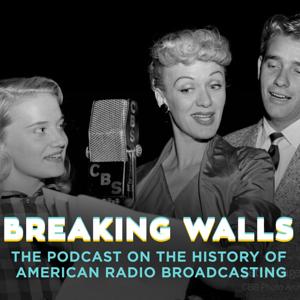
Breaking Walls: The Podcast on the History of American Network Radio Broadcasting.

More shows like Breaking Walls

Stuff You Should Know by iHeartPodcasts

Stuff You Should Know

78,328 Listeners

The Great Detectives of Old Time Radio| Daily Mystery Dramas by Adam Graham|Old Time Radio Detective Host

The Great Detectives of Old Time Radio| Daily Mystery Dramas

1,941 Listeners

Down These Mean Streets (Old Time Radio Detectives) by Mean Streets Podcasts

Down These Mean Streets (Old Time Radio Detectives)

1,058 Listeners

The Dana Gould Hour by Dana Gould

The Dana Gould Hour

2,024 Listeners

Gilbert Gottfried's Amazing Colossal Podcast by Gilbert Gottfried's Amazing Colossal Podcast

Gilbert Gottfried's Amazing Colossal Podcast

3,934 Listeners

This Day in Jack Benny by John Henderson

This Day in Jack Benny

392 Listeners

Stars on Suspense (Old Time Radio) by Mean Streets Podcasts

Stars on Suspense (Old Time Radio)

448 Listeners

Pod Save America by Pod Save America

Pod Save America

87,095 Listeners

The Daily by The New York Times

The Daily

111,809 Listeners

The Mysterious Old Radio Listening Society by Ghoulish Delights

The Mysterious Old Radio Listening Society

353 Listeners

Conan O’Brien Needs A Friend by Team Coco & Earwolf

Conan O’Brien Needs A Friend

59,416 Listeners

Literally! With Rob Lowe by Stitcher & Team Coco, Rob Lowe

Literally! With Rob Lowe

12,405 Listeners

Choice Classic Radio Detectives | Old Time Radio by Choice Classic Radio

Choice Classic Radio Detectives | Old Time Radio

201 Listeners

The Weekly Show with Jon Stewart by Comedy Central

The Weekly Show with Jon Stewart

10,711 Listeners

Real Survival Stories by NOISER

Real Survival Stories

1,327 Listeners