Breaking Walls

Breaking Walls

By James ScullyHistory
Download on the App Store

Breaking Walls episodes

  • BW - EP124: February 1954—Benny, McCarthy, and McCarthy
    In Breaking Walls episode 124 we pick up our 1954 mini series in February. We’ll focus on radio programming and national news from that month.
    ——————————
    Highlights:
    • Radio Billings Are Down. Now What?
    • Dragnet—Still Going Strong
    • Lee Deforest and The Hallmark Hall of Fame
    • Americana
    • Jack Benny Turns 39? 40? 60?
    • Guest Star and The McCarthy News
    • The College Quiz Bowl
    • Mr and Mrs North
    • Polio
    • Stars Over Hollywood
    • Ending with Bergen and McCarthy
    • Looking Ahead to March with Edward R. Murrow
    ——————————
    The WallBreakers:
    http://thewallbreakers.com
    Subscribe to Breaking Walls everywhere you get your podcasts.
    To support the show:
    http://patreon.com/TheWallBreakers
    ——————————
    The reading material used in today’s episode was:
    • On the Air — By John Dunning
    • Network Radio Ratings — by Jim Ramsburg
    As well as articles from
    • Broadcasting Magazine
    • LIFE Magazine
    ——————————
    On the interview front:
    • Jack Benny, Frank Nelson, and Don Wilson spoke to Chuck Schaden. Hear their full chats at SpeakingOfRadio.com.
    • Jack Benny also spoke for Great Radio Comedians in 1972.
    • Harry Bartell, Himan Brown, Lilian Buyeff, Bill Froug, Virginia Gregg, Lou Krugman, and Peggy Webber were with SPERDVAC. For more information, go to SPERDVAC.com
    • Hans Conried and Edgar Bergen spoke with Dick Bertel and Ed Corcoran for WTIC’s The Golden Age of Radio. Hear this full interview at Goldenage-wtic.org.
    • Dennis Day spoke with John Dunning for his 71KNUS program from Denver.
    • Lee Deforest spoke at the 1939 World’s Fair in New York.
    ——————————
    Selected music featured in today’s episode was:
    • Sh-Boom — By The Crewcuts
    • Serious Serenade — By Duke Ellington
    ——————————
    A special thank you to Ted Davenport, Jerry Haendiges, and Gordon Skene.
    For Ted go to RadioMemories.com, for Jerry, visit OTRSite.com, and for Gordon, please go to PastDaily.com.
    ——————————
    Thank you to:
    Tony Adams
    Steven Allmon
    Orson Orsen Chandler
    Phil Erickson
    Jessica Hanna
    Briana Isaac
    Thomas M. Joyce
    Ryan Kramer
    Gary Mollica
    Barry Nadler
    Christian Neuhaus
    Aimee Pavy
    Ray Shaw
    ——————————
    WallBreakers Links:
    Patreon - patreon.com/thewallbreakers
    Social Media - @TheWallBreakers

    2 hr 14 min
  • BW - EP124—011: February 1954—Looking Ahead To March
    Well, that brings February to a close, but for many of these topics, we’ve only just begun. Next time on Breaking Walls, it’s March of 1954, and Senator Joseph McCarthy’s four-year anti-communist tirade begins to come to a head.
    ——————————
    The reading material used in today’s episode was:
    • On the Air — By John Dunning
    • Network Radio Ratings — by Jim Ramsburg
    As well as articles from
    • Broadcasting Magazine
    • LIFE Magazine
    ——————————
    On the interview front:
    • Jack Benny, Frank Nelson, and Don Wilson spoke to Chuck Schaden. Hear their full chats at SpeakingOfRadio.com.
    • Jack Benny also spoke for Great Radio Comedians in 1972.
    • Harry Bartell, Himan Brown, Lilian Buyeff, Bill Froug, Virginia Gregg, Lou Krugman, and Peggy Webber were with SPERDVAC. For more information, go to SPERDVAC.com
    • Hans Conried and Edgar Bergen spoke with Dick Bertel and Ed Corcoran for WTIC’s The Golden Age of Radio. Hear this full interview at Goldenage-wtic.org.
    • Dennis Day spoke with John Dunning for his 71KNUS program from Denver.
    • Lee Deforest spoke at the 1939 World’s Fair in New York.
    ——————————
    Selected music featured in today’s episode was:
    • Sh-Boom — By The Crewcuts
    • Serious Serenade — By Duke Ellington
    ——————————
    A special thank you to Ted Davenport, Jerry Haendiges, and Gordon Skene.
    For Ted go to RadioMemories.com, for Jerry, visit OTRSite.com, and for Gordon, please go to PastDaily.com.
    ——————————
    Thank you to:
    Tony Adams
    Steven Allmon
    Orson Orsen Chandler
    Phil Erickson
    Jessica Hanna
    Briana Isaac
    Thomas M. Joyce
    Ryan Kramer
    Gary Mollica
    Barry Nadler
    Christian Neuhaus
    Aimee Pavy
    Ray Shaw
    ___________
    WallBreakers Links:
    Patreon - patreon.com/thewallbreakers
    Social Media - @TheWallBreakers
    5 min
  • BW - EP124—010: February 1954—Ending With Bergen And McCarthy
    Airing on CBS since 1949, Edgar Bergen’s 1954 Sunday at 9:30PM eastern rating was 4.7, twelfth overall. His show was sponsored by Lanolin Plus. On February 28th, the celebrity guests were the husband-wife duo June Allyson and Dick Powell.
    In the fall, Bergen’s show would go back to sixty minutes. It would air for two more seasons before Bergen wrapped up his radio run on July 1st, 1956.
    Bergen did little TV. He was a radio man, even though his art was primarily visual. With Charlie and Mortimer, he emceed the 1956 CBS audience show Do You Trust Your Wife?, and he made numerous guest appearances on TV variety shows of the 1950s. He later appeared in films such as The Phynx, Won Ton Ton, the Dog Who Saved Hollywood, and The Muppet Movie.
    13 min
  • BW - EP124—009: February 1954—Stars Over Hollywood
    Stars over Hollywood broke one of radio's strongest prejudices: That Saturday daytime was a programming wasteland.
    When Paul Pierce, CBS production superintendent on the West Coast, announced plans to launch a star-packed dramatic series on Saturday morning, few observers gave it a chance. Getting movie stars to cooperate at 9:30 AM would be impossible, and no one would listen anyway.
    The stories were generally light comedies. The set was loose and informal; the dress code casual. Occasionally the stars arrived in bathrobes and pajamas. Ivan Ditmars, musical director, used three instruments: the organ, harp, and violin, and sounded more like a small combo than a one-man show.
    Stars over Hollywood ran for thirteen years in the same time slot, with only two changes in sponsor. This season had a rating of 5.5, first overall for daytime weekend programs. On February 27th, 1954, Barry Sullivan guest-starred in “The Hundred Dollar Bill.”
    9 min
  • BW - EP124—008: February 1954—Polio and Its Vaccine
    During 1952 and 1953, the U.S. experienced an outbreak of roughly ninety-five thousand polio cases, with a death count of over forty-six hundred. Millions of dollars were invested in finding a vaccine.
    The first effective polio vaccine was developed in 1952 by Jonas Salk and a team at the University of Pittsburgh. On March 26th, 1953 Salk went on CBS radio to report the first round of successful tests. Beginning on February 23rd, 1954, the vaccine was tested at Arsenal Elementary School and the Watson Home for Children in Pittsburgh, Pennsylvania.
    Jonas Edward Salk was born October 28, 1914 in New York City, the eldest son to Russian-Jewish immigrants. He earned a medical degree from the NYU School of Medicine in 1939 and became a doctor at Mount Sinai Hospital.
    In 1942, Salk went to the University of Michigan to develop a Flu vaccine. He soon became assistant professor of epidemiology. Five years later he was appointed director of the Virus Research Laboratory at the University of Pittsburgh School of Medicine. His main mission: develop a polio vaccine.
    Salk believed his vaccine, composed of “killed” polio virus, could immunize without risk of infecting the patient. Salk gave the vaccine to volunteers who had not had polio. All developed polio antibodies and experienced no reaction to the vaccine.
    In 1954, national testing began on one million children. But, in April 1955, soon after mass vaccination began in the US, some patients contracted the disease after being vaccinated. These vaccines were manufactured by the Cutter Pharmaceutical Company. In response, the Surgeon General yanked all polio vaccines made by Cutter Laboratories from the market.
    Soon, the Wyeth polio vaccine was also reported to have paralyzed and killed several children. It was discovered that some vaccines made by Cutter and Wyeth had not been properly inactivated, allowing live poliovirus into more than 100,000 doses.
    The next month, the National Institutes of Health and Public Health Services established a Technical Committee to review all polio vaccine lots. The problem was quickly remedied.
    In the two years before the vaccine the average number of polio cases in the U.S. was more than forty-five thousand. By 1962, that number had dropped to nine-hundred ten. Jonas Salk purposely never patented the vaccine or earned any money from his discovery.
    6 min
  • BW - EP124—007: February 1954—On a Cruise With Mr and Mrs. North
    When Mr and Mrs North took to the air on Tuesday February 23rd at 8:30PM for CBS, it had radio’s sixth-highest overall rating. With a 6.1 it topped Dragnet, which aired in direct competition on NBC.
    Jerry and Pam North were average people who managed to solve murders. Jerry, played by Richard Denning, was a book publisher. Pam, played by Barbara Britton, was a housewife who loved cats, liked to play cupid, and somehow found her way to a killer’s identity. Neither was trained in any science of deduction, they were just intelligent, with a highly communicative marriage.
    The February 23rd episode was called “Winter Honeymoon.” Mr and Mrs North would air until April 18th, 1955.
    9 min
  • BW - EP124—006: February 1954—The College Quiz Bowl
    Originating as a USO activity created by Canadian Don Reid for World War II soldiers, The College Quiz Bowl was developed into a radio show by Reid and John Moses. It debuted on NBC in the fall of 1953. Two teams of All-American Varsity students from different universities competed for prizes and recognition.
    On Sunday, February 21st, 1954 at 6PM eastern time, the ladies of Smith College defended their title against the men of Washington and Lee University.
    Washington and Lee would win this evening and defend their title for five consecutive weeks until losing to Syracuse on March 28th.
    The College Quiz Bowl moved to CBS TV in 1955. In 1963 it moved to NBC where it remained on the air until 1970. Various non-televised versions of this competition continued to air into the 21st Century. In November of 2020 NBC announced a revival of the show. It premiered on June 22nd, 2021.
    11 min
  • Building To NBC's Monitor
    This is a snippet from Breaking Walls Episode 116: The Launch of NBC’s Monitor (1955)
    ___________
    With Monitor announced, a huge facility was being built on the fifth floor of 30 Rockefeller Plaza. It would be called Radio Central. NBC’s next steps were to identify key personalities to be featured. Jim Fleming was named executive producer.
    In a memo he detailed why the name “Monitor” was chosen. During the war, newsmen monitored the short-waves for information, now they’d be monitoring the entire country and NBC’s network. The name suggested alertness, service, vigilance, and a sense of responsibility. These men and women wouldn’t be announcers, they’d be “communicators.”
    One radio veteran in the fold was Ben Grauer. Born in New York in 1908, he was a child actor who became an NBC staff announcer in 1930. Grauer covered olympic games, announced for Walter Winchell’s Jergen’s Journal, and was hand selected by Arturo Tuscani to support NBC’s Symphony Orchestra. By World War II he was a senior commentator and reporter.
    Communicators would be drawn from a wide-pool of talent and paired. Some of the people suggested were Alene Francis, Morgan Beatty, Hugh Downs, Red Barber, Goodman & Jane Ace, Fred Allen, Bob Trout, Faye Emerson, Bob & Ray, Frank Blair, Burgess Meredith, Boris Karloff, Bennett Cerf, and Dave Garroway.
    Garroway was a radio veteran and jazz hound who had an unusual, homespun way of talking to his audience. He’d entered TV in 1949 with Garroway At Large. As he mentioned earlier, he’d been hosting Today since January of 1952. But Garroway initially wanted no part of Monitor. However, Pat Weaver asked him personally, and Garroway trusted Weaver implicitly. He agreed.
    On Monday May 2nd, the network produced a closed circuit practice hour. With the format all but set, it was time for a soft launch.
    13 min
  • The Story Behind The Radio Rise Of Bill Froug
    This is a snippet from Breaking Walls Episode 115: The CBS Radio Workshop (1956 - 1957)
    ___________
    William Froug was born on May 26th, 1922 in Brooklyn, New York. He was adopted, and grew up first in Little Rock, Arkansas and then Tulsa, Oklahoma. He graduated from the Missouri School of Journalism in 1943 before enlisting in the U.S. Navy. After he was discharged in 1946, he found himself living with friend and fellow writer, E. Jack Neuman.
    In 1948 and 49 he freelanced for CBS’ west-coast network, writing scripts for Rocky Jordan, Jeff Regan, and The Whistler. Froug spent the early 1950s in charge of the Hallmark Hall of Fame. The show began in the 1940s as Radio Reader’s Digest before rebranding as The Hallmark Playhouse until 1953.
    With radio audiences leaving in droves for TV, the sponsor abruptly changed format on February 8th, 1953. They brought in Lionel Barrymore to host true stories of Americana. When Barrymore passed away in 1954, The Hall of Fame dedicated their November 21st show to his memory.
    Unfortunately, by March of 1955 fewer and fewer network shows were sponsored. Hallmark canceled the show. However, In 1955 there were fifteen million radio sets produced, the most since 1948. There were now nearly 150 million radio sets in the U.S. Out of home listening now equaled TV viewing. During primetime hours, auto listeners added an additional forty percent to at-home radio audiences. CBS wasn’t ready to give up on radio drama just yet. In January, they’d launch three new shows: Indictment, Fort Laramie, and a revived CBS Radio Workshop.
    14 min

About Breaking Walls

From the publisher's feed

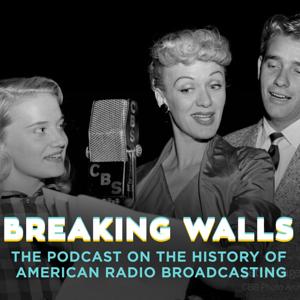
Breaking Walls: The Podcast on the History of American Network Radio Broadcasting.

More shows like Breaking Walls

Stuff You Should Know by iHeartPodcasts

Stuff You Should Know

78,328 Listeners

The Great Detectives of Old Time Radio| Daily Mystery Dramas by Adam Graham|Old Time Radio Detective Host

The Great Detectives of Old Time Radio| Daily Mystery Dramas

1,941 Listeners

Down These Mean Streets (Old Time Radio Detectives) by Mean Streets Podcasts

Down These Mean Streets (Old Time Radio Detectives)

1,058 Listeners

The Dana Gould Hour by Dana Gould

The Dana Gould Hour

2,024 Listeners

Gilbert Gottfried's Amazing Colossal Podcast by Gilbert Gottfried's Amazing Colossal Podcast

Gilbert Gottfried's Amazing Colossal Podcast

3,934 Listeners

This Day in Jack Benny by John Henderson

This Day in Jack Benny

392 Listeners

Stars on Suspense (Old Time Radio) by Mean Streets Podcasts

Stars on Suspense (Old Time Radio)

448 Listeners

Pod Save America by Pod Save America

Pod Save America

87,095 Listeners

The Daily by The New York Times

The Daily

111,809 Listeners

The Mysterious Old Radio Listening Society by Ghoulish Delights

The Mysterious Old Radio Listening Society

353 Listeners

Conan O’Brien Needs A Friend by Team Coco & Earwolf

Conan O’Brien Needs A Friend

59,416 Listeners

Literally! With Rob Lowe by Stitcher & Team Coco, Rob Lowe

Literally! With Rob Lowe

12,405 Listeners

Choice Classic Radio Detectives | Old Time Radio by Choice Classic Radio

Choice Classic Radio Detectives | Old Time Radio

201 Listeners

The Weekly Show with Jon Stewart by Comedy Central

The Weekly Show with Jon Stewart

10,711 Listeners

Real Survival Stories by NOISER

Real Survival Stories

1,327 Listeners