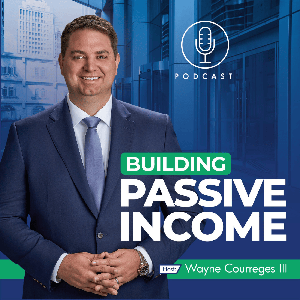
Building Passive Income

Building Passive Income

By Wayne Courreges III & CREI CollinBusinessEducationSelf-ImprovementInvesting
Download on the App Store

Building Passive Income episodes

  • Episode 31: LLC VS. LP – How Syndications Are Legally Structured
    Welcome to Building Passive Income with CREI Collin

    Confused about the difference between an LLC and an LP? In this episode, CREI Collin breaks down the two most common legal structures for real estate syndications. You’ll learn what each entity type is, how they differ, why sponsors choose one over the other, and what it means for you as a passive investor. Whether you’re reviewing your first deal or your tenth, understanding the legal structure isa critical part of due diligence.

    Read More
    17 min
  • Episode 30: Distributions 101 – When & How You Get Paid
    Welcome to Building Passive Income with CREI Collin

    When do I actually get paid? In this episode, CREI Collin breaks down distributions—the two types (cash flow and proceeds), how distribution frequency works, what affects distribution amounts, how proceeds distributions work at a sale or refinance, and how to evaluate whether a deal’s

    Read More
    18 min
  • Episode 29: Capital Calls & Reserve Funds – What Happens When A Deal Needs More Money?
    Welcome to Building Passive Income with CREI Collin

    What happens if the deal runs out of money? In this episode, CREI Collin breaks down capital calls and reserve funds—what they are, why they happen, how sponsors should handle them, and what your rights and options are as a limited partner. Learn how to reduce capital call risk by investing with sponsors who prioritize conservative underwriting and adequate reserves.

    Read More
    19 min
  • Episode 27: GP VS. LP Economics – Who Gets Paid What & When
    Welcome to Building Passive Income with CREI Collin

    If the LP puts up 95% of the money, why does the GP get 20-30% of the profits? In this episode, CREI Collin breaks down GP versus LP economics, explaining what each party contributes, how compensation is structured, and how to evaluate whether a deal’s

    Read More
    17 min
  • Episode 26: Understanding Equity Waterfalls – How Profits Are Split
    Welcome to Building Passive Income with CREI Collin

    Confused about how profits are split in a real estate syndication? In this episode, CREI Collin breaks down equity waterfalls—the formula that determines who gets paid, when, and how much. Learn what a waterfall is, the most common structures, cumulative vs. non-cumulative preferred returns, and how to evaluate whether a waterfall is fair and investor-friendly.

    Read More
    19 min
  • Episode 25: Cash Flow vs. Appreciation – Understanding Return Profiles with Tax Pro Tina
    Welcome to Building Passive Income with CREI Collin and Tax Pro Tina

    Cash flow or appreciation—which is better? CREI Collin and Tax Pro Tina break down the two components of syndication returns, how they’re taxed differently, and how to build a portfolio that balances both strategies. Learn when to prioritize cash flow, when to focus on appreciation, and how to match your investments to your life stage and tax situation.

    Read More
    19 min
  • Episode 24: The Different Types Of Real Estate Syndications – Which One Is Right For You?
    Welcome to Building Passive Income with CREI Collin

    Not all syndication deals are created equal. CREI Collin breaks down the four main types of real estate syndications—Core/Core-Plus, Value-Add, Opportunistic, and Development—and explains the risk-return spectrum. Learn how to match syndication types to your goals, risk tolerance, and timeline, and how to build a diversified portfolio across deal types.

    Read More
    14 min
  • Episode 23: The Anatomy Of A Syndication Deal – From Acquisition To Exit
    Welcome to Building Passive Income with CREI Collin
    Ever wonder what happens behind the scenes from the moment you invest to the day you receive your exit proceeds? CREI Collin walks through the entire lifecycle of a syndication deal—all six phases from acquisition to exit. Learn what the sponsor is doing at each stage, what can go wrong, and how to evaluate deals at every phase.
    What You'll Learn
    The six phases of every syndication deal lifecycle
    How sponsors source and underwrite deals before you ever see them
    The due diligence and financing process (30-90 days)
    What happens at closing and how your money is deployed
    The stabilization phase: where execution risk shows up
    Cash flow and hold period management
    The exit and disposition process
    What can go wrong at each phase and how to evaluate progress
    Key Topics Covered
    Phase 1: Deal Sourcing and Underwriting – Building the financial model
    Phase 2: Due Diligence and Financing – Validating assumptions and securing capital
    Phase 3: Acquisition and Closing – Officially becoming a limited partner
    Phase 4: Stabilization and Value-Add Execution – Where execution risk is highest
    Phase 5: Cash Flow and Hold Period – Operations and distributions
    Phase 6: Exit and Disposition – Timing the sale and returning capital
    Timestamps
    [00:00] Introduction: From investment to exit
    [02:00] Phase 1: Deal Sourcing and Underwriting
    [04:30] Phase 2: Due Diligence and Financing
    [07:00] Phase 3: Acquisition and Closing
    [08:30] Phase 4: Stabilization and Value-Add Execution
    [11:00] Phase 5: Cash Flow and Hold Period
    [13:00] Phase 6: Exit and Disposition
    [14:30] What can go wrong at each phase
    [15:45] How to evaluate deals at each phase
    Key Takeaways
    Sponsors analyze dozens of deals and only move forward with the best ones
    Due diligence often takes 30-90 days and validates all underwriting assumptions
    Earnest money is often refundable during diligence, may become hard after
    Phase Four (stabilization) is where execution risk shows up the most
    Commercial real estate is often valued primarily off income, with comps influencing pricing
    Hold periods typically last 3-7 years, but exit timing depends on market conditions
    Great sponsors communicate transparently and adapt when challenges arise
    Resources Mentioned
    Syndication lifecycle infographic
    Episode 21: How to Read a PPM
    Episode 22: Understanding Your Investor Rights
    Episode 24: Types of Real Estate Syndications
    CREI Partners deal updates and transparency: CREIPartners.com
    Schedule a consultation: Let's Talk
    Action Step
    Pull up the investor updates from one of your current syndication investments. Identify which phase the deal is in right now. Evaluate how the sponsor is executing based on the original business plan. Are they on track? Are they communicating transparently? If not, reach out and ask questions.
    Disclaimer
    This podcast is for educational and informational purposes only and should not be construed as investment, tax, or legal advice. Always consult with your CPA, attorney, and financial advisor before making any investment decisions.
    Call to Action
    Rea...
    13 min
  • Episode 22: Understanding Your Investor Rights – What Can You Control As A Limited Partner?
    Welcome to Building Passive Income with CREI Collin
    What rights do you actually have when you invest in a real estate syndication? CREI Collin breaks down the legal protections, information rights, voting rights, and fiduciary duties that safeguard your investment as a limited partner. Learn what you can control, what you can't control, and how to protect your rights before things go wrong.
    What You'll Learn
    The fundamental trade-off: passivity for simplicity
    Where your rights are defined (PPM and Operating Agreement)
    Your information rights: updates, financials, and transparency
    Your economic rights: distributions and profit participation
    Your voting rights: when you get a say in major decisions
    Fiduciary duties sponsors may owe (and how they're limited)
    What you cannot control as a limited partner
    Red flags that signal your rights may be at risk
    Key Topics Covered
    Operating Agreement: The legal document that defines your rights
    Information Rights: Financial statements, K-1s, and investor updates
    Economic Rights: Cash flow distributions and sale proceeds
    Voting Rights: Major amendments, GP removal, and exit timing
    Fiduciary Duties: Duty of care and duty of loyalty (and limitations)
    What You Can't Control: Day-to-day operations, forced sales, illiquidity
    Red Flags: Stopped communication, missed distributions, undisclosed conflicts
    Timestamps
    [00:00] Introduction: Giving up control doesn't mean no rights
    [02:00] The fundamental trade-off of passive investing
    [03:30] Where your rights are defined
    [05:00] Information rights: Your right to know
    [07:30] Economic rights: Your right to get paid
    [09:45] Voting rights: When you get a say
    [11:30] Fiduciary duties: The sponsor's obligations
    [13:00] What you cannot control
    [14:15] Red flags to watch for
    [15:30] How to protect your rights proactively
    Key Takeaways
    Read the Operating Agreement—it defines all your legal rights as an LP
    Many agreements require regular updates and K-1s, but specifics vary by deal
    Distributions depend on available cash and operating agreement terms
    Material changes typically require LP approval, often by majority or supermajority
    Depending on state and agreement, sponsors may owe fiduciary duties (often limited)
    You generally cannot force a sale or control day-to-day operations
    Watch for red flags: stopped communication, unexplained missed distributions
    Resources Mentioned
    Operating Agreement review checklist
    Episode 21: How to Read a PPM
    Episode 23: Anatomy of a Syndication Deal
    CREI Partners investor resources: CREIPartners.com
    Schedule a consultation: Let's Talk
    Action Step
    Pull out the Operating Agreement from one of your current syndication investments. Read the sections on LP rights, information requirements, voting thresholds, and fiduciary duties. Make sure you understand what you can and can't control. If you have questions, reach out to the sponsor for clarification.
    Disclaimer
    This podcast is for educational and informational purposes only and should not be construed as investment, tax, or legal advice. Always consult with your CPA, attorney, and financi...
    14 min

About Building Passive Income

From the publisher's feed

Welcome to the Building Passive Income podcast with your host, Wayne Courreges III. From serving as a U.S. Marine to becoming a successful real estate investor and founder of CREI Partners, Wayne…