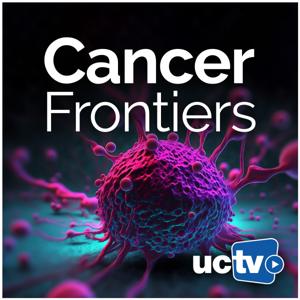
Cancer Frontiers (Video)

Cancer Frontiers (Video)

By UCTVMedicine
Download on the App Store

Cancer Frontiers (Video) episodes

  • New Treatments for Advanced Prostate Cancer
    Dr. Rahul Aggarwal presents emerging treatments for advanced prostate cancer, highlighting rapid advances in drug development. He outlines therapies targeting cancer cell surface proteins beyond PSMA, including CD46, B7-H3, and DLL3, and explains how antibody-drug conjugates deliver potent chemotherapy directly to tumors. He also discusses bispecific T-cell engagers designed to trigger immune attacks on cancer cells, including promising results from agents like Talquetamab. Aggarwal explores new isotopes such as actinium-225 for radioligand therapy, which may offer stronger and more durable responses than current treatments. He emphasizes continued innovation in targeting the androgen receptor, with drugs that degrade the receptor or block androgen production more effectively than existing therapies. Series: "Prostate Cancer Patient Conference" [Health and Medicine] [Show ID: 40813]
    10 min
  • Targeting the MLL Complex in Leukemia
    Scott A. Armstrong, M.D., Ph.D., of the Dana-Farber Cancer Institute, studies how certain aggressive forms of acute myeloid leukemia (AML) develop and survive. His work centers on a protein called menin, which helps leukemia cells keep cancer-promoting genes switched on. Armstrong’s team has found that blocking menin with specially designed drugs can shut down these gene programs, push leukemia cells to mature, and slow or stop the disease in lab models and patients. While some leukemias adapt by developing mutations in menin or finding other ways to survive, his research is revealing why certain genes are especially dependent on menin and how to target them more effectively. These discoveries are now shaping new treatments, drug combinations, and potential strategies for other cancers that rely on similar mechanisms. Series: "Stem Cell Channel" [Health and Medicine] [Science] [Show ID: 40875]
    59 min
  • Prostate Cancer Survivorship: Urinary and Sexual Wellness
    Dr. Lindsay Hampson discusses urinary incontinence and sexual dysfunction following prostate cancer treatment, emphasizing that both are common and treatable. She explains the different types of incontinence—stress, urge, mixed, and overflow—and outlines how understanding the cause helps guide treatment. Options include pelvic floor physical therapy, medications, surgical interventions like slings or artificial sphincters, and supportive devices. Dr. Hampson also reviews effective strategies for managing erectile dysfunction, such as oral medications, vacuum devices, injections, and penile implants. She highlights the importance of shared decision-making and reassures patients that even small symptoms can significantly affect quality of life and deserve attention. Series: "Prostate Cancer Patient Conference" [Health and Medicine] [Show ID: 40814]

    23 min
  • Radiation Therapy for Oligometastatic Prostate Cancer
    Radiologist Dr. Julian Hong plains how stereotactic body radiation therapy (SBRT) is used to treat oligometastatic prostate cancer—cases where cancer has spread but only to a few limited sites. This approach targets small clusters of metastases with high-dose, image-guided radiation in five or fewer sessions. Hong reviews clinical trial evidence showing that adding focal radiation can improve outcomes, especially when all visible metastases are treated. He highlights the value of modern imaging, like PET scans, in identifying lesions and shaping personalized treatment plans. Studies suggest SBRT offers effective disease control with low toxicity and minimal impact on quality of life, making it a promising option for patients with limited metastatic spread. Series: "Prostate Cancer Patient Conference" [Health and Medicine] [Show ID: 40807]
    10 min
  • Overview: PSA Recurrent Prostate Cancer
    Experts present new tools for managing PSA-recurrent prostate cancer. Dr. Steven Seyedin describes how PET/CT imaging enhances detection by reducing false positives and improving staging accuracy. Dr. Thomas Hope highlights PSMA PET imaging, now the standard approach, which identifies cancer more precisely by targeting tumor-specific proteins. Dr. Julian Hong discusses stereotactic body radiation therapy (SBRT) for patients with limited metastases, showing that it offers effective, low-toxicity treatment while preserving quality of life. Series: "Prostate Cancer Patient Conference" [Health and Medicine] [Show ID: 40867]
    33 min
  • Treatment of Advanced Prostate Cancer
    Experts from UCSF outline the latest treatments and research for advanced prostate cancer, highlighting improved outcomes and promising therapies. Dr. Kelly Fitzgerald reviews intensified androgen deprivation therapy (ADT) and the evolving role of imaging, triplet therapy, and local treatments. Dr. Ivan de Kouchkovsky shares how radioligand therapies like Lutetium-177 PSMA target cancer with precision and are now approved earlier in care. Dr. David Oh explains immunotherapy strategies, including cancer vaccines and checkpoint inhibitors, and explores new options like bispecific T-cell engagers. Dr. Terry Friedlander discusses bone health and the impact of hormone therapy, offering strategies to reduce fracture risk and improve quality of life. Series: "Prostate Cancer Patient Conference" [Health and Medicine] [Show ID: 40868]
    54 min
  • Active Surveillance for Early-Stage Prostate Cancer
    Urologic oncologist Dr. Peter Carroll presents the latest research on active surveillance as a preferred approach for managing low-risk prostate cancer and selected cases of intermediate-risk disease. Drawing from two decades of UCSF data, he explains how long-term outcomes support the safety and effectiveness of delaying treatment for carefully monitored patients. Carroll emphasizes that surveillance decisions should be guided by MRI imaging, PSA density, cancer volume, histologic subtype, and genomic testing. He notes that while many men experience gradual changes over time, only a small percentage require immediate treatment. Carroll also discusses innovations such as AI-assisted pathology and risk profiling to reduce unnecessary procedures. His data-driven approach offers patients a personalized path that preserves quality of life without compromising outcomes. Series: "Prostate Cancer Patient Conference" [Health and Medicine] [Show ID: 40801]
    15 min
  • Stem Cells and Next Generation Regenerative Medicine Therapies - Medicine Informing Novel Discoveries (MIND)
    Hear about cutting-edge advances in regenerative medicine, from lab breakthroughs to patient impact. Catriona Jamieson, MD, PhD, introduces efforts at the Sanford Stem Cell Institute to develop therapies that enhance the body’s ability to heal itself. Dan Kaufman, MD, PhD, shares progress in cancer immunotherapy using engineered natural killer cells derived from pluripotent stem cells. Karen Christman, PhD, explains how her team creates injectable hydrogels from pig heart tissue to support heart repair and regeneration after a heart attack. Tiffani Manolis highlights industry support for making cell and gene therapies more accessible. Patient advocate Justin Graves describes his life-changing experience receiving a stem cell-based therapy for epilepsy, underscoring the real-world promise of these innovations. Series: "Stem Cell Channel" [Health and Medicine] [Science] [Show ID: 40705]
    1 hr
  • Introduction to Prostate Cancer
    Prostate cancer remains the most commonly diagnosed cancer and second leading cause of cancer death among men in the U.S., with evolving screening and treatment practices reshaping care in 2025. Dr. Cornelia Ding explains how to read and understand a prostate cancer pathology report by breaking down its five key sections. Dr. Rahul Aggarwal explores how clinical trials improve prostate cancer care by advancing personalized treatment, increasing access, and correcting misconceptions about placebos. Dr. Jonathan Chou highlights the expanding role of precision medicine and how genetic insights guide individualized treatment based on each tumor’s molecular makeup. Dr. Eric Small explains how androgen deprivation therapy (ADT) targets the cancer’s dependence on testosterone and how newer therapies and combinations are improving outcomes, while also emphasizing the need to balance effectiveness with side effects through shared decision-making. Series: "Prostate Cancer Patient Conference" [Health and Medicine] [Show ID: 40865]
    1 hr 8 min

About Cancer Frontiers (Video)

From the publisher's feed

University of California researchers explain the latest developments in the fight against cancer.

More shows like Cancer Frontiers (Video)

Brain Matters (Video) by UCTV

Brain Matters (Video)

107 Listeners

Wellbeing (Audio) by UCTV

Wellbeing (Audio)

1 Listeners

Wellbeing (Video) by UCTV

Wellbeing (Video)

7 Listeners

Microbiome (Video) by UCTV

Microbiome (Video)

22 Listeners

Nutrition and Diet (Audio) by UCTV

Nutrition and Diet (Audio)

60 Listeners

Autism (Audio) by UCTV

Autism (Audio)

15 Listeners

Osher WISE: Well-being and Integrative Science for Everyone (Video) by UCTV

Osher WISE: Well-being and Integrative Science for Everyone (Video)

14 Listeners

Transplantation (Audio) by UCTV

Transplantation (Audio)

6 Listeners

Stress: Science and Strategies to Live Well (Audio) by UCTV

Stress: Science and Strategies to Live Well (Audio)

2 Listeners

Stress: Science and Strategies to Live Well (Video) by UCTV

Stress: Science and Strategies to Live Well (Video)

2 Listeners

Health Policy (Video) by UCTV

Health Policy (Video)

3 Listeners

Global Health (Video) by UCTV

Global Health (Video)

1 Listeners

Mental Health and Psychiatry (Video) by UCTV

Mental Health and Psychiatry (Video)

17 Listeners

Diabetes by UCTV

Diabetes

3 Listeners

Alzheimer's Disease (Audio) by UCTV

Alzheimer's Disease (Audio)

1 Listeners

Motherhood Channel (Video) by UCTV

Motherhood Channel (Video)

0 Listeners

Health and Medicine (Audio) by UCTV

Health and Medicine (Audio)

21 Listeners

Coronavirus (COVID-19) (Audio) by UCTV

Coronavirus (COVID-19) (Audio)

0 Listeners

Transplantation (Audio) by UCTV

Transplantation (Audio)

0 Listeners