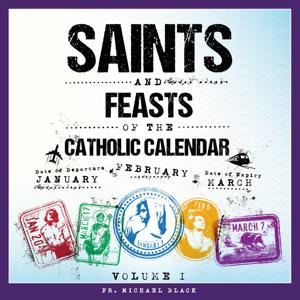
Catholic Saints & Feasts

Catholic Saints & Feasts

Download on the App Store

Catholic Saints & Feasts episodes

  • November 13: Saint Frances Xavier Cabrini, Virgin (USA)
    November 13: Saint Frances Xavier Cabrini, Virgin (USA)
    1850–1917
    USA Memorial; Liturgical Color: White
    Patron Saint of immigrants and hospital administrators

    Indomitable and charismatic, she moved mountains for God

    The hurricane of apostolic activity that was Mother Cabrini motored powerfully over the Atlantic Ocean, gathered force as it swept into the American heartland, and then rested there, perpetually oscillating, for almost three decades. A serene eye, though, hovered at the center of this low roar of activity. Mother Cabrini accomplished so much, so well, and so quickly, precisely because her soul rotated calmly around a fixed point, the immovable Christ. A peaceful focus on God in the morning rained down a storm of good works in the afternoon and evening.

    Frances Cabrini was the tenth child born into a rural but well-to-do family in Northern Italy. Her uncle, a priest, had a deep influence on her, as did the Daughters of the Sacred Heart, whose school she attended as a teen. After graduation, she petitioned for entrance into the Daughters and, later, the Conossian Sisters. But Frances’ tiny frame had never quite conquered the frailty resulting from her premature birth. These Orders needed robust women capable of caring for children and the infirm. Nuns did not take vows so they could take care of other nuns. So even an application from an otherwise stellar candidate like Frances was reluctantly rejected due to her ill health. Frances eventually obtained a position as the lay director of an orphanage. Her innate charisma pulled people toward her like a magnet, and soon a small community of women grew up around her to share a common religious life.

    As proof of her apostolic zeal, Frances added “Xavier” to her baptismal name in honor of the great missionary Saint Francis Xavier. She then founded a modest house, along with six other women, dedicated to serving in the Church’s foreign missions. Frances was clearly the leader and wrote the new Institute’s Rule. Eventually the small Order received Church approval as the Missionary Sisters of the Sacred Heart of Jesus. The sisters’ excellent work became well known, and in 1887 Mother Cabrini, the Superior, met with Pope Leo XIII in Rome to inquire about her sisters evangelizing in China. The Pope listened to her in silence and then concluded simply: Her mission was “not to the East, but to the West.” The plug had been pulled on entire regions of Italy and their populations drained away to the United States. They needed the Church’s attention.

    In 1889 Mother Cabrini left for the United States with six sisters. Disembarking from the ship in New York Harbor, they were met by not even a single person. No one expected them, and no one welcomed them. The Archbishop was cold and told Mother Cabrini that he wanted Italian priests, not sisters, and that her ship was still docked in the harbor if she wanted to return to Italy. She replied “I have letters from the Pope” and stayed and persevered amidst the most extreme hardships.

    Starting from absolute zero, Mother Cabrini miraculously began her work among Italian immigrants. She would work almost exclusively with, and for, Italians the rest of her life. She begged, pleaded, and cajoled. She pulled every lever of charm and persuasion she could reach. It worked. Her deep spirituality and constant state of motion soon put her in contact with Italian benefactors eager to help their own. Mother Cabrini was then seemingly everywhere, doing everything. She founded hospitals, orphanages, schools, workshops, and convents in New York, Denver, Cincinnati, Pittsburg, St. Louis, San Francisco, and Chicago. She trekked to Nicaragua, Argentina, and Brazil. She sailed back to Italy nine times. She became an American citizen but remained fully Italian in her identity and a source of pride for America’s many “Little Italies.”

    Mother Cabrini’s relentless energy, remarkable administrative skills, shrewdness, humility, and charisma quickly built an empire of charity. When she died in Chicago, she left behind sixty-seven institutions and a robust Order of dedicated nuns. On July 7, 1946, she became the first United States citizen to be canonized a saint.

    Mother Cabrini, you were indefatigable in your work for Christ and the Church. You knew no rest, no stranger, and no obstacle that could not be overcome. Inspire all evangelizers and teachers to be so brave and tireless in their service.

    7 min
  • November 12: Saint Josaphat, Bishop and Martyr
    November 12: Saint Josaphat, Bishop and Martyr
    1580–1623
    Memorial; Liturgical Color: Red
    Patron Saint of reunion between Orthodox and Catholics

    A holy bishop is murdered for unifying East and West

    Saint Josaphat died for something few in his era died for—ecumenism. In fact, the word ecumenism did not even exist when Josaphat was martyred. Josaphat was born in Ukraine but grew to manhood working a trade in Vilnius, Lithuania. In his late teens, he felt called to be a monk, so he rejected an offer of marriage and joined a monastery in Vilnius in 1604. Josaphat’s austerities, intelligence, and prayerfulness made him a natural leader, and he was duly ordained a deacon and priest and earned a reputation as an effective preacher.

    But it was a historic decision by Orthodox religious leaders, about ten years before Josaphat became a monk, that would bend the arc of his life and eventually lead to his death. In 1595 the Orthodox Metropolitan of Kiev and five other Orthodox bishops representing millions of Ruthenian (Ukrainian and Belarusian) faithful met in the city of Brest and signed a declaration of their intention to enter into union with the Bishop of Rome. The Pope accepted their conversion from Orthodox to Catholic, while allowing them to keep their Byzantine liturgical rites and traditions. The Union of Brest was a one-of-a-kind event. Yet it triggered Orthodox violence and bitterness toward the Catholic Church which has endured into modern times.

    Josaphat joyfully embraced the entrance of his native Orthodox faith into the Catholic fold. But he also insisted that the Eastern traditions of his pan-Slavic people should perdure, and be respected, while his people ecclesiastically migrated into the paddock of the Roman Pontiff. Unity, yes. Uniformity, no. The Church, historically, had long been composed of various liturgical traditions reflecting its numerous cultures. The Latin Rite, though, eventually predominated as Western nations grew stronger and colonized huge chunks of the world. The Union of Brest’s careful balance of accepting theological and jurisdictional unity with Rome while insisting on liturgical distinctiveness was confusing to many of the faithful Slavic peasants of Northeastern Europe. Nonetheless, when Josaphat was named a Bishop in present day Belarusia, he continued to champion the union with Rome with all his considerable powers and was largely successful in curtailing Orthodox clergy from exercising ministry in his diocese.

    Because he represented something new, an Eastern Rite Catholic, Josaphat was misunderstood by his co-religionists who should have supported him the most, particularly Polish and Lithuanian bishops and princes. The tensions of the time came to a head when an Orthodox bishop established a competing diocesan and parish structure alongside that of Josaphat’s diocese and parishes. The faithful experienced two church structures that were virtually identical in their liturgy but divergent in their leaders and lines of authority.

    In response to Orthodoxy’s aggressive incursion into his ecclesial territory, Josaphat put his usual vigor into preaching and teaching the importance of union with Rome. But in 1623, while seeking to stop an Orthodox priest from secretly ministering in his jurisdiction, Josaphat was ambushed by Orthodox faithful who conspired with their leaders to rid themselves of this thief of souls. Saint Josaphat was brutally attacked by a mob, his head was cleaved by an axe, and his body dumped into a river. Josaphat was beatified in 1643 and canonized in 1867. In the twentieth century, Josaphat’s remains were brought to Rome and buried under the altar of Saint Basil in St. Peter’s Basilica.

    Saint Josaphat, you gave your life attempting to bring East and West together. Give us your spirit of unity so that our prayers bring all Christians into common union under the leadership of a common head, the successor of Saint Peter.
    6 min
  • November 11: Saint Martin of Tours, Bishop
    November 11: Saint Martin of Tours, Bishop
    c. 336–397
    Memorial; Liturgical Color: White
    Patron Saint of France, soldiers, and conscientious objectors

    He gave away half of his cloak and then all of his life

    Many great and holy men and women are unknown to history because they lacked the one crucial ingredient to become well known—a biographer. Today’s saint was one of the fortunate ones. A historian named Sulpicius Severus personally knew and interviewed Martin in the last years of Martin’s life and put it all on parchment. In an age of few books, Sulpicius’ Life of Saint Martin was a blockbuster. Over many decades and centuries, it slipped into the bloodstream of European culture until, by the medieval age, the Life was standard reading in all monasteries. Virtually every priest and monk in Europe was deeply familiar with the details of the life of Saint Martin of Tours.

    The typical biography of a saint for the first few centuries of Christianity worked from the back to the front, from death to life. The real drama was how the saint died, not how he or she lived. Tales of bloody martyrdom, solitary exile, starvation and exposure were as moving and unfortunate as they were common. The Life of Saint Martin told of Martin’s adventures and heroism in living the faith, not just about his last few breaths. He was a saint for the new age of legalized Christianity. Martin of Tours died in his bed.

    Martin was born to pagan parents in present-day Hungary but desired to become a Christian from a young age. His father resisted his son’s holy desires and obliged Martin to follow in his footsteps and serve as a soldier in Rome’s Imperial Guard. Martin was serving in France when the most iconic moment of his life took place. Martin was slowly approaching the city gates of Amiens on horseback one cold winter evening. A half-naked man shivered on the ground, begging for help. No one stopped. No one helped. No one cared. So Martin, clad as a soldier, pulled the cloak from his back, drew his sharp sword from its scabbard, and sliced his cloak in two. The poor man’s skeletal frame was covered with just half of the cloak. That same night, when Martin fell asleep, he had a dream. Jesus appeared to him clad in the cloak and said “Martin, still a catechumen, covered me with this garment.” Upon awakening, Sulpicius tells his reader, “Martin flew to be baptized.”

    Martin subsequently befriended one of the great men of Gaul of that era, Saint Hilary of Poitiers, who ordained him into minor orders. After various apostolic adventures, Martin was chosen the Bishop of Tours in 372. In his twenty-five years as bishop, Martin was zealous, and jealous, for the House of the Lord. He aggressively tore down pagan temples, which he understood to be dedicated to demons. He traveled incessantly and was untiring in evangelizing the people of the countryside of Gaul and in founding churches. Martin also developed a reputation as a miracle worker and prophet. He cured the eye problems of Saint Paulinus of Nola, Saint Augustine’s good friend.

    By the time of his peaceful death, Bishop Martin of Tours had a well-deserved reputation for holiness. Devotion to Martin spread as Sulpicius’ biography was copied and shared. Numerous churches were named in Martin’s honor in every country of Europe. England had one hundred seventy-three churches dedicated to Martin of Tours in 1800. The Shrine over Martin’s tomb was one of the most popular pilgrimage destinations in all of Europe until France was riven by Reformation violence in the 1560s. In an interesting vestige of Martin’s enduring historic importance, Martin’s feast day in the Breviary is more fully elaborated with prayers and antiphons than almost any comparable saint on the Church’s calendar.

    Saint Martin of Tours, your encounter with the beggar has fired the imagination of countless Christians. You were generous in every single way in living your faith. Through your intercession in heaven, assist us now to see Jesus in everyone, just as you did then.
    6 min
  • November 10: Saint Leo the Great, Pope and Doctor
    November 10: Saint Leo the Great, Pope and Doctor
    Late Fourth Century–461
    Memorial; Liturgical Color: White

    Patron Saint of popes and confessors

    A Pope vigorously exercises his universal ministry and defines Christ’s divinity
    History has so far conferred on just two popes the title of “Great,” and today’s saint is one of them. Leo the Great’s origins are obscure, so nothing is known with certainty of his early life. He was, though, ordained into Holy Orders and rose to prominence as a papal advisor in the 420s. He corresponded with imminent theologians and acted as a papal emissary before he was elected Bishop of Rome in 440. Leo was a pope’s pope. He expanded the power and influence of the papacy at every opportunity. The Church’s earliest theological tradition rooted Rome’s primacy in the double martyrdom of Saints Peter and Paul in the eternal city. No other city could claim to have been sanctified by the blood of two martyrs. Pope Leo, however, emphasized what was to become a more dominant argument for papal supremacy—that the pope’s authority is not rooted merely on the historical fact that Peter and Paul died on roman ground but on the theological fact that the Bishop of Rome occupies the Chair of Saint Peter.

    By word and action, Leo repeatedly taught that the pope’s power was unequaled and without borders, that the pope was the head of all the world’s bishops, and that every bishop could have direct recourse to the pope, and not just to the local archbishop, in disputed matters. Pope Leo thus accelerated an existing tendency consolidating church governance and authority under a Roman umbrella. Regional or even local decision-making by individual dioceses or groups of dioceses did occur. But in important theological, moral, or legal matters that affected the entire church, every bishop rotated in a steady orbit within the powerful gravitational field of Rome. Pope Leo also enacted a more aggressive papal role directly overseeing and enforcing discipline over bishops, intervening in and settling disputes. The Catholic Church is not an international federation of dioceses, after all. It needs a strong center of gravity to ensure that centrifugal forces do not unwind the universal church into a galaxy of independent national churches, united in name only.

    Nowhere was Leo’s authority exercised more clearly and successfully than at the Council of Chalcedon in 451. The theological issue at stake concerned Christ’s divinity. Some theologians in the East were espousing the Monophysite heresy, which argued that Christ had only one divine nature. The Council consisted of six hundred bishops from the Eastern Roman Empire, with a handful from Africa. Leo sent three legates from Italy who were treated with all honor and respect as representatives of Peter’s successor. They read out loud to the Council Fathers the “Tome of Leo” on the Incarnation. The pope’s words laid out, with force, clarity, and eloquence, that Jesus Christ had both a divine and a human nature “without confusion or admixture.”

    When the legates finished reading, the bishops’ common response to the pope’s words was “This is the faith of the fathers; this is the faith of the apostles… Let anyone who believes otherwise be anathema. Peter has spoken through the mouth of Leo.” The Tome of Leo from then on became the teaching of the Catholic Church. If Christ were not truly man, or not truly God, the babe in the manger would be just another child whose birth was no more worthy of celebration than that of Julius Cesar, Gandhi, or Marco Polo. Pope Leo saved Christmas.

    In 452 Pope Leo entered the history books when he rendezvoused with Attila the Hun in Northern Italy, convincing him not to sack Rome. A legend says that Attila turned back because he saw Saints Peter and Paul standing right behind Leo. Pope Leo governed the Church as the Western Roman Empire was slowly disintegrating. He was courageous in alleviating poverty, protecting Rome from invaders, and maintaining Rome’s Christian heritage. While outstanding as an effective and practical leader, Pope Leo is most known for the concision, depth, and clarity of his sermons and letters, for which he was declared a Doctor of the Church in 1754. He was the first pope, after Saint Peter himself, buried in Saint Peter’s Basilica. His remains lie under a beautiful marble relief sculpture of his famous meeting with Attila.

    Pope Saint Leo the Great, give to the Pope and all bishops pastoral hearts, sharp minds, and courageous wills, so that they may lead the Church by personal example, by correct teaching, and by their caring little for worldly criticism.
    7 min
  • November 9: Dedication of the Lateran Basilica
    November 9: Dedication of the Lateran Basilica

    Feast; Liturgical Color: White

    A venerable basilica is the mother of all churches

    In the eighth chapter of his Confessions, Saint Augustine relates the story of an old and learned Roman philosopher named Victorinus. He had been the teacher of many a Roman senator and nobleman and was so esteemed that a statue of him was erected in the Roman Forum. As a venerable pagan, Victorinus had thundered for decades about the monster gods, dark idols, and breathless demons in the pantheon of paganism. But Victorinus assiduously studied Christian texts and whispered to a friend one day, “You must know that I am a Christian.” The friend responded, “I shall not believe it…until I see you in the Church of Christ.” Victorinus responded mockingly, “Is it then the walls that make Christians?” But in his grey hairs, Victorinus finally did pass through the doors of a Catholic church to humbly bow his head to receive the waters of Holy Baptism. There was no one who did not know Victorinus, and at his conversion, Augustine writes, “Rome marveled and the Church rejoiced.”

    A church’s walls do not make one a Christian, of course. But a church has walls nonetheless. Walls, borders, and lines delimit the sacred from the profane. A house makes a family feel like one, a sacred place where parents and children merge into a household. A church structurally embodies supernatural mysteries. A church is a sacred space where sacred actions make Christians unite as God’s family. Walls matter. Churches matter. Sacred spaces matter. Today the Church commemorates a uniquely sacred space, the oldest of the four major basilicas in the city of Rome. The Lateran Basilica is the Cathedral of the Archdiocese of Rome and thus the seat of the Pope as Bishop of Rome.

    A basilica is like a church which has been made a monsignor. Basilicas have certain spiritual, historical, or architectural features by which they earn their special designation. Considered only architecturally, a basilica is a large, rectangular, multi-naved hall built for public gatherings. When Christianity was legalized, its faithful spilled out of their crowded house churches and into the biggest spaces then available, the basilicas of the Roman Empire. If Christians had met in arenas, then that word would have been adopted for ecclesial usage instead of basilica.

    The Laterani were an ancient Roman noble family whose members served several Roman Emperors. The family built a palace carrying their name on a site which in the fourth century came into the possession of the Emperor Constantine, who then turned it over to the bishop of Rome. An early pope enhanced and enlarged the basilica style palace into a large church, which, in turn, became the oldest and most important papal church in the eternal city. The popes also began to personally reside in the renovated Lateran palace. By medieval times, the Basilica was rededicated to Christ the Savior, Saint John the Baptist, and Saint John the Evangelist. The popes lived at the Lateran until the start of the Avignon papacy in present day France in 1309.

    With the Avignon papacy ensconced far from Rome for seven decades, the Lateran Basilica was damaged by fires and deteriorated so sadly that by the time the popes returned to Rome in 1377, they found the Basilica inadequate. An apostolic palace was eventually built next to St. Peter’s Basilica on the Vatican hill and has been the seat of the successors of Saint Peter ever since. The Lateran Basilica retains its venerable grandeur, despite now being a baroque edifice with only a few architectural traces of its ancient pedigree. Beautiful churches are like precious heirlooms passed down from one generation to the next in God’s family. Walls do not make us Christians, but walls do clarify that certain sacred rituals are practiced in certain sacred spaces and in no others. A family in its home. A judge in his court. A surgeon in her operating room. An actor on his stage. God on His altar. We come to God to show Him the respect He deserves. He is everywhere, yes, but He is not the same everywhere. And we are not the same everywhere either. We stand taller and straighter when we step onto His holy terrain.

    Heavenly Father, we praise You more worthily when we are surrounded by the holy images in Your holy churches. Through Your grace, inspire us to render You due homage in the houses of God where Your presence burns brighter and hotter than anywhere else.
    7 min
  • November 4: Saint Charles Borromeo, Bishop
    November 4: Saint Charles Borromeo, Bishop
    1538–1584
    Memorial; Liturgical Color: White

    Patron Saint of bishops, cardinals, and seminarians

    A young nobleman becomes a Cardinal, exemplifies holiness, and reforms the Church

    Today’s saint was born in a castle to an aristocratic family. His father was a count, his mother a Medici, and his uncle a pope. This last fact was to determine the trajectory of Charles Borromeo’s entire life. Pope Pius IV (1559–1565) was the brother of Charles’ mother. At the tender age of twelve, Charles received the external sign of permanent religious commitment, the shaving of the scalp known as tonsure. He was industrious and extremely bright and received advanced degrees in theology and law in his native Northern Italy. In 1560 his uncle ordered him to Rome and made him a Cardinal at the age of just twenty-one, even though Charles was not yet ordained a priest or bishop. This was brazen nepotism. But in this instance it was also genius. The Cardinal-nephew was a man of rare gifts, and his high office afforded him a wide forum to give those gifts their fullest expression.

    At the Holy See, Charles was loaded down with immense responsibilities. He oversaw large religious orders. He was the papal legate to important cities in the papal states. He was the Cardinal Protector of Portugal, the Low Countries, and Switzerland. And, on top of all this, he was named administrator of the enormous Archdiocese of Milan. Charles was so bound to his Roman obligations, however, that he was unable to escape to visit Milan’s faithful who were under his pastoral care. Non-resident heads of dioceses were common at the time. This pained Charles, who would only be able to minister in his diocese years later. Cardinal Borromeo was a tireless and methodical laborer in the Holy See, who nevertheless always found ample time to care for his own soul.

    When Pope Pius IV decided to reconvene the long-suspended Council of Trent, the Holy Spirit placed Cardinal Borromeo in just the right place at just the right time. In 1562 the Council Fathers met once again, largely due to the energy and planning of Charles. In its last sessions, the Council completed it most decisive work of doctrinal and pastoral reform. Charles was particularly influential in the Council’s decrees on the liturgy and in its catechism, both of which were to have an enduring and direct influence on universal Catholic life for over four centuries. Charles was the driving force and indispensable man at the Council, yet he was still just in his mid-twenties, being ordained a priest and bishop in 1563 in the heat of the Council’s activities.

    In 1566, after his uncle had died and a new pope granted his request, Charles was at last able to reside in Milan as its Archbishop. There had not been a resident bishop there for over eighty years! There was much neglect of faith and morals to overcome. Charles had the unique opportunity to personally implement the Tridentine reforms he had played such a key role in writing. He founded seminaries, improved training for priests, stamped out ecclesiastical bribery, improved preaching and catechetical instruction, and combatted widespread religious superstition. He became widely loved by the faithful for his personal generosity and heroism in combating a devastating famine and plague. He stayed in Milan when most civil officials abandoned it. He went into personal debt to feed thousands. Charles attended two retreats every year, went to confession daily, mortified himself continually, and was a model Christian, if an austere one, in every way. This one-man army for God, this icon of a Counter-Reformation priest and bishop, died in Milan at the age of forty-six after his brief but intense life of work and prayer. Devotion to Charles began immediately, and he was canonized in 1610.

    Saint Charles Borromeo, your personal life embodied what you taught. You held yourself and others to the highest standards of Christian living. From your place in heaven, hear our prayers and grant us what we ask, for our own good and that of the Church.
    7 min
  • November 3: Saint Martin de Porres, Religious
    November 3: Saint Martin de Porres, Religious
    1575–1639
    Optional Memorial; Liturgical Color: White
    Patron Saint of mixed-race peoples and barbers

    A humble, mixed-race Dominican brother works miracles

    Today’s saint was born in colonial Lima, Peru, to a well-connected Spanish father and a black Panamanian mother who had been a slave. While parentage is revealing, focusing uniquely on someone’s origins can also be a lazy shortcut which reduces a complex person to mere bloodlines, leaving aside a thousand more compelling factors that make a life interesting. It would be difficult, however, to overemphasize just how much Martin de Porres’ mulatto origins (Spanish and black) impacted his life. Even though his father was perfectly well known, Martin’s baptism registration reads “Son of an unknown father,” making Martin illegitimate, a severe disadvantage. To be half black in colonial Latin America was to start life’s race ten miles behind. Catching up to the Spanish-born colonists (Peninsulares) or to the locally born pure-blood Spanish (Criollos) would be impossible. On the many-runged ladder of social acceptability in the Spanish colonies, Martin was just above an African slave.

    Martin’s father did make sure, however, that his son received a good education and enrolled him as a barber-surgeon apprentice in Lima. Martin learned how to set fractures, dress wounds, and treat infections according to the best practices of his era. And from his mother, he learned some unconventional herbal remedies that rounded out his more traditional medical education. These skills would hold Martin in good stead throughout his life. He treated the sick and injured regularly and, over time, earned a reputation as an extraordinary healer. He aided in founding a hospital and orphanage in Lima, distributed food to the poor, and cared for recently arrived African slaves. His extraordinary charity was his greatest attribute. You need candles? Of course. Blankets? One moment, please. Shoes and a comb? I’ll be back. Miracles and cures? Yes, God bless you. Martin de Porres became famous for doing many things—very many things—and doing them all well and with a smile.

    In addition to his life of interrupted service, Martin was also a spiritual warrior. He became a Dominican lay brother but never a priest. He lived in community and proudly wore the Dominican habit. He had a self-deprecating sense of humor that jokingly acknowledged his lowly mulatto status. He abstained from meat, spent long hours in prayer before the Blessed Sacrament, and was witnessed displaying supernatural gifts. He levitated. He bilocated. His room filled with light. He possessed knowledge he could in no way have possessed naturally. His wide array of natural and supernatural gifts made him famous in Lima. When his life came to an end at the age of sixty, his body was publicly shown, and pieces of his habit were discreetly clipped off as relics.

    Martin de Porres, canonized in 1962, was among the first generation of saints from the New World, along with his contemporaries Saints Rose of Lima and Turibius of Mogrovejo. Martin was also the first mulatto saint. He lived a traditionally pious spirituality in keeping with the medieval saints of Europe. But he was not from Europe, did not enjoy a European education, and did not have pure European blood. Saint Martin proved the Catholic Faith could migrate across the Atlantic Ocean intact. The ancient faith found a home in a mulatto soul. Catholicism had successfully made the passage to a new land and immediately drove its roots deep into that land’s native soil, converting a new mixed-race people to an old religion, making Jesus Christ the Lord of Latin America. Saint Martin de Porres was a harbinger of many good things to come.

    Saint Martin de Porres, we present our humble petitions to you, so that your faith and humility may bring them to our Father in Heaven. You were close to both God and man on earth. Continue to be close to us as you live with the Lord in heaven and seek favors on our behalf.
    6 min
  • November 2: The Commemoration of All the Faithful Departed (All Souls Day)
    November 2: The Commemoration of All the Faithful Departed
    (All Souls Day)
    Commemoration; Liturgical Color: White, Violet, or Black

    The earthly Church prays for the Church in Purgatory in hope of a reunion in Heaven

    Every country has a civic feast day dedicated to soldiers who died for the nation. Every country has a tomb of the unknown soldier where an honor guard stands solemnly erect near an unnamed hero whose grave represents all the unknowns who never walked off the ship to hug their wife, who never met their parents at the airport and drove home. All Souls Day is like such Memorial Days and Tombs of the Unknown. Because of the Church’s ancient pedigree, timeless customs, and unmatched role in shaping cultures, it is more apt to say, though, that civic customs and ceremonies imitate the Church’s practice rather than the opposite.

    The Feast of All Souls is the Catholic Memorial Day. Today the Church commemorates the souls of all the baptized who have died and yet who do not yet enjoy life with God in heaven. It is Catholic teaching that souls needing post-death purification can benefit from the prayers, alms, sacrifices, and Mass offerings of souls on earth. The Old Testament recounts the Jewish belief that the deceased benefit from temple sacrifice made on their behalf (2 Maccabees 12:42–46). Continuing this Semitic practice, prayers for the dead were offered by Christians from the very earliest years of the Church. The walls of the Christian catacombs of Rome were crowded with innumerable marble plaques in succinct Latin praying for the dead. There has never been a time when the Church has not commemorated, remembered, and prayed for the dead.

    Few die with their souls so perfectly purified from sin and imperfection that they proceed directly to the Beatific Vision. No one is prepared for a ten-thousand-amp light to shine into their eyeballs the moment they awake. Nor at the moment of death would most be prepared for the intense light of God Himself to gaze into our imperfect souls. We would simply not be ready for such a holy searchlight examining our every dark corner. The soul first needs to be purified. Its sins must first be burned away in the fire of God’s merciful love. This is purgatory. It is the ante-chamber of heaven, the place of waiting and preparation where the soul is readied to enter and absorb the whitest of God’s light. But souls in purgatory have no free will or ability to atone by themselves for themselves. They depend on us. They advance in purification due to our prayers and offerings for them. This is why we pray for the dead and offer Masses for their advancement into heaven.

    The Feast of All Souls, then, is much more than a spiritual family reunion where we visit the graves of our ancestors and recall with a tear all the good times. All Souls Day longs for a deeper bond, for an ultimate reunion with God at the head of the family in heaven with all His saints and angels. The dark arts of pagandom understand well the role the dead play in the imagination of the living. Vampires, werewolves, ghosts, zombies, and witches surface in many cultures on this day. They manifest a frustrated, non-Christian longing for the afterlife. These characters are the living dead who inhabit the middle ground between earthly life and ultimate death. The undead, the forever young, the “after life but before judgment” souls lust after the flesh and blood of the living to preserve their immortality. In this imaginary world, death feeds on the sacrifice of life, especially young and beautiful life, so that dark powers can slake their thirst.

    Today we put such fiction to the side and mobilize Christian prayer and sacrifice for Christian souls on a Christian Feast. Through the Sacraments, grace, redemptive suffering, alms giving, good deeds, and fasting, we move through the shadowlands of occult fiction, horror movies, and vampire legends. The hidden land of the dead is not just beyond the edge of the woods or in the dark of night after the last ember of the campfire turns black. The Church offers mystery enough for everyone. The deathly battle of good and evil, of devils against angels, of sin against grace, and of the cross against temptation is not fiction. It’s as serious as cancer. In this supernatural arena, souls hang in the balance, with heaven or hell, eternal life or eternal death, resting on the scales. Today we put our fingers on that scale and tip the balance in favor of those we love who have gone before us.

    All Holy Souls, our prayers and Mass offerings are directed to you this day in the hope that what we do on earth may benefit your advancement toward a fully divine life in heaven where you may, in turn, pray that we may one day join you there.
    7 min
  • November 1: All Saints
    November 1: All Saints
    Solemnity; Liturgical Color: White

    Heaven is populated with holy people known to God alone

    Martyrs were so revered in the early Church that their places and dates of death were sanctified by the candles, prayers, and votive offerings of the faithful, grateful for their witness. So many were the martyrs, though, that by the early fourth century it became impossible to solemnize each individually on the Church’s crowded calendar. There thus arose, over centuries, and in different ways in different regions, the custom of commemorating the memory of all the holy ones on one specific day of the year. By the early eighth century, a Feast of All Saints was celebrated in Rome on November 1. The Feast was extended to the entire Church in the next century.

    The universal sanctoral calendar of the Catholic Church is like a saint’s All-Star team. Only the most talented make the cut. There are many more canonized saints besides those on the universal calendar. Some saints are commemorated only locally or regionally, others are historically obscure, and still others did not give a sufficiently universal witness to merit inclusion on the Church’s universal calendar. The Church defines a saint as a soul enjoying the Beatific Vision in heaven. So, besides the famous saints found on the universal calendar and the lesser-known saints not on that calendar, there are still many more souls in heaven not officially recognized as saints at all. These are the saints we celebrate in a particular way today.

    The Solemnity of All Saints commemorates all those holy men, women, children, martyrs, confessors, and unknown others who lived lives of such holiness that upon death they either entered directly into God’s presence in heaven or duly purified their soul of every imperfection in purgatory before then advancing into His presence. All-Star saints such as Saint Augustine and Saint Francis of Assisi stand shoulder to shoulder in heaven with forgotten grandmas, quiet uncles, and unknown martyrs. These unrecognized but holy souls did not convert entire tribes, found religious communities, or have their bones crushed by the jaws of lions in the arena. Maybe they just kept their mouth shut when they had just the right words to humiliate a family member. Magnanimity. Perhaps they cooked dinner night after night for their family out of a sense of duty, while they gazed out the kitchen window, dreaming of another life far away doing greater deeds. Humility. Or maybe they refused to cooperate with an immoral boss and lost their job, never to recover financially, their dreams ruined for a principled stance. Fortitude.

    The dense population of heaven is unknown to us on earth, but not to God, the audience of One we should most desire to please. There are as many pathways to God as there are people, since God wants to make a project of each and every one of us. All the saints lived heroic lives in their own unique ways. Some were the steeple to the village, seen by all and inspiring others to greatness. But most saints had lower profiles. They were more like the squat stone blocks forming the church’s foundation, silently holding up the entire structure. They received little notice or credit despite buttressing the entire building. Without their support, the church and all of its luster would collapse.

    Today we commemorate those silent and sturdy ones who, without cease and without complaint, buttressed the family, the marriage, the parish, the Church, the community, the faith. Among the communion of saints are some few illustrious citizens whose virtues sparkle on their special days. But today we honor, remember, and seek to imitate that broader population of heaven never raised to the public altars but who offered their lives in quiet ways to God. They received the Body of Christ and lived His teachings in an exemplary manner in season and out of season until all seasons converged and God called them back to Himself.

    All holy men and women, so close to us yet still so far, gather our prayers to yourselves and intercede in heaven on our behalf. May our holy desires be accomplished through that chorus of prayers you constantly present to the Father surrounded by all His angels in heaven.
    7 min
  • Georgia Martyrs: Beatification October 31, 2026
    Georgia Martyrs
     
    Beatification: October 31, 2026 
     
    St. Francis Would Be Proud 

    Polyandry, or a woman taking multiple husbands, is an obscure marital custom. In the few remote Himalayan villages where it may be practiced, brothers marry the same woman to protect rights to family property. Polygamy, or a man taking multiple wives, has always been, and is still, found globally, typically in higher social strata. Only high-status men of exalted power and wealth can take more than one wife. In a harem culture, more low-status women have access to more high-status men precisely because those men are not monogamous.  This sometimes leaves low status men with fewer options for marriage among their own, leading to male-on-male class resentment or to low status men coalescing around a chief or cacique.
      
    Men's natural tendency towards polygamy in pagan cultures had to be bucked like a bronco before a tamer Christian culture flourish. And it was Catholic missionaries who did the taming. It was hard won and took centuries, but the teaching of priests and nuns and the witness of Christian couples eventually prevailed. At times, though, the price was paid in warm blood. Today's martyrs, all celibate Franciscan priests and brothers, spilled their blood in the soil of Georgia for marriage, for monogamy. 

    Such sacrifice is a golden thread in the tapestry of the saints. Herod Antipas beheaded St. John the Baptist for criticizing Herod's marriage to Herodias while his first wife was still alive. St. Thomas More was decapitated for, among a related web of issues, refusing to endorse the polygamy of his lusty King.  St. Charles Lawanga and Companions were burned alive after refusing the disordered advances of their king, who counted more than a dozen wives. Even Kolbe sacrificed his life for a marriage.   

    An Indian sub-chief named Juanillo plotted the bloody end of today's martyrs. Juanillo is a diminutive of Juan, so he could be called Little John. Juanillo was a baptized convert from the Guale tribe in modern day coastal Georgia. He had a wife but wanted another one. Juanillo was a high-status male in a traditional indigenous culture accepting of polygamy. No shortage of women thirsted to be a wife of a chief. Juanillo could have as many wives as he wanted. And no priest, especially a white European priest, would deny him what nature commanded.  

    The Spanish Conquistador Ponce De Leon christened as "La Isla de Pascua Florida" the modern state of Florida when he and his countrymen first spied it in 1513. They thought it was an island. The name can be translated as "The Island of Easter Flowers," reflecting the ships' arrival during Holy Week. Eventually "La Florida" came to mean virtually the entire southeastern United States, as Spanish, French, and English adventurers pushed deeper into the immense continent of which Florida was just a modest protrusion.  

    The struggle to evangelize the native tribes of Florida throughout the 1500s was one battle after another. Hurricanes roiled the sea. Ships sank. Men drowned. Provisions were lost. The soil was thin. Nothing grew. Colonists starved. Priests were slaughtered by natives to pay long standing debts incurred by colonists' offenses. No miraculous tilma ever appeared to dazzle the neophytes. No demon-topped temples were razed or hulking colonial churches built over them. Florida was nothing like Mexico. The 1500s was a lost century, a long trail of tears, for the Spanish in Florida. 

    In the 1590s, Franciscan friars disembarked on coastal Georgia to once again try to establish missions among the Indigenous tribes of that region, among them the Guale people. The Franciscans did not build cities on a hill. They lived among the people in primitive lodgings, ate what the natives ate, and learned their tongue. They preached, administered the sacraments, and taught the basic Christian message, which conflicted with indigenous customs in some areas. 

    And thus it came to pass that the path of the Indian and the path of Christ crossed. Father Pedro de Corpa insisted that Juanillo, a baptized Catholic, be permanently faithful to his one wife, none other and none else. Fr. Corpa was killed on September 14, 1597 and his severed head placed on a stake. Juanillo and his band of frenzied young men then went on a hunt for more prey. Over the next four days they knifed, decapitated, and slaughtered Fathers Blas Rodríguez, Miguel de Añon, and Francisco de Veráscola, and Brother Antonio de Badajóz in missions along the Georgia coast and its Sea Islands. 
     
    The Catholic Church has determined that the five Franciscans were murdered in "odium fidei" - “out of hatred for the faith.” They were not killed primarily because they were Spanish or because they were colonists but because of the faith they preached and witnessed to. 

    Today's martyrs did not find the fountain of youth in greater Florida but the fountain of eternal life. Their holy images now rest on our noble altars, where the faithful can leave flowers, light candles, and bend knees and heads as we whisper our prayers, assured of the powerful intercession of these generous martyrs. 

    Martyrs of Georgia, before the last threads of your lives were cut, you had given yourselves to Christ by abandoning country, family, language, and home. You prepared for death by dying in small ways a thousand times before. Hear our prayers. Grant our petitions. Amen.  
    8 min

About Catholic Saints & Feasts

From the publisher's feed

"Catholic Saints & Feasts" offers a dramatic reflection on each saint and feast day of the General Calendar of the Catholic Church. The reflections are taken from the four volume book series:…