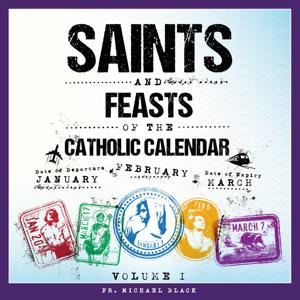
Catholic Saints & Feasts

Catholic Saints & Feasts

Download on the App Store

Catholic Saints & Feasts episodes

  • October 15: Saint Teresa of Jesus, Virgin and Doctor
    October 15: Saint Teresa of Jesus, Virgin and Doctor
    1515–1582
    Memorial; Liturgical Color: White
    Patron Saint of headache sufferers and lacemakers

    A rich, fiery personality purifies herself and the Carmelites

    The call for reform of the Church has rung out through the centuries down to today. However, it is largely misplaced. Reform of Church structures is required periodically for her internal well-running. But purification is needed more than reform. The constant purification in holiness of the baptized is harder, more efficacious, and more enduring than the reform of Church organs of governance. Today’s saint was a reformer, yes, but she was first a purifier. She purified herself, her religious sisters, and then the Carmelite Order. Structural reform came last, after she had died. Saint Teresa of Jesus, commonly known as Saint Teresa of Ávila, was the inspiration for the great Teresas who followed her: Saints Thérèse of Lisieux, Teresa Benedicta of the Cross, and Mother Teresa of Calcutta.

    Saint Teresa was born behind the high and thick walls of Ávila in Central Spain, amidst that country’s greatest century. She was from a large, middle-class and pious family. As a girl, Teresa dreamed of being a martyr, or a hermit, and loved to repeat the words “forever and ever and ever.” When she decided to become a religious, she entered Ávila’s Carmelite convent mostly because it was there. The convent was large and the nuns serious. But it was a bit too comfortable. Many nuns brought their social status into the cloister and had private kitchens, oratories, and guest rooms. Teresa was one of these. Visitors came and went at will. While the convent caused no scandal, it produced no saints either. Even so, Teresa remained faithful—she prayed, observed the rule, and endured the normal fasts and mortifications. But by the mid-1500s, the wave of Church reform, even spiritual reform, which had been rising in Central
    Europe for decades, finally broke on the shores of Catholic Spain.

    Teresa suffered various health scares, read some seminal works on mental prayer, had mystical experiences, and slowly became convinced that her convent was too lax. The Church and Christ demanded more. She had developed the practice in examining her conscience to not just weigh her virtues and vices but to consider all the graces, all the good, and all the holiness God desired of her which she had impeded. Inspired by the great reformers of her century, many of them fellow Spaniards, Teresa decided to found a new Carmelite convent. There was fierce opposition from within her own convent and from the Carmelite Order more generally. Her odyssey of reform, begun in the mid-1550s, bore fruit when her first convent opened in Ávila in 1562. Her sisters wore no shoes (the meaning of the word “Discalced”), were limited to thirteen per convent, and would accept neither dowries nor endowments. The Discalced Carmelites were to be utterly poor, to fast, to mortify, and to pray intensely. But Teresa also wanted no gloomy saints. She practiced, and expected her nuns to emulate, being ever more sociable as she progressed in holiness. Everyone liked Teresa, and she liked to be liked.

    Teresa spent her last twenty years founding new convents as she traveled throughout Spain, all the while living in the most primitive conditions. By middle age she had earned a reputation for holiness, for legitimate mysticism, for affability, and for total obedience to the Church. She lived what she demanded of others. She led by example. And she did it all with a cheerful disposition and a rich personality that overcame deep-seated opposition.

    The Discalced Carmelites were given their own Spanish province in 1580 and were recognized as a distinct Order in 1594, twelve years after Teresa’s death. On a banner day in 1622, Teresa was canonized with Saints Philip Neri, Ignatius of Loyola, and Francis Xavier. Teresa was the first female non-martyr to have her feast day extended to the universal Church, and due to the profundity of her mystical writings, she was declared a Doctor of the Church by Pope Saint Paul VI in 1970.

    Saint Teresa of Jesus, your colorful character and recollected soul merged into a powerful personality that brought about needed change. Through your intercession in heaven, assist all religious to purify themselves and their orders in accord with God’s will for the Church.
    7 min
  • October 14: Saint Callistus I, Pope and Martyr
    October 14: Saint Callistus I, Pope and Martyr
    c. Late Second Century–222
    Optional Memorial; Liturgical Color: Red
    Patron Saint of cemetery workers

    A slave takes charge of a catacomb and rises to the papacy

    Popes owned slaves for centuries to row their boats, cook their meals, and care for their horses and carriages. Kings, nobles, and middle-class families owned slaves. Slavery was a ubiquitous institution not necessarily rooted in racism, which was a latecomer as a rationale for enslavement. Rather, prisoners of war and criminals of every skin color were enslaved as alternatives to capital punishment. Others were born into slavery from slave mothers, and still others in desperate circumstances sold themselves into slavery in exchange for food, shelter, and security.

    Today’s saint, according to ancient sources, served as a slave in a Roman home for many years and thus was part of that massive social reality of slavery that not even Saint Paul explicitly condemned in his letter to Philemon. Since he was an intelligent and resourceful servant, Callistus’ master put him in charge of his personal bank. But when Callistus lost its deposits, he was blamed and was eventually exiled to the mines of Sardinia. At some point he was released from this hard labor and earned freedom from his slave status.

    Pope Zephyrinus, elected in 199, placed the capable Callistus in charge of the most important underground Christian cemetery in Rome. Under Callistus it eventually grew into a sprawling, thirteen-mile warren of dark, narrow tunnels lined with tombs chiseled out of the soft tufa stone. 500,000 bodies were encased in its walls! Callistus was so successful in managing the cemetery that it came to bear his name, and bears it still—the Catacombs of Saint Callistus. Besides numerous martyrs, it also houses a famous chapel for nine third-century popes. The Catacombs were ground zero for early Christian devotion in Rome. They were not hiding places from persecution but sacred ground on which to kneel beside a martyr’s lifeless body. Saint Jerome himself writes about his regular visits to pray at the martyrs’ tombs in the catacombs a century and a half after Callistus expanded them. There were no Viking funerals, Hindu pyres, or urns on the mantle for these early Christians. They believed in the resurrection of the body, as the Church still does. They knew, instinctively, that it was more fitting to bury a body, to keep watch with the dead, than to casually bake a body like a pie.

    The same Pope Zephyrinus ordained Callistus as a deacon. Deacons have a tighter bond, theologically, with bishops than with priests. Since the Acts of the Apostles, they were ordained specifically to assist the first bishops, the Apostles. The first three centuries of the Church resound with the names of deacons, such as Saints Lawrence and Vincent, who were martyred alongside the popes and bishops they served. Pope Saint Sixtus II was killed, in fact, along with his coterie of deacons after they were all arrested in the Catacombs of Callistus in 258. In approximately 217, Deacon Callistus was elected the Bishop of Rome, crowning his long and arduous path from slavery to a more exalted form of service to the Divine Master as head of the entire Church.

    Pope Callistus encountered resistance over the perennial third-century theological-pastoral issue of how to reintegrate into the Body of Christ Catholics who had been forced to engage in emperor worship. Callistus held that if God could forgive murder and adultery he could forgive idolatry too. No sin was unforgivable. His bitter enemies, including the first antipope, Hippolytus, considered Callistus too lax and committed their calumnies to writing. This damaged Callistus’ reputation into modern times, when scholarship finally called into question the veracity of his enemies’ accounts. Saint Callistus’ life is not richly detailed, but he died in 222, most likely by martyrdom and, ironically, was not buried in his eponymous Catacomb. His original tomb was rediscovered in 1960. His remains had been transferred in the ninth century to Rome’s Basilica of Santa Maria in Trastevere, which tradition holds was built over, or next to, an earlier church of which Callistus was the patron.

    Saint Callistus, you served an earthly master as a slave and a heavenly master as a deacon and pope. You made Christian burial and praying for the dead a defining feature of the Church of Rome. May we honor you in death just as you honored so well your own forebearers in the faith.
    7 min
  • October 11: Saint John XXIII, Pope
    October 11: Saint John XXIII, Pope
    1881–1963
    Optional Memorial; Liturgical Color: White
    Patron Saint of papal delegates

    A smart, fatherly priest becomes a warm-hearted pope

    The first Pope John XXIII was an amoral antipope. He was one of three competing popes between 1409–1417, the confusing, final chapter of the Western Schism whose power struggles and political intrigues tore at the fabric of the Church between 1378–1417. When today’s saint was elected Bishop of Rome in 1958, being well versed in church history, he chose the name John XXIII to put to rest forever and always any lingering confusions about the historical status of the first John XXIII.

    Pope Saint John XXIII was born Angelo Roncalli into a large, humble, rural family in a mountainous region of Northern Italy. He entered the local minor seminary at the age of eleven and persevered in his philosophical and theological studies, both locally and in Rome, until his ordination in 1904. Angelo had the good fortune to know, serve, and study under a succession of well-educated, charitable, and holy pastors. Both his formal and informal Church-sponsored education created in him the winning combination of rustic common sense, broad historical vision, and cultural openness that would mark his entire life. His simple, but not simplistic, farm background, stellar education, profound life of prayer, and total immersion in the rich Catholic life and history of his native region formed and molded him into a great man.

    After his ordination, Father Angelo Roncalli became secretary to his bishop, a saintly and pastoral prelate whose total dedication left a deep impression on the young priest who was at his side for everything for almost ten years. Father Roncalli also edited a monthly journal, taught theology and history in the seminary, gave priestly guidance to various groups, and served as an army medic and military chaplain during World War I. His engaging personality and deep wisdom left a deep impression. He was, simply, an outstanding priest. In 1921 the Pope called him to Rome to serve the universal church in various roles, including as the Vatican representative in Bulgaria, Turkey, and Greece, and then as the Apostolic Nuncio to Paris near the end of WWII and beyond. In 1953 he was made a Cardinal and the Patriarch of Venice, and thus returned to some of the direct pastoral duties he loved so much and which had been so reduced during his long administrative service to the Church.

    In October 1958 his accumulated knowledge and experience were placed at the service of the universal Church, when at the age of seventy-six he was elected pope. He surprised the world soon afterward by calling for an Ecumenical Council, the meeting of all the world’s bishops that became known as Vatican II. As pope, he published some important social encyclicals, waded into the dawning theological debates of the Council, and then died in 1963, after reigning for only four and a half years.

    From the age of fourteen, John XXIII had kept a spiritual journal he allowed to be posthumously published as Journal of a Soul. It reveals a trusting soul with a deep love of Jesus Christ and the Church, a man aware of all the major currents of culture, and a man of refined spirituality and profound humility. It reveals a saint. Pope John had said that he wanted to be like Pope Saint Pius X—to be born poor and to die poor. In his last will and testament he left $20 to each of the surviving members of his family. It was all he had. John XXIII was canonized on the same day as Pope Saint John Paul II on April 27, 2014. His feast day is not his date of birth, death, or ordination but the date of the opening session of Vatican II in 1962. His largely incorrupt body is visible to the faithful in a glass coffin in Saint Peter’s Basilica.

    Pope Saint John XXIII, may your long life of dedicated and selfless service to the Church and to her faithful be an example for all priests and bishops. May they see in you an example of the Good Shepherd who cares for his flock with wisdom and tenderness.
    7 min
  • October 9: Saint John Leonardi, Priest
    October 9: Saint John Leonardi, Priest
    1541–1609
    Optional Memorial; Liturgical Color: White
    Patron Saint of pharmacists

    “Either Christ or nothing!” was his cure for every ill

    Today’s saint was among that first wave of post-Council of Trent priests and founders whose purification of the Church started with themselves. Saint John Leonardi was a man ardently in love with Christ and Mary and the sacred field of the Catholic Church, where theological truths grow tall and dense in the richest soil. Because that sacred field was so in need of clearing, pruning, and weeding in his era, Saint John stripped from himself every single personal interest, desire, or goal and merged his life totally with that of Christ. John was like a small twig grafted onto the verdant root-stem of Christ. John, Christ, and the Church all grew and thrived together as one living thing.

    Like so many saints, John Leonardi was born into a large family. The hum and whistle of daily life, work, meals, conversation and prayer in large families is a small school where children learn generosity naturally. The large family’s numerous siblings serve as proxies for the diverse personalities found in the broader culture, better preparing the children for life outside the home. John’s parents won the battle for his soul early. He was a religiously inclined boy from the start. As a teenager, John studied to be a pharmacist under a local mentor for many years, leading to a life-long interest in medicine. But mature reflection eventually took him down another path. He would not apply essences, compounds, or poultices to patients’ bodies but rather feed the sacraments to people’s souls. John studied for the priesthood and was ordained in 1572.

    Father John served among the youth at parishes in his native city of Lucca, Italy, and was active in visiting hospitals and prisons. His ardour attracted a loyal following of laymen with whom he lived and worked and prayed. John’s life and priesthood flowed effortlessly into the great river of reforms that gushed from the Council of Trent, which had concluded just a few years before John was ordained. John was intensely focused on implementing the Council’s teachings. His local bishop tasked John with preaching in all of Lucca’s churches to straighten the crooked lines sketched by some theologically confused priests. Father John’s experience of orthodox preaching, and of the fierce resistance it generated, convinced him that only an impeccable moral and spiritual life could draw people to self reform and conversion. John thus sought to mirror every virtue, to be a lighthouse on the rugged cliff, drawing all people safely into the harbor of Christ.

    John’s small band of brothers were eventually recognized as a Congregation by successive popes, but due to local resistance, John had to move his work to Rome. He befriended Saint Philip Neri, was entrusted with reforming several monasteries, and was instrumental in founding the seminary for the future Congregation for the Propagation of the Faith, a successful Vatican entity which formed priests for service in the foreign missions. John advocated the Forty Hours Devotion, frequent reception of Holy Communion, and the Christian formation of children at as early an age as possible.

    By 1600 Father John Leonardi was a well-known Counter-Reformation force in Italy not due to his books, new ideas, or charisma, but due to his virtue and zeal for the house of the Lord. In 1609 our saint died well but too soon. He was infected with the plague while visiting the sick. The small Congregation he founded, the Clerks Regular of the Mother of God of Lucca, continues until today, purposely small and focused on their important work. Father John Leonardo was canonized in 1938 and is buried in a handsome baroque church near the Roman Forum.

    Saint John Leonardi, may your generous example of priestly service inspire a holy jealousy among priests so that they burn with the same desire that consumed you in service to Christ and Mary in the heart of the Church.
    7 min
  • October 9: St. Denis, Bishop, & Companions, Martyrs
    October 9: Saint Denis, Bishop, and Companions, Martyrs
    Third Century
    Optional Memorial; Liturgical Color: Red
    Patron Saint of Paris

    A missionary bishop is beheaded and the Church’s eldest daughter thrives

    Therapod, Spinosaurus, Ornithopod, Ceratopsid, Triceratops. Creatures with strange names from long ago with three toes, sharp protruding vertebrae, duck heads, three horns and jaws that crushed like the serrated walls of a trash compactor. A cephalophore? A theological neologism for another creature from long ago—a martyr who carries his own head after being decapitated. Today’s saint, Denis, is the most well-known cephalophore. He cradled his own head in his arms as proof of his sacrifice, much like a soldier might point to his battle scars to prove his valor. An early medieval tradition states that Saint Denis, the first Bishop of Paris, after being beheaded, preached a sermon on forgiving his assassins from the mouth of his own severed head while walking seven miles from his execution site to his grave. This legend is, historically, as flimsy as tissue paper, but theologically as solid as granite.

    Saint Denis was a missionary bishop sent to Gaul in the mid-third century, perhaps by the martyr Pope Saint Fabian. By that time, Gaul had been evangelized only in pockets. Blanket conversion of its numerous tribes was destined for a later century, when a unified kingdom imposed a unified faith. Even great movements must have modest beginnings. So the bishop Denis, the priest Rusticus, and the deacon Eleutherius made their way north to a small Roman city called Lutetia, on the banks of the Seine River, where they served both native Romans and the Parisii, the local Gallic tribe. Denis and his companions settled on an island next to Lutetia called, today, Île de la Cité. It is the heart of Paris, the site of Notre Dame Cathedral, and the zero point from which all distances are measured in France. Denis and his companions, embodying the three Holy Orders, were successful enough to provoke the envy of pagan priests who convinced the local governor to imprison and torture them.

    Tradition relates that around 275 A.D., the martyrs were led to a pagan height overlooking Lutetia for their ritual beheading, thus lending the hill its name, Montmartre, or martyrs’ hill. After the sword dropped and Denis’ head separated from his torso, legend relates that he chose his own place of burial by walking, head in his arms, from Montmartre to the present day site of the Basilica for which he is the eponym. This church became the burial place of the kings of France, who strove to surpass each other in devotion to Paris’ patron.

    The form of capital punishment speaks, consciously or unconsciously, to the crime being punished. The heretic is burned, like his books, his flesh melting in the fires which replicate on earth those waiting for him in eternal damnation for having led the faithful astray. Every false clause, sentence, and paragraph of the heretic’s books must float into the air as cinders, never to mislead again. Death by drowning during the Reformation killed those who rejected or taught falsehoods concerning the saving waters of baptism. Hanging, a firing squad, lethal injection, suicide by jumping, the electric chair: all convey subtle meaning via the manner in which they extinguish life.

    Decapitation is the purest form of capital punishment, caput being Latin for “head.” The decapitation of a bishop, in particular, was meant to separate the head of the Church from its body, leaving the ship without its pilot. Saint John the Baptist, Saint Paul, Saint Cyprian, Pope Saint Sixtus II, were all Christian leaders and were all beheaded. The legend of Saint Denis is fanciful but profound. The story captures the meaning of decapitation and responds to it. Bishop Denis’ head is cleaved from his body but still united to it. Christ’s head can never be separated from His body the Church. Christ is one, head and body, and every bishop stands in Christ’s stead to exercise the fullness of Christ’s priestly ministry to teach, govern, and sanctify the people of God. A shepherd always pastors a flock, a pilot always helms a ship, and a bishop is always united to a diocese, even if that diocese is long dormant. The bishop images Christ the head to the earthly members of Christ’s body.

    Saint Denis and companions, you died in the mission fields of the Church’s eldest daughter, France. Your blood spilled long ago so that our blood would not spill today. We thank you for your witness and ask your intercession to make us fearless like you.

    7 min
  • October 9: Saint John Henry Newman (England and Wales)
    October 9: Saint John Henry Newman
    1801–1890
    Memorial; Liturgical color: White

    As mellow as a breeze, as elegant as a swan, he walked alone the path to Rome

    Pope Benedict XVI, a professional theologian, did not typically perform beatification ceremonies, instead entrusting them to his Cardinals. But such was Benedict’s immense respect for Cardinal John Henry Newman’s life and thought that the Pope not only personally celebrated Newman’s beatification Mass but even traveled to England, Newman’s homeland, to do so in September 2010.

    Cardinal Newman is known to most American Catholics as the namesake of the Newman Centers, which are found on the campuses of many secular universities in the United States. Yet Newman’s profile casts a much broader shadow than these university centers alone. John Henry Newman was a man of vast learning culled from a life of prodigious reading. He was a one-man library who mastered both Greek and Latin, had a comprehensive knowledge of Scripture, and was conversant with the theological nuances of every great theologian of the first five centuries of the Church. In addition, Newman elucidated complex theological material in a prose so elegant that the words of his many essays and books seem to glide across the page.

    It was precisely in his writing where Newman’s gifts sparkled. He had that elusive gift called style. Newman’s swan-like gracefulness can be favorably compared with any other man or woman who has ever put pen to paper in the English language. Newman’s ability to express lyrically and precisely his every thought would have counted for little if he had had nothing to say. But, of course, Newman did have something to say. He had much to say, in fact.

    The silken threads of Newman’s words weave like a loom. His intricate sentences thread over and under and around each other, creating a taut and beautiful garment of masterful theology, original insight, and deep historical awareness. When a foe pulled at this or that thread of his theological fabric, Newman would unsheath his pen from its inkwell and wield it like a rapier to slice into shreds his opponent’s arguments, but never his character. Newman did not make personal attacks. Newman’s exquisite works make for compelling reading, provided the reader concurs. If not, Newman was, and is, a gigantic problem who must be confronted.

    John Henry Newman was a convert to Catholicism. He was raised as an Anglican and was somewhat evangelical in his youthful love of the Lord Jesus. As his head sunk deeper and deeper into books in adulthood, however, he concluded that to be immersed in history was to cease to be a Protestant. His conversion to Catholicism shook the English academic world and led to decades of adversarial letters, books, and essays arguing disputed theological points between Newman and his colleagues. But Newman’s ability to express his ideas on the page was so superior, his arguments so unassailable, and the personal cost he paid for converting so agonizing, that the totality of his witness ultimately carried the day.

    Yet Newman was more than just a brain in a jar. His bravery in converting to Catholicism manifested steely resolve and deep virtue not otherwise apparent in his genteel and sensitive personality. His conversion cost him almost everything—status, friendship, income, prestige, academic positions—and on and on. Yet his example emboldened numerous others in subsequent decades to walk the same path to Rome which Newman had first trod alone. A whole generation of English academic converts to Catholicism trace their theological lineage to Cardinal Newman.

    In the last few years of his life, Newman lived like a monk without a desert. Though he was never ordained a Bishop, Father Newman was named a Cardinal by Pope Leo XIII. It was a wreath of laurel crowning a great man’s quiet holiness, brave perseverance, immense erudition, and unequalled polish in composing from within the most dramatic work he ever authored—the story of his own holy life.

    Saint John Henry Newman, from your place in heaven, we ask that your virtues of serenity amid controversy, of erudition amid confusion, and of steadfastness amid attacks provide a holy example to all Christians to persevere in seeking the truth.
    7 min
  • October 7: Our Lady of the Rosary
    October 7: Our Lady of the Rosary
    Memorial; Liturgical color: White
    Patroness of Malaga, Spain, and the Archdiocese of Vancouver

    Mary comes to the rescue, and the Catholic West avoids the fate of the Orthodox East

    In 1204 Venetian Crusaders traveling to the Holy Land sacked Constantinople. Debts were not being paid, so something had to be done. Relics were packed up and shipped back to Italy, as well as gold, silver, precious stones, art, vestments, and booty. The city was stripped clean. The conquered have much longer memories than the conquerors, and Constantinople, the New Rome, never forgot 1204. So, in the first half of the 1400s, when Ottoman Turks ringed the walls of Constantinople, making it a tiny Christian island in a vast Islamic sea, unifying with Rome for common defense was not an option for the Orthodox.

    As the Muslim noose tightened around the city’s neck, little by little, year after year, Constantinople struggled for air. Emperor and Patriarch were desperate, so they finally approached the Pope and Western princes. Help us! A deal was struck. The Orthodox would unify with Rome, just in time to save Constantinople! But the memories of 1204 were too much to overcome. The Orthodox faithful rejected the rapprochement. Westerners were hated; their help unwelcome. A Byzantine official, when asked about unifying with Rome, made the sad comment that “I would rather see the Muslim turban in the midst of the city than the Latin mitre.” And so in 1453 the high, thick walls of Constantinople were breached. The Turks let loose on the city, slaves were taken, churches desecrated, the Hagia Sophia turned into a mosque, and the last Roman Byzantine Emperor, ironically named Constantine like the first Byzantine Emperor, was killed. New Rome having been taken, Old Rome was next. All of Europe now lay before the Turks like an empty table. No one and nothing stopped the Ottoman Turks until Our Lady did. The naval battle of Lepanto was the “September 11, 2001” moment of its generation. On the first Sunday of October, 1571, the ships of a Holy League of Catholic Kingdoms and the Papal States defeated the Ottoman navy

    decisively in the seas off of Greece. Islam was stopped in its tracks. There would be no repeat of 1453 in Old Rome. No desecration or pillaging, no murder of the Pope. A line had been drawn which has still not been crossed.

    Pope Saint Pius V, a Dominican, animated and organized the Holy League. He implored the faithful throughout Europe to pray the rosary, and himself led a rosary procession in the Eternal City, for Christian triumph. The ships of the Holy League were outmatched and outnumbered and needed all the divine assistance prayer could muster. These prayers were answered. The doors to the Mediterranean, and to the Atlantic beyond, were shut on the Turks. In thanksgiving for this miraculous victory, Pius V instituted the “Feast of Our Lady of Victory,” later changed to “Feast of the Holy Rosary” and finally “Feast of Our Lady of the Holy Rosary.” Pope Leo XIII added the title "Queen of the Most Holy Rosary" to the Litany of Loreto in honor of Mary’s intercession through the rosary.

    It may seem redundant to give Mary the title “Our Lady of the Rosary.” It sounds a bit like saying “Jesus of the Cross.” Of course she is Our Lady of the Rosary and of course He is Jesus of the Cross! Yet Mary and Jesus are multi-faceted, like diamonds whose angles and cuts play and sparkle as we admire their flawless symmetry. One mystery, then a doctrine, and then a truth, flash and blink as they rotate before us. The title “Our Lady of the Rosary” is like a facet. One aspect of the mystery of Mary shines in that title, deepening our love of the whole gem. Reflecting on one specific truth also helps the believer absorb the otherwise unfathomable greatness of God. Today our eye trains itself on the crown, the face, or just the cool elegance of our one-hundred carat Lady. Today we focus on Saint Mary, who loves to hear us call her by name, over and over and over again as our fingers run up and down the beads.

    Our Lady of the Rosary, we implore your intercession day in and day out, in the morning and in the evening, because we love to say your name and you love to hear us invoke you. You defeated vast armies seeking to destroy the Church. Help us to conquer our sins.
    7 min
  • October 6: Saint Bruno, Priest
    October 6: Saint Bruno, Priest
    c. 1030–1101
    Optional Memorial; Liturgical Color: White
    Patron Saint of Calabria, Italy, and of Germany

    Solitary confinement is not a punishment when it is voluntary and shared with God

    Today’s saint was born in an unknown year. He left his native Cologne to study in Rheims, France, as a young man and was ordained a priest around 1055. Aware of Bruno’s obvious talents, the Bishop of Rheims demanded that the young priest remain in his diocese, where Bruno became the head of Rheims’ most illustrious school for almost two decades and then Chancellor of the diocese. Bruno’s trajectory was, at this point in his life, typical of talented, educated, and well-connected priests of his era. He was destined to become a good, scholarly, and politically aware medieval bishop, the kind whose graves fill the floors and stuff the side chapels of many Gothic cathedrals. But a bad bishop altered the arc of Bruno’s trajectory.

    Bruno’s bishop-patron died and was succeeded by a corrupt aristocrat who had bought his office. This ecclesiastic had little concern for the Church except as a well of money and power from which he could freely drink. Revolt, sharp tensions, recriminations, and violence ensued. Everyone was damaged. Bruno withdrew from the scene, partly to avoid being named a bishop himself and partly to reevaluate what prize he was truly seeking in life. Bruno and some companions then sought out a well-known hermit in Southern France who, a few years later, would go on to found the Monastery of Citeaux, the mother foundation of the Cistercian Order. Citeaux was the very same monastery which had such an influence on Bruno’s contemporary Saint Bernard of Clairvaux. But Bruno was not meant to be a Cistercian. Still searching, Bruno and six companions approached the Bishop of Grenoble, France, who was favorable to their plan and granted them a remote location in the French Alps called Chartreuse. It was 1085. Saint Bruno’s successors reside at the Grande Chartreuse to this day, living the part hermit, part community of prayer, part work, part study, all poor, and all silent existence of Carthusian monks that Bruno envisioned.Though Bruno founded the Grande Chartreuse, he did not remain there for long. A former pupil of Bruno’s had become Pope, and he needed Bruno’s hand on the rudder to help him navigate the ship of the Church in the rough seas of medieval ecclesiastical politics. So Bruno moved to Rome and lived in a cell amidst the crumbled arches and half walls of the Baths of Diocletian. His every intention of returning to the Grande

    Chartreuse was frustrated. The Pope compelled Bruno to remain in Italy in case his services were needed, even as the Pope and his court were on the run from determined enemies. Resigned to his exile, and refusing an appointment as bishop in Southern Italy, in about 1094 Bruno and some followers spawned a mini-Chartreuse in Calabria, Italy, called La Torre, although this second foundation was later to be absorbed into the Cistercian Order. Bruno died there, living in silence as a monk. He was never formally canonized and left no rule for his Order, leaving that task to a successor.

    Saint Bruno had a burning love for the Holy Eucharist and for the Virgin Mary. Silence was also his muse. God speaks beautifully through His creation, but one must “hear” God’s silence to understand Him. Silence is a powerful form of speech, a negative word which God, as the Father of a large family, often uses to communicate. The internal word is not less of a word because it remains unspoken. A word is an internal mental tool for organizing thought before it is a means of communication. God’s own internal Word was so powerful that it became flesh and blood, a living Word more powerful than mere spoken language. Words are a form of action, but they can also limit meaning. God speaks most deeply in the action of creation, through His Son and in silence.

    As lovers know, a glance, a touch, a smile, a thought is sufficient. Words may add to these things, but they can also subtract from them. It has been said that even if a marble statue of Saint Bruno could stretch open its mouth, he would still keep his vow and remain silent, for “When words are many, transgression is not lacking” (Prv 10:19).

    Saint Bruno, your life of generous and active service to the Church was curtailed, and you chose the better portion, seeking God in silence, poverty, study, and prayer. Help all who are in the world to emulate your quiet dedication, focus, and endurance.
    7 min
  • October 6: Blessed Rose Marie Durocher, Virgin (U.S.A.)
    October 6: Blessed Rose Marie Durocher, Virgin (U.S.A.)
    1811–1849
    Optional Memorial; Liturgical Color: White
    Invoked against the loss of parents

    When the call came, she was prepared to say “Yes”

    The story of today’s Blessed is largely one of waiting for the hammer to strike. Years of quiet, humble, and faithful generosity to family, the Church, and students prepared Eulalie (her baptismal name) for the moment when she was asked to sacrifice her entire life, eliciting from her a full throated “Yes.”

    Eulalie was born into a successful Quebecois family of eleven children, where sharing, sacrifice, and service were not extraordinary but simply the way things were. Three of her brothers became priests, and a sister became a nun. At the age of twelve, Eulalie entered the convent boarding school where her sister was a novice. But poor health impeded her acceptance into Montreal’s Congregation of Notre Dame. Her boarding school classmates noted Eulalie’s sterling character, charm, meekness, and delicate attentiveness to the will of God.

    When her mother died prematurely in 1830, Eulalie took on a maternal role, caring for her siblings and making the family’s house a home. A year later she, her father, and the family moved onto the premises of a parish where her brother was the priest. For twelve years, Eulalie served as the parish secretary and housekeeper, all the while keenly noting the desperate need for a religious congregation to educate the mass of rich and poor children of Quebec who remained ignorant for lack of schools.

    In 1841, the great Bishop Eugene de Mazenod of Marseilles, France, the founder of the Missionary Oblates of Mary Immaculate, was coordinating with a Canadian priest to send a teaching order of sisters to Quebec. Eulalie learned of the effort and committed herself in advance. But it was not God’s will and the plan failed. Along with her earlier non-acceptance by the convent, this was the second great disappointment of Eulalie’s life. The Church was not yet ready to accept her “Yes.” Her long engagement with Christ

    would again be delayed before the two could be permanently bonded at the altar.

    When he realized his French-based missionary plan would fail, Bishop Mazenod recommended to the Bishop of Montreal that he start his own local congregation of teaching sisters. After the usual steps had been completed, in 1843 Eulalie’s dream came true. When the hammer finally struck and she was asked to become a sister, Eulalie’s powder was dry, her aim true, and her life ready to hit its target. The Bishop of Montreal, moreover, not only asked her to join the new Congregation but to lead it! Two other women trained with Eulalie under the guidance of an Oblate priest. In 1844 the three took vows and received the religious habit, with Eulalie taking the religious name Marie-Rose. The Sisters of the Holy Names of Jesus and Mary were born, with Sister Marie-Rose Durocher as the Mother Superior.

    The services of the new Congregation were in intense demand, and the sisters responded with due generosity. The number of students exploded, new convents were established, and vocations flourished. In just five years, by 1849, there were four convents of the Holy Names’ Sisters educating hundreds of boys and girls in both French and English. Our Blessed, though, had never conquered her poor health, and the non-stop work of the new Congregation weakened her already fragile frame. Sister Marie-Rose died in 1849 at the age of thirty-eight. Her marriage to Christ was late but not long.

    In 1927 the local effort to investigate her heroic virtue commenced, leading to her beatification by Pope Saint John Paul II in 1982. With one more verified miracle, our Blessed will be canonized a saint. Blessed Marie-Rose lived a mostly quiet life of service to others, observing and absorbing where her spiritual and practical skills could most fruitfully be utilized. She was ready through long practice when the call to generosity finally came.

    Blessed Marie-Rose, inspire all educators to dedicate themselves fully to the needs of the young so in need of religious instruction. May your example lead Catholic teachers to see their work as a vocation in service to Christ more than a mere profession in service to the world.
    7 min
  • October 5: Saint Faustina Kowalska, Virgin
    October 5: Saint Faustina Kowalska, Virgin
    1905-1938
    Optional Memorial: Liturgical Color: White
    Patron Saint of Mercy

    Her humble sail caught a powerful theological wind

    The martyr Saint Faustino was killed in the second decade of the second century in northern Italy under the emperor Hadrian. Nothing else is known of him. Today’s saint was baptized Helen and, for unknown reasons, was given the martyr’s name when making her first religious vows. Saint Faustino must be honored, and grateful, to share his name with so holy and consequential a nun as Saint Maria Faustina Kowalska, who was canonized in 2000, and whose optional memorial was added to the Church’s universal calendar in 2020.

    Saint Faustina was a peasant in the best sense of the word. She could read and write but otherwise attended school for only a few years in her rural village in central Poland. Her large and pious family needed her hand on the plow, financially speaking, and so at the age of sixteen young Helen Kowalska obtained work as a housekeeper in nearby towns. She was expert in the domestic arts of sewing, cleaning, cooking, and the related skills which convert a house into a home. These skills served her well, but not long, in the convents where she resided throughout her short life.

    While she felt called to be a religious sister as a child, Helen’s parents were reluctant to let her enter a convent at too tender an age. But then, in her late teens, Christ appeared and spoke to Helen in mysterious and deeply personal encounters, demanding that she not keep Him waiting much longer. These visions propelled the pious teen to seek acceptance in a big-city convent. She moved to Warsaw at nineteen, received advice from a sympathetic priest, and knocked on the doors of various convents hoping that one of them, just one, would accept her. One finally did. After proving herself in its novitiate, she took solemn vows and spent the rest of her life as a faithful nun doing humble chores alongside her religious sisters in convents in Poland and present-day Lithuania.

    Like so many saints, the unseen vigils, prayers, mortifications, fasts, and sufferings were Faustina’s real life, while the visible realities seen by her fellow religious and the occasional visitor were of lesser importance. And what went unseen in Saint Faustina’s life was astounding! This humble nun experienced remarkably vivid, high-octane, technicolor, 3-D visions of Jesus Christ in the chapel, behind the door, in her cell, and around every corner for many years. Jesus’ strong voice spoke to her in a direct and unmistakably clear manner about His desires for her life. He commanded her, repeatedly, to spread the message of Divine Mercy. So Faustina had an artist paint a famous image of Christ with two rays emanating from his chest, promoted a liturgical feast day in honor of the Divine Mercy on the Sunday after Easter, and kept an exhaustive diary chronicling the content of her vivid spiritual experiences.

    Saint Faustina’s message is not really Saint Faustina’s message. It is God’s message. God wants mankind to know, and to feel, the Divine Mercy oozing out of the heart of Christ. This mercy, unlike human or judicial mercy, can wash away even the most wretched sins. God’s mercy is not in competition with his justice but is an over abundance of justice. God knows all things and forgives all things when His mercy is freely requested. The modern western world is very focused on questions of justice – racial justice, economic justice, environmental justice, etc… But it is, at the same time, opposed to judging. This dichotomy of favoring justice but abhorring judging is incongruous. The modern west suffers from similar tensions regarding the virtue of mercy.

    An American Cardinal noted years ago that modern secular culture permits, even promotes, practically everything. It seems that no moral aberration, sin, or dysfunctional behavior is not smiled upon as a rightful expression of personal freedom. And yet…modern secular culture forgives almost nothing. “Just Do it!” But, beware, when you do do it, you might never be forgiven for having done it. The message of Divine Mercy is that because all can be forgiven, all relationships can be restored. Relationships precede our rights and even our choices. We are more than our choices! We are more than our rights! And when we receive mercy, or extend mercy to others, our relationships with ourselves, with friends, family, nature, and God are restored.

    Every expression or reception of mercy is like a mini jubilee-year. Every traveler returns home, every field lies fallow, and every debt is forgiven. Mercy is the father waiting on the ridge. He sees the ragged figure on the horizon limping home in the evening light. The petition for mercy. The granting of mercy. The tight embrace. The relationship restored. The ring on his finger. The robe on his back. The calf on the spit. The feast begins. Divine Mercy conquers all.

    Saint Faustina, your humble and generous service to the Church included sharing your visions and the message of Divine Mercy. Help all who seek your intercession to be blessed with your same virtue and your same docility to God’s will.
    8 min

About Catholic Saints & Feasts

From the publisher's feed

"Catholic Saints & Feasts" offers a dramatic reflection on each saint and feast day of the General Calendar of the Catholic Church. The reflections are taken from the four volume book series:…