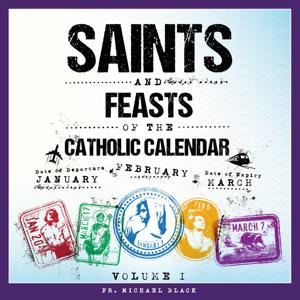
Catholic Saints & Feasts

Catholic Saints & Feasts

Download on the App Store

All Catholic Saints & Feasts episodes

  • November 18: Saint Rose Philippine Duchesne, Virgin
    November 18: Saint Rose Philippine Duchesne, Virgin
    1769–1852
    Optional Memorial; Liturgical Color: White
    Patron Saint of perseverance amid adversity

    Born into a refined French family, her life ended in hardship on the American prairie

    Today’s saint was born into a large, refined, educated Catholic family situated in an enormous home in the venerable city of Grenoble, France. Rose’s parents and extended family were connected to other elites in the highest circles of the political and social life of that era. Despite this favored parentage, Rose would leave the world and all the advantages she inherited to become a hardscrabble missionary nun serving rough settlers and Indians in the no man’s land of the American plains. Saint Rose was named after the first canonized saint of the New World, Saint Rose of Lima. As a child, her imagination had been fired by hearing about missionaries on the American frontier. She dreamed of being one of them, yet her path to becoming a pioneer missionary would be circuitous.

    When Rose felt the call to a contemplative religious life as a teen, she joined, against her father’s wishes, the Order that so many French women of status joined—the Congregation of the Visitation, founded by Saint Jane Frances de Chantal in the early seventeenth century. The massive social upheavals of the French Revolution shuttered her Visitandine convent, though, and she spent years living her Order’s rule privately outside of a convent as her country disintegrated into chaos. After the revolution, when religious life was no longer illegal, Rose tried to re-establish her defunct convent by personally purchasing its buildings. The plan didn’t work, and Rose and the few remaining sisters united themselves to a new French Order, which would later be known as the Religious Sisters of the Sacred Heart.

    Saint Rose was destined to be a holy and dedicated nun in her Order’s schools. But in 1817, a bishop serving in the United States came to France on a recruitment tour, as so many bishops did in the first half of the nineteenth century. The bishop visited Rose’s convent in Paris, and Rose’s childhood dreams were rekindled. After receiving permission from her superiors, in 1818 Rose boarded a ship with four other sisters for the two-month sea voyage to New Orleans, U.S.A. The second act of her life was starting at age forty-nine. From this point forward, her life was replete with the physical hardships, financial struggles, and everyday drama typical of the French and Spanish missionaries who brought the faith to the ill-educated pioneers and Indians on the edge of the American frontier.

    Rose and her troupe of sisters had to take a steamboat up the Mississippi River to Missouri after the bishop’s promises of a convent in New Orleans came to nothing. In remote Western Missouri, Rose began a convent in a log cabin and then started a school and a small novitiate. The people were poor, the settlers generally unschooled, the weather cold, the food inadequate, and life hard. Rose struggled to learn English. Yet after ten years, the Sacred Heart Sisters were operating six convents in Missouri and Louisiana. In 1841, the Sisters began to serve Potawatomi Indians who had been harshly displaced from Michigan and Indiana into Eastern Kansas. At seventy-one years old, Rose joined this missionary band to Kansas not for her practical usefulness but for her example of prayer. Saint Rose prayed so incessantly that she was on her knees before the tabernacle when the Indians went to sleep and kneeling there when they woke up, still praying. Wondering at this, some children put pebbles on the train of her habit one night. The next morning the pebbles were still there. She hadn’t budged an inch all night long! The Potawatomi called her “She Who Prays Always.” Howling cold and the rigors of frontier life forced Rose to return to a more humane convent existence for the last quiet years of her life. She was beatified in 1940 and canonized in 1988.

    Saint Rose, you persevered heroically in your vocation despite serious challenges. Inspire all religious to continue in their unique vocations despite setbacks, and to unite, as you did, a quiet contemplative soul with a missionary’s courage and drive.
    7 min
  • November 18: The Dedication of the Basilicas of Saints Peter and Paul, Apostles
    November 18: The Dedication of the Basilicas of Saints Peter and Paul, Apostles
    Optional Memorial; Liturgical Color: White
    The Apostles Peter and Paul are the Patron Saints of the City of Rome

    The barque of Peter is tethered to two stout anchors

    A cathedral is theology in stone, the medievals said, a truism which extends to all churches, not just cathedrals, and to their sacred web of translucent glass, glowing marble, gold-encrusted wood, bronze canopies, and every other noble surface on which the eye falls. A Church mutely confesses its belief through form and materials. Today’s feast commemorates the dedication of two of the most sumptuous churches in the entire world: the Basilica of St. Peter, the oversized jewel in the small crown of Vatican City, and the Basilica of St. Paul Outside the Walls, a few miles distant, beyond Rome’s ancient walls. The foundations of these two Basilicas are each sunk deep into the blood-drenched ground of first-century Christianity, though today’s impressive structures stand proxy for their long-razed originals. If strong churches reflect a strong God, these Basilicas are all muscle.

    The present Basilica of St. Peter was dedicated, or consecrated, in 1626. It was under construction for more than one hundred years, was built directly over the tomb of the Apostle Peter, and considerably enlarged the footprint of the original Constantinian Basilica. That prior fourth-century Basilica was so decrepit by the early 1500s that priests refused to say Mass at certain altars for fear that the creaky building’s sagging roofs and leaning walls would collapse at any moment. The ancient Basilica of St. Paul Outside the Walls was consumed by a mammoth fire in 1823. The rebuilt Basilica was dedicated on December 10, 1854, just two days after Pope Pius IX had formally promulgated the dogma of Mary’s Immaculate Conception. The Basilica’s vast classical elegance is breathtaking—its marbled central nave stretches out longer than an American football field.

    The two Basilicas were, for centuries, linked by a miles-long, roofed colonnade that snaked through the streets of Rome, sheltering from the sun and rain the river of pilgrims flowing from one Basilica to the next as they procured their indulgences. Rome’s two great proto-martyrs were like twins tethered by a theological umbilical cord in the womb of Mother Church. The pope’s universal ministry was explicitly predicated upon these two martyrs. Rome’s apostolic swagger meant the Bishop of Rome’s headship was not merely symbolic but actively intervened in practical matters of church governance throughout Christendom. The pope, the indispensable Christian, was often depicted in early Christian art as a second Moses, a law-giver, who received from Christ the tablets of the New Testament for the new people of God.

    At intervals of five years, every diocesan bishop in the Catholic Church is obligated to make a visit “ad limina apostolorum”—“to the threshold (of the tombs) of the apostles.” This means they pray at the tombs of Saints Peter and Paul in Rome and personally report to Saint Peter’s successor. These visits are a prime example of the primacy of the pope, which is exercised daily in a thousand different ways, a core duty far more significant than the pope’s infallibility, which is exercised rarely.

    There is no office of Saint Paul in the Church. When Paul died, his office died. Everyone who evangelizes and preaches acts as another Saint Paul. But the barque of Peter is still afloat in rough seas, pinned to the stout tombs which, like anchors, hold her fast from their submerged posts under today’s Basilicas. A church is not just a building, any more than a home is just a house. A church, like a home, is a repository of memories, a sacred venue, and a corner of rest. On today’s feast, we recall that certain churches can also be graveyards. Today’s Basilicas are sacred burial grounds, indoor cities of the dead, whose citizens will rise from beneath their smooth marble floors at the end of time, like a thousand suns dawning as one over the morning horizon.

    Holy martyrs Peter and Paul, your tombs are the sacred destinations of many pilgrimages to the eternal city. May all visits to the Basilicas dedicated to your honor deepen one’s love and commitment to Mother Church.
    7 min
  • November 17: Saint Elizabeth of Hungary, Religious
    November 17: Saint Elizabeth of Hungary, Religious
    1207–1231
    Memorial; Liturgical Color: White
    Patron Saint of the Third Order of Saint Francis

    A faithful wife loses her husband and becomes a Franciscan

    The marriage of today’s saint was not any less happy for being arranged. Elizabeth of Hungary’s parents betrothed her at the age of four to a young German nobleman named Ludwig and sent her away as a child to live in his family’s court. Elizabeth wed Ludwig when she was fourteen and he twenty-one. Only in a post-industrial age have the teenage years been understood, in some countries but not all, as a time of self-discovery, boundary pushing, rejection of tradition, and excuse for total confusion. Puberty, not the entire span of the teen years, was historically understood as the passage to adulthood, responsibility, and a professional life. It was typical of her era, and of many other eras too, that Elizabeth would marry at fourteen. She was ready and became a contented, serious, and successful wife and mother, bearing three children, while still a teen.

    Before Ludwig left on Crusade in 1227, he and Elizabeth vowed never to remarry if one were to die before the other. Then Ludwig died on his way to the Holy Land. Elizabeth was distraught but fulfilled her promise. So at the age of twenty, her already pious and prayerful soul waded into deeper Christian waters. Her mortifications became more rigorous, her financial generosity more total, and her prayer time more all consuming. Most of all, Elizabeth’s life now began to revolve almost uniquely around the poor, the aged, and the sick. She opened a hospice near a relative’s castle and there welcomed anyone in need.

    Elizabeth also fell under the spell of a charismatic and over-bearing spiritual director who insisted that she make the most severe emotional and physical sacrifices in her quest for perfection. As a sign of her commitment to the poor, and to aid her in conquering herself, Elizabeth took the habit of a Third Order Franciscan in 1227. Franciscanism was spreading like wildfire throughout Europe, and Elizabeth was not the only noblewoman far from Assisi to be drawn to the message of Saint Francis so soon after his death. A native Hungarian, who came in search of Elizabeth in Germany at this time, was shocked to find her dressed in drab grey clothes, poor, and sitting at a spinning wheel in her hospice. He begged Elizabeth to return to her father’s royal court in Hungary. She refused. She would stay near the tomb of her husband, stay near her children, now in the care of nuns and relatives, and stay close to the poor whom she loved so much.

    Most likely worn out by her austerities and near constant contact with the sick, Elizabeth died at the age of twenty-four on November 17, 1231. Miracles were attributed to her intercession soon after her burial, and testimonies to her holiness were collected so rapidly that she was canonized by the pope just four years after her death. In 1236 a shrine was dedicated to her memory in Marburg, Germany, and her remains were transferred there amidst great ceremony. Pilgrims continued trekking to her shrine throughout the middle ages, until a Lutheran prince, full of dissenting Protestant spit and vinegar, removed Elizabeth’s relics from her shrine in 1539. They have never been recovered.

    Saint Elizabeth of Hungary, we seek your heavenly intercession on this date of your early death. Help all young mothers to persevere in their vocations and all young widows to not despair but to be confident as they walk forward in life, knowing that Christ is at their side.
    6 min
  • November 16: Saint Margaret of Scotland
    November 16: Saint Margaret of Scotland
    c. 1045–1093
    Optional Memorial; Liturgical Color: White
    Patron Saint of Scotland, large families, and parents who have lost children

    A foreign-born royal becomes queen and inspires by her refinement and devotion

    In the early eleventh century, a Danish Viking named Canute reigned as King of England. Canute exiled his potential rivals from an Anglo-Saxon royal family. One of these exiles, Edward, made his way to Hungary, married, and had a daughter named Margaret who grew up in a well-educated, royal, Catholic home. Margaret’s father eventually returned to England at the request of the king, his uncle Saint Edward the Confessor, and he brought his family with him, including Margaret. But Edward died shortly after coming home, leaving Margaret fatherless, and then Edward the Confessor died without an heir. War broke out. In 1066 at the Battle of Hastings, the Anglo-Saxon English lost to the Norman French. Margaret and her siblings were displaced to Scotland, far away from French efforts to eradicate Anglo-Saxon royals who had claims to the English throne. Thus was the circuitous route by which a woman of English blood who grew up in Hungary is commemorated today as Saint Margaret of Scotland.

    Saint Margaret was known to her contemporaries as an educated, refined, and pious woman. She married a Scottish King named Malcolm who was far more rustic than herself. He could not even read. The earliest Life of Margaret, written by a monk who personally knew her, states that Malcolm depended on his wife’s sage advice and admired her prayerfulness. According to Margaret’s biographer, Malcolm saw “that Christ truly dwelt in her heart...What she rejected, he rejected...what she loved, he, for love of her, loved too.” Malcolm embellished Margaret’s devotional books with gold and silver. One of these books, a selection of Gospel passages with illuminated miniatures of the four Evangelists, is preserved in an English museum. King Malcolm and Queen Margaret, along with their six sons and two daughters, truly created a domestic church centered on Christ. One son, David, became a national hero as King of Scotland and is popularly referred to as a saint.

    Margaret’s presence infused the unsophisticated, rural, Scottish court with culture. She brought her more Roman experiences of Church life with her to Scotland, and so pulled the Scottish Church into conformity with Roman and continental practice regarding the dating and observance of Lent and Easter. She encouraged the faithful to more fully observe Sunday by not working and, like so many medieval royals, she was also a prolific foundress of monasteries, including one she intended to be the burial place for Scottish kings and queens. Margaret was known for her concern for the poor, for dedicating hours a day to prayer and to spiritual reading, and for her great skill in embroidering vestments and church linens.

    Saint Margaret died, not yet fifty years old, just a few days after she was informed that her husband and son were killed in battle. Margaret and Malcolm were buried together under the high altar of a monastery. Devotion to the holy queen began soon after her death, and she was canonized in 1250.

    Saint Margaret of Scotland, you were the model of a virtuous queen who cared for both the spiritual and material welfare of your people. Inspire all leaders to give personal witness to holiness so that, through their leadership role, they inspire their people to be more virtuous.
    5 min
  • November 15: Saint Albert the Great, Bishop and Doctor
    November 15: Saint Albert the Great, Bishop and Doctor
    c. 1206–1280
    Optional Memorial; Liturgical Color: White
    Patron Saint of natural scientists

    He knew everything, taught Aquinas, and placed his complex mind at the Church’s service

    Saint Francis de Sales wrote that the knowledge of the priest is the eighth Sacrament of the Church. If that is true, then today’s saint was a sacrament unto himself. There was little that Saint Albert did not know and little that he did not teach. His mastery of all the branches of knowledge of his age was so manifest that he was called “The Great” and the “Universal Doctor.”

    Albert was born in Germany and educated in Italy. During his university studies, he was introduced to the recently founded Dominican Order and joined their brotherhood. While continuing his long course of formal studies, Albert was sent by his superiors to teach in Germany. He spent twenty years as a professor in various religious houses and universities until he finally obtained his degree and began to teach as a master in 1248. His most famous student was the Italian Dominican Thomas Aquinas, whose rare intellectual gifts Albert recognized and cultivated. Albert was also made the Prior of a Dominican Province in Germany, was a personal theologian and canonist to the Pope, preached a Crusade in Germany, and was appointed the Bishop of Regensburg for less than two years before resigning. Albert was neither ruthless nor politically minded, and the complex web of elites who had interests in his diocese required a bishop to display a sensitivity to power relationships which was not among Albert’s skills.

    After his short time as a diocesan bishop, Albert spent the rest of his life teaching in Cologne, punctuated by travels to the Second Council of Lyon in 1274 and to Paris in 1277 to defend Aquinas from his theological enemies. Albert’s complete works total thirty-eight volumes on virtually every field of knowledge known to his age: scripture, philosophy, astronomy, physics, mathematics, theology, spirituality, mineralogy, chemistry, zoology, biology, justice, and law. Albert’s assiduous study of animals, plants, and nature was groundbreaking, and he debunked reigning myths about various natural phenomena through close personal observation. He devoured all the works of Aristotle and organized and distilled their content for his students, re-introducing the great Greek philosopher to the Western world forever and always. This life-long project of philosophical commentary was instrumental in grounding subsequent Catholic theological research on a wide and sturdy platform of critical thinking, which has been a hallmark of Catholic intellectual life ever since.

    Albert’s comprehensive approach to all knowledge contributed to the flourishing of the nascent twelfth-century institutions of learning known as universities. The “uni” in university implied that all knowledge was centered around one core knowledge—that of God and His Truth. The modern understanding is that a “multiversity” is merely an administrative forum in which numerous branches of knowledge spread out in pursuit of their separate truths unhinged from any central focus or purpose.

    Saint Albert’s prodigious mind never ceased to be curious. Every bit of knowledge which he culled led him to gather even more. His encyclopedic knowledge embraced reality itself as one sustained instance of God loving the world. No bifurcation, no subcategories, no “my truth” and no “your truth.” God was real and God was knowable. Reality and Truth were one for Albert and his era, and autonomous reason could be trusted to lead the honest, rational seeker to those eternal verities. Albert was beatified in 1622 and was canonized and named a Doctor of the Church in 1931.

    Saint Albert the Great, your knowledge of the sacred and physical sciences understood God as a total reality. Through your divine intercession, help the faithful to see reality not as divided but as an expression of the Trinitarian God, a knowable person who is accessible to reason.
    6 min
  • November 13: Saint Frances Xavier Cabrini, Virgin (USA)
    November 13: Saint Frances Xavier Cabrini, Virgin (USA)
    1850–1917
    USA Memorial; Liturgical Color: White
    Patron Saint of immigrants and hospital administrators

    Indomitable and charismatic, she moved mountains for God

    The hurricane of apostolic activity that was Mother Cabrini motored powerfully over the Atlantic Ocean, gathered force as it swept into the American heartland, and then rested there, perpetually oscillating, for almost three decades. A serene eye, though, hovered at the center of this low roar of activity. Mother Cabrini accomplished so much, so well, and so quickly, precisely because her soul rotated calmly around a fixed point, the immovable Christ. A peaceful focus on God in the morning rained down a storm of good works in the afternoon and evening.

    Frances Cabrini was the tenth child born into a rural but well-to-do family in Northern Italy. Her uncle, a priest, had a deep influence on her, as did the Daughters of the Sacred Heart, whose school she attended as a teen. After graduation, she petitioned for entrance into the Daughters and, later, the Conossian Sisters. But Frances’ tiny frame had never quite conquered the frailty resulting from her premature birth. These Orders needed robust women capable of caring for children and the infirm. Nuns did not take vows so they could take care of other nuns. So even an application from an otherwise stellar candidate like Frances was reluctantly rejected due to her ill health. Frances eventually obtained a position as the lay director of an orphanage. Her innate charisma pulled people toward her like a magnet, and soon a small community of women grew up around her to share a common religious life.

    As proof of her apostolic zeal, Frances added “Xavier” to her baptismal name in honor of the great missionary Saint Francis Xavier. She then founded a modest house, along with six other women, dedicated to serving in the Church’s foreign missions. Frances was clearly the leader and wrote the new Institute’s Rule. Eventually the small Order received Church approval as the Missionary Sisters of the Sacred Heart of Jesus. The sisters’ excellent work became well known, and in 1887 Mother Cabrini, the Superior, met with Pope Leo XIII in Rome to inquire about her sisters evangelizing in China. The Pope listened to her in silence and then concluded simply: Her mission was “not to the East, but to the West.” The plug had been pulled on entire regions of Italy and their populations drained away to the United States. They needed the Church’s attention.

    In 1889 Mother Cabrini left for the United States with six sisters. Disembarking from the ship in New York Harbor, they were met by not even a single person. No one expected them, and no one welcomed them. The Archbishop was cold and told Mother Cabrini that he wanted Italian priests, not sisters, and that her ship was still docked in the harbor if she wanted to return to Italy. She replied “I have letters from the Pope” and stayed and persevered amidst the most extreme hardships.

    Starting from absolute zero, Mother Cabrini miraculously began her work among Italian immigrants. She would work almost exclusively with, and for, Italians the rest of her life. She begged, pleaded, and cajoled. She pulled every lever of charm and persuasion she could reach. It worked. Her deep spirituality and constant state of motion soon put her in contact with Italian benefactors eager to help their own. Mother Cabrini was then seemingly everywhere, doing everything. She founded hospitals, orphanages, schools, workshops, and convents in New York, Denver, Cincinnati, Pittsburg, St. Louis, San Francisco, and Chicago. She trekked to Nicaragua, Argentina, and Brazil. She sailed back to Italy nine times. She became an American citizen but remained fully Italian in her identity and a source of pride for America’s many “Little Italies.”

    Mother Cabrini’s relentless energy, remarkable administrative skills, shrewdness, humility, and charisma quickly built an empire of charity. When she died in Chicago, she left behind sixty-seven institutions and a robust Order of dedicated nuns. On July 7, 1946, she became the first United States citizen to be canonized a saint.

    Mother Cabrini, you were indefatigable in your work for Christ and the Church. You knew no rest, no stranger, and no obstacle that could not be overcome. Inspire all evangelizers and teachers to be so brave and tireless in their service.

    7 min
  • November 12: Saint Josaphat, Bishop and Martyr
    November 12: Saint Josaphat, Bishop and Martyr
    1580–1623
    Memorial; Liturgical Color: Red
    Patron Saint of reunion between Orthodox and Catholics

    A holy bishop is murdered for unifying East and West

    Saint Josaphat died for something few in his era died for—ecumenism. In fact, the word ecumenism did not even exist when Josaphat was martyred. Josaphat was born in Ukraine but grew to manhood working a trade in Vilnius, Lithuania. In his late teens, he felt called to be a monk, so he rejected an offer of marriage and joined a monastery in Vilnius in 1604. Josaphat’s austerities, intelligence, and prayerfulness made him a natural leader, and he was duly ordained a deacon and priest and earned a reputation as an effective preacher.

    But it was a historic decision by Orthodox religious leaders, about ten years before Josaphat became a monk, that would bend the arc of his life and eventually lead to his death. In 1595 the Orthodox Metropolitan of Kiev and five other Orthodox bishops representing millions of Ruthenian (Ukrainian and Belarusian) faithful met in the city of Brest and signed a declaration of their intention to enter into union with the Bishop of Rome. The Pope accepted their conversion from Orthodox to Catholic, while allowing them to keep their Byzantine liturgical rites and traditions. The Union of Brest was a one-of-a-kind event. Yet it triggered Orthodox violence and bitterness toward the Catholic Church which has endured into modern times.

    Josaphat joyfully embraced the entrance of his native Orthodox faith into the Catholic fold. But he also insisted that the Eastern traditions of his pan-Slavic people should perdure, and be respected, while his people ecclesiastically migrated into the paddock of the Roman Pontiff. Unity, yes. Uniformity, no. The Church, historically, had long been composed of various liturgical traditions reflecting its numerous cultures. The Latin Rite, though, eventually predominated as Western nations grew stronger and colonized huge chunks of the world. The Union of Brest’s careful balance of accepting theological and jurisdictional unity with Rome while insisting on liturgical distinctiveness was confusing to many of the faithful Slavic peasants of Northeastern Europe. Nonetheless, when Josaphat was named a Bishop in present day Belarusia, he continued to champion the union with Rome with all his considerable powers and was largely successful in curtailing Orthodox clergy from exercising ministry in his diocese.

    Because he represented something new, an Eastern Rite Catholic, Josaphat was misunderstood by his co-religionists who should have supported him the most, particularly Polish and Lithuanian bishops and princes. The tensions of the time came to a head when an Orthodox bishop established a competing diocesan and parish structure alongside that of Josaphat’s diocese and parishes. The faithful experienced two church structures that were virtually identical in their liturgy but divergent in their leaders and lines of authority.

    In response to Orthodoxy’s aggressive incursion into his ecclesial territory, Josaphat put his usual vigor into preaching and teaching the importance of union with Rome. But in 1623, while seeking to stop an Orthodox priest from secretly ministering in his jurisdiction, Josaphat was ambushed by Orthodox faithful who conspired with their leaders to rid themselves of this thief of souls. Saint Josaphat was brutally attacked by a mob, his head was cleaved by an axe, and his body dumped into a river. Josaphat was beatified in 1643 and canonized in 1867. In the twentieth century, Josaphat’s remains were brought to Rome and buried under the altar of Saint Basil in St. Peter’s Basilica.

    Saint Josaphat, you gave your life attempting to bring East and West together. Give us your spirit of unity so that our prayers bring all Christians into common union under the leadership of a common head, the successor of Saint Peter.
    6 min
  • November 11: Saint Martin of Tours, Bishop
    November 11: Saint Martin of Tours, Bishop
    c. 336–397
    Memorial; Liturgical Color: White
    Patron Saint of France, soldiers, and conscientious objectors

    He gave away half of his cloak and then all of his life

    Many great and holy men and women are unknown to history because they lacked the one crucial ingredient to become well known—a biographer. Today’s saint was one of the fortunate ones. A historian named Sulpicius Severus personally knew and interviewed Martin in the last years of Martin’s life and put it all on parchment. In an age of few books, Sulpicius’ Life of Saint Martin was a blockbuster. Over many decades and centuries, it slipped into the bloodstream of European culture until, by the medieval age, the Life was standard reading in all monasteries. Virtually every priest and monk in Europe was deeply familiar with the details of the life of Saint Martin of Tours.

    The typical biography of a saint for the first few centuries of Christianity worked from the back to the front, from death to life. The real drama was how the saint died, not how he or she lived. Tales of bloody martyrdom, solitary exile, starvation and exposure were as moving and unfortunate as they were common. The Life of Saint Martin told of Martin’s adventures and heroism in living the faith, not just about his last few breaths. He was a saint for the new age of legalized Christianity. Martin of Tours died in his bed.

    Martin was born to pagan parents in present-day Hungary but desired to become a Christian from a young age. His father resisted his son’s holy desires and obliged Martin to follow in his footsteps and serve as a soldier in Rome’s Imperial Guard. Martin was serving in France when the most iconic moment of his life took place. Martin was slowly approaching the city gates of Amiens on horseback one cold winter evening. A half-naked man shivered on the ground, begging for help. No one stopped. No one helped. No one cared. So Martin, clad as a soldier, pulled the cloak from his back, drew his sharp sword from its scabbard, and sliced his cloak in two. The poor man’s skeletal frame was covered with just half of the cloak. That same night, when Martin fell asleep, he had a dream. Jesus appeared to him clad in the cloak and said “Martin, still a catechumen, covered me with this garment.” Upon awakening, Sulpicius tells his reader, “Martin flew to be baptized.”

    Martin subsequently befriended one of the great men of Gaul of that era, Saint Hilary of Poitiers, who ordained him into minor orders. After various apostolic adventures, Martin was chosen the Bishop of Tours in 372. In his twenty-five years as bishop, Martin was zealous, and jealous, for the House of the Lord. He aggressively tore down pagan temples, which he understood to be dedicated to demons. He traveled incessantly and was untiring in evangelizing the people of the countryside of Gaul and in founding churches. Martin also developed a reputation as a miracle worker and prophet. He cured the eye problems of Saint Paulinus of Nola, Saint Augustine’s good friend.

    By the time of his peaceful death, Bishop Martin of Tours had a well-deserved reputation for holiness. Devotion to Martin spread as Sulpicius’ biography was copied and shared. Numerous churches were named in Martin’s honor in every country of Europe. England had one hundred seventy-three churches dedicated to Martin of Tours in 1800. The Shrine over Martin’s tomb was one of the most popular pilgrimage destinations in all of Europe until France was riven by Reformation violence in the 1560s. In an interesting vestige of Martin’s enduring historic importance, Martin’s feast day in the Breviary is more fully elaborated with prayers and antiphons than almost any comparable saint on the Church’s calendar.

    Saint Martin of Tours, your encounter with the beggar has fired the imagination of countless Christians. You were generous in every single way in living your faith. Through your intercession in heaven, assist us now to see Jesus in everyone, just as you did then.
    6 min
  • November 10: Saint Leo the Great, Pope and Doctor
    November 10: Saint Leo the Great, Pope and Doctor
    Late Fourth Century–461
    Memorial; Liturgical Color: White

    Patron Saint of popes and confessors

    A Pope vigorously exercises his universal ministry and defines Christ’s divinity
    History has so far conferred on just two popes the title of “Great,” and today’s saint is one of them. Leo the Great’s origins are obscure, so nothing is known with certainty of his early life. He was, though, ordained into Holy Orders and rose to prominence as a papal advisor in the 420s. He corresponded with imminent theologians and acted as a papal emissary before he was elected Bishop of Rome in 440. Leo was a pope’s pope. He expanded the power and influence of the papacy at every opportunity. The Church’s earliest theological tradition rooted Rome’s primacy in the double martyrdom of Saints Peter and Paul in the eternal city. No other city could claim to have been sanctified by the blood of two martyrs. Pope Leo, however, emphasized what was to become a more dominant argument for papal supremacy—that the pope’s authority is not rooted merely on the historical fact that Peter and Paul died on roman ground but on the theological fact that the Bishop of Rome occupies the Chair of Saint Peter.

    By word and action, Leo repeatedly taught that the pope’s power was unequaled and without borders, that the pope was the head of all the world’s bishops, and that every bishop could have direct recourse to the pope, and not just to the local archbishop, in disputed matters. Pope Leo thus accelerated an existing tendency consolidating church governance and authority under a Roman umbrella. Regional or even local decision-making by individual dioceses or groups of dioceses did occur. But in important theological, moral, or legal matters that affected the entire church, every bishop rotated in a steady orbit within the powerful gravitational field of Rome. Pope Leo also enacted a more aggressive papal role directly overseeing and enforcing discipline over bishops, intervening in and settling disputes. The Catholic Church is not an international federation of dioceses, after all. It needs a strong center of gravity to ensure that centrifugal forces do not unwind the universal church into a galaxy of independent national churches, united in name only.

    Nowhere was Leo’s authority exercised more clearly and successfully than at the Council of Chalcedon in 451. The theological issue at stake concerned Christ’s divinity. Some theologians in the East were espousing the Monophysite heresy, which argued that Christ had only one divine nature. The Council consisted of six hundred bishops from the Eastern Roman Empire, with a handful from Africa. Leo sent three legates from Italy who were treated with all honor and respect as representatives of Peter’s successor. They read out loud to the Council Fathers the “Tome of Leo” on the Incarnation. The pope’s words laid out, with force, clarity, and eloquence, that Jesus Christ had both a divine and a human nature “without confusion or admixture.”

    When the legates finished reading, the bishops’ common response to the pope’s words was “This is the faith of the fathers; this is the faith of the apostles… Let anyone who believes otherwise be anathema. Peter has spoken through the mouth of Leo.” The Tome of Leo from then on became the teaching of the Catholic Church. If Christ were not truly man, or not truly God, the babe in the manger would be just another child whose birth was no more worthy of celebration than that of Julius Cesar, Gandhi, or Marco Polo. Pope Leo saved Christmas.

    In 452 Pope Leo entered the history books when he rendezvoused with Attila the Hun in Northern Italy, convincing him not to sack Rome. A legend says that Attila turned back because he saw Saints Peter and Paul standing right behind Leo. Pope Leo governed the Church as the Western Roman Empire was slowly disintegrating. He was courageous in alleviating poverty, protecting Rome from invaders, and maintaining Rome’s Christian heritage. While outstanding as an effective and practical leader, Pope Leo is most known for the concision, depth, and clarity of his sermons and letters, for which he was declared a Doctor of the Church in 1754. He was the first pope, after Saint Peter himself, buried in Saint Peter’s Basilica. His remains lie under a beautiful marble relief sculpture of his famous meeting with Attila.

    Pope Saint Leo the Great, give to the Pope and all bishops pastoral hearts, sharp minds, and courageous wills, so that they may lead the Church by personal example, by correct teaching, and by their caring little for worldly criticism.
    7 min
  • November 9: Dedication of the Lateran Basilica
    November 9: Dedication of the Lateran Basilica

    Feast; Liturgical Color: White

    A venerable basilica is the mother of all churches

    In the eighth chapter of his Confessions, Saint Augustine relates the story of an old and learned Roman philosopher named Victorinus. He had been the teacher of many a Roman senator and nobleman and was so esteemed that a statue of him was erected in the Roman Forum. As a venerable pagan, Victorinus had thundered for decades about the monster gods, dark idols, and breathless demons in the pantheon of paganism. But Victorinus assiduously studied Christian texts and whispered to a friend one day, “You must know that I am a Christian.” The friend responded, “I shall not believe it…until I see you in the Church of Christ.” Victorinus responded mockingly, “Is it then the walls that make Christians?” But in his grey hairs, Victorinus finally did pass through the doors of a Catholic church to humbly bow his head to receive the waters of Holy Baptism. There was no one who did not know Victorinus, and at his conversion, Augustine writes, “Rome marveled and the Church rejoiced.”

    A church’s walls do not make one a Christian, of course. But a church has walls nonetheless. Walls, borders, and lines delimit the sacred from the profane. A house makes a family feel like one, a sacred place where parents and children merge into a household. A church structurally embodies supernatural mysteries. A church is a sacred space where sacred actions make Christians unite as God’s family. Walls matter. Churches matter. Sacred spaces matter. Today the Church commemorates a uniquely sacred space, the oldest of the four major basilicas in the city of Rome. The Lateran Basilica is the Cathedral of the Archdiocese of Rome and thus the seat of the Pope as Bishop of Rome.

    A basilica is like a church which has been made a monsignor. Basilicas have certain spiritual, historical, or architectural features by which they earn their special designation. Considered only architecturally, a basilica is a large, rectangular, multi-naved hall built for public gatherings. When Christianity was legalized, its faithful spilled out of their crowded house churches and into the biggest spaces then available, the basilicas of the Roman Empire. If Christians had met in arenas, then that word would have been adopted for ecclesial usage instead of basilica.

    The Laterani were an ancient Roman noble family whose members served several Roman Emperors. The family built a palace carrying their name on a site which in the fourth century came into the possession of the Emperor Constantine, who then turned it over to the bishop of Rome. An early pope enhanced and enlarged the basilica style palace into a large church, which, in turn, became the oldest and most important papal church in the eternal city. The popes also began to personally reside in the renovated Lateran palace. By medieval times, the Basilica was rededicated to Christ the Savior, Saint John the Baptist, and Saint John the Evangelist. The popes lived at the Lateran until the start of the Avignon papacy in present day France in 1309.

    With the Avignon papacy ensconced far from Rome for seven decades, the Lateran Basilica was damaged by fires and deteriorated so sadly that by the time the popes returned to Rome in 1377, they found the Basilica inadequate. An apostolic palace was eventually built next to St. Peter’s Basilica on the Vatican hill and has been the seat of the successors of Saint Peter ever since. The Lateran Basilica retains its venerable grandeur, despite now being a baroque edifice with only a few architectural traces of its ancient pedigree. Beautiful churches are like precious heirlooms passed down from one generation to the next in God’s family. Walls do not make us Christians, but walls do clarify that certain sacred rituals are practiced in certain sacred spaces and in no others. A family in its home. A judge in his court. A surgeon in her operating room. An actor on his stage. God on His altar. We come to God to show Him the respect He deserves. He is everywhere, yes, but He is not the same everywhere. And we are not the same everywhere either. We stand taller and straighter when we step onto His holy terrain.

    Heavenly Father, we praise You more worthily when we are surrounded by the holy images in Your holy churches. Through Your grace, inspire us to render You due homage in the houses of God where Your presence burns brighter and hotter than anywhere else.
    7 min