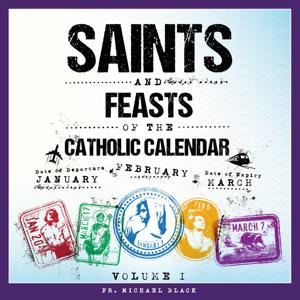
Catholic Saints & Feasts

Catholic Saints & Feasts

Download on the App Store

Catholic Saints & Feasts episodes

  • November 22: Saint Cecilia, Virgin and Martyr
    November 22: Saint Cecilia, Virgin and Martyr
    c. Third Century
    Memorial; Liturgical Color: Red
    Patron Saint of Music and Musicians

    A girl martyr’s mysterious death seizes the imagination

    The First Eucharistic Prayer, also known as the Roman Canon, is principally a liturgical document. But like so many things liturgical, it also has immense historical value. Only a tiny fraction of the ancient world’s documents have survived. Archives flood, libraries burn to ash, monasteries collapse, castles are sacked, and coastlines erode—the cities perched above them crumbling into the waves, everything lost, as the sea pushes inland. When documents disappear, historians must work from scraps of pottery and marble, or from the detritus of watery shipwrecks, to gather just tiny pieces of the fuller mosaic of what once was. The Catholic Church is a phenomenal exception to culture’s progressive Alzheimer’s. In its law, catechisms, calendar, feasts, buildings, hierarchy, and most especially in its liturgy, the Church’s past is never really past. Catholicism’s collective memory is stored, not in rack upon rack of digital servers in hermetically sealed rooms, but in the minds of its hundreds of millions of adherents. The faithful are the cloud. Priests and religious in particular circulate the living faith, ensuring that it is perpetually churning, flowing, and spreading like a rushing river.

    The names of the martyrs listed in the Roman Canon include today’s saint, Cecilia. From one perspective, that is all we need to know. She lived. She was martyred. She was remembered. Cecilia’s name was included in the only Eucharistic Prayer then said at Sunday Mass, presumably because she stood out from the many other martyrs for a particular reason. That reason has been lost. Perhaps a stirring homily, committed to writing, preserved moving details of Cecilia’s life and tragic death. But maybe that homily was converted to cinders and slowly floated away when the enormous library of the Monastery of Cluny burned during the French religious conflicts of the 1500s. Perhaps there was a biographically detailed marble epitaph over Cecilia’s grave in the catacombs. Yet maybe that epitaph was wrenched from the wall by a barbarian plunderer who later used it as a sturdy doorstep for his house in Aachen.

    Cecilia’s details are lost, for reasons unknown. But the Roman Canon is not lost, and it gathers together some notable virgin martyrs of the first few centuries: “...Agatha, Lucy, Agnes, Cecilia, Anastasia…” Like flies in amber, their names are preserved, to be heard in hundreds of languages by millions of people every week until the end of time.

    Cecilia was likely martyred by cuts to her neck after attempts to steam her to death were unsuccessful. She was then buried in a loculus near the papal crypt in the Catacombs of Saint Callixtus. After being the object of devotion in the catacombs for centuries, Cecilia’s remains were transferred by the Pope in the early 800s to her own Basilica in the Trastevere neighborhood of Rome. During some restoration work on the Basilica in 1599, Cecilia’s body was uncovered and found to be incorrupt. Before contact with the atmosphere caused her fragile, paper-mache like skin to disintegrate, an artist carefully noted what he saw. His sculpture of Saint Cecilia is evocative and justly famous. The marble itself seems to rest in peace. It is not a forward, glorious pose in the Counter-Reformation tradition dominant when the statue was executed. The marble is white, reflecting Cecilia’s purity. The saint’s face and hair are mysteriously covered by a sheet, inviting the mind to wonder. Cecilia’s fingers seem to form a cryptic Christian symbol of the Trinity—Three in One. And her neck is sliced by the stroke of an axe.

    The sculptor’s personal testimony is embedded in the floor near his work: “Behold the body of the Most Holy Virgin, Cecilia, whom I myself saw lying uncorrupt in her tomb. I have in this marble expressed for thee the same saint in the very same posture and body.” We don’t know the full story of our saint, but we are certain of her end—a generous act of self gift to Christ.

    Saint Cecilia, you died an early death, preserving your virginity and choosing Christ over all others. Be an example to all youth of the true goal of their lives. Help them to seek God first and the good and holy pleasures of life only after Him.
    7 min
  • November 21: The Presentation of the Blessed Virgin Mary
    November 21: The Presentation of the Blessed Virgin Mary
    Memorial; Liturgical Color: White

    Mary was likely consecrated to God as a child

    Stillbirths, infant mortality, and mothers’ dying during labor have been among the most predictable human tragedies since time immemorial. Medical progress has only in recent generations dramatically reduced such deaths, albeit unevenly throughout the world. In light of the real dangers of pregnancy and childbirth, the successful birth of a healthy baby has naturally given rise to ceremonies in many cultures thanking God for the precarious gift of new life. Jewish law required the ritual dedication of first-born sons to God in the Temple. It is probable that a similar custom, if not a law, called for Jewish girls to also be so dedicated. It is the likely presentation of the child Mary in such a ceremony that we celebrate today.

    The Church does not claim that today’s feast is rooted in Sacred Scripture. There is no direct biblical support for Mary’s Presentation except in the apocryphal “Gospel” of Saint James, a problematic text replete with follies. The lack of textual support is, nevertheless, no reason to doubt the ancient tradition, especially preserved in Eastern Orthodoxy, that Joachim and Anne consecrated Mary, their daughter, to God at the age of three in the Jerusalem Temple. The prophet Samuel was similarly presented by his mother, Hannah. Both Hannah and her namesake, Anne, were long barren and were thus all the more grateful to see the fruit of their unexpected pregnancies.

    It is a good and holy thing for Christian parents to proactively dedicate their children to God, or even to invite them to consider a life consecrated to God as priests or religious. While some may consider it an unwise imposition for parents to so explicitly encourage their children to take steps down that holy path, all parents, in fact, are energetic in promoting some level of conformity with their own religious or quasi-religious beliefs. These “beliefs” may be related to the environment, politics, leisure, art, sports, or a thousand other causes or hobbies. Parents always indoctrinate their children. It is intrinsic to their role. The only question is what the content of that indoctrination will be. Ideally, Christian parents hand on to their children their most deeply held beliefs—including their faith in Jesus Christ.

    The essence of any sacrifice is to burn, kill, or destroy something of value in order to close the yawning gap between God and man. A sacrifice can be in thanksgiving, to repent of a sin, or in petition for a favor. Primitive priests in cultures across the globe since time immemorial have stood at their rough stone altars on behalf of their people to offer God fatted calves, heifers, sheep, the finest grain, red wine, and even their fellow man. Abraham was willing to offer his very own son to God. Blood sacrifice gradually receded in Judaism, however, to bloodless sacrifice, and eventually to non-sacrificial pathways to God. The age of priests in the Jerusalem Temple sacrificing animals gradually mutated, from the late first century onward, into rabbis in synagogues teaching from books.

    To present a child to God, either in a formal ritual or in a private dedication, is to lay that child on a symbolic altar and to say to God: “You create. We procreate. My child is Your child. Do with this child as You will.” Such humble and antecedent submission to the will of God is not an abdication of the duty to form a child in human and religious virtue. It is just to be realistic. Children are gifts, not metaphorically but actually. A child is not a piece of property or an object a parent has a right to possess. No one understands this like the infertile couple. When parents consecrate a child to God, whether at baptism or otherwise, even informally, they are manifesting a willingness to return a gift to its remote source, to please the Maker by giving Him what He already possesses, life itself and all who share in it.

    Saints Anne and Joachim, in gratitude for the gift of life, you presented Mary in the Temple. Help all young parents to see in you a model of dependence on God’s providence and may similar consecrations in today’s world prepare saints for the Church of tomorrow.
    6 min
  • November 20: St. Bernward of Hildesheim, Bishop
    November 20: Saint Bernward of Hildesheim, Bishop
    c.960–1022 
    Optional Memorial; Not on Universal Calendar; Liturgical Color: White 
    Patron saint of goldsmiths & architects 

    A well-educated and pious bishop sponsors the practical arts 

    Some doors in the city of Rome draw people in like huge vertical magnets, pulling groups of pilgrims slowly towards them across broad atriums. The dots of laser pointers dance over the doors of the Basilica of St. John Lateran as guides point and explain how these towering doors once swung open onto the Roman Curia, where senators in white togas stood debating matters of empire. The colossal, sober, bronze doors of the 2nd century Pantheon still hang from its jambs.  And the large, intricate, wood paneled doors of Santa Sabina date from the 430s! The eyes of today’s saint, Bernward of Hildesheim, gazed up in wonder at these very same sets of doors when he visited Rome in the year 1001. And while he gazed, he also resolved to carry back just a bit of this Roman elegance, this Roman nobility, this Roman weight, to the cold land, to the far land, he had come from. 

    St. Bernward of Hildesheim lived at the half-way point between us and Jesus Christ. His life spanned mankind’s crossing from the first to the second millennium.  Bernward had an impeccable pedigree, with the branches of his noble family tree extending throughout lower Saxony, in today’s northern Germany. His family lineage, fine education, and personal piety opened doors of power and influence to him throughout his life. He was chosen as the tutor to the most important man of his time and place, Otto III, who became the Holy Roman Emperor. And he was appointed bishop of Hildesheim at a young age in 993 and remained in that position, and in that town, until he breathed his last thirty years later. 

    Bernward lived long before the founding of the great universities of Europe, in an age when monasteries and cathedrals were Europe’s preeminent centers of learning. A cathedral school, in particular, was the equivalent of an elite prep school today. It was as important to a diocese as the cathedral itself. Bernward attended the cathedral school of Hildesheim as a youth long before becoming bishop of the same diocese.  

    The academic theology done in Europe’s universities starting in the 1200s created a more disciplined and professional guild of theologians but moved theology to a neutral location. In Bernward’s more feudal age, men learned theology in the beating heart of the church, in the red-hot centers of prayer and apostolic activity where the faithful habitually gathered – in cathedrals and monasteries. Bishops, thinkers, and authors baptized babies, said funeral masses, anointed the sick, sang vespers, and led processions while also studying and writing. Their audience was the faithful. Their forum was the pulpit. University-based theology was severed from the great centers of spirituality so familiar to the first millennium. It was more scientific, yes, but also more dry. St. Bernward was a man of the first millennium. His public was not other academics but his happy people. His theology was both intellectual and practical, with church ideas and church life braided tightly together, as they should be. 

    Bernward mastered the seven liberal arts common to his age and showed a keen interest in practical craftmanship. He was an energetic bishop who commissioned the building of castles, an abbey, and numerous decorative items for his churches. Inspired by his extended roman visit, he ordered a huge set of bronze doors for his cathedral, known as the Bernward doors. These commanding pieces of functional art, with their simple but expressive figures in deep relief, can still be admired today. They were not made of perishable material. They were made to last and have lasted for half the life of the church.  

    St. Bernward’s kind disappeared with his epoch. The monastic reforms of Cluny and the later groundbreaking ways of the Franciscan and Dominican Orders spread like wildfire in the 1200s and brought a definitive end to first millennium Catholicism. We remember St. Bernward today because he was a model bishop committed to one diocese and one people in matters practical and spiritual.  

    St. Bernward, your education, piety, mortification, and practical concern for your faithful have kept the flame of your memory burning in your see city. We seek your divine intercession on behalf of all bishops, that they may emulate your fund of virtues. Amen. 
    8 min
  • November 16: Saint Gertrude, Virgin
    November 16: Saint Gertrude, Virgin
    1256–1302
    Optional Memorial; Liturgical Color: White
    Patron Saint of nuns and of the Diocese of Magdeburg, Germany

    Incandescent visions of Christ drew her into the deep

    Today’s saint, known as Saint Gertrude the Great, is one of the most provocative spiritual writers in the long and rich history of the Church. When just a child, she was placed in the care of Benedictine nuns, perhaps because of her parents’ early deaths. The high walls surrounding the cloister broadened the young girl’s mind, instead of confining it. For Gertrude, as for so many women of her era restricted by custom to narrow cultural lanes, a monastery-sponsored education amidst a self-governing community of women was superior to the forms of life otherwise available to them.

    Gertrude flourished in religious life and became well versed in the humanities, theology, and Latin, a language which she showed mastery of in her spiritual writings. At the age of twenty-five, Sister Gertrude had a jarring spiritual experience which would divide her life dramatically into two halves, “before” and “after.” “Before,” Gertrude was a faithful nun but overly interested in secular writers and knowledge for knowledge’s sake. “After,” she buried her head in Scripture, read widely in the Fathers of the Church, and melted under the high-amperage gaze beaming at her from the eyes of Christ.

    Gertrude struggled to convey in words the richness of her spiritual experiences. A distillation of her visions covers five volumes known in English as the Revelations of Saint Gertrude. Metaphors, adjectives, and other superlatives flow from our saint’s pen on page after page as she tries to capture the incandescent mystery of what she sees, hears, and feels. In a heavy, syrupy style common to her era, Saint Gertrude oozes about the intense love of Christ for mankind as symbolized by His Sacred Heart. More than three centuries before the visions of Saint Margaret Mary Alacoque in France, Saint Gertrude had visions of the Sacred Heart of Jesus! In one vision, Saint John the Evangelist placed Gertrude close to Christ’s wounded side, where she could feel His pulsating heart. Gertrude asks John why he did not reveal the mystery of Christ’s loving heart to mankind. Saint John responds that his duty was to reveal the very person of Christ, but it was for later ages, colder and more arid in their love of God, to discover His Sacred Heart.

    Gertrude lived a “nuptial mysticism” in which she was Christ’s bride and the Mass was the wedding banquet at which a chaste self-giving consummated the sacred bond of lover and beloved. Gertrude’s vowed virginity was the proof and basis of her enduring commitment to Christ, a promise made in the company of His mother, Mary, and all the angels and saints. Gertrude composed her spiritual diaries at the express command of her spouse, Christ. Their hymns, prayers, and reflections also show a profound concern for the holy souls in purgatory. Gertrude continually begged Christ’s mercy on them, and Christ responded that merely petitioning for the release of such souls was sufficient for Him to grant the favor.

    In Gertrude’s visions, Jesus speaks to her almost exclusively at Mass and during the Liturgy of the Hours. This is consoling. Most Catholics meet Christ more through the Sacraments than through books, so Christ appearing in priestly vestments, holding a chalice, or standing at an altar is absolutely congruent with our experience of Sunday Mass. Apart from her writings, few details of Gertrude’s life are known. She left virtually no footprint besides her life of quiet fidelity as a contemplative nun. Like John the Baptist, she decreased so the Lord could increase. Gertrude’s alluring private revelations became common spiritual reading among the saints of the sixteenth and seventeenth centuries and continue to fire the imagination of all who read them today.

    Saint Gertrude, as we turn the pages of your mystical revelations, we meet the true Christ, so powerful yet so close to us in His Sacred Heart. May we respond as you did to Jesus’ invitation and dedicate our lives totally to Him.
    6 min
  • October 5: Blessed Francis Xavier Seelos, Priest (U.S.A.)
    October 5: Blessed Francis Xavier Seelos, Priest (U.S.A.)
    1819–1867
    Optional Memorial; Liturgical Color: White
    Invoked against cancer

    A good man becomes a great priest serving immigrants in the young United States

    Ship after ship, riding low in the water with the weight of thousands of European immigrants, docked in the harbors of the great coastal cities of the United States in the nineteenth century. Transatlantic ship passage was by then routine and relatively safe. These immigrants traveled to America’s open prairies and virgin forests to carve out farms, charter towns, and establish schools where none had ever existed before. These daring men and women came to build new lives, lives often of deep faith. So priests and nuns came with them, planting the seeds of an ancient religion into fresh soil.

    Today’s Blessed was one of those immigrants. Francis Seelos was born into a large family in Bavaria, a land thick with medieval castles, crusader tombs, and timeless traditions. Francis left that rich culture for a new life on the American frontier. He exhausted himself riding horseback, walking, and traveling by ferries and trains up and down and across the wide flowing rivers and narrow dirt roads of the young United States, serving new citizens but age-old Catholics.

    Blessed Francis felt the call to the Priesthood from a young age. He had the support of his family and local clergy and duly studied

    philosophy and theology from some distinguished professors in his native land. One of his Benedictine teachers was the pioneer who later brought the Benedictine Order to America. By accidents of history, the Redemptorist Order, though founded in Italy by an Italian, had become more prominent in Germany. Francis met Redemptorist priests during his education and became intrigued with their work among the immigrants who had emptied out swathes of Germany to go to America. So Francis joined the Redemptorists with the specific intention of serving the many priest-less German Catholics across the ocean.

    It was not easy for Francis to leave his close-knit family. Only his father knew his secret plan. Only his father knew that Francis’ departure for the seminary would be the last time he would ever leave home. Francis embraced his mother and siblings and said goodbye. He then came to his father, who, wordless, tearfully gestured with his finger toward the sky. Son and father knew. They would meet again in heaven. Francis never saw his family again.

    Francis arrived in New York in 1843 and was ordained a priest in 1844 in Baltimore, Maryland. He was first assigned to a parish in Pittsburg, and then was assigned to serve alongside Saint John Neumann, a fellow Redemptorist. They carried out ordinary parish duties and gave parish missions. Father Francis quickly gained a reputation as holy, always available, amiable, and wise. Like Neumann, he became well known as a sage confessor who exercised this ministry of mercy in multiple languages.

    Father Francis’ apostolic zeal, prudence, kindness, and doctrinal integrity thrust him into positions of leadership in his order. He was so skilled a priest, and so admired for his virtue, that he was proposed to be the Bishop of Pittsburgh. Francis only narrowly avoided this exalted burden by personally writing to Pope Pius IX arguing for his own inadequacy. After years of priestly service in America’s eastern portion, Francis became an itinerant German and English preacher in the nation’s middle, crisscrossing Illinois, Michigan, Wisconsin, and Missouri.

    In 1866 Father Francis was assigned to New Orleans, where he continued his tireless, uncomplaining priestly service, and where his prayers were considered unusually efficacious. But in New Orleans

    his service came to an end. He contracted yellow fever while visiting some of its victims. He died at 48 years old, but not before at least one miracle of healing was attributed to his intercession while he lay dying. His cause was opened in 1900, and Francis Seelos was beatified in 2000 by Pope Saint John Paul II. This priest par excellence stands shoulder to shoulder with Saints Marianne Cope, Damian de Veuster, John Neumann, Mother Frances Xavier Cabrini, and thousands of non-saint clergy and nuns, all nineteenth-century European immigrant missionaries to America. They each left things comfortable and known for their opposites. They each made immense personal sacrifices to pass on the faith, to give a new church new heroes.

    Blessed Francis Xavier Seelos, your zeal, intelligence, and innate goodness was plain for all to see. You were an ideal priest loved by all you encountered. Through your intercession, help all missionaries to persevere in their difficult vocations in unfamiliar lands.
    7 min
  • August 9: Saint Teresa Benedicta of the Cross, Virgin and Martyr
    August 9: Saint Teresa Benedicta of the Cross, Virgin and Martyr
    1891–1942
    Optional Memorial; Liturgical Color: Red
    Co-Patron Saint of Europe

    A Jewish intellectual discovers St. Teresa of Ávila, converts, and dies for her race

    Edith Stein, today’s saint’s given name, was a highly cultured European intellectual. She obtained a doctorate in philosophy summa cum laude from a German university after being accepted as a student by a renowned philosopher. She mastered numerous languages and worked as both a nurse and interpreter during World War I. She was a naturally gifted and effective teacher. She translated various works of Saint John Henry Newman from English and a work of Saint Thomas Aquinas from the original Latin. She published a book called Potency and Act on some foundational concepts in Thomism. Her erudition opened doors to elite circles of artists, philosophers, and other creators of culture. Yet she decided, in the flower of her life, to leave the shore, to wade into the sea of God, and to dive deep for the pearl of great price.

    Years after converting to Catholicism, Edith took vows as a Carmelite nun, becoming Teresa Blessed (or “Benedicta”) of the Cross. Yet in the convent, her worldly achievements counted little. When she first walked through the doors, one of Mother Superior’s initial questions to her was: “Can you sew?” The science of the Cross had begun.

    Edith Stein was born and raised a Jew, the last of eleven children in a pious, middle-class German family. But she lost a living faith as a teenager and stopped praying. After passing all of her courses with distinction, and after serving at a war hospital in Austria, she finished a doctorate on the subject of empathy. She then became a full-time assistant to her philosophical mentor. Edith had various positive experiences with individual Christians during the war years. She saw, first hand, how Christians understood their own loss and suffering in light of the Cross of Christ. On a visit to the Cathedral of Frankfurt, these experiences of others’ faith merged, rather suddenly, with a profound experience of her own. From the back of the church, Edith saw a woman with a shopping bag enter, kneel in prayer for a few moments, genuflect, and then depart. Our saint was deeply moved by the mystery of it. The woman clearly came into the church to have a short conversation with someone. Edith had never seen anyone do this in a synagogue or in a Protestant church. It struck her—Truth is a person, not a mere concept. God is living, breathing Truth in the person of Jesus Christ.

    A couple of years later, in 1921, while spending time at a friend’s home, she discovered an autobiography of Saint Teresa of Ávila in the home’s library and started reading it. She read all night. She read until the sun came up. In the morning she bought a Catholic Catechism and devoured that too. She had finally found the truth she couldn’t quite find in her philosophical studies. She would convert to Catholicism. On January 1, 1922, Edith Stein was baptized. She was confirmed the next month by the local bishop in his private chapel. When she went home to tell her mother that she was now Catholic, the two could only cry in each other’s arms at their complex emotions. After her conversion, Edith taught at a Dominican high school, engaged in scholarly work, and lectured on women’s issues with the encouragement of her bishop.

    Finally, in 1933, after experiencing the dawning anti-semitism of the Third Reich, Edith fulfilled a long-held dream and entered the Carmelite convent in Cologne. Before entering, she went home to say a bittersweet goodbye to her family and attended synagogue one last time with her mother, who felt betrayed and who never responded to any of her daughter’s many subsequent letters. Sister Teresa Benedicta took final vows in 1938. On New Year’s Eve of that same year, she secretly transferred to a Carmelite convent in the Netherlands to escape Germany’s insane anti-semitism. There, she was a model nun, devoted to Saint John of the Cross and to the Carmelite spirituality of the Cross. She prayed in front of the tabernacle for long hours and wrote for many more.

    After the Dutch bishops released a letter protesting the deportation of Dutch Jews, the retaliation against the Church was swift and merciless. The gestapo soon pounded on the doors of all local convents to take away any Jewish converts. On August 2, 1942, Edith was praying in the chapel when the gestapo came. She had five minutes to leave. Edith and her sister Rosa, also a convert who was helping in the convent, were taken away. They were transported in trains, like cattle, to Auschwitz, gassed to death, and cremated, most likely on August 9, along with hundreds of other Jews. Edith Stein was sharply aware of her double spiritual identity as a Jew and a Catholic. She knew she was dying, spiritually and physically, for each of her identities. Her iconic life and death, so redolent of the tensions of the twentieth century, caused Saint John Paul II to name her a co-patron of Europe. She was beatified in Cologne in 1987 and canonized in 1998 after a miraculous healing of a little girl in the state of Massachusetts was attributed to her intercession.

    Saint Teresa Benedicta of the Cross, you were Jewish by blood, Catholic by baptism, and Carmelite by solemn vows. Your multiple spiritual identities, complex mind, and education found their unity in Christ. May we follow your example in finding our unity in Him as well.

    8 min
  • July 21: Saint Lawrence of Brindisi, Priest and Doctor
    July 21: Saint Lawrence of Brindisi, Priest and Doctor
    1559–1619
    Optional Memorial; Liturgical Color: White
    Patron Saint of Brindisi, Italy

    A little-known Doctor of the Church did it all and did it well

    Julius Caesar Russo was born into a religious family, yet from a young age was drawn to join another religious family—that of Saint Francis of Assisi. After his father’s early death, little Julius was placed in the care of the Friars Minor by his mother. Upon moving to Venice, though, he came to know the Capuchins, another expression of Franciscanism, and joined their Order as a teenager. He took the religious name of Lawrence, was ordained a priest in 1582, and from that point on plowed his way through life like a high speed train. Father Lawrence bulleted north and south, east and west, stopping in Italy, Germany, Austria, Hungary, France, Bohemia, Spain, and Portugal. This one-man army seemed to be everywhere, doing everything, and yet always made the salvation of his own soul his highest priority.

    Father Lawrence was smart. Very smart. His intellectual gifts were fully deployed in the service of the Lord to master whatever discipline he studied. He learned the biblical languages of Greek, Hebrew, Latin, and Syriac. In addition to his native Italian, he also spoke Spanish and German, which he put to extensive use in his ministry in Central Europe. His knowledge of Scripture was so wide and so deep that it seemed he had memorized the entire Bible. He even earned the esteem of Jewish scholars for his profound understanding of rabbinic texts.

    Lawrence also cultivated a burning love for Jesus Christ, the Virgin Mary, and the Holy Eucharist in long hours of prayer. It sometimes took hours for him to say Mass. He seemed to be carried away in ecstasy and had the gift of tears. This level of fervor, education, poverty, intelligence, and devotion to the Church made Saint Lawrence of Brindisi the ideal priest for his time and place. He was many things, but among them he was the ultimate Counter-Reformation warrior.

    Saint Lawrence explained with great force and lucidity the truths of the Catholic faith to those who had fallen into the trap of Protestantism. He calmly elaborated upon the Scriptural and patristic foundations of the Papacy, Bishops, Mary, and the Sacraments. Lawrence was the anti-Luther and the epitome of the great Capuchins who invigorated Franciscanism in the 1500s and beyond. Amid all of his labors as a preacher and teacher, Lawrence also carried out a parallel set of demanding duties in the administration of the Capuchin Order. He was a novice master, provincial, and minister general, or head, of the Order. Father Lawrence completed mountains of work, day in and day out, for many years, a sustained drive and competence which inevitably led to him being burdened with still more weighty responsibilities.

    As a Franciscan dedicated to preserving and restoring peace, Lawrence was tasked by both the Holy Father and secular princes with various diplomatic missions geared toward settling controversies among Christian states and between these states and the surging Ottoman Empire. Yet Lawrence’s desire for peace was not divorced from truth, from the right to self-defense, or from love of Christian Europe.

    He was the chaplain of a Christian army which was mustered in Germany against the Turks at Lawrence’s insistence. Lawrence then personally led the troops into battle with his crucifix held high. The German army’s victory was attributed to our saint’s intercession and inspiring example. Saint Lawrence died on his birthday, July 22, at age sixty, while on a diplomatic mission to Lisbon, Portugal. He is buried in a monastery in Northern Spain and was canonized in 1881. In 1959 Pope Saint John XXIII proclaimed Saint Lawrence of Brindisi an Apostolic Doctor of the Church for his creative yet orthodox writings on the Virgin Mary and for his commanding erudition in, and harmonious presentation of, Scripture, patristics, and fundamental theology. He is the third Franciscan Doctor of the Church, along with Saints Bonaventure and Anthony, and, unfortunately, one of the least well known.

    Saint Lawrence, you were ideally suited to the needs of your age and moved all you met through your virtuous example, vast knowledge, and life of prayer. Through your intercession, help all priests, especially Franciscans, to not spare themselves but to emulate your zeal.
    7 min
  • January 4: Saint Elizabeth Ann Seton, Religious (U.S.A.)
    January 4: Saint Elizabeth Ann Seton, Religious (U.S.A.)
    1774–1821
    Optional Memorial; Liturgical Color: White
    Patron Saint of Catholic schools, widows, loss of parents

    She had it all, lost it all, and then found it all again

    In late 1803, Elizabeth Ann Seton, with her husband, left the United States for Italy, as a confident, high-born, wealthy, educated Yankee Protestant. She returned in June 1804, bankrupt, a widow, burning with love for the Holy Eucharist, tenderly devoted to Mary, and with the heart of a Roman Catholic. She was received into the Church the next year. Her upper-class friends and family abandoned her out of anti-Catholic spite.

    Our saint was an unexpected convert. She was, well into adulthood, a serious U.S. Episcopalian. She loved the Lord. She loved the Bible. She loved to serve the poor and the sick. Her excellent Episcopalian upbringing provided sufficient preparation for not being Episcopalian any longer. She took that faith as far as it could go. She probably never suspected her faith was lacking until she experienced the abundance of Catholicism.

    After her husband died of tuberculosis in Pisa Italy, Elizabeth and her daughter were taken in by family friends from nearby Livorno. In God’s providence, this Italian family lived their faith with relish. Elizabeth was not only consoled and cared for by them in her grief but also saw how engrossing their faith was. The longer she stayed in Italy, the more its Catholic atmosphere enveloped her. She wept at Italians’ natural devotion to Mary. She wondered at the beauty of a Corpus Christi procession through the narrow streets of her town. She understood the Holy Father’s link to the early Apostles with clarity. And so she came to see the gaps in her native religion. She hadn’t noticed them before. Having seen the real thing with her own eyes, she knew that she held a replica in her hands. The real presence of Christ in Catholicism is often understood only after a real absence is felt in non-Catholic Christianity.

    After her conversion, Elizabeth spent the rest of her short life dedicated to Catholic education. She started a Congregation of sisters in Maryland that taught girls, especially poor girls who could not afford an education. She was the first of tens of thousands of teaching sisters to operate Catholic schools in the United States. She is rightly considered in the United States as the foundress of Catholic parochial education. Besides her husband, she also lost two of her five children during her lifetime. She struggled, like all founders, to build up her Congregation. But her intelligence, charm, and drive paid off. Her Order thrived and thrives still. The Daughters of Charity of St. Vincent de Paul gather each year on this feast near her tomb inside an immense Basilica in Northern Maryland to thank God for their foundress, for a life so well lived.

    Saint Elizabeth Ann Seton, help us overcome the alienation of family due to our religious convictions. Aid us in persevering through the hardships of illness and death, and give us the same zeal for souls that you showed toward your students, seeing in each one the image of God.
    5 min
  • January 2: Saints Basil the Great and Gregory Nazianzen, Bishops and Doctors
    January 2: Saints Basil the Great and Gregory Nazianzen, Bishops and Doctors
    St. Basil: 329–379; St. Gregory: c. 329–390
    Memorial; Liturgical Color: White
    Patron Saints of Russia, monks, hospital administrators, and poets

    Obvious truths are hard to explain, but smart theologians can explain them

    The persecution of the Church in the first few centuries, sometimes aggressive, more typically passive, starved her skinny biblical frame of nourishment. When the Emperor Constantine legalized Christianity in 313 A.D., the Church’s bones finally stretched, grew, and added muscle on muscle. Churches opened. Bishops preached. Schools taught. Theologians wrote. And, most significantly, Councils met. Three hundred years after Jesus Christ ascended into heaven, these large gatherings of bishops and theologians sought to end theological confusion, to settle thorny questions, and to establish a standard Christian doctrine. In the vast halls and churches of these councils, the great cast of theologians of the fourth century put their prodigious talents on full display. We commemorate two of the greatest of these bishops and theologians in today’s memorial.
    Saints Basil and Gregory lived so long ago, were so prolific, and played such crucial roles in so many areas of Church life, that they could each be remembered for any number of contributions to liturgy, theology, ecclesiology, Church history, monasticism, and even popular customs, especially in the Orthodox East. Yet perhaps their greatest contributions were as theologians who defined, fundamentally and decisively, what the word Trinity actually means; how Jesus is both fully God and fully man; and how the Holy Spirit is related to God the Father. Such definitions and distinctions may seem technical, abstract, or remote. But it is always the most obvious things—the most necessary things—that are the most difficult to explain. Why do things fall down instead of up? Why does the sun rise in the east instead of the west? Why are there seven days in a week instead of nine?
    The most fundamental doctrines of our faith, understood now as perennial, were not always perennial. They originated in the minds of certain people at certain times in certain places. To today’s saints we owe the decisive words that the Holy Spirit “proceeds” from the Father and the Son. These words fall simply and familiarly from our lips. But the word “proceeds” was the fruit of intense thought and prayer. The Father generated the Son, but the Holy Spirit “proceeds” from them both. Interesting. Dozens of millions of Catholics say reflexively every Sunday that the second Person of the Trinity is “consubstantial” with the Father. Not equal in origin. Not equal in role. But “consubstantial,” or equal in nature. Thank you, Saints Basil and Gregory! Thank you, great Bishops and Doctors of the early Church! Thank you for pulling aside the veil of mystery for a peek into the Godhead.
    Without the teachings of the fourth century on the Trinity and Christ, there would be no Christmas trees. Think about that. Why celebrate the Christ child if He were not God? But He is God. So carols are composed, mangers are set up, lights are hung, and gifts are exchanged. Culture happens, culture flourishes, when theology makes sense. Thank you, Saints Basil and Gregory, for… everything!

    O noble Bishops and Doctors Basil and Gregory, we ask for your continued intercession to enlighten our minds and to remove the dark shadows that cause confusion. Assist us to recognize that good theology understands God as He understands Himself. When you gave us good teaching, you gave us God. We seek nothing more.
    6 min
  • Sunday in the Octave of Christmas: The Holy Family of Jesus, Mary, and Joseph
    Sunday in the Octave of Christmas: The Holy Family of Jesus, Mary, and Joseph
    Or December 30 if there is no such Sunday
    Feast; Liturgical Color: White

    Model for Christian families

    The Holy Trinity is like a family; God’s Son lived family life
    Language is like currency. There must be a common understanding of its value for it to function as an effective means of exchange. When that common agreement deteriorates, wages, prices, and costs cut anchor, and economies drift. Similarly, a word can drop in value, suffer inflation, or entirely lose its meaning when a language group loses a common understanding of its meaning. This has happened to the word “family.” Some have inflated the value of “family” to mean any grouping of two or more people, or even one person and a dog. For others, “family” has lost value since their personal experiences of family life were dysfunctional and damaged their mental and emotional development. On today’s Feast of the Holy Family, the Church defends normalcy. She holds up what has always been. She offers her faithful the model of what family life should be.

    Reflections on the Holy Family presuppose a lack of ambiguity on what the word family means. Common cultural understandings of marriage and family create space for more mature spiritual and theological reflection. But if a certain percentage of a culture matures without, for example, experiencing the love, discipline, and guidance of a good father, then it is difficult to talk about the goodness, mercy, and justice of God the Father. Those who didn’t have a father, or whose father was largely absent, will struggle to connect with God the Father being at the same time a judge, a source of mercy, and a font of unconditional love. The same applies to family life in general. A person lacking a personal experience of an intact family, even a family replete with tensions and imperfections, will fail to understand what “family” even means.

    Today we commemorate the fact that God chose to be born and raised in the same environment as all men, when He could have chosen otherwise. We can do no better than to reflect on the beautiful and profound words of Pope Benedict XVI in his message for the 2008 World Day of Peace:

    “The first form of communion between persons is that born of the love of a man and a woman who decide to enter a stable union in order to build together a new family...The natural family, as an intimate communion of life and love, based on marriage between a man and a woman, constitutes “the primary place of ‘humanization’ for the person and society,” and a “cradle of life and love”…Indeed, in a healthy family life we experience some of the fundamental elements of peace: justice and love between brothers and sisters, the role of authority expressed by parents, loving concern for the members who are weaker because of youth, sickness or old age, mutual help in the mutual necessities of life, readiness to accept others and, if necessary, to forgive them. For this reason, the family is the first and indispensable teacher of peace…Where can young people gradually learn to savor the genuine “taste” of peace better than in the original “nest” which nature prepares for them?...This point merits special reflection: everything that serves to weaken the family based on the marriage of a man and a woman, everything that directly or indirectly stands in the way of its openness to the responsible acceptance of a new life, everything that obstructs its right to be primarily responsible for the education of its children, constitutes an objective obstacle on the road to peace.”

    Holy Family of Nazareth, be a model of tranquility and harmony for all families. Give powerful graces to husbands and wives, children and siblings, to overcome differences so they can build a common life with your own as a model.
    6 min

About Catholic Saints & Feasts

From the publisher's feed

"Catholic Saints & Feasts" offers a dramatic reflection on each saint and feast day of the General Calendar of the Catholic Church. The reflections are taken from the four volume book series:…