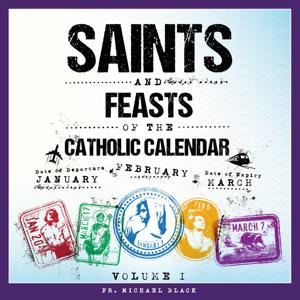
Catholic Saints & Feasts

Catholic Saints & Feasts

Download on the App Store

Catholic Saints & Feasts episodes

  • January 7: Saint Raymond of Peñafort, Priest
    January 7: Saint Raymond of Peñafort, Priest
    c. 1175–1275
    Optional Memorial; Liturgical Color: White
    Patron Saint of canon lawyers and medical record librarians

    He wove scripture and the law into a harmonious tapestry

    Today’s saint lived numerous lives inside of his one hundred years on earth. He was an intellectual prodigy who was teaching university-level philosophy by the age of twenty and who took degrees in civil and canon law from the premier law university of the time—Bologna. While in Bologna, he likely came to know the founder of a new religious Order who had also moved there and who would later die there—Saint Dominic de Guzman. The example of the Dominicans led Father Raymond to exchange the diocesan priesthood for the Dominicans.

    Saint Raymond’s abilities and holiness were such that everyone seemed to want him in their service. Kings and Popes and Bishops and Orders all had plans on how to utilize him best. He was called to the Pope’s service to make the great contribution for which he is still known today, the organization of a huge compendium of Church law which served as the basic reference for canon lawyers until the early twentieth century. Exhausted by his three years of effort on this project, he returned in middle age to his native Barcelona.

    But his life of quiet and prayer did not last long. He was shocked to learn from Dominicans sent to him from Bologna that he had been elected the second successor to Saint Dominic as the Master General of the Dominican Order. He served his Order well and dutifully as Master General but not long. He resigned due to old age when he was 65. But there was still a lot of life left to live. Saint Raymond’s activities in his old age included efforts to try to convert the Muslims then occupying Spain, his rejection of an episcopal appointment, the establishment of theology and language schools dedicated to converting Muslims, and his probable personal encouragement of the young Thomas Aquinas to write an apologetic work directed at non-Catholics, the Summa contra Gentiles.

    Saint Raymond’s life shows an admirable synthesis of traditional piety and devotion, service to the Church, obedience to his superiors, love of theology, dedication to his Order, and respect and love for the law. To know, love, and follow the law is not contrary to charity. When kept, the law promotes charity and protects the weak, the poor, and the ignorant from being taken advantage of. It takes very smart and holy people to protect simple people and bad people from themselves. Saint Raymond was smart and holy. He laid his gifts at the altar of God, and God used those gifts splendidly.

    Saint Raymond, teach us to see the law of God and the law of the Church as one harmonious law meant to foster true communion among men and true communion between God and men. May God’s law be our law. And may the law never be an obstacle to true love and devotion.
    5 min
  • January 5: Saint John Neumann, Religious
    January 5: Saint John Neumann, Religious (U.S.A.)
    1811–1860
    Memorial; Liturgical Color: White
    Patron Saint of Catholic education

    He gave of himself until there was nothing left to give

    Today’s saint worked like a mule. He studied, he wrote, he prayed, he preached, he traveled, he built, he founded, he guided, he taught. And then one day, carrying construction plans for his Cathedral in Philadelphia to an office, he died in the street. He had worked himself to death. He was forty-eight years old.

    Saint John Neumann was born in Central Europe in what is today the Czech Republic. Like many people born in small countries, he had to learn more than his native tongue in order to become a success. But Saint John outdid himself. He learned seven languages in addition to his native Czech. He had a gift. Yet he found it hard to find a bishop to ordain him after he had completed his theological studies. He wrote to numerous bishops throughout Europe and to one on the other side of an ocean he had never seen. The other-side-of-the-ocean bishop wrote back: If you can get here, I’ll ordain you. Saint John got there and was ordained in 1836 by Bishop John Dubois of New York, himself a transplant from Paris, France.

    He was assigned to rural areas in Upstate New York and was outstanding in his zeal for souls. But the isolation was a burden, and he felt the need for priestly community. So he joined the Redemptorist Order and began many years of priestly service in Maryland. His intelligence, ability to preach and hear confessions in multiple languages, extraordinary work ethic, life of poverty, good nature, and general holiness were traits that all observed and all admired. He was named the fourth Bishop of Philadelphia in 1852. The city’s growth was exploding, especially its Catholic population of immigrants. Saint John threw himself into his work with no concern for his own well-being. He was a tornado of apostolic activity. He was everywhere and did everything. The Church benefitted and grew at an extraordinary pace. But Saint John’s only gear was overdrive, and he did not personally benefit. Zeal for His house consumed him, and zeal for His house killed him. Yet that is probably the way he wanted it.

    Saint John was buried in a Redemptorist Church in Philadelphia, and his reputation for holiness quickly spread after his death. The faithful asked. The faithful received. The miracles were documented, and Philadelphia had its saint. Saint John Neumann was canonized by Pope Saint Paul VI in 1977, an immigrant who was the first male American citizen to be raised to the altars.

    Saint John, you left home and family to toil in the remote regions of the United States for the sake of the Gospel. Your tireless dedication to the needs of the Church is an inspiration to all, especially priests. Enkindle in the hearts of all priests the same fire of love that burned in your own.

    5 min

About Catholic Saints & Feasts

From the publisher's feed

"Catholic Saints & Feasts" offers a dramatic reflection on each saint and feast day of the General Calendar of the Catholic Church. The reflections are taken from the four volume book series:…