
Sign up to save your podcasts
Or

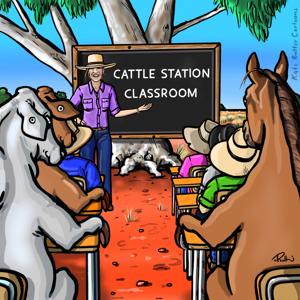


Welcome to the Cattle Station Classroom Podcast. In today’s lesson we are going to be learning about the WA Pastoral Lands Board. The Pastoral Lands Board is a statutory authority established under Section 94 of the Land Administration Act 1997 (WA). The board has joint responsibility with the Minister for Lands for administering Western Australian pastoral leases in accordance with Part 7 of this Act.
To do this I will be joined by Tim Shackleton, who has been the Chairperson of the Pastoral Lands Board since 2017.
Learn more about the WA PLB here: https://www.wa.gov.au/organisation/department-of-planning-lands-and-heritage/pastoral-lands-board
Hosted on Acast. See acast.com/privacy for more information.
Welcome back to another “Station Stickybeak” episode.
This series was created to share an insight into why pastoralists do what they do, given their circumstances – whether it be location, country type, rainfall zone, infrastructure, ownership model, market, or any of the many other factors influencing management decisions.
In each Station Stickybeak episode I’ll chat to Station owners and managers about a range of topics, broadly covering country, infrastructure, cattle, and people to show that there are many ways to achieve positive outcomes for people, livestock, the land and business.
In this episode I sit down with John Henwood who, with his wife Annette, owned and operated Fossil Downs Station in the central Kimberley for over 50 years. John has a wealth of knowledge and experience, and with the assistance of Jardine McDonald we had a great chat with John about Fossil Downs and what he learnt during his time there.
Before we got into the official Stickybeak line of questioning, we were having a yarn about water and fence placement in relation to scrub bulls, and that’s where this episode starts.
Hosted on Acast. See acast.com/privacy for more information.
Welcome back to the Cattle Station Classroom podcast. This episode is the first in a new sub-series we are launching called “Station Stickybeak”, because it is exactly that – a stickybeak.
No two cattle stations are the same, and as such, neither are management strategies.
I wanted to create this series to share an insight into why pastoralists do what they do, given their circumstances – whether it be location, country type, rainfall zone, infrastructure, ownership model, market, or any of the many other factors influencing management decisions.
In each Station Stickybeak episode I’ll chat to Station owners and managers about a range of topics, broadly covering country, infrastructure, cattle, and people. Now, as this was the first episode, I didn’t realise until partway through that the order of topics I had planned for didn’t really make sense, so we did a bit of a shuffle.
The purpose of this sub-series is not to demonstrate the best or only way of doing things – it’s quite the opposite. To share the who, what, where, when and why of different pastoral enterprises around the country, and show that there are many ways to achieve positive outcomes for people, livestock, the land and business.
For our first episode, I sat down with Col Greenfield from Billa Kalina Station in South Australia.
Hosted on Acast. See acast.com/privacy for more information.
Welcome to the Cattle Station Classroom Podcast. In today’s lesson we are going to be learning about the landscape rehydration method of Waterponding.
To learn about waterponding, we are joined by Jardine Macdonald, the Program Manager for Rangelands Natural Resource Management.
Jards is a hydrogeologist who comes from an environmental consulting and mining background, and did research on groundwater recharge and catchment water balance dynamics in the Pilbara.
Starting with Rangelands early 2019, he took up the project management role for the West Kimberley LCDC Smart Farms grant project ‘Brining soil back to life through waterponding’, funded by the National Landcare Program.
The West Kimberley LCDC setup this project with collaborative support of Mel McDonald (previously Rangelands NRM) and Matt Fletcher (DPIRD), building on both Mel and Matt’s waterponding work with guru Ray Thompson and Kimberley stations since 2009.
The West Kimberley LCDC, Rangelands NRM and DPIRD collaborated to complete a month of waterponding with the NSW pros Ray Thompson and Ben McKillop, across West Kimberley LCDC stations at the end of 2019.
As part of this project, the West Kimberley LCDC also produced a video on how to build waterponds which was uploaded to Youtube April this year on the Rangelands NRM channel.
Link to Video: https://youtu.be/UJSrC8uuM98
Link to Webinar recording and presentation slides: https://futurebeef.com.au/knowledge-centre/building-waterponds-with-a-road-grader/
Hosted on Acast. See acast.com/privacy for more information.
Welcome to the Cattle Station Classroom Podcast. In today’s lesson we are going to be learning about Surgical spaying of beef cattle.
Long-term contraception of cattle can benefit the welfare and production of animals where females cannot be segregated from males and in other, limited, circumstances. In extensive pastoral conditions, contraception enables cull females to survive and achieve marketable body condition by preventing the stress of mismanaged pregnancy, calving and lactation.
To do this I’m going to be joined by Dr Dave Morrell. Dave is the founder and owner of Broome Cattle Vets, and has over 40 years’ experience as a small, large and exotic animal vet. Dave actively participated in the Tuberculosis eradication campaign and is an active member of the Australian Cattle Vets and Northern Australia Biosecurity Surveillance network.
In preparation for this episode, I used resources from the Australian Veterinary Association, Meat and Livestock Australia, and the Australian Animal Welfare Standards and Guidelines, all of which are linked in the show notes below.
Resources:
Cattle Standards and Guidelines - Spaying - Discussion Paper
Welfare responses of female cattle subject to reproductive procedures in Northern Australia
Australian Veterinary Association
Rear Window - blog by Robert Johnstone
This podcast is brought you by Central Station and hosted by Steph Coombes, BSc Agriculture (Hons.), MSc Agricultural Communication & Education.
Find over 1200 stories from Outback Cattle Stations at www.centralstation.net.au.
If you enjoyed this podcast, you're sure to love our other series "Central Station - Stories from Outback Australian Cattle Stations"
Hosted on Acast. See acast.com/privacy for more information.
Welcome to the Cattle Station Classroom Podcast. In today’s lesson we are going to be learning about Pregnancy detection for beef cattle.
To do this I’m going to be joined by Dr Dave Morrell. Dave is the founder and owner of Broome Cattle Vets, and has over 40 years’ experience as a small, large and exotic animal vet. Dave actively participated in the Tuberculosis eradication campaign and is an active member of the Australian Cattle Vets and Northern Australia Biosecurity Surveillance network.
To learn more about Pregnancy Testing, visit the FutureBeef website: https://futurebeef.com.au/knowledge-centre/pregnancy-testing/
This podcast is brought you by Central Station and hosted by Steph Coombes, BSc Agriculture (Hons.), MSc Agricultural Communication & Education.
Find over 1200 stories from Outback Cattle Stations at www.centralstation.net.au.
If you enjoyed this podcast, you're sure to love our other series "Central Station - Stories from Outback Australian Cattle Stations"
Hosted on Acast. See acast.com/privacy for more information.
Welcome to the Cattle Station Classroom Podcast. In today’s lesson we are going to be learning about Semen Testing.
To do this I’m going to be joined by Dr Tracy Sullivan. Dr Tracy Sullivan has extensive experience as a large and small animal veterinarian, researcher and a decade's experience working as an accredited bull semen morphologist. She is an active member of the Australian Cattle Vets (ACV), promoter of BULLCHECK and is focused on producer education and the importance of semen analysis as a tool for male fertility evaluation.
This podcast is brought you by Central Station and hosted by Steph Coombes, BSc Agriculture (Hons.), MSc Agricultural Communication & Education.
Find over 1200 stories from Outback Cattle Stations at www.centralstation.net.au.
If you enjoyed this podcast, you're sure to love our other series "Central Station - Stories from Outback Australian Cattle Stations"
Hosted on Acast. See acast.com/privacy for more information.
Welcome to the Cattle Station Classroom
In today’s lesson we are going to be learning about livestock agents. Most of us kind of know the basics of what a livestock agent does – buy and sell livestock – that bit is pretty obvious, but there’s a fair bit more to it and that’s why I wanted to do this episode.
To do this, I’ll be joined by Andrew Stewart, the Principal Livestock Agent for Northern Rural Supplies, in Broome, Western Australia. Andrew has 30 years as a livestock and realestate agent, 20 working in the Kimberley region.
This podcast is brought you by Central Station and hosted by Steph Coombes, BSc Agriculture (Hons.), MSc Agricultural Communication & Education.
Find over 1200 stories from Outback Cattle Stations at www.centralstation.net.au.
If you enjoyed this podcast, you're sure to love our other series "Central Station - Stories from Outback Australian Cattle Stations"
Hosted on Acast. See acast.com/privacy for more information.
Welcome to the Cattle Station Classroom
In today’s lesson, we’re going to be learning about radio communication.
A two-way radio is a fairly standard piece of equipment in the beef industry, and for the most part we simply dial in to a channel, press a button, and connect with someone at the other end. If fact, most people only ever use a small fraction of a two way radio’s function.
There are many different functions available depending on the type of unit, and then there’s things like UHF, VHF, repeater towers, all the buttons and dials, and so much more.
Today I’m going to be speaking with Tony Crooke from GME. Since 1959 GME has been an Australian owned family company and remains the only Australian manufacturer of UHF CB radios, with their products designed, engineered, and manufactured in Sydney’s North West.
GME’s products cover a range of recreational activities from fishing to 4WDing and touring, in addition to catering for heavy vehicles and agriculture. Their Land category encompasses a range of products, the main being UHF CB radios (both Fixed Mount and Hand Held), Antennas, Personal Locator Beacons and accessories.
This podcast is brought you by Central Station and hosted by Steph Coombes, BSc Agriculture (Hons.), MSc Agricultural Communication & Education.
Find over 1200 stories from Outback Cattle Stations at www.centralstation.net.au.
If you enjoyed this podcast, you're sure to love our other series "Central Station - Stories from Outback Australian Cattle Stations"
Hosted on Acast. See acast.com/privacy for more information.
Welcome to the Cattle Station Classroom
In today’s lesson, we’re going to be learning about Personal Locator Beacons.
It’s something we all hope we’ll never have to use, but unfortunately I do know a few people who have had to use theirs. But, what actually is the difference between a Personal Locator Beacon, and an EPIRB, and even those Spot trackers that some people have? Which one should you have and how do they actually work?
Today I’m going to be speaking with Tony Crooke from GME. Since 1959 GME has been an Australian owned family company and remains the only Australian manufacturer of UHF CB radios, with their products designed, engineered, and manufactured in Sydney’s North West.
GME’s products cover a range of recreational activities from fishing to 4WDing and touring, in addition to catering for heavy vehicles and agriculture. Their Land category encompasses a range of products, the main being UHF CB radios (both Fixed Mount and Hand Held), Antennas, Personal Locator Beacons and accessories.
This podcast is brought you by Central Station and hosted by Steph Coombes, BSc Agriculture (Hons.), MSc Agricultural Communication & Education.
Find over 1200 stories from Outback Cattle Stations at www.centralstation.net.au.
If you enjoyed this podcast, you're sure to love our other series "Central Station - Stories from Outback Australian Cattle Stations"
Hosted on Acast. See acast.com/privacy for more information.
From the publisher's feed
Hosted on Acast. See acast.com/privacy for more information.
257 Listeners