
Sign up to save your podcasts
Or

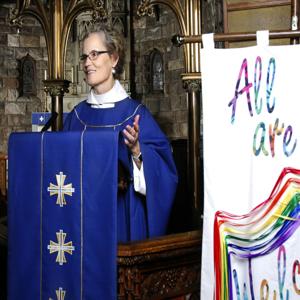


June 2, 2024: May God’s words be spoken. May God’s words be heard. Amen.
Like many of you, I was glued to the television taking in the monumental news this week of a former President of the United States being convicted of 34 felony crimes by the people of the State of New York. Of course, this is new to us here, but many other countries, including France, South Korea, Egypt, Algeria, Japan, Israel, Russia, Norway, Italy, and more, have convicted & imprisoned former heads of state long before we ever got around to just putting one on trial. So, not exactly big news around the rest of the world. Of course there are other trials going on – this time in Federal court – with our own Democratic Senator of NJ Menendez that starts this week, and Democratic Congressman Cuellar from the state of Texas. Corruption seems to know no political party boundary. And none of this is limited to politicians. There was also the news of horrific videos of Sean “Diddy” Combs and the Federal Grand Jury investigation into alleged sexual assault too. And so much more.
The sad truth is that we have an unhealthy habit in this country of assuming that if you are rich, famous, or powerful, you must also be good, right, and just. We tend to put our famous folks up on pedestals, and we become shocked when they come falling down – hard. We want to blame the system. We want to think it can’t be true.
Why is it that we can believe the most horrific things that are untrue about some people, but not believe the very real things about people we like? Well, it is a type of blindness, or really deafness, to what is right in front of us, and it doesn’t happen overnight.
I was thinking about all this when pondering the texts for today. In the story of Samuel in the first reading today, the passage opens with “Now the boy Samuel was ministering to the Lord under Eli. The word of the Lord was rare in those days; visions were not widespread.”
“The word of the Lord was rare in those days; visions were not widespread.” Hold on to that thought as we hear again the story of Samuel.
He was a boy, probably around 12, the first child of Hannah, who had prayed to God, in that very temple where Eli serves, for a child. She promised in that prayer to give the child to God’s service if her prayer were answered. And when she finally gave birth to him and he was fully weaned, she made good on that promise, brought him to the temple, and offered up a prayer. And, if we paid attention, we would hear this in parts of Hannah’s prayer: ‘My heart exults in the Lord; my strength is exalted in my God… …The bows of the mighty are broken, but the feeble gird on strength. Those who were full have hired themselves out for bread, but those who were hungry are fat with spoil…The Lord raises up the poor from the dust; he lifts the needy from the ash heap…”
Sound familiar? It is what Mary, the mother of Jesus, had in her heart when she prayed with knowledge of who it was that was in her womb – and yeah, as I always point out – Mary knew.
Back to the story today though… Eli was old and had stopped listening to God. His sons, leaders in the temple, were corrupt, and they had preyed upon those they were called to serve. Into this environment the young Samuel was offered by his mother in fulfillment of her promise to God. This is why, as the text notes, the boy did not yet know God. There was no one to teach him…at least not until this moment.
Samuel is sleeping in the temple and hears a voice. Now, this might be a warning for everyone – be careful where you sleep. Or, as one pastor put it, the sermon for this text ought to be titled “The Danger Of Sleeping In Church.!”
Anyway, back to young Samuel, he hears this voice calling out “Samuel! Samuel!” He gets up, runs to where Eli is sleeping, wakes him up and says “Got your call – wadda ya need?” Eli, likely annoyed, sends him back to bed. The voice is heard again. Again Samuel goes to Eli, and again Eli tells him to knock it off and go back to bed. Finally, when it happens again, Eli realizes that this isn’t some sort of annoying prank, but that maybe, just maybe, this kid is hearing something from God. So, Eli tells him to go back, and if he hears the voice again, to respond with “Speak Lord, for your servant is listening.” And listen he does – to the bad news that he must deliver to Eli – that God is really ticked off at the wickedness of his sons and his unwillingness to do anything about it – so things are not going to go well for them.
Samuel goes back to his mentor and says, “Eli, ya gonna lose it all.” And Eli responds, “Yeah, that tracks.”[1]
The thing is, this a call story. For Samuel, of course, but also Eli – for though he had long ago stopped listening to God himself, he had the experience and the wisdom to guide the young Samuel in how to listen to God, and thereby enabled the prophetic work he would do in his life.
Now, remember that bit that opened the story of Samuel and Eli? “The word of the Lord was rare in those days; visions were not widespread.” “The word of the Lord rare?”…highly unlikely. The reality was they weren’t listening. God is always speaking – then and now. The question for us, are we listening? Do we even know how to listen?
Samuel could hear, but he didn’t understand. That’s because hearing and listening are not the same thing. He needed someone to help him. Every single person who ever was called into ordained life will tell you that we didn’t understand what it was we were called to without help. People saw in us, or heard God’s call in us – they were able to help us listen, help us respond. Eli may have lost his way, but in a sort of final act of grace, he was able to guide his young charge so that Samuel could do what he was called to do. And to Eli’s credit, he pushed Samuel to fulfill his vow to God and speak the prophetic messages he was told to – no matter how hard it was for Eli to hear.
What about us?
What about you?
Whose voice are you listening to?
Sadly, though many go to church on Sundays, they often follow others – whether on Instagram, Threads, Facebook, the news…whatever it is – we are really good at following. But the one we promise in our baptism to follow – his voice – well, sometimes it just doesn’t break through. Maybe it would be better if Jesus had a Tik Tok channel – you know “Christ Tok.” Like a mug one of you gave me that says “Jesus is my influencer.” The other side of the mug says “Like and follow him.”
Folks, we are not meant to listen and follow to famous people – music or movie stars, politicians, or insta influencers…because when we do that – I can assure you – we will be deeply disappointed. We, who are baptized into him, are meant to listen to Jesus, to hear his voice, to answer his call! And oh how we need to do that these days, because the voices of others are loudly proclaiming to follow Jesus, but advocate with flags, banners, and social media Christian Nationalism.
Now I have been talking about this for some time and I will continue to do so as long as there are those who dare to conflate following Jesus with earthly civil power. These folks are the Elis and his sons of today – they have stopped listening to the Word of God. Worse, there are memes going around where the former POTUS is hugged by Jesus with the words “I too was persecuted, or depicted hanging on a cross with a flag as his loin cloth” I kid you not! To which, I think his mom would like to have a word – something along the lines of the Magnificat “He has brought down the powerful from their thrones, and lifted up the lowly; he has filled the hungry with good things, and sent the rich away empty.” Never, and I mean never, equate the son of God to any human politician, artist, or anything else – no matter who they are. That is blasphemous.
Folks, we have serious work to do, and we cannot delay in doing it. We need to listen to God. We need to speak about our faith. We need to proclaim the good news of Christ – of that unconditional love of God. We need to be guided by the Holy Spirit and help others to be as well.
And that means that sometimes we will have to say things to people, as Samuel did to Eli, that they don’t want to hear.
It means we also need to listen to the ways in which God is calling us.
It means we will need to be watchful for those God is calling, and help them to hear God’s voice – help them to respond and be who they were born to be.
And that takes practice – so it also means we have to continually remind ourselves of who we are and what we are called to do.
I remember a story about the former newscaster, Dan Rather. He spoke once about his way of keeping his professional objective always in mind. He says he looks often at a question he’s written on three slips of paper. He keeps one in his wallet, one in his pocket, and one on his desk. The probing reminder asks, “Is what you are doing now helping the broadcast?”
We should have those notes too – except for us, it would read “Is what you are doing helping spread the good news of Jesus?”
And of course the best place to practice is here – right here in church…though try not to fall asleep.
For it is here that we are reminded of who we are in Word and in sacrament.
Here we are given strength for that call in the real presence of Jesus in the Eucharist.
Here we learn to listen – to listen to God’s voice – because, for perhaps the only time in our busy week, we don’t have our cell phones out, we aren’t also cooking, watching TV, working… those are set aside. Here we allow ourselves the luxury of a singular focus – to listen in heart, mind, and soul, to God.
And when you do this, when you set your ears to listen, you just might feel in your deepest heart some voice stirring. If that happens, remember the words of Eli: Say “Speak God, for your servant is listening.”
And if someone tells you they are sensing something deep inside – something persistent they can’t quite name – tell them to listen more, and help them to hear it, to respond to it, no matter what it may mean for you.
Do this, all of you.
Do it because the world needs prophets – those who hear the Word and share it with others – for there are many powerful voices out there shouting hate and killing God’s children by their words and actions.
The world needs visions – for so many have lost the ability to dream of what can and should be. And visions are the lanterns that light the path toward what is possible.
As we enter this month of June in which we call for an end to gun violence on June 3rd, when we celebrate the freedom of people of color on Juneteenth, when we proclaim that love is love is love in all of this Pride month – we need to remember who we are – to listen for God’s voice, to help others to listen too, and to respond to that voice in the world.
Because that is what being a follower of Jesus is – we listen to his voice and model him in the world.
And that means we never align with earthly power, but serve all of creation, guided by the Holy Spirit, and with the humility of Jesus by the grace of God.
That means we never hate anyone or anything, but love all people unconditionally, and seek forgiveness when we fail, as we humans are bound to do.
That means we do not look to human idols for our guidance, but only to the one true God.
Because Jesus is our influencer – and we follow him.
And because of that, we will fight against injustice, as he calls us to do.
We will speak up for the voiceless, as he calls us to do.
We will be repairers of the breach, as he calls us to do.
We will serve the prisoner, the immigrant, the sick, the poor and thirsty, as he calls us to do.
We will listen to His voice, we will say “Speak God, for your servant is listening.”
And if we do that, all the world will come to know that “The word of the Lord is truly plentiful in these days and visions are widespread” most especially the vision of peace and harmony, of love and joy that God dreams for us all.
Amen.
For the audio, click below, or subscribe to our iTunes Sermon Podcast by clicking here (also available on Audible):
Sermon Podcast
[1] From Matt Skinner on Sermon Brainwave.
The Rev. Diana L. Wilcox
Christ Church in Bloomfield & Glen Ridge
June 2, 2024
The Second Sunday After Pentecost
Proper 4 – Track 1
1st Reading – 1 Samuel 3:1-10(11-20)
Psalm 139:1-5, 12-17
2nd Reading – 2 Corinthians 4:5-12
The post “Jesus Is My Influencer” appeared first on Christ Episcopal Church.
May God’s words be spoken. May God’s words be heard. Amen.
The Feast of Pentecost doesn’t get the same attention as Easter or Christmas. We don’t hold big family gatherings (though for some, that may be a good thing). It isn’t a typical day for exchanging gifts or sending Pentecost cards proclaiming a windy day of fire and speaking in tongues. Which is kind of a shame, because that would be so cool!
Now last week, because it was Mother’s Day, I asked you all to step out of your comfort zone and join me in using mother rather than father when speaking of God, because, as scripture makes clear, both male and female are made in God’s image. To be unable to recognize the divine feminine is to essentially say to God, “I don’t care that you are both male and female, or neither. I refuse to see you as anything but male.” It is essentially trying to push God into the same patriarchal box the folks centuries ago created – making God in the image we choose – as IF God could be contained by our human definitions!
Even if that is sadly too big a leap for some people to make, it is scripturally inaccurate to refer to the Holy Spirit as He. As I point out each year, Spirit in the Greek is pneuma – a gender neutral noun (from where we get pneumatology), and in Hebrew it is Ruach – a feminine noun. We didn’t make the Holy Spirit a boy until we latinized the Hebrew and the Greek. So, that outta be a reason to lift up this Sunday, because it gives focused attention to the feminine side of the Trinity.
And, if wind, fire, and the divine feminine isn’t enough – the Feast of Pentecost does give us some great music.
The hymnody for this Sunday is wonderful. The hymns we sing today, of course, but also “Gracious Spirit, give your servant” to the tune of Abbot’s Leigh, “Come, Holy Spirit, heavenly Dove,” sung to St. Agnes, and more. Of course, back in 2014, on my first Pentecost Sunday with you, I not only mentioned a pop song, but played it during The Peace dancing down the aisle as we all sang along. Anyone remember what that was?
Right – Billy Joel’s “We didn’t start the fire.” And there is another one too – [start the music]
“Prepare yourself you know it’s a must – Gotta have a friend in Jesus. So you know that when you die, He’s gonna recommend you. To the spirit in the sky (spirit in the sky)”1
See? the Holy Spirit at least gets Her due in music!
But to be clear, that other pop song had it wrong. Besides the part where it says “Never been a sinner, never sinned. I’ve got a friend in Jesus.” I mean – seriously? Never? While it is nice to know “you have a friend in Jesus”, ‘cause you do, it is clear you haven’t spent a human day on this earth if you’ve never sinned. But seriously, this whole “Spirit in the Sky” stuff may be good for pop music, but downright off when talking about the Holy Spirit, the Paraclete (as Jesus refers to it in the gospel we heard today). Because the Holy Spirit isn’t waiting up “there.” She is just not that passive.
The thing is – Billy Joel had it right. “We didn’t start the fire, it was always burning since the world’s been turning.”
The Holy Spirit has been around since the dawn of all time. That holy breathe of God moved across the chaos of the darkness and brought into life creation. The Holy Spirit has been at work in the world before the incarnation and ever since too. So, just as Easter cannot be contained in Eastertide – we are an Easter people, the workings of the Holy Spirit cannot be contained within this Sunday, or for that matter, the entire season of Pentecost!
But on this Sunday, it is a good thing that we reflect on the way in which the Holy Spirit was at work in the origin of the church, because it is something we need to remember if we are going to be the church today.
In the gospel of John, we hear a part of a longer passage that is broken up over the three lectionary years. In Year B, the one we are in now, we get the part where Jesus is telling his followers about his impending death, resurrection, and ascension. He says that he will send them the Paraclete (from the Greek παράκλητος). It is traditionally translated as Advocate, Intercessor, Comforter, etc. However, it is better thought of as “the one who comes alongside.”
Now, you might think – “that’s not exactly how this thing all went down for those earliest followers, – I mean…wouldn’t coming alongside mean more like pulling up a chair not setting my head on fire?” Sure, sometimes. Sometimes though, we just might need a bit more, because we aren’t good at listening to God. Oh, we are good at talking to God – we do it all the time, or so I hope so. But prayer, that is a conversation. And it requires listening, because this advocacy, this walking alongside, it’s a partnership. It is hard to be a good partner if you aren’t listening – ask anyone currently married. When it comes to God, well, we just don’t always listen. God invites us into our calling in the world, but we often don’t see the open door. Instead, we can be like those horror movies where there is a noise in the basement when alone at night, and instead of leaving the house and calling 911, we go down there to check it out.
I saw a meme the other day that said “Me yelling at squirrels in the street to move so they don’t die is probably the same feeling God has watching me live my life most days.” So very true for many of us, and I suspect that those earliest followers of Jesus were not too different either. They were going to need a message from God that would get their attention. And Lordy, the Spirit deliver on that!
Thankfully, through the centuries, many have heard the Spirit of Truth walking alongside them, and they responded, without the need for wind and flames. One of those is a saint of the church, who we celebrated this past week. And you know what? She died in 1965. She was not from a very long time ago in a galaxy far, far, away. Her name is Frances Perkins.
Frances Perkins was born Fannie Coralie Perkins in Boston, Massachusetts on April 10th 1880. “While a student at Mount Holyoke College, Perkins heard a speaker vividly describe the nation’s growing urban and industrial problems. She was deeply moved.
When she was living in Lake Forest, Illinois, and working in Chicago, she was attracted to the Episcopal Church. Perkins was confirmed at the Church of the Holy Spirit, Lake Forest, on June 11, 1905. She remained a life-long Episcopalian.
While working at a Chicago settlement house, she determined to “do something about unnecessary hazards to life, unnecessary poverty” because “our Lord has directed all those who thought they were following in His path to visit the widows, the orphans, … the prisoners and so forth.”
Perkins earned an M.A. at Columbia University in 1910. In 1911, after hearing of the Triangle Shirtwaist fire in New York in which 146 factory workers died, she took up industrial safety work for the City of New York. “Perkins continued her work in industrial relations, serving at the state level with Al Smith and Franklin D. Roosevelt during their respective terms as Governor of New York.”1
In 1933 President Franklin D. Roosevelt appointed her Secretary of Labor. Before accepting the job, she consulted with her friend, Suffragan Bishop Charles K. Gilbert of New York. She responded to Roosevelt by outlining for him a set of policy priorities she would want to pursue: a 40-hour work week; a minimum wage; unemployment compensation; worker’s compensation; abolition of child labor; direct federal aid to the states for unemployment relief; Social Security; a revitalized federal employment service; and universal health insurance. She made it clear to Roosevelt that his agreement with these priorities was a condition of her joining his cabinet. Roosevelt said he endorsed them all, and Frances Perkins became the first woman in the nation to serve in a Presidential cabinet.”
Frances Perkins led a “Committee on Economic Security, where she forged the blueprint of legislation finally enacted as the Social Security Act. Signed into law by the President on August 14, 1935, the Act included a system of old age pensions, unemployment compensation, workers’ compensation and aid to the needy and disabled. In 1938, Congress enacted the Fair Labor Standards Act, also crafted with the support of Perkins, establishing a minimum wage and maximum work hours and banning child labor.”2
Of course, I should note, she also was the winner of the Golden Halo of Lent Madness several years ago too!
Frances Perkins, seeing the poor and homeless, hearing of the horrific deaths of workers at the Triangle Shirt Waist Factory, heard the Spirit of Truth, the advocate, call her into ministry. Her faith, her willingness to see the need around her, led Frances to go further into the world than was expected of a woman of means at that time.
See, the thing about the Holy Spirit, as we hear in the Pentecost story in Acts, is that the world wasn’t made able to hear the apostles, the apostles were made to be able to listen to the world. They were given the gift of the languages of the world that they might go and meet people where they are – and join in the work the Holy Spirit was calling them to – which is, as Peter says to the crowd, prophet work. Peter, quoting from Joel, told them “God said, “Then afterwards I will pour out my spirit on all flesh; your sons and your daughters shall prophesy, your old men shall dream dreams, and your young men shall see visions.”
Frances was given that gift too – to be able to see, to hear, to have compassion for, to respond to, the people most in need in our society. To prophesy to the highest positions in our land that something must be done. Not only to prophesy – but to force the changes needed. She was able to dream dreams, and to make them reality.
And the thing is – we are meant to do that too!
Okay, maybe we don’t speak multiple languages, though in this very diverse congregation, with people from many parts of the world, you actually do. But we are meant to go out into the world to see, to listen, to meet people where they are rather than expecting them to come through our doors. And, we are meant to prophesy.
We are called to bear witness to injustice.
We are called to visions and dreams of what could be.
And that can’t be done only on Sunday mornings at 10:30am.
No. As I have said often in my 10 years with you, Church isn’t a destination. This is where we are given strength for the journey – in the real presence of the Eucharist.
This is where we are reminded of our baptismal call.
This is where we respond to the deacon’s dismissal to go out into the world.
Frances Perkins understood that. She knew that her faith meant that she could never turn her back on children of God who were suffering. She could have – certainly women in those times were meant to be seen more than heard (often true today too). But no. She insisted that her work, her life, have meaning – the meaning God intended for her, and for the world. That didn’t mean it was easy.
In 1939, the programs she was advocating for were enraging Republicans, and she was brought up on impeachment charges, claiming she was a Communist. This was a deeply stressful time for this first woman cabinet secretary. Yet Frances recalled later that “I had a sense of a spiritual companion. As the Christians would say, My Lord walked beside me to the jaws of death. I had a sense of the Lord Jesus looking after his people and walking beside them.”
Frances knew she did not do the work she was called to do alone, and neither do we.
For as Jesus promised, the Spirit of Truth, the Advocate, came to those first apostles, leading them out into the world to bear witness to the good news.
And that same Spirit of Truth, that same Advocate, that same Holy Spirit came to Frances, is not up in the sky – She is right here with us too.
She will light a fire in our heart.
She will sustain us by that divine wind flowing through our lives.
She will lead us to places we never thought we would go, and gives us what we need to do the work we are called to do.
She will do all those things…and more.
If we will only be the Pentecost people we are meant to be.
If only we will prophesy.
If only we will, in the words of Frances Perkins, “be a doer of the Word, and not a hearer only, whenever and wherever we see the need.”
Amen.
For the audio, click below, or subscribe to our iTunes Sermon Podcast by clicking here (also available on Audible):
Sermon Podcast
1 Norman Greenbaum – click here for the music: https://www.youtube.com/watch?v=W2msh0jut2Y
2 https://www.episcopalchurch.org/glossary/perkins-frances/
3 https://francesperkinscenter.org/learn/her-life/
The Rev. Diana L. Wilcox
Christ Church in Bloomfield & Glen Ridge
May 19, 2024
The Feast of Pentecost
1st Reading – Acts 2:1-21
Psalm 104: 25-35,37
2nd Reading – Romans 8:22-27
Gospel – John 15:26-27; 16:4b-15
The post “Spirit In The Sky?” appeared first on Christ Episcopal Church.
May 5, 2024: Alleluia, Christ is Risen! The Lord is risen indeed. Alleluia! Amen.
Some of you know that I received my Master of Divinity from the seminary of Drew University, a Methodist institution. I am very proud of that, as the classes were filled with people from many denominations, cultures, languages, races, and theological points of view. So, as a Drew seminary grad, my Facebook feed was exploding with the posts of former classmates rejoicing in news out of the United Methodist Church General Conference (similar to our General Convention, except theirs are every four years, rather than every three years). For one, the tension and argumentative nature of the meetings were gone. Since the recent departure of those who were steadfast in their belief that homosexuality was “incompatible with Christian teaching,” there was less disagreement and more joy. They also proclaimed that it wasn’t incompatible with scripture to love differently, and they agreed to be in common communion with us, The Episcopal Church.
We experienced a similar thing with regard to inclusion and separation. While our identity is rooted in the via media – the middle way, we too can find that parting is the right path. This middle way, rooted in the beginnings of the Anglican Church – when Roman Catholics and those in the Church of England were killing each other over their beliefs – offers us a framework for loving one another not in spite of our differences, but alongside them.
However, not everyone is able to live in the tension of our differences. When one party in a relationship is insisting on all or nothing, rather than a both/and approach, even after much work toward reconciliation, it is often the loving thing to agree to disagree and separate – allowing each to live in harmony and peace. Because above all, Jesus wants love more than common liturgy, sacramental theology, or doctrine. That is what happened to us in years past, and it too resulted in a more harmonious legislative gathering at subsequent General Conventions.
Now, as far as common communion goes, it does not mean we agree on everything. It means that we agree on the basics. As described by The Episcopal Church, common communion means that “Each [partner]… recognizes the catholicity and independence of the other and maintains its own. Each … agrees to admit members of the other …to participate in the Sacraments. [It]…does not require from either … the acceptance of all doctrinal opinion, sacramental devotion, or liturgical practice characteristic of the other but implies that each believes the other to hold all the essentials of the Christian faith.”[1] We still need to approve it on our end, likely in 2027. And to be clear this is not something that just came on the scene – it has been the faithful work of people in both denominations for many years, and I pray it comes into reality one day.
These intra-denominational splits, and the desire to be in common communion across differences come to mind even more when we consider the scripture this morning from the Acts of the Apostles.
In the passage, we hear that Gentiles and Jews (described as uncircumcised and circumcised) were all listening to Peter preach when the Holy Spirit descended on them all, much to the astonishment of the circumcised. To understand what is going on here, we have to take a step back.
First, we need to know that Peter is one of the circumcised a good Jew (as was Jesus and all of his earliest followers). And, like all good people of faith, he and the other disciples abide by the teachings of their tradition – these include dietary restrictions, circumcision, and laws on what is clean, good and moral. Most of those that they followed we can find today in the books of Leviticus and Deuteronomy – called the Holiness Code. These laws were meant to be followed by all Torah (meaning Scripture) abiding Jewish people. They were not for Gentiles, but were meant to set Jews apart from Gentiles as being the chosen people of God.
These laws were so important to Jews that the earliest followers of Jesus, if not already Jewish, were told that they had to follow them – they had to be circumcised if male, and everyone had to adhere to all the other rules too. In other words, to be considered a true follower of Jesus, you had to first be Jewish, as he was, even if Jesus himself often broke those very laws by healing on the sabbath, eating with defiled hands, and so on.
Now, just before this scene in Acts we hear today, something changes all of that – at least for Peter. As I so as I do every time this passage comes up, here is the Cliff Notes version: A Centurion has a vision that tells him to find some dude named Peter and get him to his house right away. Meanwhile, back at the apostle ranch, Peter is having the weirdest dream – he sees a sheet filling the sky and in it are all these animals he cannot eat according to that code I was telling you about. And God tells him to go ahead and feast on anything he wants. While Peter would sure love to have him some bacon with a side of lobster, being the good Jewish boy that he is responds with “No way God…is this some sort of test?” Yet God insists that whatever God has created cannot ever be deemed unclean by humans, so fire up the grill and eat up Peter.
Now, as I also point out each time – nobody ever asked the animals how they felt about it, but I am guessing they wished God would have told Peter all about the virtues of being a vegetarian. Anyway, just then some folks drop by telling Peter to go to the Centurion’s house, which is a big deal because again, Peter is being told to go somewhere that good Jewish boys (or girls) just don’t go – into the home of a Gentile.
Fast forward and Peter sees that the Holy Spirit is with the Centurion, and like the dream, Peter realizes that human law, even if in scripture, has little bearing on how God actually works in the world. God can do whatever God wants with whomever God chooses. Period.
So, in the passage we heard today, we can now understand why the circumcised folks there just can’t quite understand how the Holy Spirit would descend on “those people.” And if they weren’t Jews originally, but were circumcised in order to follow Jesus, well that would really annoy a person. I mean, they might be thinking – you have GOT to be kidding me. I went through that holy hell of pain and all I had to do was just wait a bit longer and I could have avoided it all together?
And, the newly evolved Peter says back to them, “Can anyone withhold the water for baptizing these people who have received the Holy Spirit just as we have?” Or, put another way – are you trying to argue with what God is doing just because it isn’t what you think God should do?
The thing is, God’s grace doesn’t follow us into the world, we follow it. The Holy Spirit is already active, already present, we just have to be open to seeing it and to being a part of it. And that, as Peter and his followers discovered, is a choice we make. We choose whether we will participate in the on going work of God in the world – and God hopes we do choose to join in.
Unfortunately, we often don’t.
We try to control God. We essentially make the choice not to be a part of God’s work, not to be in relationship, not to love as Christ loved us. And sometimes, we have the audacity to say that God tells us to make that awful choice. And you know what…some even use these same Holiness Codes today to do just that – texts never meant for them – to exclude, deny, and harm.
We must make a different choice. We must choose to love. And the thing is, it won’t always come naturally to us. But, you know who set us an example of choosing to love? Jesus. He said in the passage today “You did not choose me but I chose you.” God chose to come among us, to be with us, to die for us, and then to live for us – that we might know God’s love. God made that choice to show us how to choose to love and to serve, as Jesus commanded us. All followers of Jesus are called to make the choice to love as he loved, and sometimes that means we have to change our relationship with one another in ways we don’t always want, at least initially, because it isn’t how we always did it before. Sometimes it means we join together, and sometimes it means we separate and wish one another well.
And that brings me back to the possibility of common communion with the United Methodists and the splits in both their denomination and our own. Jesus calls us to love one another, and to be one as he and God are one. Yet, the truth is that sometimes the best way for us to love one another, the best way to have relationship with one another, is to let one another go in a different direction, as much as it is to try to join together. This is true for both the Methodists and for us.
In fact, we were once united. Methodist was initially a derisive term applied to John Wesley, his brother Charles, and a few other students at Oxford, who regularly met to pray. They were called that because of their dogmatic or methodical adherence to scripture and worship as a way to reform their church – the Church of England. The Wesleys were preacher’s kids, their father being an Anglican priest, and despite John having been instrumental in forming what would later be the Methodist denomination, he did not advocate for breaking away from the Anglican Church. Still, he laid the seeds for that very thing. And so the Methodist Episcopal Church, as it was first known, split off from the Church of England, and many other splits and reunifications occurred off of that branch of the Jesus Movement in the years since.
We also had our split from the Church of England after the Revolutionary War, and in the many years since. And, more recently, we have also come into common communion with the Lutherans, the Moravians, and a few other denominations. We continue to have dialog with our Roman Catholic sisters and brothers too.
Now, you might think none of this is such a big deal, but it is. It is, because no matter which path one chooses in the Jesus Movement – we all are brothers and sisters in Christ. To act as if one Christian is better than another is absurd and the height of hubris. We can have our disagreements, but we must always choose to love – unconditionally.
The problem is, that many so called followers of Jesus – who unfortunately have grabbed the public microphones of Christian identity – choose a different path. One that excludes, that tries to control the Holy Spirit by making God’s love and grace conditional.
Worse yet is the attempt of some to enforce this conditionality on everyone through a doctrine of Christian Nationalism. Nothing could be more antithetical to the gospel of Jesus Christ than to equate belief in him with civil power. To align Jesus with empire is blasphemous. To sell bibles with national documents contained inside is a sacrilege. We must stand against this at every turn.
So, what can we do?
Well, here is where we, as the Episcopal branch of the Jesus Movement.
Our middle way – our willingness to disagree and still love one another – is something we can teach the world, which seems often to be at one another’s throats., because so many demand that everyone be or think or live just like them. It can be a healing balm across our nation too, where families struggle to even converse at the dinner table because of entrenched political differences.
To live the gospel, is to be willing to enter into relationship with those who are different. It is also to choose to love those who need to go their own way. And it is to evangelize the unconditional love and grace every single day of our lives.
This we must do.
For that is the example set for us by Peter, who opened the door of life to those who had been previously thought to be undesirable and unworthy.
That is how we follow Jesus, who called us to love one another – period. Not just some, but all.
At a time when people of color are killed for the crime of being black, and not believed when they cry out “I can’t breathe!” as once again happened with Frank Tyson (when, oh when, will we believe them Lord!), we can not walk away from our calling!
We must choose to love as Christ calls us and like Peter, follow the work of the Holy Spirit, who calls us into new life, not because we agree with one another, or are the same in any other way, but because we are all children of the same God.
God who loves us all – no matter how we love, what gender we claim, what language we speak, how we pray, the color of our skin, or how we vote.
As proclaimed in the psalm today “Sing to the Lord a new song, for God has done marvelous things,” let us sing a new song of peace, of unity, and most of all, of love.
Love for one another – in our commonality and across our differences.
The harmonies we produce today will, by God’s grace, resound across the world for generations to come, spreading peace where there is war, hope where there is despair, love where there is hate.
Amen.
For the audio, click below, or subscribe to our iTunes Sermon Podcast by clicking here (also available on Audible):
Sermon Podcast
[1] https://www.episcopalchurch.org/ministries/ecumenical-interreligious/meaning-of-full-communion/
The Rev. Diana L. Wilcox
Christ Church in Bloomfield & Glen Ridge
May 5, 2024
The Sixth Sunday Of Easter
1st Reading – Acts 10:44-48
Psalm 98
2nd Reading – 1 John 5:1-6
Gospel – John 15:9-17
The post “Sing A New Song” appeared first on Christ Episcopal Church.
April 28, 2024: Alleluia, Christ is Risen! The Lord is risen indeed. Alleluia! Amen.
While it happens more often than we realize, how strange it is to hear two places in one of our scripture readings that feature so heavily in our news cycle today: Jerusalem and Gaza. Stranger still is what takes place.
In the reading from the Acts of the Apostles, we hear about Philip, one of the seven anointed deacons (as opposed to Philip one of the original 12 apostles). He is told by an angel of God to travel on the road that connects Jerusalem to Gaza, and here the author of this sequel to the gospel of Luke wants the reader to know something – that this is a “wilderness road.” On that road is a chariot carrying a Eunuch a court official of the Queen of what was then called Ethiopians, who was returning from a trip to Jerusalem to worship. First, let’s give him a name… how about Caleb.
Caleb is reading a scroll of the prophet Isaiah as he travels in the chariot back home. This is when Philip is told by the Holy Spirit to “Go over to this chariot and join it.” Philip hears Caleb reading from the scroll and here’s where it gets interesting…he asks “Do you understand what you are reading?” Caleb replied, “How can I, unless someone guides me?” And he invited Philip to get in and sit beside him. As we hear, “the passage of the scripture that he was reading was this:
“Like a sheep he was led to the slaughter, and like a lamb silent before its shearer, so he does not open his mouth. In his humiliation justice was denied him. Who can describe his generation? For his life is taken away from the earth.”
Caleb asked Philip, “About whom, may I ask you, does the prophet say this, about himself or about someone else?” Philip, starting with the scriptures that Caleb was reading, told him about Jesus. As they went along, there appeared some water, and Caleb said ““Look, here is water! What is to prevent me from being baptized?” Philip baptizes him, and then was immediately, and I quote, “snatched away,” by the Holy Spirit to another place, while Caleb continued on home rejoicing.
If we read or hear this amazing narrative with our 21st century lens, we will miss so many important details that those who first heard it would have understood, including Theophilus, for whom the author of this two parter of Luke-Acts was writing.
First is that Caleb, who had traveled to the temple in Jerusalem, was a high court official with financial means and status – at least in his homeland, because he is riding in a chariot, is entrusted with the treasury of the Queen, and he is also literate, which most people in that time were not.
And the author also tells us he is a Eunuch – meaning he had been castrated – a practice for many centuries in some cultures, particularly for those in service to a monarch. But what we may not understand is that most likely, after traveling to Jerusalem to worship, Caleb was likely returning home broken hearted. The scriptures were clear – in Deuteronomy it says that no castrated man could enter the assembly of God. Caleb was probably turned away from entering the temple. He likely was shunned by the religious faithful at every turn.
But there is something else we may miss if we are not learned in scripture, that there may have been a reason Caleb chose to read Isaiah, and what it was he was really asking Philip in his initial question to him.
See, if Caleb was traveling to Jerusalem to worship, he may have been Jewish, or had at least been exposed to the teachings of the Hebrew scriptures. And I have to wonder if sometime in his life he had heard that the prophet Isaiah offers solace and hope to Eunuchs. Maybe that is why he had purchased the scroll – not a cheap thing to do in those days – because he wanted some good news.
And if he had just read a few verses more, he would have seen it, for in Isaiah 56:4-5 it says “To the eunuchs who keep my Sabbaths, who choose what pleases me and hold fast to my covenant— to them I will give within my temple and its walls a memorial and a name better than sons and daughters; I will give them an everlasting name that will endure forever.”
But Caleb was on the passage in Isaiah 53 instead, and having been rejected from the temple, considering what it must feel like to not be welcome, he ends up reading about one who is silent in the face of his oppressors, who is humiliated and denied justice. Now hear his question to Philip again ““About whom, may I ask you, does the prophet say this, about himself or about someone else?” Or perhaps, what was really being said in Caleb’s heart “Is this about the prophet…or, could it be, that the prophet is talking about me and those like me?”
For all these reasons, I find this to be one of the most powerful narratives in our scriptures – and one that, if we allow ourselves to understand it in this way – resonates with so many people, because it is still happening today.
How many people have we, the church, through the centuries, turned away– all on account of snippets of scripture taken out of their historical context? For those in the LGBTQ+ community, we don’t have to imagine what Caleb was feeling – we have either felt it ourselves, or known someone who experienced it. The same is true of other marginalized groups too – people of color, women, the homeless, and more.
Of course the church has come a long way, but we have even more work to do. I remember a classmate in seminary. We were sitting having a snack in the atrium one evening after class. She seemed exhausted, and I asked her how she was doing. She nearly broke down in tears. It turned out that she had an autistic child. The pastor at the church told her that she and her family would have to leave because the child was too noisy.
I remember her saying something like “It is so hard – I try to keep him busy, to keep him focused. It is even hard just getting him to church, but I do because I need it so very much, and now we have nowhere to go.” And she just wept. My heart ached thinking about this woman and her child.
Thankfully this parish doesn’t mind a bit of noise, for we not only welcome a family who is in a similar situation, but prior to pandemic, offered services designed especially for those with special needs. And we have the most diverse parish in this diocese, and perhaps anywhere – people from many countries, LGBTQ+, and from all walks of life.
So what then does this story teach us here?
I think that depends on who we are in the story.
Are we Caleb, or are we Philip?
If we are Philip, then we need to pay attention to what he does, because it is something we need to be doing more of these days. Philip, whom we celebrate on October 11 in our calendar of saints is known as Philip the Evangelist.
Now, the big E word carries a tainted meaning for us here in the US because we have allowed it to be taken over by what is known as Evangelicals. Folks, we need to grab that back. In fact, the Episcopal Church has been doing that for a few years now – holding Evangelism Revivals, because Evangelism is what we are called to do!
No, not the type many of those so called Evangelicals do – that isn’t Evangelism, that is “I have the only truth, you don’t, and if you don’t listen to me you’re goin’ to hell” intolerant nonsense. As someone once said, “God wants spiritual fruit, not religious nuts.” No, that isn’t what we are called to do.
Evangelism is a spiritual practice. It isn’t about putting butts in the pews – it is about telling the story of our faith. But the key is – to do it the way Philip did. Anything else is just another path toward helping ourselves rather than serving Christ.
First, Philip listens to the message of God to go where he is not, and then to Caleb. Then Philip asks Caleb about what he is reading, rather than speaking his own truth first. In interpreting the text, Philip starts where Caleb is – that passage of Isaiah, and he then tells the story of his own faith in Jesus. That, folks, is evangelism, and it is what we are called to do. No – you don’t have to go looking for Eunuchs in chariots – Philip certainly wasn’t.
We need to listen to where the Holy Spirit is calling us.
We need to meet people where they are, not where we want them to be.
We need to be a seeker always by listening first.
You know, there is a reason that in our Anti-Sexism and Anti-Racism trainings required in our diocese we go over the differences between debate and dialog with everyone who attends. It is because we so often think we are conversing, when what we are really doing is debating. The difference is that in debate we are speaking with an end goal in mind. With dialog – there is no end goal – we are listening deeply and openly. We are speaking not to change another’s mind, but just to give voice to our own truth. That is the path of an evangelist too.
And because of Philip’s evangelism, Caleb, who had likely left Jerusalem in spiritual pain, had a life changing turn around. When he sees the water he tells Philip – “Look, here is water! What is to prevent me from being baptized?”
Listen to that – “What is to prevent me from being baptized?” It is written with a question mark at the end, but I would think it rather had more of an exclamation point. For Caleb had come to hear by Philip that the one whom he was reading about, the oppressed who was denied justice, it was God. God who became incarnate in Jesus, dwelt among us, suffered on the cross, died and rose from the grave. And that God did all of this because God loved us – loved HIM! Yes – him, the one others excluded. That is why it was he and not Philip who suggested baptism – that is how empowering evangelism can be…not for the evangelist, but for those whom they encounter.
And oh how God needs us to be like Philip now, because there are so many Calebs in the world. There are so many who feel excluded, who are seeking, who yearn to be loved, who sense there is something greater than themselves but are not sure what that means for them. Calebs who hope to be seen, hope to be listened to, hope to be understood, hope to be loved unconditionally – just as they are.
And if you are Caleb in this story – if you have been turned away, if you are a seeker, if you yearn to be seen, if you wish that just for once someone would meet you where you are, as you are, know this:
We want to see you.
We want to listen to you.
We want to know you.
Because to see you is to see Christ.
To listen to you we enter into relationship with him.
To know you is to love as he called us to love. It is to live into our own baptismal vows, which is the path for all who follow Jesus.
Which is why, perhaps, we are reminded today as well about the words in 1 John: “Beloved, let us love one another, because love is from God…Whoever does not love does not know God, for God is love… Those who say, “I love God,” and hate their brothers or sisters, are liars; for those who do not love a brother or sister whom they have seen, cannot love God whom they have not seen. The commandment we have from him is this: those who love God must love their brothers and sisters also.”
So, if you are a Caleb, and we come to you in openness – if we listen to you first, if you sense that we see you – invite us in to sit beside you as Caleb did. Ask what is in your heart. For if we have done this, if we have come to understand that Evangelism isn’t about conversion, but about conversation– a conversation that builds loving relationship with all of God’s children – then maybe, just maybe, we can, by our entering into relationship with you, help you to know that you are beloved by God – just as you are. And you will help us too, in ways unimaginable.
Now, for all you Philip’s out there, you might be wondering, how do I start? How exactly does one begin to be a good evangelist? Well, how about something like this: the next time someone asks you what you did this weekend, tell them. In addition to the other stuff – a trip, hanging out with friends, and all that – tell them you went to church. Tell them why you went to church. Heck, you certainly will get their attention if you tell them you heard about a Eunuch!
And, the next time you are walking about – look for Calebs. They are all around us, though we may have to go down some wilderness roads to find them because we have pushed them out of the way. And when you encounter the Calebs of our world today – go to them, listen to them, and starting from where they are, let them know about this unconditional love God has for them.
It will change them – not because they will all decide to be baptized – but because love does that.
Love changes things.
It will change you too.
It most definitely will change the church.
And that is good news indeed.
Amen.
For the audio, click below, or subscribe to our iTunes Sermon Podcast by clicking here (also available on Audible):
Sermon Podcast
The Rev. Diana L. Wilcox
Christ Church in Bloomfield & Glen Ridge
April 28, 2024
The Fifth Sunday Of Easter
1st Reading – Acts 8:26-40
Psalm – Psalm 22:24-30
2nd Reading – 1 John 4:7-21
Gospel – John 15:1-8
The post “Eunuchs & Evangelists” appeared first on Christ Episcopal Church.
PHOTO: Diana Wilcox
April 21, 2024: Alleluia, Christ is Risen! The Lord is risen indeed. Alleluia! Amen.
It is Good Shepherd Sunday, which always is the fourth Sunday of Easter. Of course, the obvious clues to this are Psalm 23 and the passage from the Gospel of John. Many, even those who have never been to church, know the words of the Psalm – we say it at services, especially funerals, at hospital bedsides, and for many, it is a personal mantra. The gospel is less familiar outside of the church, but still an image many grew up with for Jesus.
In the fourth gospel, the authors include seven “I Am” statements one of which we heard today, where Jesus says “I am the good shepherd…” He also uses other ones – like door or gate, vine and bread – but we don’t do a Door Sunday. I guess it isn’t as catchy, and sadly there aren’t a whole lot of hymns about Jesus being a door.
And while many may hear Jesus in this gospel and focus on shepherds and sheep, it isn’t really the sheep that should draw our attention. Jesus wasn’t comparing shepherds to sheep, he was comparing shepherds to something else – to hired hands.
Whenever I hear this passage, I am reminded of my first few months here. I gathered our Vestry and Wardens together at a retreat. This retreat, unlike others we have taken, was a working one. We needed to get to know and trust one another. I was a new thing in the midst of a parish with significant financial and building concerns.
I am no longer a new thing, and we have come a very long way – into new life and resurgence in the first five years, then into pandemic for the next three, and finally into our post-pandemic struggles, which by the way, are much like where we started – reduced attendance, and financial stresses and building issues that loom large.
At that first retreat, I used this passage for our bible study and to ground our work. Through prayer, dialog, and breakout groups, we began to identify what it means to be a shepherd, rather than a hired hand. Jesus said “The good shepherd lays down his life for the sheep. The hired hand, who is not the shepherd and does not own the sheep, sees the wolf coming and leaves the sheep and runs away—and the wolf snatches them and scatters them. The hired hand runs away because a hired hand does not care for the sheep.”
And the fact that we are still here, worshipping in this space, serving the people of our neighborhood in Christ’s name, offering care and education to children in our school and employment for our teachers – all of that is because they were shepherds then, and all of you have truly stepped into your calling as shepherds through the years.
You did not run away when the wolf of financial trouble that cast a shadow over our future.
You did not run away when the wolf of pandemic terrorized the nation and destroyed lives all around us.
You did not run away when the wolf of financial trouble growled around us once more post-pandemic.
You stayed, because you chose not to be hired hands.
You chose to be shepherds – followers of the great shepherd, Jesus.
And that has made all the difference.
Because through these many years, from 2014 to now, there were other wolves attacking the sheep entrusted to our care – from the killings of Eric Garner, Michael Brown and Tamir Rice in 2014, the Emmanuel AME mass shooting and the terrorist attack at a newspaper in Paris in 2015, the Pulse Nightclub massacre, the death of RBG, and the election of 2016, the racist Charlottesville march and mass shootings in Las Vegas and a church in Sutherland Springs in 2017, the war in Syria, the Mass shooting at Parkland High School, wildfires in the US and Hurricane Florence in 2018, another mass shooting, this time at a Walmart in El Paso, and a fire that ripped through Notre Dame Cathedral in 2019.
2020 brought the pandemic and the murder of George Floyd. 2021 began with the insurrection by domestic terrorists on January 6th and ended with tornadoes that killed 91 across the south and Midwest. Then in 2022, Russia invaded Ukraine, children were killed at Robb Elementary, and the 50+ year precedent of Roe v. Wade was overturned. Last year brought book bans, a devastating wildfire to Maui, the attempted bombing our neighborhood synagogue – Temple Ner Tamid, and war in the Middle East. And just in the first few months of this year, we have seen a bridge collapse in Baltimore, the intensity of another election in a very divided nation, and the rise of people advocating Christian Nationalism – an oxymoron if ever there was one. And through it all – every year – our climate continues to worsen by our abuse and neglect.
Of course, that litany of events isn’t complete. And, there were also many signs of hope, of light, of love through these years too: The Me Too movement and the women’s marches, the rise of Black Lives Matter, a fierce backlash in response to the Roe decision and a tidal wave of advocacy for LGBTQ+ rights and women’s healthcare, January 6th hearings that brought some level of accountability and visibility to our pained republic, the end of the pandemic and a return to in-person worship and other aspects of life that nourish us, Episcopal Church revivals and an increased presence of women leadership in the church, and profiles in courage too numerous to name by people who were willing to sacrifice everything for the good of others, for the country, for creation.
In our parish we continue to have visitors come, and many stay, as we grow in membership every single year. And most especially, I have witnessed your great love for one another and those in need – visiting the sick, offering food to the hungry, providing Christmas presents to the children of prisoners, caring for the animals in shelters, making the space accessible to all including learning to sign, opening our doors to those with special needs, marching in the streets to combat racism, sexism, and advocate for justice and love, and so much more.
All of this to say that hired hands would have fled a long, long, long time ago. Shepherds stay through the storms – not because they are stronger, but because they know that they are not alone – there is a greater shepherd who walks alongside them.
As we hear in the epistle, “We know love by this, that he laid down his life for us– and we ought to lay down our lives for one another. How does God’s love abide in anyone who has the world’s goods and sees a brother or sister in need and yet refuses help? Little children, let us love, not in word or speech, but in truth and action… All who obey his commandments abide in him, and he abides in them. And by this we know that he abides in us, by the Spirit that he has given us.”
He abides in us – indeed.
These verses have a special place in my heart, as they were set to music in an anthem I chose to be sung at my ordination to the priesthood. It was a reminder to me then and through the years that we are to love, not only in word and speech, but in truth and action – and that through it all – the Holy Spirit, given to us, will carry us on.
And while I may not have been a perfect shepherd of this parish flock through these long years, like all of you, I was given strength for the journey by the love of this community and by the incarnational reality of Christ in the Eucharist and in my heart.
And so we together continue.
We step once more into the unfolding of God’s infinite activity in creation, and our role within that.
We take up our shepherd’s staff and continue to care for the sheep entrusted to us – most especially the poor, the outcast, the lonely, the imprisoned, the oppressed, the addicted, and the spiritually hungry.
And we will have no fear of the wolves in our midst – those who choose might over right, those who hate and harm, and especially those who turn their backs on Jesus and try to weaponize him against the sheep in our care.
Nor will we be afraid of the snarling wolf’s teeth of parish challenges that rattle the rafters of our church, and that of many other parishes.
No, these will not shake us.
The wolves shall not drive us away.
For we have been here before, and we know what we must do. We know that that we are shepherds, not hired hands, and it is our call to care for the sheep of God’s creation, it is our call to serve one another and all of humankind in love.
We know too that there is another hand – one over our own – on that proverbial crook we carry – the hand of Christ Jesus.
Jesus – our great shepherd.
Jesus – who laid down his life for his sheep.
Jesus the risen One – who destroyed death.
So we will walk through the valleys and the shadow of wolves that lurk about – never abandoning our call to love and serve those entrusted to us.
For He is with us.
He guides us along the pathways of our calling.
He revives our souls.
He comforts us at this table before us.
Our cup is truly running over.
Goodness and mercy will follow us, and those we serve in his name.
And at the end of our lives, when we pass on our staff to the next generation of this parish, we know, that having been good and faithful shepherds, we truly will dwell in the house of the Lord forever.
Amen.
For the audio, click below, or subscribe to our iTunes Sermon Podcast by clicking here (also available on Audible):
Sermon Podcast
The Rev. Diana L. Wilcox
Christ Church in Bloomfield & Glen Ridge
April 21, 2024
The Fourth Sunday Of Easter
1st Reading – Acts 4:5-12
Psalm 23
2nd Reading – 1 John 3:16-24
Gospel – John 10:11-18
The post “Shepherds Through The Valleys” appeared first on Christ Episcopal Church.
Easter Sunday – March 31, 2024: Alleluia, Christ is Risen! He is risen indeed. Alleluia! Amen.
Well, that’s a really strange ending to this gospel’s resurrection narrative! Is it any wonder why later scribes added a tweak or two to the ending?
Just look at that last part, where it says that Mary Magdalene, Mary the mother of James, and Salome “…went out and fled from the tomb, for terror and amazement had seized them; and they said nothing to anyone, for they were afraid.”
Now – that’s a bit of a problem, right?
I mean, if they told no one – what the heck are you’all doing here?
Obviously – somebody told somebody something, right?
Well, that’s why we get the added on sections, known as the Shorter Ending of Mark and the Longer Ending of Mark – clearly, these later authors were not big on creative marketing. Here is how those added bits went:
Mary Magdalene actually did tell the rest of the disciples. They rolled their eyes.
Now, just an aside, this outta have been a great time for Peter to make amends for his denial of Jesus three times. Maybe jumping up like Ron Wesley supporting Hermione Granger in The Deathly Hallows, after he had really, really, messed up. Peter could be like that and say “I believe Mary. Let’s take a vote! Now, all in favor…”
But noooooo.
Continuing on, Jesus appeared to two others on the road– perhaps Cleopas and his wife on the road to Emmaus – They told the disciples. Again, the disciples wouldn’t believe it.
Jesus then figured it was time for a holy smack down of those 11 guys. What a scene THAT must have been
On the whole, I’d like to say that it was a nice gift by this author to those 11 guys hiding away in Jerusalem not to mention their disbelief of Mary Magdalene or the other two, but it kinda did throw them all under the disciple bus.
What a story in Women’s History Month. Which reminds me of a meme I saw on Threads the other day, which read: “Women – Celebrate Women’s History month by interrupting men with your unsolicited opinions and taking credit for their work. If they get upset about it, tell them they sound hysterical and should smile more.” I think Mary Magdalene would drop a mic on that one.
The truth is though, maybe the author of Mark had the ending right all along. No, not in making it seem the women would be too afraid to tell anyone. Lord knows, and he does, it was the women who stood courageously at the foot of the cross, and came to the tomb as soon as the sabbath was over. Neither were safe to do. Perhaps that is why it was the women, in every gospel account, who are the first to receive the good news of the resurrection. Jesus knew he could count on them.
No, the reason the original ending works is because of the beginning.
This gospel doesn’t start with a narrative of Christ’s birth, genealogy, or a long hymn to the wonder of the incarnation. It starts with the immediacy, directness, and brevity we get in the rest of it. The gospel opens with “The beginning of the good news of Jesus Christ, the Son of God.”
Now some might take that to be the opening of the first chapter, a biblical “Once upon a time” or “A long time ago, in a galaxy far, far away…”. Perhaps they are right. But, I would argue it is actually the title – because of the way the gospel ended.
Yes, it does sound like circular reasoning, that the ending is because of the beginning, which is because of the ending. And on this glorious day of resurrection, you might be thinking – so what?
Here’s the thing though – even while many come to church on Easter Sunday, enjoying all that this service brings to ones heart and mind, it can be hard to take in this story of the empty tomb, if we are really being honest. In our hearts we may feel the resurrection – the real presence of Jesus – but our heads sometimes find it all beyond comprehension. Which is why the ending of this story is so important, and points us back to the beginning. While that does sound like something Yoda the Jedi Master might say, “The ending not, the beginning it is,” perhaps this story will help.
In your Easter newsletter, both our Wardens wrote wonderful articles, and I commend them to you. Tom Reynolds – our livestream tech whose wife Amy is over there ushering – wrote something that touches on this very point about the resurrection. I will share a bit of it with you, but I hope you read it in full.
He wrote: “The other day, I was driving to the nursery school [of our church] to drop Sophia off, and she said, “Grandma is my best friend.” It hit me like a ton of bricks. My grandmother has been gone for six months, and Sophia starts the morning with this?! “Grandma says I have to go to school.” She continues. I felt the tears choke back as I tried to keep my vision from blurring coming down Hillside Ave. “What else did Grandma say?” I ask with a cracked voice. “Grandma says ‘I love you.’” [She replied.]
I’m glad the light was red, and I could collect myself then.
Tom continued “I think about moments like that as we come into this Easter season, this Resurrection season. We could put too much emphasis on the word resurrection; it feels heavy. It draws images of unthinkable acts or something we can dismiss because I’ve never seen a resurrected person before… They placed the lifeless body in the tomb and sealed it up. And then he was resurrected. Or, in my context, we buried my grandmother’s body, and now she is speaking through my child—the impossible.
But maybe that’s what Easter is about—taking a brief moment to believe the impossible. Like the line from Alice in Wonderland, “Why, sometimes I’ve believed as many as six impossible things before breakfast.”
The thing that struck me most in Tom’s story is at the stop light. He has heard something beyond comprehension – that someone he loves deeply, who has died, is still alive, though not in the way he knew her in her earthly life. He needed to stop – to take a breath – to process what it was he was hearing, before he could move on to what was next.
Now remember what happened with Mary Magdalene and the other women. They went to anoint Jesus, whom they had seen die a brutal death. The heavy stone that closed the tomb was gone. And they are told, in a strange scene with what other gospels describe as an angel – that he is risen – he’s alive! Not only that, but Jesus is on the loose! He is heading to Galilee.
The original ending was their stoplight moment – they went out and fled from the tomb, for terror and amazement had seized them; and they said nothing to anyone, for they were afraid.”
But while this unimaginable experience froze them for a moment, clearly it didn’t end there. Not for them, or for Tom.
The thing is, when we encounter the incomprehensible, all of us need time to catch our breath, to replay what just happened in our minds, to consider what it means for us. In that moment we are often silent. Sometimes out of choice, but usually because we can’t really figure out how to put the experience into words.
But once we do – once we find our voice – what was once incomprehensible becomes just the beginning of the story as the experience shapes our lives in ways unimaginable.
That is what the good news of Jesus Christ, the son of God, does.
That is the power of the cross and the empty tomb.
So, all the later scribes needed to do was end with the start, because the ending is the beginning.
The ending is an invitation to continue the story ourselves – to spend time here taking in the incomprehensible – experiencing of the real presence of Christ in the Eucharist – to pause from the craziness of the day at this proverbial stop light and allow ourselves to be amazed. To believe the impossible, precisely because we know that the impossible is only that which our own minds are not yet capable of understanding.
And then…be the beginning of the good news.
Be like Tom and believe in the seemingly impossible and tell others about it.
Be like Sophia and tell others that “God says, I love you!”
Why? Why should we do this?
Because this type of transformative experience needs to be shared in a world where so many live in despair and hopelessness.
Because the unconditional love and grace of God – who chose to dwell among us, even knowing the painful cost – is the balm the wounded souls of the marginalized and oppressed need.
Because those stoplight moments are what can turn lives around, especially our own – and change what seems impossible into lived reality.
Because once we know the power of Christ’s resurrection – that awe inspiring, incomprehensible, mind blowing reality – then we also know that hate will always be defeated by love, light will always overcome darkness, and death never, ever, has the last word.
This is the beginning of the good news of Jesus Christ, the Son of God!
Now it is up to us to continue the story.
So let us proclaim loud and clear for all the whole world that…
Christ is risen! He is risen indeed! Alleluia!
Christ is risen! He is risen indeed! Alleluia!
Christ is risen! He is risen indeed! Alleluia!
Happy Easter everyone.
Amen.
For the audio, click below, or subscribe to our iTunes Sermon Podcast by clicking here (also available on Audible):
Sermon Podcast
The Rev. Diana L. Wilcox
Christ Church in Bloomfield & Glen Ridge
March 31, 2024
Easter Sunday
1st Reading – Acts 10:34-43
Psalm 118:1-2, 14-24
2nd Reading – 1 Corinthians 15:1-11
Gospel – Mark 16:1-8
The post “The Beginning Of The Good News” appeared first on Christ Episcopal Church.
Good Friday-March 29, 2024: May God’s words be spoken, may God’s words be heard. Amen.
Jesus says before he gives up his spirit “It is finished.”
“It is finished.”
God became incarnate, became human in Jesus through Mary his mother. Jesus breathed in the air with us, felt the warmth of human touch, tasted the food and drink made of the earth. Jesus taught us to love and serve others. Jesus challenged the injustice of the world – not through violence, but through love.
Jesus saw the ones no one else noticed. Jesus met people where they were – going to places others would not dare. And Jesus felt the scorn of humanity’s capacity to hate, to hurt, to harm, as he died a criminal’s gruesome death on the cross.
What crime had he committed?
The one that angers oppressors the most – the willingness to love one’s enemies, do good to those who harm you, serve the poor, heal the sick, give rest to the weary and suffering – asking nothing in return, and perhaps most of all – letting people know that God loves them unconditionally and for all time.
Love is something tyrants know is dangerous – it changes things. And weapons, no matter how powerful, are useless against it. Armies, no matter how large, can never defeat it.
But tyrants throughout history seem to always think they can be the ones to conquer it, and the Roman governor, Pilate, was no exception. Pilate had Jesus flogged, bound and nailed to the cross, and left to die.
And he did.
Jesus gave up his spirit and died.
In Psalm 22 we heard “Be not far from me, for trouble is near,
It would seem so standing in the shadow of the cross.
Those who have experienced great loss in their lives – you know this deeply. You understand the darkness, the emptiness, the sorrow of this moment.
And yet…
And yet…
Even in this, our darkest hour, we know that this is not the end of the story.
Our Collect on Good Friday – used in ordinations and other transformative moments of the church – rings true: “…let the whole world see and know that things which were cast down are being raised up, and things which had grown old are being made new.”
Indeed they are.
For we who are weary and suffering in the tomb of our despair over what we see in the world – people cast down by the might of oppression, war, addiction, tragedy of all kinds – this will not be the final place for us.
Because hate will never have the last word.
Love did not die on that cross.
God is not dead.
But what has been cast down will be raised up.
What has grown old will be made new.
This night, this night of the cross, of Jesus’ suffering…this isn’t the end of the story.
It is, however, the chapter we must stay in, if we are to really understand what is coming next. For as we know – that while we who are baptized in his name shall rise with him, the first part of that baptismal journey is to die with him.
So, I invite you to feel the darkness of the moment, feel the loneliness of the Psalmist, feel the grief of those who stood at the foot of the cross.
Let it cause you to tremble, as we hear sung later. Tremble in your very soul.
Because you were there when hate tried to kill love.
You were there when darkness tried to extinguish all light.
You were there when they crucified Jesus.
And because of that – nothing – not you, not those who know you, not the church, not the world, will ever, ever, be the same.
Amen.
For the audio, click below, or subscribe to our iTunes Sermon Podcast by clicking here (also available on Audible):
Sermon Podcast
The Rev. Diana L. Wilcox
Christ Church in Bloomfield & Glen Ridge
March 29, 2024
Good Friday
Psalm 22
Gospel – John 18:1-19:42
The post “Let The Whole World See And Know” appeared first on Christ Episcopal Church.
Palm Sunday – March 24, 2024: “Blessed is the one who comes in the name of the Lord!” Amen.
Just a reminder, as I say every year, this should be only Palm Sunday. The passion should not be read here – on Palm Sunday where it really doesn’t belong. Some say that we have always done it that way (meaning it was done that way in their memory). Maybe so, in the Episcopal Church anyway. But, sadly, there is no other reason it became a part of tradition other than many will not make it to the first to parts of the Paschal Triduum service (Maundy Thursday and Good Friday), so we add the passion to this service – because Easter, without Maundy Thursday and Good Friday, is an empty experience. So, we do it. We are always blessed to have the passion brought to life by the Dzieci Theatre, and we change up the order of things, to have that done as the final moment of the service.
So, sticking with text from the liturgy of the Palms, which today is Mark 11:1-11, Jesus tells his disciples to go into the village, untie a colt (a young donkey really), tell folks not to worry – that they are just borrowing it, and then he goes toward Jerusalem riding it as people shout praises of him in the streets. He then goes into the temple, looks around, and heads to Bethany for the night.
After that wild entry into the city – all the palms, and shouts of Hosanna, this is how he ends the day? According the gospel, “…he entered Jerusalem and went into the temple; and when he had looked around at everything, as it was already late, he went out to Bethany with the twelve.”
What was he looking at or for, and why was that such an important detail to note – particularly in this, the Gospel of Mark, written in such a hurry at the time of the 2nd temple destruction (around 68-70 CE).
This gospel author is not one for long narratives as you find in Matthew, or poetic hymns and lengthy discourses as the authors of John provide. Nope – this is the short, sweet, and to the point Gospel of Mark.
In Eastertide, I will be offering an adult formation series on this gospel, using a book called The Gospel of Mark as Story: An Introduction to the Narrative of a Gospel. One of the authors is a friend and terrific Markan scholar. In the book, it says “When we enter the story of the Gospel of Mark, we enter a world of conflict and suspense, a world of surprising reversals and strange ironies, a world of riddles and hidden meanings, a world of subversive actions and political intrigues. And the protagonist – Jesus – is the most surprising of all.”
So, with that in mind, let’s remember the setting of this part of this gospel. Tensions in the city of Jerusalem are at a high at this time each year – during the Passover. Why? Because this is both a time when good and faithful Jewish people flood the city to celebrate this most important time, which just happens to celebrate release from the bondage of the oppressor. In the case of Passover, from Egypt, but it isn’t the sort of story that sits well with the current Empire of Rome. Which is why every year, entering into that same city at that same time is a large group of soldiers and the Roman Governor who ruled under the authority of the Emperor.
This was a difficult time for the Jewish leaders, who hoped to keep the peace with Rome, especially as the Jews have been granted the ability to celebrate their faith traditions (as long as they paid their taxes and stayed out of trouble). Those who didn’t faced terrible persecution, and Pilate, despite the clean-up the authors of the Gospel of John did, was no nice guy. He had brutally crucified thousands in previous years. The answer to his question of “what is truth?” is “you’re a tyrannical nut case Pilate!”
So, tensions are high among Romans and Jews alike – and Jesus then comes into town. He rode a humble donkey, a can’t miss contrast to the steeds being ridden at nearly that same moment on the other end of town by the Empire’s best and brightest. And the people gather in mass shouting Hosanna, claiming him to be their long awaited hope – found in the line of King David – and laying leafy branches before him.
What a scene this must have been. We have indeed entered into “a world of conflict and suspense…surprising reversals and strange ironies, … riddles and hidden meanings, … subversive actions and political intrigues.” What could possibly go wrong?
The stage is set.
It is now dusk.
The people are settling down for the night.
And Jesus goes to the temple and looks around. He then went to Bethany, a nearby town he knew well, to spend the night.
I often have a chance to be alone here – in this sacred space – sometimes at dusk, or at night – the light of the sun fading and its low setting casting colorful shadows on the walls. It offers for me a moment of contemplative prayer. I am called into the stillness before or after the chaos of the day. So, I sometimes wonder if that was this type of moment for him.
But the Greek would tend to move us in a different direction, because the author of this gospel uses the word περιβλέπο to describe what Jesus does in the temple – perí meaning “all-around” and blépō meaning to “look at, or gaze on.” This is used only 7 times in the Christian scriptures, all but one of them in this gospel. But this looking around is a bit more specific than just taking in the surroundings. It signifies that this is an act of closely observing with a sweeping or encompassing look and with high personal involvement or self-interest as expressed in the movement of the person’s eyes.[1]
St. Paul, in the epistle to the Philippians we heard earlier, said “Let the same mind be in you that was in Christ Jesus.” Well, that is meet and right so to do (for all you 1928 prayer book folks).
So, what was Jesus searching so intently for in that moment. What was in his mind?
If we were to continue the story, we find that he returned to Jerusalem the next day, cursing a fig tree along the way for not bearing fruit (a metaphor for what he saw). He entered the temple and angrily overturned the tables of those who had turned that sacred space into a place of profit. This poked an already tense situation in the city, and Jesus wasn’t done yet.
But let’s not get ahead of ourselves. After the craziness of the palm parade, Jesus went to the place where people should be spiritually fed. Where he could be fed. And I suspect he left feeling spiritually hungry. His anger the next day at the fig tree – a symbol of the temple elite – is evidence of that. Whatever he did or did not see, it was clear that he knew what he had to do – but that moment was not the right time – he headed to Bethany to spend the night.
That is what Palm Sunday is supposed to be for us. That moment when we look around and know things need to change, and to prepare ourselves for what is to come.
There is much that we can look around and see, or not see, and know that change – big change – needs to happen.
For we know that this story is not something that happened once so long ago. It is happening now.
Empires that oppress.
Places of worship that do not nourish God’s children.
Jesus betrayed, denied, and crucified.
Because Jesus is the trans-teen left for dead after being savagely beaten. He is the immigrant imprisoned trying to flee persecution. He is the black man tortured and shot by police. He is the gay woman broken hearted that she is unwelcome in the church. He is the terrified and abused Jewish hostage of Hamas. He is the child in Gaza starving amid the rubble and death of the destructive bombing. He is the refugee hoping to find a safe home. He is the Ukrainian soldier fighting to keep her homeland free.
We live in a perpetual Holy Week. We also know that there is good news ahead, but only if we are willing to walk with Jesus into the fullness of this moment – one step at a time.
The procession of the palms is a transition point only, and not the full story. What we will experience in the days to come, like it was for those who were with Jesus that night, will change us, if we let it.
Today, we must have the same mind as Jesus – we must look around – see what is, and what is not – and then go to a place of rest, for there is much to come. Palm Sunday is our time in the temple and in Bethany. Our time to consider what we have seen or not seen, to consider what God calls us to do in response, and to rest for what is to come – what we as the body of Christ will bring about.
Holy Week is a journey we make every year by choice – not because it is the same – but precisely because it is not. How we enter into it, what we hear in it, what we feel going through it, and how we respond to it in the world, will change from year to year because we and the world are never the same from one year to the next. But one thing is for sure, moving through it makes Easter the transformative experience it is meant to be.
Holy Week will challenge you.
Holy Week will engage you.
Holy Week will change you.
If you let it.
I invite you all to the journey of a lifetime.
The rest is up to you.
Amen.
For the audio, click below, or subscribe to our iTunes Sermon Podcast by clicking here (also available on Audible):
Sermon Podcast
[1] https://biblehub.com/greek/4017.htm
The Rev. Diana L. Wilcox
Christ Church in Bloomfield & Glen Ridge
March 31, 2024
Palm Sunday
1st Reading – Isaiah 50:4-9a
Psalm 31:9-16
2nd Reading – Philippians 2:5-11
Gospel – Mark 11:1-11 & Mark 14:1-11
The post “Now Is Not The Time” appeared first on Christ Episcopal Church.
March 3, 2024: Let the words of my mouth and the meditation of my heart be acceptable in your sight, O God, my strength and my redeemer. Amen.
Well, here we are again, now in part 3 of this lectionary trilogy on covenant. Two weeks ago, it was God’s unconditional covenant with all creation following the great flood. Last week, it was God’s covenant with the descendants of Abraham, Sarah, and later Hagar. And today, we get another covenant. One that God makes with the people of Israel on Mount Sinai through the giving of the law – known as the commandments.
Now, these commandments, the Decalogue as it is also called, they are so very familiar… I mean – how many think of Charlton Heston, right?
Heck, you can Google 10 commandments and find them for just about anything – golf, marriage, men…. I even found one from a Cat, which included:
And,
Anyone who has ever lived with a cat can understand.
And while cats believe they are Gods, and they were once thought of that way in some cultures (something they never want us humans to forget), these commandments we heard today from the book of Exodus are the ones given to humankind by the one true God. They are so nice – we get ‘em twice – as they are also in the book of Deuteronomy. And to be clear, as my dear friend and colleague, Fr. Jim Warnke, once said “They are in fact commandments, and even though we are Episcopalians, they have not been renamed “The 10 Interesting Suggestions.”
Now, I started this sermon talking about these Lenten scriptures as being about covenant, and you may be left wondering – what have these commandments to do with that?
The thing is – the law we hear today is not about restricting us, quite the opposite. The commandments are really there to ensure that we stay connected in a relationship of respect, care, and love. They are about freedom and identity – ours and God’s.
A free life is one in which we recognize that we are God’s beloved children, and that all of creation is of God. A free life means we do not hurt our neighbor, we respect one another and God, we give ourselves Sabbath rest, we respect our elders, we are content enough in who we are that we have no jealousy of anyone or anything. For those searching for the purpose driven life – look no further. Because jealousy, hatred, disrespect, constantly working rather than constantly loving, all of it is a self-made prison.
These commandments of God aren’t complicated either. As Christ boiled it down for us: all 10 amount to doing two things: loving God and loving our neighbor as ourselves.
Well, and speaking of Jesus, he was not a happy guy today in the gospel, right? Our Lord and Savior went into the temple, found it filled with the folks who were using it to make a profit, often at the expense of the poor. They had defiled the place where others seek God by using it as a place to make a buck. The very place where one should be given restoration and renewal on the Sabbath had become a place where one was fleeced in order to follow some doctrine of conduct around sacrifice and coin imagery.
It was not always so – these money changing tables originally were meant to help people exchange Roman coinage for temple coinage, as the Roman coins had the image of the emperor on it – a symbol of idolatry not allowed in the sacred space of the temple. The tables were also there to allow people to purchase sacrificial animals to offer in thanksgiving – I know, horrific for us to consider today, but it was the practice of the faithful then. But greed had taken over, and these were now places where people were cheated in order to follow the temple laws.
If there was one thing Jesus was, it was a rule breaker – not because he didn’t value the temple or God’s laws, quite the opposite. His rule breaking was to remind us that we should never value doctrine over relationship with God and all of God’s creation, because in many respects that is worshiping idols – valuing human actions, rather than divine ones, as we heard Jesus say to Peter last week.
This is what following the commandments are all about. I know – no where in there does it say “Thou shalt overturn the tables of thy temples.” But if we follow them, there will be a need for us to do as Jesus did in the gospel, maybe not at houses of worship (but sometimes there – to be sure).
And this week our country remembers some folks who did exactly that – who followed the commandments by overturning tables of injustice.
March 7th is the 59th anniversary of “Bloody Sunday,” a pivotal moment in the civil rights movement, and boy did these brave souls knock over a few proverbial tables. In the words of the late, great, Rep. John Lewis, who was nearly killed that day, this is what happened:
“In Selma, Alabama, in 1965, only 2.1% of Blacks of voting age were registered to vote. The only place you could attempt to register was to go down to the courthouse. You had to pass a so-called literacy test. And they would tell people over and over again that they didn’t or couldn’t pass the literacy test. On one occasion, a man was asked to count the number of bubbles on a bar of soap. On another occasion, a man was asked to count the number of jellybeans in a jar. There were African American lawyers, doctors, teachers, housewives, college professors flunking this so-called literacy test. And we had to change that, so we sought to march.
And we got to the top of the bridge. We saw a sea of blue — Alabama state troopers — and we continued to walk. We came within hearing distance of the state troopers. And a man identified himself and said, “I’m Major John Cloud of the Alabama state troopers. This is an unlawful march. It will not be allowed to continue. I give you three minutes to disperse and return to your church.” And one of the young people walking with me, leading the march, a man by the name of Hosea Williams, who was on the staff of Dr. Martin Luther King Jr., said, “Major, give us a moment to kneel and pray.” And the major said, “Troopers, advance!” And you saw these guys putting on their gas masks. They came toward us, beating us with nightsticks and bullwhips, trampling us with horses.
I was hit in the head by a state trooper with a nightstick. I had a concussion at the bridge. My legs went out from under me. I felt like I was going to die. I thought I saw Death. All these many years later, I don’t recall how I made it back across that bridge to the church. But after I got back to the church, the church was full to capacity, more than 2,000 people on the outside trying to get in to protest what had happened on the bridge. And someone asked me to say something to the audience. And I stood up and said something like: “I don’t understand it, how President Johnson can send troops to Vietnam but cannot send troops to Selma, Alabama, to protect people whose only desire is to register to vote.” The next thing I knew, I had been admitted to the local hospital in Selma.”[1]
The scenes on the bridge shocked the nation, emboldening leaders in Washington to pass the Voting Rights Act five months later. John Lewis and all the others who left their church buildings to cross the Edmund Pettis bridge that day were people who truly knew what being a people of the covenant and followers of Jesus was all about. They understood that being a person of faith was about far more than going to church on Sunday. They knew that what you do when you leave the doors of your church is as important as what you do inside them. They knew that being a child of God means living as God calls us to live – loving God, loving neighbor, loving self. It wasn’t something doctrinal – it was an identity – an identity rooted in covenant – in relationship with God!
Being a child of God is an identity given freely to all of us from the moment we are born, and that means that we are meant to be in relationship with God and one another. We are essentially baptized in those birth waters into a creation of love – for love. And God calls us again and again to return home to who we are – to be the beloved child of God we are called to be, and to live into that promise for ourselves and our neighbors. The role of faith, the role of the church, the whole purpose of all of God’s interactions with us through the course of history, is to remind us of that – to remind us of who we are. That is what Lent is all about too – returning home to who we are. It is about remembering our identities as those who claim to be followers of Jesus, and what that really means for us.
Because being a Christian isn’t about rules, doctrine, or dogma – not really. They are the things we would do naturally and freely if we understood who we are – and so they remind us of our identity. It isn’t about committees, vestries, dioceses, conventions – those offer us a way to serve Christ together.
But being a follower of Jesus IS about what we do in the world, and what we do here.
It IS about loving neighbor – fighting for the oppressed, working to bring people out of the dark corners of marginalization, speaking out against anyone or any system that seeks to harm any child of God.
It IS loving God through loving what God has entrusted to us – working to ensure that creation – the animals, the earth, the sea, and the sky is treated with respect and cared for – being the good stewards God asked us to be.
And – it IS about loving God and loving ourselves – remembering to honor the Sabbath by taking time to come here, to give thanks for all that we are given, to be nourished with the body and blood of Christ, to be strengthened by the fellowship of community, and to remember that we are loved – unconditionally and for all time.
That is what it means to follow Jesus.
Rep. John Lewis and the others knew that as they bravely marched across that bridge on that Sunday in March of 1965.
Many years later, Rep. Lewis often said when speaking about that moment “Get in good trouble, necessary trouble, and redeem the soul of America.” That’s a good message for us today too.
The commandments are a covenant – a reminder of what our identity means. That we are beloved children of God, called to a relationship of love with our Creator and with all of God’s creation. To live into this covenant, followers of Jesus must live as he modeled for us. And that will take coming here for strength and restoration at this table, and then leaving from here and getting into some “good trouble, necessary trouble,” for the redemption of the world, and of our own souls.
Amen.
For the audio, click below, or subscribe to our iTunes Sermon Podcast by clicking here (also available on Audible):
Sermon Podcast
[1] https://www.democracynow.org/2020/7/20/remembering_john_lewis_selma_voting_rights
The Rev. Diana L. Wilcox
Christ Church in Bloomfield & Glen Ridge
March 3, 2024
Third Sunday of Lent
1st Reading – Exodus 20:1-17
Psalm 19
2nd Reading – 1 Corinthians 1:18-25
Gospel – John 2:13-22
The post “Good Trouble, Necessary Trouble” appeared first on Christ Episcopal Church.
February 11, 2024: Arise, shine! For your light has come, and the glory of the Lord has risen upon you. Amen.
This is a busy day in the Episcopal Church.
It is World Mission Sunday, which is always on the last Sunday of Epiphany. It is a time when the church comes together to focus on the global impact of our baptismal call to “seek and serve Christ in all persons.” Later today is also the diocesan service honoring Absalom Jones, the first African American to be ordained a priest in the Episcopal Church. His story of enslavement, perseverance, faith and justice work is remembered and honored on the Sunday prior to his saint day of February 13th.
And so it is good that today, with these two things in mind, we hear the story of the transfiguration of our Lord on the mountaintop, and of Elijah passing on his mantle to Elisha. Because the church, the world, all of us, are in need of transfiguring, and we have been passed the mantle of the work we are called to do now in our time.
In the gospel, Jesus tapped Peter, James, and John to go on a field trip up the mountain. They get up there and Jesus gets lit up like a Superbowl stadium at halftime – which, by the way, is yet another thing happening today. Anyway, Jesus isn’t alone. He seems to be having a conference with two other big stars of biblical fame – Elijah and Moses. The three of them standing there chatting away.
Now, I don’t know about you, but I sure would have loved to have been able to eavesdrop on that conversation – I mean, what the heck were they talking about. Perhaps they were taking bets on who will win – the Chiefs, the Niners, Taylor Swift, or the commercials. Whatever it was, we never get to know, nor do Peter & the Sons of Thunder (great band name, right?).
And then Peter decides he has to do something. No – he doesn’t take a selfie (he probably left his phone back in his tent – but dang that would’ve been some insta post, right?). Out of fear, the text says, he suggests building tents for Jesus, Elijah, and Moses up there on the mountain. God tells him to just listen to Jesus, who after the other two disappeared, leads the disciples back down the mountain.
Holy smokes what a great script for a Hollywood movie. But wait, here’s another one!
There is the story of the prophet Elijah and his protege Elisha. Elijah, as we heard today, was nearing the end of his life – he knew it, and so did Elisha. At every turn, Elijah offered his disciple an off-ramp – a way to avoid having to follow in Elijah’s footsteps. And at ever turn, Elisha refuses. Finally, after they had crossed the Jordan, Elijah says to his younger charge, “Tell me what I may do for you, before I am taken from you.” Elisha said, “Please let me inherit a double share of your spirit.”
Now, you have to wonder about that request, right? What exactly does that mean? I mean, maybe Elisha should have asked for something practical, like, I don’t know, a rule book, or a compass for all those crazy desert crossings, or a maybe a top 10 list of things no wandering prophet should ever do, right? But instead, he tells Elijah “Make mine a double!,” and in this very request, he is showing that he has learned something very important about this prophet work.
You see – prophets do not do the work themselves. Elisha knew that if he were to carry this work on, he needed to have the spirit that Elijah had, even doubly so (showing his humility in the presence of his mentor) – a spirit that would enable him to be open to being used by God for work in the world.
And then, when Elijah was taken up to God in what can only be described as the most fabulously Hollywood dramatic display of fire in almost a space-age version of the chariot race from Ben Hur, Elisha saw that Elijah’s mantle, his cloak of sorts, was left behind, and he picked it up – the transition was complete, and the journey was now Elisha’s alone.
These are two amazing biblical narratives. I mean, Elijah should win the Oscar for Best Dramatic Exit for flying up into the heavens in a fiery horse drawn chariot. And the transfiguration – Jesus, Elijah, and Moses lighting up like a Christmas tree on fire is mind blowing too. But let’s not get lost in the extravaganza and lose sight of what these stories are telling us about our faith, and our life – especially as we remember blessed Absalom Jones and World Mission Sunday.
But what could that message for us be? What are we to learn from these biblical narratives and that of Absalom Jones? What does any of it have to do with World Mission Sunday? Let’s take a step back and consider the news of today.
This past week, I was asked to sit in for our bishop on a House of Bishop’s call regarding the situation in Gaza. The speaker was The Rev. Fadi Diab, who serves as rector of St. Andrew’s Church in Ramallah and St. Peter’s Church in Birzeit in the West Bank. In addition to his parish responsibilities, he has multiple roles in the Episcopal Diocese of Jerusalem, including serving on the board of the Al-Ahli Arab Hospital in Gaza (which has been bombed, and has seen overwhelming tragedy), and as chaplain of St. Philip’s Church, which is on the hospital compound. And, Fr. Diab happens to be the one to write the sermon for World Mission Sunday offered by The Episcopal Church. (A link to this sermon is included at the end of this post)
He described on that call, and in his sermon, what life is like there now. “Tens of thousands have been killed and injured—70% of them women and children. Two million have been displaced. Entire neighborhoods have been leveled to the ground. Entire families have been wiped from the civil registry. Gaza has been described by UN officials as “a graveyard for children,” and “a living hell for everyone else.” And then he adds this: “What has been even more distressing to the Palestinian Christian community is the utter silence, even indifference, of the majority in the international church.”
The horror he described to us on that Zoom meeting left my heart broken. Even while we know this latest genocide began in response to the horrific attack by Hamas where women were sexually assaulted, children killed, and hostages taken, we also know that the complete destruction of a people is not the answer, nor is the persecution in Gaza something new, just something escalated beyond imagination. Political solutions may be complicated, but injustice is not – no matter who is doing it, or who the victims may be.
In the case of Absalom Jones, much of the church not only remained silent in the face of slavery, but in his case, literally turned their backs on him and those who had joined the parish because of his evangelism. History may say they left St. George’s, but the truth is – the church left them. And while we are blessed that he continued in his prophetic work, later ordained a priest in the Diocese of Pennsylvania, that by no means absolved the church, then or now, for standing silent in the face of injustice, and especially for participating in it.
In these transfiguration moments – these pivotal crossroads in our faith, both in our past and today – the church as a whole has not always made the right choice. We have sometimes sought refuge on the mountaintop. We have turned aside from the prophets of our age when there was an easier path to choose. We have even said “well, the church shouldn’t be political.” As though the suffering of a child of God could be called political. It is not political.
Yet as Fr. Diab wrote in his sermon for today, “As the Holy Land goes through what seems like an endless night, the church is called to engage, not retreat. To help transform pain into hope and oppression into liberation…Such a transfiguration mission requires that the church overcome neutrality, fear, self-centeredness, and carelessness. It entails engaging the messiest conditions and conflicts; it involves getting our hands dirty. It encompasses an indispensable action to dismantle systems of injustice and oppression. It believes that there is no sphere into which the church may not speak or cannot engage. It entails a prophetic denunciation of everything that seeks to undo God’s dream for God’s world. And yes, it anticipates criticism, repudiation, pain, and death for the sake of God’s mission.”
I believe blessed Absalom Jones would agree and add “let the people say Amen!”
Folks, this is no time for the church to be silent!
No, we must pick up the mantle given us in our baptism, and cross the Jordan to be the prophetic witnesses God has called us to be.
We must not allow ourselves the comfort of our personal experience of Jesus, but look inward at our complicity in systems of injustice, and atone for our sins, make amendment of our lives, and take action in the world.
Our work as followers of Jesus, as prophetic witnesses of God’s love for everyone – no exceptions – is not easy work.
Being a follower of Jesus means stepping into a journey where the cross looms as a possibility. You see, whenever we do the work of Christ – whenever we truly follow Him – we do not stand idlily by – we are not silent. We will do the things he did.
We will overturn the tables of hate.
We will stand with the suffering.
We will resist, persist, and enlist others in our cause of love.
And that, my friends, really annoys those who have power. Jesus knew that. Jesus knew what lay ahead for him once they descended down that mountain. Jesus was going to do what he came to do, the things we are called to do as his followers – and he knew the cost may be his life.
So here we are – a people amidst the rise of violent racism here in our country, genocide in Gaza, antisemitism around the world.
And having experienced the transfigured Christ in his real presence among us in the Eucharist, we stand at the crossroads of prophetic witness or safety as we leave our churches on Sunday mornings.
We are called to come down from the mountaintop, to not choose what is comfortable, but tread the righteous path!
We are meant to not only follow Christ, but to ask for a double share of his humility, his grace, his love – not for ourselves, but as a mantle to be worn in our work in his name!
And, we are doing some of that work across the church now, using our voice, our witness, our treasure to bring about the beloved community God dreams for us all. Like prophetic work has always been throughout time – it is for each of those who follow Jesus a life long journey – with hills and valleys – progress and setbacks. Yet we will not grow weary – we will not hide on the mountaintop – we will not choose to go another way.
Not while children of God are being slaughtered in the Middle East, in Ukraine, in our streets, at our borders because of the color of their skin, the faith they profess, for being female, because of who they love, what language they speak, and what gender they claim.
We, the church, followers of Jesus, will not be silent.
We will take on the mantle of Christ, pray for a double share of his humility, boldly leave our proverbial mountaintops and cross whatever rivers we must to speak the truth.
The truth that everyone is made in the image of God – everyone is God’s beloved child.
And, we will not be silent, we will not stand on the sidelines, when any of God’s beloved is harmed, nor will we turn our back on any part of God’s creation.
This we will do.
This we must do.
May God grant us all a double share of the Holy Spirit to equip us for the work we are to do in the name of Jesus, that all may come to live in love not fear, peace and not war.
Amen.
For the audio, click below, or subscribe to our iTunes Sermon Podcast by clicking here (also available on Audible):
Sermon Podcast
Fr. Diab’s sermon for World Mission Sunday: https://www.episcopalchurch.org/ministries/global-partnerships/world-mission-sunday/?mc_cid=a87322c206&mc_eid=4975198647
The Rev. Diana L. Wilcox
Christ Church in Bloomfield & Glen Ridge
February 11, 2024
Last Sunday After the Epiphany
1st Reading – 2 Kings 2:1-12
Psalm 50:1-6
2nd Reading – 2 Corinthians 4:3-6
Gospel – Mark 9:2-9
The post “We Will Not Be Silent! appeared first on Christ Episcopal Church.
From the publisher's feed