
Sign up to save your podcasts
Or

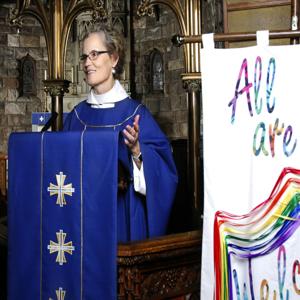


PHOTO: Diana Wilcox
October 27, 2024: May God’s words be spoken, may God’s words be heard. Amen.
The lesson we heard from the letter to the Hebrews started with “The former priests were many in number, because they were prevented by death from continuing in office.” Nice, right? As you might guess, this priest isn’t planning on preaching from THAT text today.
I would much rather talk with you’all a bit about the gospel reading from Mark 10, in which a blind man calls out to Jesus, is healed, and then follows Jesus “on the way” to Jerusalem.
Now, there is a lot to say about this very short story, but one thing I saw in a commentary had me rolling. It read, I kid you not, “While a symbolic reading offers insight, it has blind spots.” Seriously? A symbolic reading about a blind man offers insights and blind spots???” Needless to say, we need not dwell on that too much. Instead, let’s begin by taking a look at just the first two sentences, because they are packed with subtext that we, with our twenty-first century lens, might miss. Remember, it said “Jesus and his disciples came to Jericho. As he and his disciples and a large crowd were leaving Jericho, Bartimaeus son of Timaeus, a blind beggar, was sitting by the roadside.”
First – in this gospel that, as I have often noted, is always in a hurry and generally not one to offer long narratives, why the need to repeat a reference to the city of Jericho? Secondly, why the need to tell us twice that our blind guy Bart was the son of Timaeus? Yes, the actual text spells it out only once, but that meaning was already in the actual name: Bar-Timaeus. It literally means “son of Timaeus.”
Before we begin, remember when it is that this gospel is likely to have been written. Most scholars point to a time around 68-70 CE, about 35-37 years after the resurrection. This is the first gospel to be written and comes after the letters of St. Paul, and at or just after, the time of the second destruction of the temple in Jerusalem. To this author, standing amidst the dust and rubble of the temple, the Western wall the only remaining part of what was once the center of Jewish faith life, the good news of Jesus, son of God, as he exclaims at the opening of the gospel, was critical for all to understand. Keep this in mind, let’s return to this story, and the opening lines.
Starting with the first thing about Jericho…it cannot be lost on those earliest listeners of this story the meaning of this city to the faithful. Not only was Jericho only about 17 miles from Jerusalem, so clearly we are heading toward that important city whose temple walls were left in ruin, but Jericho itself is central to another time when walls came tumbling down. In that story, as we know, it was Joshua, who led God’s people, and the walls of the city of Jericho fell.
That was a fascinating story to be sure, but what has Jesus to do with that? Well, it is all in the name – Joshua, or Yehoshua in Hebrew. The Greek translation of Joshua is, drum roll please…Jesus! So, what is the author up to? Well, perhaps he wanted his listeners to consider a question – whose shout will tear down walls now? Bartimaeus to Jesus? Crowds in Jerusalem shouting “Hosanna in the highest” and then “crucify him?” Jesus’ loud cry from the cross? The author just a few chapters later will tell the story of Jesus saying to his disciples, as they stood in the shadow of the great temple walls, “Not one stone will be left here upon another; all will be thrown down.’”
So, what these earliest listeners would be primed to understand just by this reference to Jericho, is that a new Joshua was about to bring down some mighty big walls.
And then we need to consider why the double naming of Bart. This is one that could have several possible meanings, but the one I think is most interesting and plausible is that it is a figurative reference to Plato’s Timaeus, who delivers “Plato’s most important cosmological and theological treatise, involving sight as the foundation of knowledge.”[1]
Now, we sometimes think that folks in the time of Jesus had no knowledge of science or philosophy, but that is not the case at all. Greek philosophy and language spread throughout all of the known world during the Hellenistic period, and was not only well known to writers like St. Paul, who was university educated, but to the authors of the gospels. Greek philosophy also heavily influenced the earliest church theologians.
So, enough of history, and back to Bart, or rather, to Plato and Timaeus. Timaeus is one of those in conversation with Plato in his dialogs about the nature of the world and of humanity. Timaeus, in his bit of the dialog “begins with a distinction between the physical world, and the eternal world.”[2] He says “The sight in my opinion is the source of the greatest benefit to us, for had we never seen the stars and the sun and the heaven, none of the words which we have spoken about the universe would ever have been uttered… God invented and gave us sight to the end that we might behold the courses of intelligence in the heaven, and apply them to the courses of our own intelligence, which are akin to them…that we, learning them and partaking of the natural truth of reason, might imitate the absolutely unerring courses of God and regulate our own vagaries.”
So, why this reference to Timaeus, especially as we rarely get the name of anyone who is healed, including the previous guy back in chapter 8? Was he, as one scholar believes, throwing off the cloak of philosophy as he went forward to follow Jesus? Maybe. But perhaps it is simpler than that. Perhaps it is meant to remind people of what Timaeus said about sight. That sight allows us to “behold all that is before us, which in its vastness and beauty expose an intelligence beyond our comprehension, which draws us closer to God.” And Bartimaeus, being restored in his sight, beheld God standing before him in the face of Jesus Christ, and because he had that experience, he was awakened to his part in the cosmos, and followed Jesus on the way to Jerusalem and the cross.
Now, all of this has been a lot of fun for folks like me who are biblical nerds and love exegetical deep dives into Greek texts and philosophy, but what does any of it have to do with us and our lives today?
Well, one thing is that we might want to first consider what we are doing with our own sight?
A few weeks ago, many across this area got to see something amazing – the aurora borealis, or Northern lights. It was absolutely stunning! But, one story I heard really struck me. It was at the Clergy Conference. We were blessed to have as a speaker and leader Dr. Deirdre Goode, an Academic Dean at two local seminaries, and biblical professor. She and her wife live up in Maine, and they were so excited to see the aurora, that they drove to a special place, but it was far too dark to even drive the roads. They came back to where they began and got out of their car.
As they stood looking up, they couldn’t see anything. But as their eyes adjusted, Dr. Goode said that they saw a “disturbance in the darkness.” Getting out their telescope and phones and cameras, they were able to see the aurora that was waiting for them to behold.
Many of us experienced something similar – that we could sense the presence of a change
PHOTO: Diana Wilcox
in the sky, but couldn’t see it without help. Living in Sussex County, without much light pollution, I couldn’t see it either until I used my iPhone and wow! There in the night sky was this awesome mix of pink, green, and purple. While not what one might experience further north, it took my breath away. It felt like a glimpse of the eternal world from the physical world. And behold, “the courses of intelligence in the heaven” did seem so near to me, and perhaps to you as well.
But for this experience to become more than a neat snapshot to post on social media, we need to remember Timaeus and his words that we may “behold all that is before us, which in its vastness and beauty expose an intelligence beyond our comprehension, which draws us closer to God.” Of course, for followers of Jesus, we don’t need an iPhone camera to do this. No, we just need to be like Bartimaeus and have a willingness to let Christ in our hearts that he might open our eyes.
And because of that, because through Christ we see the vastness of God’s creation, because we have experienced the healing grace of Jesus here at this table – we, like Bartimaeus, cannot turn back! We must follow him and by our lives in him make a few walls come tumbling down today:
Walls of hate and division.
Walls of cruelty and ignorance to the needs of others.
Walls of arrogance and abuse of God’s creation.
That is our response to this glimpse of God we experience here and in the world. It isn’t just philosophy, or limited soley to auroras. As one of our parishioners, Michelle Ryndak, a scientist herself, once wrote: “There were Christians who openly expressed that science was opposed to God and caused people not to believe. Honestly, this puzzled me. I felt nothing could come as close to conveying the mystery and deepness and vastness of God and life and creation as science. When God said, “Let there be light,” did [God] flip a heavenly switch on a wall, or did an “extremely dense point explode with unimaginable force, creating matter and propelling it outward to make the billions of galaxies of our vast universe?” Does this not sound like work on the scale of “God?”…The rejection of science was, to me, a rejection of God.
Who needs Timaeus when you have a scientist who sees an “intelligence beyond our comprehension,” in the universe we see and explore each and every day? That is what being a child of Timaeus means. That is what being a child of God means!
So, today, as part of our stewardship season, you will receive a gift blessed at the altar. This is not a thank you for being a good parishioner by coming today, though I want to say Thank You! Thank you for choosing to share of your time and your gift of presence with us. It means more than you can know to me and to all of the rest of us gathered here. No, this gift is to remind you of what you heard today. It is a piece of sea glass.
Many find that they experience God’s presence in the universe best by looking up at the stars, as Timaeus spoke about, but others find the vastness of the ocean touches their hearts, minds, and souls in much the same way. Sea glass is made from broken bits of bottles that, over the course of time, get tossed and turned in the ocean, changing them in the process. They start as pieces with sharp edges that will cut, and glass too dark to see through. By the time the ocean has done it’s work, they become softer and beautifully unique.
Let these little bits of glass remind you of the ocean, inspiring you, no matter where you are, “to behold the courses of intelligence in the heaven, and apply them to the courses of your own intelligence.” Or put another way, let it help you to see God in all things, and to act with that knowledge deep in your heart.
Let it also remind of you this place, your spiritual home, and the importance of your presence here – physically on Sundays. You may be one person, but when joined with all the others, we truly become something to behold. For here we are nourished in Christ, our rough edges are healed, and we made ready once more to join him on the way.
We need to do this now more than ever, because the world has grown dark in some places. We feel it deeply as we approach the election results, and the aftermath that will entail here in the United States, and most especially for those who are suffering from poverty, hunger, war, and neglect all over the world. And yet we know there is a “disturbance in the darkness,” and with our knowledge of the love of God found in Christ Jesus, we see the beauty of God’s creation, and the vastness of God’s love – no camera lens required.
So, let us shed our cloaks and follow him – be him – on the way that others may also see the wonder of God in all creation, and come to experience the unconditional healing grace and love of Christ Jesus by his light shining in us and through us.
Amen.
For the audio, click below, or subscribe to our iTunes Sermon Podcast by clicking here (also available on Audible):
Sermon Podcast
[1] https://en.wikipedia.org/wiki/Healing_the_blind_near_Jericho
[2] https://en.wikipedia.org/wiki/Timaeus_(dialogue)
The Rev. Diana L. Wilcox
Christ Church in Bloomfield & Glen Ridge
October 27, 2024
Pentecost 23 – Year B – Track 1
1st Reading – Jeremiah 31:7-9
Psalm 126
2nd Reading – Hebrews 7:23-28
Gospel – Mark 10:46-52
The post “Disturbance In The Darkness” appeared first on Christ Episcopal Church.
September 29, 2024: May God’s words be spoken, may God’s words be heard. Amen.
In our first reading, from the book of Esther, we got to hear a small part of this incredible woman’s story. For the life of me, I cannot understand why our lectionary, the readings chosen for each week, and used by nearly all denominations, only gives us this little bit of this fantastic story. This is it – just this reading. Sure, we can have five weeks on a single chapter of the gospel of John every August in Year B (the year of the lectionary we are in at the moment), but we can’t give this story more than a single Sunday? Not only that, we don’t give you the full story, so it is hard to understand what is really going on here. So…let’s correct that error and give Esther her due.
Now, I am going to have to leave some things out, but here is the story: There are still Jews are living in the Persian Empire following the Babylonian diaspora. Hadassah, called Esther for the remainder of the story, was an orphan in the care of her cousin, Mordecai. They lived under the realm of King Ahasuerus, or King Xerxes I, depending on the translation. The King was in search of a new Queen after the current one, Vashti, refused to obey a stupid royal order to put herself on display before lots of people at a banquet of the King.
So, a royal beauty pageant of sorts was to take place to find this new Queen. Mordecai encourages Esther, who is young and beautiful, to enter this contest – but not to reveal that she is a Jew. She does, she wins, she enters into the harem of the King, and after a year of preparation, she is presented to him, and the king chooses her as his Queen. Mordecai keeps watch over her from the gate of the palace.
Next we hear that Mordecai discovers a plot to assassinate the king. He tells Esther, who tells the king – plot averted.
The king’s right hand guy, Haman, is a treacherous sort. Everyone bows and shows allegiance to Haman, but Mordecai refuses. This really ticks off Haman, so having been told that Mordecai was a Jew (but not knowing that Esther was his cousin), Haman tells King Ahasuerus that all throughout his kingdom are a people who don’t obey the laws of the king, and that they should be destroyed. The King authorizes Haman to do what he will with them. Haman issues a decree read far and wide that the Jews were to be destroyed and all of their goods to be taken.
All the Jews, including Mordecai, were distressed and mourning what was to come. Mordecai sends a message to Esther, warning about the plot of Haman against the Jews, and imploring her to use her influence to stop the King from allowing this to happen.
Esther reminds Mordecai that anyone who approaches the King without his invitation is killed, and the King has basically ghosted her – she hasn’t received an invite in over a month. Then Mordecai tells her that she herself will not be spared just because she is Queen. And he says, to her “Who knows? Perhaps you ended up where you are for just such a time as this.” Esther then tells Mordecai to have all the Jews in town fast and pray for three days on her behalf, and at great risk to her life, she goes in to the King without an invitation.
Esther finds favor with the King, he asks her what she wants, and she tells him she would like to prepare a banquet for him and for Haman. Haman for his turn, is delighted and is also looking forward to killing his nemesis, so he has a gallows built to hang Mordecai.
Meanwhile, back at the Palace, the King is having trouble sleeping, so he had the annals of the court read to him – well, that outta cure your insomnia, right? But instead, the King is reminded that a fellow named Mordecai saved his life. He summons Haman, and asks him, “What should be done for one the King wants to honor?” Haman thinks the king means him, so he says “Give him a royal robe, a horse to ride, and have him led through the city to be celebrated!” And here is the best part…so far anyway: The king then says “Great idea Haman…go do that for Mordecai!”
This, as you might guess, did not make Haman happy. But we aren’t done yet. After he does all that, he now goes to the banquet that Esther has prepared for him and for the King.
During the feast, the King asks Esther to name anything she might want, and it would be granted. And here is where it really gets fun: Esther begs for her life, and the life of her people, saying an evil man is plotting to kill them all. The King is furious, demands to know who it is that has done such a thing. And just like in a TV courtroom scene, Esther points to Haman and says “That guy!” And one of the Eunuchs tells the king that Haman even has gallows ready to hang Mordecai, the one who saved the king’s life!
Haman is executed on the gallows he built for Mordecai. Mordecai is elevated to the position Haman had. The Jewish people were saved. And everyone celebrated in a new Feast day – Purim – and still do to this day. The end.
Now is that a great story or what?
Apparently, playwrights, screenwriters, and authors through the years thought so too, as you can find movies, plays, books, poems, and more that tell it in their own unique ways. And there is also this little interesting twist, that in the original Hebrew text, the book of Esther is only one of two in all the bible (the other being the Song of Songs) that does not explicitly mention God by name anywhere in the story. The Greek versions changed that a bit.
Cool. But what does all this mean for us?
The thing is, this story is sadly happening now. Each of these characters exist today – even in our own country.
King Ahasuerus is the very model of power without bounds, and the effects of that on vulnerable people. All over the world, there is a rise of authoritarianism – rooted in fascist or Nazi ideology, which itself has racist, antisemitic, and misogynist foundations. And we have seen throughout history what can happen when these dictators take power – genocide, enslavement, mass deportations, and wholesale violence against a people.
Haman’s also exist – especially within the inner circle of wanna be dictators. They guide the actions of weak leaders to their own benefit – and the people suffer.
Yet there are also Mordecai’s – those who work behind the scenes to subvert the plots of evil doers.
And lastly, there are Esthers and Vashtis – the ones who refuse to follow along, who stand up for their own dignity, and who risk their lives for others. Women like Malala Yousafzai, Harriet Tubman, Elizabeth Cady Stanton & Lucrecia Mott, Anna May Wong, Wangaari Maathai, Sherin Ebadi, and more. These were those who were meant for a time such as the one in which they lived – meant for our time now.
There are also many men of course, but their names and stories are told far more readily, so I won’t mention them here, with one exception – Nelson Mandela. Imprisoned for 27 years for fighting against the unjust apartheid of his country of South Africa, he later rose to lead his people as President. This was something most in his country thought impossible in the time of the oppressive apartheid. Yet Mandela once said “It always seems impossible until it’s done.”
“It always seems impossible until it’s done.”
Now, that may seem only like we are asked to push through seemingly insurmountable obstacles until we achieve our goals, but think about that for a moment. Who has determined that the goal is impossible in the first place? The answer to that is the subject of a lot of philosophical and psychiatric work. It is the difference between objective and subjective reality, but more simply put – we are the ones who determine what we believe to be possible or impossible.
We assume we make this determination based on experience and rational thought, but sometimes there is more to it. Sometimes it is based on fear. Esther thought it was impossible to appeal to the King. It wasn’t. Haman thought his power and favor of the King would protect him – it didn’t. The South African government thought they could quell the voice of Mandela and others – they could not. Many suffering under apartheid thought it would never end – it did. And in the church, many have proclaimed for decades its destruction – we are still here.
“It always seems impossible until it’s done.”
The story of Esther is a story for our time. For we can feel overwhelmed by the dangers we see swelling up around us. As we witness the rise of swastikas and confederate flags, the blatant disregard for the dignity and welfare of others, we fear for the vulnerable – the poor, people of color, LGBTQ+ people, people of other faiths, women, and more. Perhaps we are among the vulnerable ourselves. This story reminds us that authoritarians, like the King, like dictators all around the world, and those that wanna be them, are dangerous because they use their power arbitrarily, and without regard for the consequences to anyone but themselves.
Yet one thing is clear from what we heard today about Esther and King Ahasuerus – those with absolute power are not invulnerable, nor are the vulnerable without hope. In other words – their current situation is not destined to be their future one.
And most especially we know, that despite the Hebrew version’s explicit omission, God most definitely is at work in those who become the change makers. They are those who, by God’s grace, are able to see beyond the boundaries of what many deem impossible, to do what they are called to do. They too had been brought into whatever situation they were facing for just such a moment.
And today, as we stand amidst the turmoil of our time in this nation and around the world, a voice is saying to each of us: “Do not think that those in power will not eventually turn on you – you too are in danger. Yet, who knows? Perhaps you have come to this place, in this moment, for just such a time as this.”
Indeed we have.
We, the Episcopal branch of the Jesus movement, are here for just such a time as this.
And now more than ever, we must not hide who we are and what we believe from those who wield power.
We must stand up to protect the vulnerable and speak for those without a voice.
We must break the bonds of injustice to free the oppressed.
We must proclaim to all the world the good news of Jesus Christ that all are children of God – loved just as they are – deeply and for all time.
We must protect God’s creation from the ravages of human greed, arrogance, and abuse.
We must do this even when we feel it may cost us everything.
Even when we and others think it is impossible.
For we, the followers of Christ Jesus, who gave his life for the sake of the world – we are meant for a time such as this.
Like Esther, we are where we are now, in this moment, that we might also save our people and our planet from the effects of unchecked power.
“It always seems impossible until it’s done.”
But one day we will look back – and because we did not remain silent, because we did not turn our backs in fear, because we believed in ourselves and the transformative power of Christ’s love working in us – we will be able to rest from our labors knowing that it wasn’t impossible at all. Not when we believe in ourselves and in the God who loves us.
And we will be able to say, “It is done.”
Amen.
For the audio, click below, or subscribe to our iTunes Sermon Podcast by clicking here (also available on Audible):
Sermon Podcast
The Rev. Diana L. Wilcox
Christ Church in Bloomfield & Glen Ridge
September 29, 2024
Pentecost 18 – Year B – Track 1
1st Reading – Esther 7:1-6, 9-10; 9:20-22
Psalm 124
2nd Reading – James 5:13-20
Gospel – Mark 9:38-50
The post “For Just Such A Time As This” appeared first on Christ Episcopal Church.
May God’s words be spoken, may God’s words be heard. Amen.
Gosh it is so good to be back here with all of you! While I really enjoyed my vacation, and needed it so very much, I missed you’all! I missed the choir too! And it is so awesome to be returning on Choir Appreciation Sunday. What an amazing sound they raise up to God every week! And, I am so happy to finally be able to truly welcome our new Director of Music, Ryan Bridge!
Now, one of the things I had hoped to do while I was away was to get to Citi Field to watch my Mets play. I didn’t, but I did get a chance to enjoy watching them on TV. And if, like me, you are a baseball fan, you probably heard about a big event this past week – and no, not the three game stretch of the Mets scoring 10 or more runs, with every single 10th run being the result of a particular rookie in the lineup. While that WAS a big deal, something even more amazing happened, and sadly, it had nothing to do with the Mets.
Shohei Ohtani, a player for the Los Angeles Dodgers, has done something that had never been done before in Major League Baseball. He hit 50 home runs and snagged 50 stolen bases! Prior to this feat, which he did while also going 6 for 6, with 3 homeruns and 10 RBIs (runs batted in), the big challenge for baseball players every season was to cross the 40/40 mark – 40 homers and 40 stolen bases. I mean, there has never been anyone to ever make it to 50/50. Did I mention he also pitches (though not this season)? It’s an insane level of playing that has everyone in baseball calling Mr. Ohtani the GOAT – Greatest Of All Time.
The thing is, while there are arguments for or against the GOAT title for Ohtani, and many argue that the title is still in the hands of greats like Babe Ruth and Willie Mays, we sure do have a fascination with it lately. We see the GOAT label attached to all sorts of things – even an Optimum TV commercial (with another baseball legend – Derek Jeter). And it would seem that this desire to throw this label around is as old as humanity. Just take a look at our gospel today.
Before we get to what we heard a moment ago, let’s look at what preceded it. Just before this passage we heard today, the disciples had tried to cast out a demon from a man’s son but failed. Why? Well, Jesus, after taking care of it himself, tells them that this strong a demon requires prayer to cast out. Now, that might seem like he was saying it wasn’t their fault, but when combined with what happens next, we see that isn’t the case at all.
Just after this, the part we heard today, as they were going through Galilee on the way to Capernaum, Jesus was telling them again about his impending death and resurrection. They didn’t understand what Jesus was saying, but was too afraid to ask him to explain it. I suppose you could understand that, given the “Get behind me Satan!” response Jesus had to Peter the last time this subject came up. Still, they were unwilling to look like they didn’t know something, so remained quiet – at least about that anyway. Instead, they began to argue among themselves.
When Jesus asks them what the argument was about, they wouldn’t answer because they were, if you can believe it, fighting over who was the greatest. Of course, this is a rhetorical question Jesus is asking. He knows the answer in the same way that parents often know what is actually going on when they ask the same thing of their children. I mean, at this point, you wouldn’t blame Jesus for just ditching them, and exchanging them for all the women and other outcasts who actually pay attention and understand who Jesus is. But, he doesn’t.
Instead, Jesus sits them down and tells them bluntly – “Whoever wants to be first must be last of all and servant of all.” But more than that, he brings a child among them and tells them that this child is to be welcomed in his name – and those who do – welcome not only Jesus, but God.
Now, it is hard to imagine how this came across to the disciples given that we have a different view of children today, in our society at least. In the ancient Near East however, at the time of Jesus, children were akin to slaves in worth (and it is quite likely that given the hour, this might have been the child of a slave – the lowest of the low). They were not images of innocence and playfulness as we see them now, but of poverty and powerlessness. And, Jesus sits down – at eye level – with the child – modeling for his disciples the way of life he expects of them.
Jesus is breaking down the assumptions of the disciples about who they are, and what it means to be his followers. Assumptions that were blocking them from being able to live fully into their calling. The disciples thought that being a follower of the Messiah meant that they had privileges – the ability to heal, a special pass into heaven, the best seats at the table. They began to believe that following Christ was a path to privilege and power, rather than a journey of service and humility.
Jesus was trying to show them what is required of them. For their master was at eye level in that moment with the lowest of the low in society, telling them that is where they needed to be too. That is where they will meet and welcome him. Why does Jesus do this?
The lure to be powerful is an evil that lingers throughout all of history – in nearly all cultures and eras. It is a snare that can entrap even those who start out with the best of intentions. And once caught, corrupts absolutely. Which is why the seeds of humility must be planted early, so that the roots can grow deep and strong, before fame and money can begin to try to weaken the plant of a human soul.
Perhaps that is why Shohei Ohtani’s first coach at Hanamaki Higashi, the High School he attended in Japan, had a rather unique approach to mentoring his charges. As reported in the Los Angeles Times back in 2017, “Higashi’s players live on campus, returning home for only six days a year. [Hiroshi Sasaki, the coach of the team,] assigns them chores. The pitchers clean toilets.
Sasaki had a reason this particular assignment never changed. “The mound is the most elevated place on the field,” he explained. “It’s a stage. If you’re on that stage, you receive the most attention. You get interviewed and written about the most.” The coach wanted to teach his pitchers humility. “It might be a little different than what you do in the United States,” he added.1
Ha, you think?
For Ohtani, it seems to have prepared him well for what was to come, as he is reported to be quiet, humble, and gracious. For those that are not baseball fans, I promise you, this is my last mention of it, sort of, but it does make the point. The closer we get to power, the more the power corrupts, and the greater our need to be rooted in the humility that will save us.
For followers of Jesus, this is especially important. To understand why, we need to return to the moment before this one – where the disciples failed to help someone in need of healing. Jesus told them that this type of healing could only be done through prayer. What he is telling them was that it is one thing to say you are my follower and do the easy things, but to really make a difference, to really be my disciple, you are going to need to difficult work, which you cannot do on your own.
Jesus is telling them that it is only through prayer that they will be able to truly heal in his name. Or to put it another way – they have to first recognize that they are not the be all end all. They must have the humility to see that only through God’s grace can real healing be done in the world.
And folks, we need to understand this lesson we are hearing today as much as those earlier disciples, because we have some big healing work to do ourselves. For today there are those who claim to follow Jesus, but ignore his teaching in the pursuit of power – even to the point of wanting to create a Christian state in the US. And make no mistake about it – this Christian Nationalism is a demon that has infected part of the body of Christ in this country, and it is one that will require prayer and humility to exorcise.
To be clear about these “Christians” (their description of themselves, not one I would use) – their “gospel” isn’t that of Jesus – the Beloved Community of God in which all are welcome, all are included, all are made in God’s image. Instead, it is good news only to those who are – white, straight, citizens of the US, and English speaking. For they have forged a cross of their own making, corrupting the teachings of Christ for their own well being, for their own power, and crucifying him in the process. The sad thing is, like those disciples arguing on the road, they actually believe they are doing what Jesus would want them to do.
Yet, they have not only failed to welcome the lowly – the child of Jesus’ teaching – they have been the ones to push that child into vulnerability through neglect, abuse, oppression, and hate. They seek to place upon all in this country the tenets of their faith – or more to the point – their warped interpretation of it. They want the Ten Commandments put up schools, but do not abide by them. They want prayer in schools, but hold fast to their right to have assault rifles, even as children are slaughtered in the classrooms. Some of them wave Confederate battle flags – a symbol of racist violence – while wearing the cross of Christ on their necks, or tattooing scripture on their arms. Some even lift up a man convicted of fraud and sexual assault, and call him the chosen one.
Lest we think they are harmless, there are people dying because of it – children in schools, Jews at worship in Synagogues, people of color, and pregnant women. Just this past week we began to hear the first stories of the effects of the repeal of Roe V. Wade by the Supreme Court. Amber Thurman and Candi Miller died after complications from traveling out of state to get medically induced abortions. Both have other children and both deaths were deemed preventable had the laws not been in place preventing proper medical attention. These happened in the early days after the Dobbs Supreme Court decision and subsequent state legislation back in 2022. They are not the last – we will be hearing about more women’s deaths as cases are made public. Those who passed these horrific laws restricting women’s reproductive healthcare, and those who refuse to pass other laws preventing common sense gun legislation, I guarantee you, they also go to churches on Sunday. They claim to be followers of Jesus.
Yet Jesus says, “Whoever welcomes one such child in my name welcomes me, and whoever welcomes me welcomes not me but the one who sent me.” The way in which we treat the most vulnerable among us is the way in which we welcome Jesus, the way in which we welcome God. Children are not being welcomed in our country, they are being killed in school, orphaned by our laws, and ignored if they are poor, homeless, undocumented, LGBTQ+, female, or non-white.
The demons that have infected the hearts of those who see Christianity as being endowed with rights, rather than being a life of humility with serious responsibilities, will not be easy to exorcise. Our only hope is through the humble act of prayer – for them, and for the strength to challenge them. And to remember the lessons of Jesus today:
That the least of these is Christ – how we treat them is the measure of how we treat him.
That the grace to heal comes not from personal power, but from prayerful humility.
That to be first, is to be last and servant of all.
As we walk along the road with Jesus, let us not be arguing with one another, or hoping for recognition, but instead:
Seek the vulnerable children in our midst and welcome them.
See the need for something to be done, and be the first to clean the toilet, or do whatever other task others will not do.
For there are innings yet for us to play out in our lives, and we have much work to do before we retire our jersey and meet the one and true GOAT.
May we be truly ready for that moment, knowing we had left it all on the field, our uniforms covered in dirt, sweat, and grass stains, when that day comes for us.
Amen.
1 https://www.latimes.com/sports/la-sp-shohei-ohtani-20170930-htmlstory.html
For the audio, click below, or subscribe to our iTunes Sermon Podcast by clicking here (also available on Audible):
Sermon Podcast
The Rev. Diana L. Wilcox
Christ Church in Bloomfield & Glen Ridge
September 22, 2024
Pentecost 18 – Year B – Track 2 (this week only)
1st Reading – Isaiah 35:4-7a
Psalm 54
2nd Reading – James 3:13-4:3, 7-8a
Gospel – Mark 9:30-37
The post “The GOAT” appeared first on Christ Episcopal Church.
August 18, 2024: May God’s words be spoken, may God’s words be heard. Amen.
One phrase we often hear, particularly in political punditry or business consulting, is that of “splitting the baby.” Have you’all heard that? Now, why on earth would anyone talk about doing such a gruesome thing? Well, glad you asked… because it was something that marked the early part of the reign of a long ago king. The very one we heard about in today’s reading from, appropriately, Kings. Specifically 1 Kings 2 & 3.
This was a moment of transition. King David was dying, and Solomon, one of his sons, was made the next King. Sounds simple enough – if you just take the verses we get today. However, as I have often said, notice when there are gaps in the verses. Well, we get a boatload of them today.
The short version of what is missing is how it was that Solomon came to be named the next King rather than his older brother Adonijah. It’s an interesting story of a bit of intrigue, deception, and murder. Not to mention Solomon marries the daughter of the Egyptian Pharoah and sacrifices at altars around town. It is then that we get to what we heard today – God appears in a dream to Solomon (according to Solomon anyway) and like some blue Genie out of Disney’s Aladdin, asks “What can I give to you – just ask?”
Now, how many of you would love that to happen?
And if it did, what would you ask for – money (for the church, right? – of course), or perhaps you might be thinking on a more selfless plane, and ask for world peace? I think I would want to be able to know all the languages of the world, including the language of music and animals. But the new King Solomon did not ask for any of that, but instead replies that, being a young new monarch, he wanted God to grant him wisdom to be able to serve well.
As you might guess, God was very pleased with this, and grants it (even though in the asking, Solomon is showing he has what he has asked for already). Then God throws in a whole lot more – riches, long life, the whole nine yards. Geez! Solomon sort of got the trifecta (just to mix our sports metaphors)!
If only earthly leaders of governments would follow Solomon’s lead and seek to have wisdom that they might serve their people well. In fairness, some have been very wise, and here is a short little story about one of them – President Abraham Lincoln. During the Civil War, he once got caught up in a situation where he wanted to please a politician, so he issued a command to transfer certain regiments. When the secretary of war, Edwin Stanton, received the order, he refused to carry it out. He said that the President was a fool. Lincoln was told what Stanton had said, and he replied, “If Stanton said I’m a fool, then I must be, for he is nearly always right. I’ll see for myself.” Lincoln then met with Stanton, and as the two men talked, the President quickly realized that his decision was a serious mistake, and without hesitation he withdrew it.”
Now, I don’t know if this story about Lincoln is true, though it does fit with the overall way of our 16th President. The thing about what President Lincoln did was not about the change in his decision itself. No, the thing was that he was willing to listen to others to discern what was the right course of action – he didn’t think he knew everything.
This fall, we will elect our 47th President along with others to serve in roles from Senator to Board of Education member. We certainly hope that those who win will be like Solomon – to know their need for God’s grace and guidance, and seek first to be wise and good leaders in service to their people. We know too that sadly, there will be those who are the opposite of all of these characteristics, and many will pay the price on account of their arrogance, selfishness, and ignorance.
Solomon, for his part, was a bit of both – the wise and the unwise. Oh, don’t get me wrong – he started out really well. In fact, that’s when we get that whole baby splitting bit, right after he receives this gift of God. The story goes that two women came to him arguing over who was the true mother of a baby. Both had given birth at the same time and in the same house. One baby died during the night, and that mother swapped her dead baby for the other one. The two women argue back and forth before King Solomon, who then sends a servant to fetch his sword that he might split the baby into two halves, to be given to the women. Just then, one of the women says “No! Do not harm him. Give him to her and let him live.” The other woman, for her part, said “If I can’t have him, neither should she, so go ahead and split him.” Solomon gave the child – the whole child mind you – to the one who was willing to give the baby up for the sake of its life, saying that it was she who was the true mother.
This little story is the nugget we are all told about in the church as proof of Solomon’s wisdom. It’s a great story too. I remember the artwork in my family’s bible that depicted the scene. Did any of you have one of those?
Solomon, like his father David before him, wanted to do what was right by God, but sadly, also like his dad, he was deeply flawed and it showed in some of what he did during his reign – like using forced labor for his numerous building projects, over taxing his people, and building up extravagant wealth.
The thing is though, it is the lack of perfection in these larger than life figures of our faith that can make them accessible to us, that can make their lives instructive to us today. And one of those lessons is that Solomon, as flawed as he was, initially had the insight to know that he needed help – that he was young and in over his head in this new role.
In psychological circles, they say the first step toward health is recognizing you need help, right? Well…apparently Solomon knew it. However, he didn’t understand this wasn’t a one and done type of thing. He lost sight of what it was that made him make that request in the first place. He stopped using the first gift God gave him. And to be clear, it wasn’t really wisdom.
You see, the Hebrew is a little more subtle than that – it says that he asked God to “Give your servant therefore an understanding heart to judge your people, that I may discern between good and evil; for who is able to judge this your great people?’” Solomon asked for an understanding heart, that he might have the ability to discern what was right as a servant of God’s people.
Think about that – he wanted an understanding heart, the ability to discern what was right, and all to be a good servant to others. Now that is true wisdom.
For wisdom isn’t about knowing facts or having a high IQ. Wisdom is really the recognition that we do not yet understand all things, and the desire to learn – not for ourselves alone, but that we might better serve others. And what is foundational to it, what is needed to be truly wise, is humility.
As I have said before, humility isn’t about beating oneself up – that’s just crazy, not humble. Humility isn’t about letting someone else beat up on you either – that’s just abuse and it is wrong. No. Humility is rooted in truth – the desire to understand, to recognize that we do not know everything, to seek knowledge, to learn from all of God’s creation, to ask for forgiveness when we fail, as we inevitiably will do from time to time – and all that we might be better stewards of those we serve.
This is an important attribute often lacking in today’s political leaders to be sure, but it is not meant only for them. While they, like King Solomon, are earthly appointed leaders that are meant to serve their constituents, we are divinely annointed leaders called to serve all of God’s creation. We, the body of Christ, annointed and sealed at baptism, are called to serve God’s people.
And if we are to be successful, and Lordy, this is a time when we need to be successful, we have to have a little dream interaction with God ourselves – just like Solomon. Now, we may not actually have a dream like that, but that’s okay – God is waiting to listen in all sorts of ways if only we paid attention, if only we will have the humility to ask – to ask for discerning hearts.
And once we ask, once we listen, we need to do it over and over again. This isn’t some magic formula like that genie from Alladin: Poof! Where God says “Okey doke – go forth and be your wise self there girl…you got this.” And off we go riding into the proverbial sunset, doing everything right all the time. That certainly didn’t happen for Solomon, and it ain’t likely to happen to you or me either just because we asked for it.
Our lives in service to God’s people, as followers of Jesus, guided by the Holy Spirit, is a never ending cycle of listening, responding, and listening again. We do get better at it with age, if we practice this cycle of discernent, and not because we clocked in a certain number of years.
Which reminds me of something journalist and humorist H.L. Mencken once said, “The older I grow, the more I distrust the familiar doctrine that age brings wisdom.”
Ain’t, that the truth. While age does provide experience which can build wisdom, there are a lot of wise young folks like Solomon out there as much as there are older people who haven’t a clue. And it is very much the case that those experiences that teach us the most are the ones that are the most difficult. It is wisdom born of graduating from what my grandpa called the school of hard knocks.
Yet we all know people who have come out on the other side of those difficulties with hard hearts, rather than discerning ones. Lest we judge them, we need to remember that judgement comes not from humility, but from arrogance. The discerning heart will seek to understand, to forgive, to listen, to love.
So, no – this openness to asking God to help us, this desire to have discerning hearts not hard ones, to listen more than to speak, to understand more than to be understood – it isn’t a thing of age, or a one and done act of grace in a moment of prayer. This is a continual cycle for those who seek to serve God – really of those who seek to have a life of any sort of meaning.
Solomon forgot that. He started off well, but eventually he got off track. As the Hebrew scholar, Walter Brueggemann once wrote: “The wisdom that Solomon does not learn is attentiveness to those for whom God has special attentiveness. There are all kinds of dreams — of power and money and prestige and control. But the dream of justice for widows, orphans, and immigrants is the deep wisdom of Torah obedience.” Solomon left that dream of God behind, and began to dream of other things – large temples, luxurious banquets, and riches, rather than just and understanding service to those most in need.
We can learn a lot from King Solomon – from all of who he was, not just the things that we like to hear. He wasn’t perfect. He wanted to do the right thing, and sometimes he succeeded, and sometimes he failed. He loved God, and sometimes failed the very God he loved. And most of all – that all through his life, no matter what he did or did not do – one thing never changed – God loved him.[1]
And the good news today?
God is hoping you will be open to meeting in your own dream – asking for what you need. God is hoping that what we will ask will come from a place of humility and a desire to do what is good and right in service to others, not for ourselves. God hopes this because God has dreams too. God dreams always for a just and good world for all people and for all of creation, and desires so very much to partner with us in bringing about this dream.
And even though we will inevitably stumble, even though we will sometimes forget God’s dream and substitute our own, we are no less to God than King Solomon and no more than the lowliest of God’s creatures. God’s love is infinite, unconditional, and for you – yes you!
That is the power of God’s great love!
Let it send us to our knees in thanksgiving, and out from these doors in humble service.
Amen.
For the audio, click below, or subscribe to our iTunes Sermon Podcast by clicking here (also available on Audible):
Sermon Podcast
The Rev. Diana L. Wilcox
Christ Church in Bloomfield & Glen Ridge
August 18, 2024
Pentecost 13 – Year B – Track 1 – Proper 15
1st Reading – 1 Kings 2:10-12; 3:3-14
Psalm – Psalm 111
2nd Reading – Ephesians 5:15-20
Gospel – John 6:51-58
[1] Grateful for the work of Debi Thomas on this text: https://www.journeywithjesus.net/essays/324-a-king-s-tale
The post “Dream A Little Dream” appeared first on Christ Episcopal Church.
August 11, 2024: May God’s words be spoken, may God’s words be heard. Amen.
Somehow I wish we were hearing more about Jesus calming the storm rather than being bread, given the weather lately. Lordy. We offer our prayers to all those who have been affected by Hurricane Debby and all the other crazy storms that have occurred.
But, that is not the gospel today, and given the storm of another sort that will be our lives here in this country during election season, we need to continue our look at the Epistle to the people in Ephesus.
In the letter to the Ephesians read this morning, we continue to hear about how to live as followers of Christ. The author writes: “Putting away falsehood, let all of us speak the truth to our neighbors, for we are members of one another… Let no evil talk come out of your mouths, but only what is useful for building up, as there is need, so that your words may give grace to those who hear… Put away from you all bitterness and wrath and anger and wrangling and slander, together with all malice, and be kind to one another, tenderhearted, forgiving one another, as God in Christ has forgiven you. Therefore be imitators of God, as beloved children, and live in love, as Christ loved us…”
“…be kind to one another…be imitators of God…live in love as Christ loved us”
Now, a smart preacher would leave it there – what else needs to be said, right? But, never let it be said that I am a smart preacher.
The truth the author of Ephesians would want us to speak today is that there is a great deal of unkindness around the world. Just look at what happens during elections. People posting things on Facebook or tweeting or emailing the most horrific comments about those running for office – the same folks who on Sunday come to church and claim an identity as Christians. Now, I know that sometimes, most times, politicians say things that for the life of me makes me question the idea that humans are the smartest of God’s creation. But that isn’t what is sinful here.
Where we go wrong is not when we disagree, but when that disagreement becomes personal. When the anger over what someone says or does becomes vitriol launched at that person. Then we have crossed a line. Then we have sinned. And just as a reminder, sin is turning away from God, coming out of relationship with God and one another. Redemption is turning back – it is reconciliation.
Now, you might ask, what about speaking truth to power, as we learned we need to do from last week’s scripture? Are we not to stand up boldly and stand against what is wrong – be like Nathan, to be like Jesus? Yes, of course. But speaking truth isn’t without its own slippery slope too. We all know of folks who hide behind “speaking the truth,” when what they are really doing is being hurtful. The truth about truth is that sometimes it is not meant to be said at all.
I have said it before, about the playground chant of “Sticks and stones may break my bones, but words will never hurt me” – that whoever first uttered those words was probably crying to himself in some dark closet at the time – “Sticks and stones may break my bones, but words can break my spirit,” is more like it.
The thing is, our words can be a potent instrument of love, and peace, and justice…and also of hate, and abuse, and oppression. It is an unfortunate thing that in this age of techonology, what we say can often happen without filter in a moment of reaction, and often we feel empowered to say it even more from the anonymous bully pulpit of the internet. And yet, far too often we end up wishing we could undo the moment we hit send on a tirade filled email or tweet… So many would like to remove the shoe that invariably fills our mouths from time to time.
It is most especially now, when things happen so quickly, that we need to remember the old adage: “Before you speak, stop and think -Is it necessary? Is it true? Is it kind? Will it hurt anyone? Will it improve on the silence?” And, if you still answer that it is okay to attack a person, rather than their words or actions, go back to step one and think again. Or, perhaps do this – insert the name of a person you truly like and admire into your words – does it still sound right to you? Remember too the letter to the Ephesians – the author tells us to “Let no evil talk come out of your mouths, but only what is useful for building up, as there is need, so that your words may give grace to those who hear…” Ask yourself – does what I am about to say build this person up or try to tear them down?
Now, to be clear, we sure as hell need to speak truth, and be angry at injustice, but we also need to understand our role as healers in a broken world to ensure we speak and act in a way that allows us to live as we should. We are called to a higher standard, but we so often find it hard to live into. No one said being a follower of Jesus was a walk in the park. But does that mean we are destined to fail always at this imitators of God stuff? Not at all.
You know, as I have been working on the sermons on Ephesians these past two weeks, I have also been joining in with folks from all around the world watching the Olympics in Paris. Have you’all been watching them? So exciting – seriously. You can learn a lot by watching them too.
Watching the Judo matches, I am reminded of when I competed in Judo all over the East Coast as a kid (God bless my parents – nothing is more boring than a Judo match). The key to Judo is to yield, to use the other person’s aggressiveness against them. They will inevitably be off balance, and that is to your advantage.
In many ways, Judo has been a good life teacher. It is not about being the biggest or the strongest, but about knowing when to yield and when to move forward, when to be patient and when to be assertive, and most of all – how to take a hard fall, get up, and go back into the next round.
There are other lessons to be found in these Olympic games. As we watch the gymnastics and diving, for instance… – I mean – WOW! Aren’t they amazing to watch? Those divers just flow through the air and cut into the surface of the water without making a spash. How on earth do they do that? And the gymnasts – I cannot imagine how much strength it takes to hold yourself in what is known as the Iron Cross position on the rings – both arms straight out on your sides. Then there is the way they fly through the air off the vault or across the mat.
These divers and gymnasts make it all look so easy. Yet we know that for Stephen Nedoroscik and Simon Biles, and all the other gymnasts it isn’t easy at all. It only looks that way because they practice, practice, practice, workout, and then practice some more. And, they provide nourishment for their bodies, so that they can be as fit as possible. The same is true for those divers too.
Each athlete is looking to achieve as close to perfection as possible for their sport. The truth is, we need to do the same as followers of Jesus.
Unlike athletes in the Olympics though, practice for a follower of Jesus isn’t about achieving a high score, or beating out a competitor (though the church can sometimes seem act like it is). No, it isn’t a competition. It is instead about being authentic to what we believe by our practicing to be as Christ like as possible.
The theologian Martin Luther once said, “This life, therefore, is not godliness but the process of becoming godly, not health but getting well, not being but becoming, not rest but exercise. We are not now what we shall be, but we are on the way. The process is not yet finished, but it is actively going on. This is not the goal, but it is the right road.”
Our lives as Christians are a continual quest to be imitators of Jesus, or as the author of Ephesians put it “imitators of God.” Imitators are never the real thing, but strive always to appear to others as the one they are imitating. What if we were to try every day to have others see and experience Jesus when they encounter us? What would our lives look like?
Jesus tells us in the gospel readings these past two weeks that he is the bread of life. His very life is life giving to others. We are the body of Christ alive today, and we must ask ourselves – are we life giving to others, or do we leave people feeling hungry in our wake?
But whether we are being good imitators of Christ, or we are falling short, we all have to be like those Olympic athletes. We know that they practiced over and over again, and took care of their bodies to get to their goal. Do we think that those who win gold medals stop practicing because they have achieved their goal? Do they stop caring for their bodies? No, not unless they are retiring.
As followers of Jesus, we don’t retire until we are gone from this earthly plain – so how then do we practice like those Olympians? How then do we achieve our goal of being, as the author of the epistle says “imitators of God, as beloved children…?” Well, you are doing part of it right now.
For us to live as imitators of God, we must engage in a continual practice of prayer, worship, and service. Prayer allows us to know God’s intention for us in our lives, worship nourishes us – it feeds our souls, and service is how we live out our lives in Christ – how we become imitators of God. This isn’t a routine for us only on Sundays – this is something we need to do every single day of our lives. This continual practice we do is how we will be the bread of life for others, as we ourselves are nourished in Christ here, and by serving him in the world.
If we think of it that way – if we consider that our practice, our daily quest to imitate God, can feed others who hunger for love, mercy, and justice, but will also feed our own souls…then maybe practicing won’t seem such a big thing. And maybe, just maybe, as each day goes by, as we become better imitators of God, we just might get as good at being a follower of Jesus as Simone Biles is at Gymnastics.
We won’t receive a gold medal, and we don’t really want one – not if we are truly being Christ like humble servants, not if we are imitators of God.
No, there won’t be a gold medal, but there will be something far more important – we will be the ones to help heal a broken world. And that – that is worth more than gold!
Amen.
For the audio, click below, or subscribe to our iTunes Sermon Podcast by clicking here (also available on Audible):
Sermon Podcast
The Rev. Diana L. Wilcox
Christ Church in Bloomfield & Glen Ridge
August 11, 2024
Pentecost 12 – Year B – Track 1 – Proper 14
1st Reading – 2 Samuel 18:5-9, 15, 31-33
Psalm 130
2nd Reading – Ephesians 4:25-5:2
Gospel – John 6:35, 41-51
The post “Going For The Gold” appeared first on Christ Episcopal Church.
July 21, 2024: May God’s words be spoken, may God’s words be heard. Amen.
“Come away to a deserted place all by yourselves and rest a while.”
This is what we just heard Jesus say in our gospel reading from Mark.
“Come away to a deserted place all by yourselves and rest a while.”
Now, Sabbath rest is important – so much so that God decreed it one of those top ten things were are to do. But what if I were to tell you that there is more to what Jesus is saying here than a relaxing trip to the Jersey shore?
So, let’s dig a little deeper, because this is a passage for our time, to be sure.
Before we get to that, this is the last time we will hear from the Gospel of Mark until September. Unfortunately, in this preacher’s view, Year B of our lectionary moves to the Gospel of John and the bread of life discourse of Jesus for an entire month. I think this is also why so many priests go on vacation in the month of August. And, I know this is about the time that some big fans of that gospel think the rest of us are crazy.
Not only that, but we don’t even get the whole gospel text from Mark. Once again, just like with the narrative from 2 Samuel last week, there are verses missing in this passage from Mark.
Between the beginning where Jesus tends to the crowd, and the last bit about the beach landing at Gennesaret, there are the stories of the feeding of the five thousand and Jesus walking on water. We don’t get to hear Mark’s version of those events in Year B (the year we hear from this gospel). Instead we spend 5 entire weeks on John 6? It makes absolutely no sense to me. But, we aren’t there yet, so let’s give the gospel of Mark more attention than our lectionary people do, and get back to the narrative for today.
His disciples had just returned from their first mission to teach and offer God’s healing grace and love in his name – and from all accounts, it would seem they were successful. That type of work, Jesus knows, while spiritually and emotionally fulfilling, is also physically exhausting. He bids them to come away to a deserted place and rest for a time.
Now, a vacation always sounds good, right? We are one overworked world, at least 98-99% of us anyway. These are sweet words for anyone to hear. But – this is Jesus, and while he is one to heal, to nourish, to restore and renew us – this isn’t just a way for him to care for his disciples, and now for us. This is far more subversive and revolutionary.
First, let us do some pushback on the lectionary, and consider the fullness of this gospel text. The disciples return from being out in the world spreading the good news, healing, and casting out demons. This message of Jesus is going far beyond wherever he happens to be physically present. They come back, and they try to retreat for rest. The crowd follows, and when it is late, Jesus engages the disciples to feed them – more than five thousand in all (I note more than five thousand, because the text only counted the men). After that, Jesus again sends his disciples on to the other side of the lake, presumably to get that long desired rest. For his part, Jesus went up the mountain to pray.
As Jesus comes down the mountain, he crosses the lake – on his own two feet, you know, as you do when you are the savior of the world. His disciples see him and think he is a ghost. Now, Jesus wasn’t going to join them in the boat, but seeing them fight against the current, he got into the boat, and the sea calmed.
As they reach the shore in hopes of that long desired rest – there rushing toward them were crowds who recognized Jesus, and many were brought to him for healing.
Think about all of that scene.
The ministry that Jesus has launched in the world – first to the disciples, then to others directly or through them – it is spreading like wildfire. The crowds are growing in number, and it seems now there is no where to hide, no way to stop the flow.
And that is a dangerous thing.
If we step back a moment and think about how various political systems work through history, we find that there are often two driving forces at work: Hope or Fear. In democratic societies, there is often ambiguity – this is a part of everyone participating in something – the outcome can vary and sometimes even take a bit longer to come into being. Yet this type of uncertainty brings with it the possibility of changing what is into what may be. It is the stuff of dreams, and it is rooted in hope.
In autocratic societies, fear is central to the existence of the state. With that there is more certainty, faster outcomes (though not necessarily desired ones for the people, as that plays no part in it except the desire of the one ruler). The certainty in this system is born of fear, which inhibits any diversion from what is prescribed by the one in power. It is a prison, fear is the key that locks the cell door.
I am reminded of a story about Nien Cheng, a woman who was imprisoned in 1966 during Mao Tse-Tung’s so called “Cultural Revolution” in which he was attempting to reassert centralized control in China. In her book, Life and Death in Shanghai, Nien Cheng writes of her experiences in prison, [describing] the brutality of her captors as they attempted to break her will and force from her a confession of conspiracy against the government of the People’s Republic of China. But she would not break, and she constantly affirmed her innocence.
At a key moment in her incarceration, Ms. Cheng writes, that she saw a tiny spider, a “creature was no bigger than a good sized pea,” crawling up the side of the cell window. When it had climbed to the top, it began the intricate process of spinning a web: She noted that “It swung out and descended on a thin, silken thread spun from one end of its body. With a leap and a swing, it secured the end of the thread to another bar.” This process, Ms. Cheng recalled, happened over and over again, until there was a frame upon which to build a web: “There was no hesitation, no mistake and no haste. It knew its job and was carrying it out with confidence.” When the spider’s task was complete, it “went to its center and settled there.” Of this moment, Nien Cheng wrote:
“I had just watched an architectural feat by an extremely skilled artist, and my mind was full of questions. Who had taught the spider how to make a web? Could it really have acquired the skill through evolution, or did God create the spider and endow it with the ability to make a web so that it could catch food and perpetuate its species?” And then she concludes: “For the moment, I knew I had just witnessed something that was extraordinarily beautiful and uplifting. Whether God had made the spider or not, I thanked God for what I had just seen. A miracle of life had been shown to me. It helped me to see that God was in control. Mao and his revolutionaries seemed much less menacing. I felt a renewal of hope and confidence.”[1]
This is the power of hope.
This Jesus knew.
He knew that healing people wasn’t about eliminating illness from the world. People still died – yes, even those he and his disciples healed would eventually die.
Healing people was about hope – and hope is a radical thing – a life changing thing – a dangerous thing if you are part of an autocratic system like the Roman Empire, or benefiting from it. Hope is the key that unlocks the prison of fear, and fear is needed to retain control over an oppressed people.
Jesus also knew that while hope was a powerful thing, sabbath rest was foundational to nourishing it.
This is why God insists upon it – upon sabbath rest.
Look, we all know what can happen to us when we are burned down to the core. Sleep deprivation leads to disease, yes, but also to despair, paranoia, irritability, and anxiety. All of which are the antithesis of hope. They are the roots of our self-imprisonment. Is it any wonder then why oppressive regimes use it as a weapon against political prisoners?
Jesus knew this.
He also understood that healing people changes things in unexpected ways – it allows them to function and participate in work and in society. This not only creates economic mobility and freedom, it transforms the places these healed people go. They become a living example that life can change, even when you are sick, or blind, or lame. That type of hope is infectious, and over time will erode fear because it is far more powerful.
Just consider the story of Ms. Cheng. Over the course of her 61/2 years in solitary confinement, it was reported that she was so “tightly handcuffed that she feared losing her hands and [was] confined in a frigid cell too small for her to lie down in[. She] lost her teeth, caught pneumonia and had hemorrhages.” Yet that moment in her cell, with that spider and her miraculous web weaving, was more powerful than all the Red Army could dish out against her. The hope she experienced in the knowledge of God, enabled her to retain awareness that oppression would not have the last word.
What Jesus was doing here – in healing, in feeding thousands, in stilling the rough waters for his disciples, in offering sabbath rest to himself and to his followers – it wasn’t about making all the ills of the world disappear. Jesus was bringing something far more transformational into the world – Jesus was bringing hope.
Hope that for all of time has toppled empires and broken the chains of their oppression.
Hope that heals the wounded soul.
Hope born of the knowledge of God’s great love for us.
So let us get our Sabbath rest here, and then in Christ’s name feed the hungry, heal the wounded and broken, soothe the troubled waters of discord and violence with peace, care for creation, and proclaim to all that they are loved – deeply and unconditionally – by God – just as they are.
That’s gonna scare some folks. They will shout at us – telling the world that we and those we serve are the problem and the cause of all their troubles. They will try to stop us – to imprison us in their cells of fear. But they will not prevail.
For we know that even a creature as small as a pea, as small as that little spider, can overcome entire armies when it serves as a living reminder of God’s presence in our lives.
So let us go out into the world and spin threads of hope into the corners of despair. The webs we weave will change us, and transform the world.
Amen.
For the audio, click below, or subscribe to our iTunes Sermon Podcast by clicking here (also available on Audible):
Sermon Podcast
[1] From obituaries of her death and from Gordon MacDonald in Christ Followers in the Real World (Nashville: Oliver Nelson, 1989), 102-3.
The Rev. Diana L. Wilcox
Christ Church in Bloomfield & Glen Ridge
July 21, 2024
Pentecost 9 – Year B – Track 1
1st Reading – 2 Samuel 7:1-14a
Psalm 89:20-37
2nd Reading – Ephesians 2:11-22
Gospel – Mark 6:30-34, 53-56
The post “The Webs We Weave” appeared first on Christ Episcopal Church.
July 14, 2024: May God’s words be spoken, may God’s words be heard. Amen.
I don’t know how many of you got a chance to watch the movie Barbie when it was out, or streamed it online, but if you did, then you know it wasn’t about a doll – not really. It was a fabulous critique of patriarchy, misogyny, and sexism – all in the hilarious context of Barbieland and Kendom.
Today we are getting a view into some biblical Kendom, that land of blatant patriarchy, in our story from 2 Samuel and in the Gospel. No, not really in the text itself, but in the way we have interpreted it through the centuries. So, before we can address what good news is being offered to us in either text, we should first understand a few things about what these scriptures and their interpretation have done.
First, the stories themselves. Just briefly – in the gospel, we find a classic Mark thing – a story in bookends. The beheading of John the Baptizer sits between the sending out of the disciples by Jesus (which we heard last week), and their return (which we will hear next Sunday). The story is kinda gross – King Herod has a daughter Salome (but in Mark she is Herodias, which is kinda confusing as that is also Herod’s wife’s name, so we will use Salome, to be more clear). Anyway, she does a dance to entertain her dad’s guests on his birthday. They are all enthralled by the performance. He promises to grant her anything she wishes. She goes to mom to check on what she should ask for and is told “the head of John the Baptizer.” This is because John, who is in the King’s prison, had been telling the King that his marriage to his brother’s former wife isn’t moral. That could annoy people. Anyway, Salome obeys and adds her own unique twist – that she wants his head served up on a platter. Apparently, she has watched way too many horror movies for a girl her age. The king, being a total jack…, well, you know, doesn’t have the courage to tell his daughter she is out of line, and does what she asks. Good grief – I mean who’s the parent here? This is a nightmare of a story if ever there was one.
And, in 2nd Samuel, David goes to retrieve the Ark of God. Now, as I have said many times, take note when there are verses missing and…there is a big whopper of a tale cut from the passage we heard. We read that David goes to retrieve the Ark (newsflash – because he hears it brings the current holder of it, Abinadab, much good fortune). He is dancing before it playing instruments along the way – that is one happy and talented guy!
Then we skip a bunch of verses, and we hear that he is now taking it out of the house of Obed-edom, still dancing mind you, but this time wearing the priestly garb of an Ephod, sacrificing animals along the way (an ugly detail, but in context, that is how folks gave their thanksgiving to God in those days – kinda makes giving by check or Venmo a whole lot nicer, right?). Then the story takes a weird turn, and shows his wife, Saul’s daughter, Michal, despising David for his behavior dancing in the Ephod before the Ark as he came into town.
What that heck is THAT all about?
Well, first, what did they cut out? Why was the ark first in one guy’s house then in another guy’s house? Well, here is what is missing. David didn’t bother, apparently, to read up on how to properly transport the ark. There’s lots of scriptures about it, but instead, he just puts it on a cart and rolls it along. When Uzzah, a son of Abinadab and one of those charged with transporting it, tries to secure it because it had been jostled by the oxen bearing it, well…you know what happened right? You know, that is, if you ever watched Raiders of the Lost Ark. Goodbye Uzzah.
Fact is, David is really at fault here, because unlike the instructions for assembling a piece of Ikea furniture, God did provide very clear directions on how to build and transport the Ark. There was practically a Tik Tok channel dedicated to it (see Numbers, Exodus, Raiders of the Lost Ark…). First of all, only Kohathites from the priestly tribe of Levi were to transport it. Had they been there, no one would have touched it. For that matter, it never would have been placed on an ox pulled cart in the first place. God was clear about that too – the Levites would bear the ark on their shoulders using poles inserted into rings on either side – see, very detailed instructions – RTFM David.
David saw what happened to Uzzah and said “Oh no… hey – you take it” as he laid it like a bomb at the house of Obed-edom the Gittite. Nice, right? But guess what? Good things came to Obed-edom when his home was filled with the presence of God. So, you see where this is going, right? And that brings us to where our passage we read this morning picks up again. David goes and gets it from Obed-edom, but this time with maybe a little more reverence – he is vested as a priest. The narrative doesn’t say if he thought to have priests carry the ark on their shoulders, but I am guessing he ditched the whole ark on a cart thing.
Then you get that weird bit about Michal. Yet, again – we are not told the whole story. Here is the Cliff Notes version: Michal was given to David by Saul, because that’s the way things worked then for women (to be clear, THAT’s a story in itself, but let’s not go there). Saul tried to have David killed, and Michal saves his life. For that she is married off to someone else while David builds himself up in power. After Saul’s death, he negotiates to get Michal back. After their tiff today, she doesn’t have any children by him.
So, we are all caught up.
There is a lot to learn about both texts, but first let’s address what the church through the years has done to Salome and to Michal – to David and to Herod – because it matters. No where does it say that Salome danced in any sort of sexual manner, yet that is often the rather salacious take that preachers since the beginning have taken. Let’s be clear – this type of interpretation says more about the pastor than it does about the actual story – and it isn’t a good look. With Michal, she has been treated with derision, and the assumption is that she had no more children by David because God had contempt for her. No where in scripture does it say that either – only that she and David had a tiff. Given what we later find out about David’s rather despicable acts, not to mention that he removed her from the home she had with her other husband – we begin to see how our own sexism is laid into the text as we condemn one without cause, while lifting up the other as a patriarch of the faith.
Haven’t you ever noticed how women in the bible are either saint or sinner, perfect or the devil incarnate. Men, well they can commit adultry and rape like David, deal with their wives and concubines in terrible ways like Abraham, deny Jesus three times like Peter, persecute followers of Jesus like Paul and what do we do – they become the heros of the faith? Meanwhile, we call Bathsheeba a whore, push Hagar out of the picture, and totally ignore the women followers who funded Jesus’ ministry like Mary Magdalene. We call Salome a temptress and Michal a woman punished by God for annoying David.
It reminds me of the monologue from the Barbie movie offered by the fabulous America Ferrara. Speaking to some of the women who had been duped into accepting the patriarchy of the new Kendom, her character says: “It is literally impossible to be a woman. You are so beautiful, and so smart, and it kills me that you don’t think you’re good enough. Like, we have to always be extraordinary, but somehow we’re always doing it wrong.
You have to be thin, but not too thin. And you can never say you want to be thin. You have to say you want to be healthy, but also you have to be thin. You have to have money, but you can’t ask for money because that’s crass. You have to be a boss, but you can’t be mean. You have to lead, but you can’t squash other people’s ideas. You’re supposed to love being a mother, but don’t talk about your kids all the damn time. You have to be a career woman but also always be looking out for other people.
You have to answer for men’s bad behavior, which is insane, but if you point that out, you’re accused of complaining. You’re supposed to stay pretty for men, but not so pretty that you tempt them too much or that you threaten other women because you’re supposed to be a part of the sisterhood. Always stand out and always be grateful. But never forget that the system is rigged. So find a way to acknowledge that, but also… always be grateful.
You have to never get old, never be rude, never show off, never be selfish, never fall down, never fail, never show fear, never get out of line.
It’s too hard! It’s too contradictory and nobody gives you a medal or says thank you! And it turns out in fact that not only are you doing everything wrong, but also everything is your fault. I’m just so tired of watching myself and every single other woman tie herself into knots so that people will like us.” (a link to this moment in the movie is at the end of this sermon)
Michal, Salome, and for that matter – Mary Magdalene, Mary the Mother of Jesus, the woman at the well, and every dang woman since the dawn of time – says AMEN!
Folks, we continue to perpetuate our real world Kendom – a world of patriarchy – every time we look at scriptures in this way. Every time we lift up the men, but condemn the women, or create unrealistic expectations of them. This must end now. Enough is enough is enough!
That said –what then can we get from these texts, once we strip them of their patriarchy. Well, it’s simple really.
First, we are reminded that transporting the presence of God is risky business, if done without reverence for the divinity we bear! And second, as we carry that presence with us, we must have the courage and integity that our faith teaches us to do what is right, even when it may be hard to do.
As Jesus makes clear, before and after the story of the beheading of John, we are sent by him to heal, to love, to cast off demons. We who are baptized into him, quite literally carry with us the presence of Christ within us. His light shining, not through our perfection, but through our own brokenness. Knowing this, we should walk with great reverence and humility for the presence of God that is all around us, and in us.
And while we tend to be enthralled by royalty and the trappings of power, we find in the gospel that with great power should come great responsibility – sadly, it often is lacking. But we do see that courage that Herod lacked, and it is found in the disciples of John who bravely came for his body after learning of his execution. That was a dangerous thing to do, but they knew it was right and respectful of the dignity of this servant of God.
All over the world we see this play out over and over again – those who may not have earthly power, but have reverence for God’s creation and the courage to do what is right, rather than what is expedient. They are the ones we need to model.
We see it the mourners who came to the church and the cemetary in the outskirts of Moscow in defiance of Putin to mourn the death of Navalny, the man killed because he fought for freedom in Russia.[1] We see it in those who stood against the torch bearing racists in Charlottesville. We see it in the people who serve Christ in Palestinian territory, including Layan Nasir, an Anglican laywoman, who has been detained by Israel without charge since April. We saw it in the Rev. Dr. Martin Luther King, Jr., Archbishops Tutu and Romero, the Nuns on the Bus and the Sisters of Memphis, and so many more throughout time.
Here’s the thing folks… God’s presence isn’t contained in any human made box, but is in everything – how we treat one another, and all of creation – that is how we act toward God. It has the power to heal, to build up, to create, to restore. And, our lack of reverence for it will kill us and those around us.
Now to be sure, those whose faith leads them to be a voice for the voiceless, to stand against injustice – people like John the Baptizer and Jesus, and many people of God before them and since – well, it can lead to their death. Yet, as one commentator noted, “Opposition to the reign of God takes a toll and has lasting consequences, but it never has the last word….We don’t always have the power to rein in the destructive potential of self-obsessed rulers, toxic values, and an unwillingness to listen to truth. But innocent people will suffer when we don’t use the power available to us.”[2]
Indeed. We certainly see in our news from last night of the destructive potential of violence when we do not do what is right. Innocent people do “suffer when we don’t [wisely and courageously] use the power available to us.”
So, let us be the ones – the ones to say we will no longer allow our sacred texts to be used to justify patriarchy, sexism, and misogyny. Instead – we will lift up the voices of women, respect them, and learn from them. For women are made in God’s image, and our behavior toward them is a reflection of our reverance for God.
We will not cower for fear of how we may look if we do the right thing in a difficult circumstance – we will do what is right even to the cross.
We will dance with joy, sing with gusto, and pray with all our heart because we are grateful – not for things, but for the very breath of life, the beauty of God’s creation, the love we experience in Christ Jesus.
Because as followers of Jesus, as ones who revere the holy presence of God all around us – there is no other way – to do otherwise is to die rather than truly live.
Let us choose life.
Amen.
For the audio, click below, or subscribe to our iTunes Sermon Podcast by clicking here (also available on Audible):
Sermon Podcast
[1] https://www.workingpreacher.org/commentaries/revised-common-lectionary/ordinary-15-2/commentary-on-mark-614-29-6
[2] https://www.workingpreacher.org/commentaries/revised-common-lectionary/ordinary-15-2/commentary-on-mark-614-29-6
Barbie monologue clip: https://www.youtube.com/watch?v=CBqlDWHkdHk
The Rev. Diana L. Wilcox
Christ Church in Bloomfield & Glen Ridge
July 14, 2024
Pentecost 8 – Year B
1st Reading – 2 Samuel 6:1-5, 12b-19
Psalm 24
2nd Reading – Ephesians 1:3-14
Gospel – Mark 6:14-29
The post “Transporting The Ark Out Of Kendom” appeared first on Christ Episcopal Church.
July 7, 2024: May God’s words be spoken, may God’s words be heard. Amen.
Well, it is really good to be back from General Convention and here in this pulpit again. I missed you’all!
Gee – did I miss anything? Did anything happen these past few weeks– you know, in the country, in our church? Maybe just a few things, right?
But before we go there, I want to just remind folks about something we heard earlier in the second letter of St. Paul to the church in Corinth (and no, that isn’t called “Two Corinthians” – anyone who ever went to church knows that).
In the epistle, St. Paul reflects on having been given a thorn in the flesh…by Satan no less…which he continues to bear with great pain. He then writes “Three times I appealed to the Lord about this, that it would leave me, but he said to me, “My grace is sufficient for you, for power is made perfect in weakness.”
“Power is made perfect in weakness.”
Now, I want to make it very clear that St. Paul is NOT saying that anyone who is oppressed, or abused, should just put up with it in the name of Jesus. What on earth could folks be thinking about when they say such a thing (and they do)? The Jesus I know, the Jesus in my heart, would never ever want any child of God to suffer.
No, that isn’t what is going on here. However, we can better understand what St. Paul is telling us by going to the gospel passage from Mark we also heard today.
After being rejected by his hometown, Jesus sends his followers out in pairs, and telling them not to take anything with them – no money, or extra provisions. They are to go from village to village, and stay with whomever welcomes them, as they proclaim the good news.
Now, why on earth would Jesus do that? Why would he send them out without even a credit card or a backpack with a change of clothes?
Well, for one thing, traveling this way makes them vulnerable. They must rely upon the kindness and compassion of strangers. If they are to have a place to rest their head or get a meal, they must also enter into the life setting of others. Then, and only then, are they able to really share the good news.
If only Christians would understand this today.
There have been things going on these past few weeks in our country and in the church. Across this nation a few days ago, we celebrated our Independence Day. A few weeks ago we celebrated Juneteenth, another day of Independence. The previous weekend was the conclusion of Pride month. All of these are moments of liberation, of freedom for the oppressed who suffered under the yoke of the tyranny of the powerful.
These past few weeks also brought news of Louisiana legislating the display of Hebrew scriptures – specifically the so called “Ten Commandments,” in the classrooms of school children. I am not sure which version of this covenant between the Jewish people and God they are referring to, the one from Exodus or the one from Deuteronomy – and I bet they couldn’t answer that either. And, not only is it to be displayed, but it must be in large type on something the size of a poster. Hopefully it is also in the original language of Hebrew, but something tells me that these errant so-called Christians think this came down with Moses from Mount Sinai written in English, preferably that of the era of King James I (or the VI, if you are Scottish).
And we certainly cannot forget what the Supreme Court has done – for one thing: creating a monarchy – a King or Queen with immunity for things done during their term of office as President. The founders of our democratic republic must be turning over in their graves. As we know from history, absolute power of this kind always brings with it tyranny over the most vulnerable among us.
And what is ironic, and truly horrifying, is that these folks, the people on the Supreme Court who made this decision, and the people in Louisiana, self-identify as Christians – as followers of Jesus!
Folks, we have work to do. We have so much work to do.
Because sadly these headline grabbing folks who claim to be followers of Jesus have lost their way.
We know from just this gospel passage that we are not meant as followers of Jesus to seek power, or to instill power in others so that they may thwart justice.
And most especially, we are not meant to force the good news on others – demanding that they listen.
These folks in Louisiana, in an attempt to return to their proverbial hometown, the comfort zone of Christian majorities and filled churches on Sunday, have become the very ones who reject the Christ in their midst.
Jesus in this passage from Mark is very clear – we are sent by him into the world, NOT to dominate, not to nationalize, not to change people to be just like us. We are sent to go to where others are, to seek them out, to live in their context, to know them and let them know us.
Some might say – didn’t Jesus tell his disciples to condemn anyone who rejected the gospel? That isn’t what Jesus was saying at all. He sends his followers out to be the guests of others, and that is a place of vulnerability. For anyone to not welcome the stranger was to reject the law of God. That was the sin of Sodom, as the Matthew version of this story suggests. So Jesus told them to condemn their lack of hospitality to them, and move on.
You know, maybe these folks need to read the entire bible, not just their favorite parts, because there were other commands of God, some from those same books of Exodus and Deuteronomy. In fact, over a hundred of them make it clear that God demands that we welcome the stranger. And who is the stranger? Those who are not like us, those who are vulnerable, those who need us to help them. Today those strangers would be the immigrant or refugee, the homeless, the addicted, the poor, the marginalized and oppressed.
Jesus knew these laws to welcome the stranger, as did his disciples. So no, Jesus was not telling them to condemn their unwillingness to be a follower of Jesus, but their unwillingness to take in the vulnerable, the stranger in their midst.
So, to the folks in Louisiana as well as those who made the Supreme Court decision – we must make it absolutely clear, that as followers of Jesus, we aren’t meant to have power, but have authority.
Authority to speak truth to those with power.
Authority to heal by the grace of God.
Authority to cast out the demons of hate.
And, like Jesus, we aren’t meant to return to our hometowns either.
No, I don’t mean you can’t go visit family or attend a school reunion. But the church needs to guard against its own propensity to look backward to where we came from, not forward to where Jesus is sending us now. We are not meant to yearn for days gone by – for the comfort food of home – the home of yesterday – when pews were filled and budgets were ample.
No. Jesus, in his trip back to his old stompin’ grounds, realized that you can never go back. So he sends his followers out into the world – to places unknown – not as conquerors, but as servants – his servants. If only we had heeded this gospel in days past when our missionary work was misguided and colonialist.
But while we can’t change our past, we can change our future.
We are here today, and Jesus is sending us out too!
He sends us to be an example of what the church should be: Not a people who tell others what to believe, but as those who listen and, rooted in Christ’s love, share the good news by our lives.
Jesus sends us out not condemn, but to shake the dust of hate, bitterness, and division from our feet and proclaim that being unwilling to welcome the stranger, to care for the vulnerable among us, that goes against the law of God.
And that is what your church is doing, and why there was much Good News coming out of General Convention. One event I helped put together was on the work of the committee on which I serve – the Executive Council Committee on Corporate Social Responsibility. At Convention, we celebrated 50+ years of putting our treasure where our heart is by our ethical investing and advocacy through proxy resolutions at shareholder meetings. This might not sound like much, except that it had a direct impact on apartheid in South Africa, on human rights around the world, on the use of fossil fuels, the use of weapons of mass destruction, and more. (For a video on this work, see this link: https://www.episcopalchurch.org/video/the-ccsr-story/ )
At General Convention, we elected our next Presiding Bishop and others to positions of church leadership. We once again made our prayer book marriage rights more inclusive. We condemned both Hamas and the destruction of the Palestinian people. We marched in the streets against gun violence and listened to the voices of young people who suffer under the shadow of it. We lamented our role in the tragedies that took place at Indigenous boarding schools, and so much more. We also “reexamined [our] clergy disciplinary canons while agreeing to consider how lay leaders might be disciplined for wrongdoing, and supported changes in the structures of seven of [our] dioceses,”[1]as we seek to meet the needs of today, rather than of days gone by.
There were other decisions coming out of General Convention that I think were shrouded in the sense of being forward thinking, but I believe were misguided. Things like what happened years ago when the structure of the church was reduced to be more fleet and flexible, when what it did, unintentionally I believe, was limit the number of participants in church governance.
One of those concerns the consecration of our new Presiding Bishop, the Rt. Rev. Sean Rowe, who decided to scale the service down to a small one in the chapel at the Church Center in New York, rather than having it at our cathedral, Washington National Cathedral, in DC. This will eliminate a great many who could normally attend in-person. Yes, either place could livestream it, and it will be, but we are a church born from the incarnational presence of God – the Word made flesh. Physical presence matters. God knew that, why do we struggle to understand it? Participation by livestreaming is not the same thing. Not to mention the evangelism opportunity lost by not having the larger service in such a public sphere. Again, a decision that, on the surface, looks cool, new, and forward thinking, but I believe is retreating into oneself for comfort, or to make a statement, rather than stepping boldly forward into the future Christ is calling the church.
All this to say that while we strive to follow Jesus, we will sometimes make mistakes – because we are not him, we are fully human, and we are vulnerable, and hopefully that will keep us humble for the work we need to do.
Still, on the whole, we are a church on the move – not trying to go back to what once was – but yearning to go where Jesus needs us now.
And so folks, this is an exciting time to be an Episcopalian – a part of this branch of the Jesus movement!
Because we are NOT trying to turn schools for children into church recruitment centers – we are lifting up the voice of children to help build and guide the future of the church!
We are NOT using our baptismal authority to force others to be just like us – we are opening our doors to welcome in the stranger and going out from those same doors in humility to offer nothing less than our service to others and our listening hearts.
We are NOT saying God hates whomever we want to hate – but instead we choose love – because as our Presiding Bishop said at the revival early on in the Convention, in front of more than 2,000 people – “choose love because love can save us.”
Love can save us.
God’s love.
It is the only thing that ever has.
It is the only thing that can.
So don’t look back – look forward!
Don’t hope for what once was – rejoice in what is about to be!
Jesus is sending us – sending you – out into the world.
Grab your staff, put on your sandals and follow the Holy Spirit wherever she leads you.
Because you will cast out demons of hate – by the unconditional love of Jesus.
You will heal people – by the grace of God.
And by your work, the church, you, the entire world, will be saved.
Amen.
For the audio, click below, or subscribe to our iTunes Sermon Podcast by clicking here (also available on Audible):
Sermon Podcast
[1] https://episcopalnewsservice.org/2024/06/28/81st-general-convention-wraps-up-in-louisville/
The Rev. Diana L. Wilcox
Christ Church in Bloomfield & Glen Ridge
July 7, 2024
The Seventh Sunday After Pentecost
Proper 9 – Track 1
1st Reading – 2 Samuel 5:1-5, 9-10
Psalm 48
2nd Reading – 2 Corinthians 12:2-10
Gospel – Mark 6:1-13
The post “Don’t Look Back!” appeared first on Christ Episcopal Church.
June 16, 2024 – LGBTQ+ Sunday: May God’s words be spoken, may God’s words be heard. Amen.
For the past three weeks, I have been trying to live into our State nickname – you know, The Garden State. As you know, I live up in Sussex County, where there are farms, cows, sheep, and horses. So, I figured I better do my part. However, the area is filled with Martinsburg Formation, the slate/shale that is all over New Jersey, Pennsylvania, Maryland, and other parts of the Appalachian Valley (or in my neck of the woods – Kittatinny Valley). So, to plant anything, you need to use a pick axe to dig, and it takes a lot of muscle and time.
Which is why I decided to give the no-dig garden a try. It is where you put cardboard and/or newspaper over the area you want to garden. You water that, and then put a layer of soil/compost. Water that too. Then – you are done! You put in your plants, and BAM! Instant garden. Except, mine is on a slope, so I have lots of that shale to find, load into a wheelbarrow, and add to a dry stone wall I am building to prevent soil run-off. This, folks, is gonna take awhile.
So, I say all this because I laughed so hard when I heard the gospel today. I mean, Jesus tells his followers a parable about a farmer who puts seeds into the ground, goes to bed, gets up, day after day after day, and TA-DA! The earth just produces everything all by itself! The plants just come right up without the farmer having any idea how. Clearly Jesus never saw me try to garden.
Now, this first of two parables we hear is only in the gospel of Mark – the second one is also in Matthew and Luke, but with some changes. Several of you participated in the book club study of the Gospel of Mark as story. And in Mark, the first of the canonical gospels to be written, nothing is put in there without significance. This author was not interested in lots of detail, but rather had a sense of urgency throughout the gospel narrative. So for Mark to pair this unique story about the farmer who does not know how the seed that he planted ends up growing from the earth, with the other one about the mustard seed, there must be some reason.
I was thinking about that and these parables as we approached this LGBTQ+ Sunday in this Pride Month. Earlier this month, a news agencies reported that a political party in Colorado sent out an email that “referred to LGBTQ+ people as “barbaric,” “creeps,” “degenerates,” “godless,” “groomers,” “predators,” “radicals,” and “reprobates.” The message also linked to a sermon from Pastor Mark Driscoll, which proclaimed in the video thumbnail “God hates flags,” wordplay on a popular conservative slogan that uses a derogatory slur.”[1]
That type of vitriolic and sinful hate is sadly not new, nor is the fact of that sort of speech coming from so-called Christians. Hate, bigotry, violence – it has been a part of humanity since the dawn of time. However, when it comes from the mouths of those who were baptized into Christ, it is a stark reminder of just how little some people actually understand the Savior they claim to follow, and what that means for them.
Worse, they act as if the bible told them to hate. Nothing could be further from the truth. It makes me wonder if any of them ever really read it. Take the story we are beginning to hear this morning about the young handsome boy with beautiful eyes God chooses to make King over Israel, David. Something tells me that folks never read anything more about David, especially about his rather intimate love relationship with Jonathan, King Saul’s son. Now that’ll rock the world of those gay bashing folks, well, it would, except they would need to actually read it and not ignore what they read, or try to twist it into something that fits their narrative – you know, like David and Jonathan were like really, really, great pals.
King Saul didn’t think they were just buddies, because he exploded on his son at dinner once saying “‘You son of a perverse, rebellious woman! Do I not know that you have chosen the son of Jesse to your own shame, and to the shame of your mother’s nakedness?” Not sure why he had to bring up his mother’s nakedness, talk about being a bit perverse (but that is also putting my 21st century lens on it, and we shouldn’t do that). But to put those words of Saul into today’s parlance – “You are no son of ours for choosing David as your soul mate. Your mother and I are really upset.” Many gay folks can relate to that story, to be sure.
See – the bible really is filled with cool stuff for everyone. Want more – try the Song of Solomon. That will read like one of those many, many, many sex scenes in Bridgerton. Honestly, can’t those screenwriters come up with dialog?
Now, back to our parables today, because in this world where people get all crazy about what they do not know or understand – we need to really listen to what Jesus is saying.
Here’s one way to think of it – Every day of our lives are like a seed God planted into soil. We don’t always know how things are going to go. You know – that soil I used over the cardboard – it was dark – I can’t see what’s going on in there. And…it’s full of compost, which means it is basically organic waste. I suppose you could say that when God plants us, we can’t really know how things are going to go – the future is dark to us, and a boatload of crap is going to be a part of our growing process. And through it all, the sun will rise and set as the years go by and we grow into all God hoped for us, unless, of course, someone dumps a whole lot of toxic stuff on us.
But, for followers of Jesus, there is more to it, which is why these two parables may have been joined together by this gospel author. We are seeds, but we are also the farmer too. And you know what is really awesome about these two parables being side by side? Sometimes, as we follow Jesus into the world, we will plant mustard seeds too. In fact, we must.
As you already know, most of you, from past sermons, the humble mustard plant was to Jesus’ audience as the pesky Russian Olive shrub is to NJ homeowners. No one would ever plant it. Those mustard shrubs were invasive – they exploded everywhere and got into everything. So, to the folks Jesus was speaking to, this was a riddle – a joke – like Jesus telling you to plant dandelions in your yard. Crazy, right? Well…not so really – dandelions feed our much needed pollinators – the bees.
Back to Jesus – why would he say that? Why would he give his disciples this riddle of sorts?
Well because like any invasive weed, the mustard plant, will spread incessantly once it takes root. Weeds are like that, as any gardener will attest – especially me. For instance, a single dandelion will cast off loads of seeds, which make it difficult to control. So, Jesus is telling us that the kingdom of God like a humble weed that will not be stopped, cannot be controlled, and will spread far and wide to nourish others, to the annoyance of some. Yet this is only possible, if a single seed is dropped.
So, what has this gospel to do with what is happening here in this country of ours? Everything.
Look, it can be hard for people to really understand what it feels like to be LGBTQ+ if you are not. So, let me tell you my story. I won’t go through the whole growing up bit – we’d be here all day. I can tell you though that as an adult, a woman working in the male dominated tech corporate world, things were tough already. I had to be three times better than the men to get noticed. Worse though, was that I couldn’t be myself. I was gay, and when I would have a wonderful weekend with someone I was dating, I couldn’t share it over lunch with colleagues on Monday.
Many knew, or suspected, but it wasn’t like I could put photos up on my desk. This was especially hard once I met (in church no less) my wife, Brenda. After dating for a year, we became engaged, and then had the wedding and honeymoon of dreams (and o fmany, many dollars). People still talk about it to this day – in fact, just yesterday, someone told me that a mutual friend who attended was just saying the other day that she hadn’t danced that much before or since.
And while the most important day of my life, it would be some time before I would dare to put a photo of our wedding day on my work desk. But things did change, and started to get better for the LGBTQ+ community in those years.
Domestic partnerships, in NJ at least, was passed. It protected us legally, though marriage equality was years away. And when Brenda was diagnosed with metastatic breast, even the large insurance company I worked for gave me the time off I needed to be with her and care for her. So…perhaps things would be fine for us and for all LGBTQ+ people, right?
Well, about that marriage equality – it was not yet a thing in 2006 when eventually, Brenda succumbed to the cancer, and entered the communion of saints in heaven. So, because we were not married in the eyes of the government, I ended up with a huge tax bill, because the government declared her life insurance to be income. It was a devastating financial blow on top of all the grief I was drowning in at the time.
But my church, and the Community of St. John Baptist – the sisters of our Episcopal Convent in Mendham – they were there for the both of us while she was ill, and for me in the years afterward. By God’s grace, they nurtured me back into new life.
They were the mustard plant – feeding me in my time of need, offering shelter in my darkest hours.
And so here we are today – and marriage equality, while a reality now, is under threat.
LGBTQ+ people are still being targeted.
So called “Christians” are not loving their neighbor and welcoming the stranger, but are hating other children of God. Worse – they are creating God in their image – telling people that God just so happens to hate the very things and people they do – talk about idolatry! And, they threaten to harm those very people.
Just this past week, the wife of Supreme Court Justice Samuel Alito said this to an undercover operative ““You know what I want? …I want a Sacred Heart of Jesus flag because I have to look across the lagoon at the Pride flag for the next month.” …Ms. Alito said that after sharing this idea with her husband he said, “Oh, please, don’t put up a flag.” Seriously? A flag that is about love and inclusion is that offensive to someone who follows Jesus? Sadly, there is more…
She added that after her husband was “free of this nonsense” (Nonsense? The work of the highest court in our land? I don’t even have time to deal with that one). Anyway, she said she would be putting up flags, including one that would read in Italian, Vergogona, or “Shame.” But she didn’t stop there, she added ““Look at me, look at me. “I’m German, from Germany. My heritage is German. You come after me, I’m going to give it back to you.”
Lordy, that is some crazy, well, keeping it clean – compost – coming out of her mouth and heart. Well, Ms. Alito, I can assure you that while you may be making not so veiled references to a painful time in German history, I know them to be good people, And, surprise! Germany is ranked one of the highest countries for the rights of…wait for it…LGBTQ+ people!
Truth be told though, it is truly sad. Sad that someone has such bitterness in their hearts. What kind of life is that? “Vergogna” is right, but not in the way she intended it to be. If she hung that flag outside of her home, it would indeed be a good fit – but not about her neighbors.
All of this is a reminder that when we have people like her and that pastor in Colorado out there saying crap like that, saying that people like me, like my wife Brenda, like many of you here today, are not worthy of love, of respect, of the ability to feel pride in being children of God, we need to get to work.
We have some planting to do, my friends, and we need to do it with abundance.
The seeds we plant will be mustard seeds – humble seeds of unconditional love and grace that will nourish those in need, and be an invasive annoyance to those who would choke off the life of children of God.
We will plant these seeds abundantly, and like the farmer, we won’t always know how things come about, but be sure that it will. It will by God’s grace.
Then, day by day, seed by seed, humble mustard shrub by mustard shrub, we will build that beloved community – that world of peace God dreams for us all.
Then, we will truly know that love is love is love.
God’s love most of all.
Happy Pride Everyone!
Amen.
For the audio, click below, or subscribe to our iTunes Sermon Podcast by clicking here (also available on Audible):
Sermon Podcast
[1] Ryan Adamczeski, Yahoo News
The Rev. Diana L. Wilcox
Christ Church in Bloomfield & Glen Ridge
June 16, 2024
4th Sunday After Pentecost – LGBTQ+ Sunday
Proper 6 – Track 1
1st Reading – 1 Samuel 15:34-16:13
Psalm 20
2nd Reading – 2 Corinthians 5:6-10, 14-17
Gospel – Mark 4:26-34
The post “Vergogna & Compost” appeared first on Christ Episcopal Church.
June 9, 2024: May God’s words be spoken, may God’s words be heard. Amen.
I love our Mass on the Grass…With Brass! Of course this year, we are missing “the grass.” Still, we do this each year, not only because we can be surrounded by the beauty of God’s creation, but because when we move outside our doors into our community – together – to offer our thanksgiving to God, we are literally surrounded by the gifts of God – the sounds and sights of creation, and the many people we serve in Christ’s name. And by that, we are reminded that going to church isn’t about a specific place, but about getting strength for the journey of being the church in the world.
But, to the sermon now…
Homiletic professors will rightly tell you not to try to preach on all the text of the day – just too much unless you want to go on for an hour and we know that no one, in the Episcopal Church at least, wants a sermon longer than 20 minutes. So, buckle your seatbelts, because this might get a bit bumpy.
In the Hebrew text, our boy Samuel is now really old. I mean, just last week we heard the story of his call as a young boy serving in the temple, and now suddenly he’s an old guy? Dang…you can’t even go grab some popcorn with this narrative.
Truth is, there were some chapters between (all about the Philistines, the stolen Ark, and a crazy story about a God named Dagon – cool stuff, but nothing about our prophet Sam). We next here about him in the verses just prior to this that tell us that Sam has been the judge of Israel for many years.
Now to today’s episode, Samuel listens to the people saying “You know what, we want to be like everyone else – we want a King to rule over us!” Sam isn’t happy and tells God about it. God says., “Look Sam, they didn’t reject you, they rejected me. Go warn them to be careful what they ask for.” So Sam tells the people everything a King or any autocrat will do: You know, like take your stuff, take your children, enslave the people, tax the hell out of you, and utterly oppress everyone…. And you know what the people said “Hell Yea! That’s just what we want!”
Seriously, you can’t make this stuff up.
Now, let’s pause there and head over to St. Paul’s second letter to the church in Corinth. This is part of a longer passage that is one of the most beautiful in our scriptures. It is a favorite choice for funerals, and with good reason. St. Paul writes “So we do not lose heart. Even though our outer nature is wasting away, our inner nature is being renewed day by day. For this slight momentary affliction is preparing us for an eternal weight of glory beyond all measure, because we look not at what can be seen but at what cannot be seen; for what can be seen is temporary, but what cannot be seen is eternal. For we know that if the earthly tent we live in is destroyed, we have a building from God, a house not made with hands, eternal in the heavens.”
“…what can be seen is temporary, but what cannot be seen is eternal.” Park that for a minute…
And then you have the gospel of Mark, where Jesus is casting out demons. Jesus’ own blood relatives were trying to scurry him away from the crowds for fear of all that crazy stuff he was saying and doing, because to most folks, it seemed impossible to cast out demons unless he was possessed. The scribes said he had to be filled with the spirit of the devil himself. It’s like they were all the Church Lady of Saturday Night Live pointing at Jesus and saying “Can you say Satan?”
Now, I am sure Jesus’ relatives are not the first or the last to think someone in their family was just about “two fries short of a happy meal.” I suspect there are several of you here today that have relatives that leave you wondering if they are possessed, …or perhaps vice versa.
But, rather than answering his critics, both family and scribe, with a Billy Joel like “You may be right, I may be crazy, but it just may be a lunatic you’re looking for…” Jesus responded with righteous indignation, asking How can evil cast out evil? He tells them, “…if a house is divided against itself, that house will not be able to stand.” And yeah…Abraham Lincoln (and everybody else) was quoting Jesus you’all, despite all the social media memes that tell you otherwise.
Now what on earth or heaven could these three texts have to do with one another and why do we care?
Good questions. Here’s the thing…
Many houses these days are divided – across the country and around the world – leaving lots of people thinking their family members are crazy – and…perhaps they are! Seriously though, especially here in this country, the divides are deep and destructive – across political lines, race, gender, ways of being and loving, age, physical ability and more. This is what drives people to a level of despair and fear that destroys not only them, but anyone around them.
The downward spiral starts simply enough – people feel threatened, they despair the world around them, they fear change or what is not known to them – as crazy as that sounds, this is what is happening right now. Talk about temporary insanity!
The thing is democracy, like faith, can sometimes feel too dang hard for some folks, because it asks people to live within the tension of difficult choices, of not knowing what may be, of being open to things, to people, to ideas that feel foreign to them. It means be willing to stand shoulder to shoulder with those who disagree with you and love them anyway (or at least listen to them).
So when some folks can’t take all of that, they start to think life would be easier if some kind of control could be imposed, and to be clear – control over OTHER people, not them, of course. Insert whomever one considers to be other in this scenario. It is then that, like the people of Israel in the story of Samuel, there will always be those who scream for a king (or in today’s parlance – an autocrat, a dictator, or a president without any accountability). And into these times of distress will come those who will take advantage by telling everyone that they alone can make that all go away – they can take care of all the problems.
This is when, as followers of Jesus, we need most to remember the words of St. Paul “So we do not lose heart. Even though our outer nature is wasting away, our inner nature is being renewed day by day. …what can be seen is temporary, but what cannot be seen is eternal.”
While that sounds like things will be fine after we die, even if things really stink here on earth, and that is true, what St. Paul was also trying to say is that, in the midst of hardship, there is hope. And hope will be what allows us to keep going as the world seems to be spinning out of control.
In this crazy world, where strife and divisions threaten to tear asunder, where some are turning their hearts over to wanna be dictators to be their savior, where injustice abounds and creation groans under the weight of our abuse, the words of St. Paul can help us. For in that hope we are grounded once again in the knowledge of the eternal – of God, and we remember who we are and whose we are, because the truth is, we sometimes forget.
In her book “Penguins and Golden Calves,” Madeleine L’Engle tells a true story about a family who has a 2 1/2-year-old daughter and a newborn baby. They do all they can to soften the displacement their older daughter might feel, encouraging her to hold and help change the baby. Everything is fine until they try to put the daughter to bed one night. She says, rather frantically, “I want to see baby.”
“Well, of course, darling, well take you to see the baby.”
“No, just me.”
“No, Mummy or Daddy will go with you.”
“No! I want to see baby alone!”
Seeing she was getting upset, they finally, they let her go. As they stood back in the doorway, the little girl bent over the cradle and said, “Tell me about God. I’m forgetting.”
See, we are all born with the knowledge of God. And now, more than ever, we need to try to reach back to the eternal – to remember the things we knew as children – the joy of life without boundaries, of believing in things not seen. And, we also need to remember that, like children, we are dependent on God to guide us, to stand beside us, to work through us, and to love us.
If we can do that, if we can remember who we are, and whose we are, then we will have our hearts open to the power of the Holy Spirit to do as St. Paul said, “renew our inner nature day by day.” We won’t run out of gas, even as we enter into the insanity of an election year. And that, my friends, will just allow us to do what we are called to do as followers of Jesus.
To break the chains of oppression.
To be a voice for the voiceless.
To be stand for the helpless.
To be a light for those who live in darkness.
To bring about God’s dream for us of that beloved community where all are welcome, all are loved, all are filled with hope.
And you know what – folks are gonna call that crazy!
They are gonna say we are out of our freakin’ minds if we think we can do all that!
They are gonna want us to shut up too!
They will want some authority or other to put us away!
Well, let ‘em. Let ‘em try.
Because we know the meaning of unconditional love – as we have been loved by Christ Jesus and nothing that any human can throw at us will ever stop us.
We know, that their fear, their hate, is temporary, but God’s love is eternal.
We know, that there is nothing crazier in this dang world than believing that some human is going to save us. We already have a savior, and he isn’t running for President, or Govrenor, or the local Council!
So, let ‘em. Let ‘em tell us we’re crazy. Heck, they may even be right.
That is… if it’s crazy to hope.
Crazy to care.
Crazy to love.
But we know different.
We know it ain’t crazy at all.
What’s crazy is a world that would think so.
But right now, we can’t worry about that, can we!
We are the Episcopal Branch of the Jesus Movement, and we will follow him – be him in the world – casting out the demons of despair, hate, fear, and violence – because we know about a “crazy little thing called love” – God’s love – and there is nothing that can stand in the way of that.
There are no tyrants that are more powerful, nor armies that are stronger.
There is not any hate that can defeat it, nor fear that it cannot overcome.
These are temporary afflictions, and we who follow Jesus will draw on our inner nature – the one renewed day by day in Him – to change the world – one crazy act of love and grace at a time.
Amen.
For the audio, click below, or subscribe to our iTunes Sermon Podcast by clicking here (also available on Audible):
Sermon Podcast
The Rev. Diana L. Wilcox
Christ Church in Bloomfield & Glen Ridge
June 9, 2024
The Third Sunday After Pentecost
1st Reading – Genesis 3:8-15
Psalm 130
2nd Reading – 2 Corinthians 4:13-5:1
Gospel – Mark 3:20-35
The post “Temporary Insanity” appeared first on Christ Episcopal Church.
From the publisher's feed