
Sign up to save your podcasts
Or

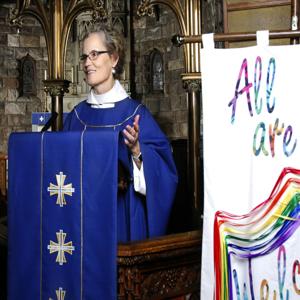


Welcome to our Mass on the Grass…with Brass!
What a joy it is to be out worshiping with all of you here in the midst of God’s beautiful creation. When we started this annual outdoor service back in 2015, we couldn’t imagine how popular it would become. Perhaps it is beloved because it is followed by a picnic with lots of food, but I think it is more likely that folks sense something profound in the setting.
Now, our church building is, I think, one of the most beautiful anywhere – its imposing neo-gothic stonework, the Romanesque main tower that soars above the altar, the Tiffany stained glass windows that rain down an array of sparkling colored lights across the worship space, the large labyrinth that beckons you to a journey in the narthex, the carvings in the wood that harken to another age – it all captivates the heart and centers our very souls on the sacred. So why do we leave it to come here?
Well, just look around you? There is sacredness in creation too, for while the church is the work of human hands dedicated to God, this is God’s direct handiwork – and how alive it is too. The sounds, the smells, the feel of the grass…and yeah, even the occasional bite of a mosquito or annoyance of gnats flying by – it is all so active and full of life. And I can’t think of a better Sunday for us to be out here than on the Feast of Pentecost, for on this day, and forevermore, the promise Jesus made to his disciples in the passage from the gospel we read this morning came into being…and the world has never been the same since.
So, let’s start with what happened, as we hear it in the passage from Acts read every year on this Sunday. On the day of Pentecost, the apostles being good Jewish men and women were gathered in Jerusalem to celebrate the Festival of Weeks and the giving of the law, one of three times faithful Jews were required to make pilgrimage and gather – the other two being Passover and the ingathering of the harvest. But for the followers of Jesus, this was a time of uncertainty. Jesus had departed, telling them, as we heard in the gospel today, that the Spirit of Truth, the Advocate, would be with them always – but what would that look like? What did that mean?
In that house in Jerusalem, they found out – a rush of wind, and tongues of fire rested on each of them – they were filled with the Holy Spirit, and began to speak in other languages – speech that was unfamiliar to them. It was all so strange that when they began to speak to the crowds that had gathered outside of the house in response to the noise, folks thought they were drunk. As I say every year, that led to perhaps one of the funniest lines in all of scripture, as Peter says to them “…listen to what I say. Indeed, these are not drunk, as you suppose, for it is only nine o’clock in the morning.” You gotta love it, right?
The story of Pentecost is that the Holy Spirit makes a wild, noisy, entry – not like a gentle dove – but a blow the church doors open sort of experience, which is absolutely amazing, but what does it mean for us now?
First, those earliest followers of Jesus didn’t do anything to bring about this gift of grace. To be sure, they were a very mixed bag of folks – none of the rich or powerful, all of them not exactly the model of perfection in any sense of the word. Of the men anyway, one denied him, two others competed with one another for his affection, and most of the others were generally clueless. Yet the Holy Spirit alighted on them all the same.
God works through the ordinary to bring about the extraordinary. God chooses to work through us not because we are perfect, but because through the cracks of our imperfections God’s light shines brightly.
It is also a reminder that God works within the context of diversity – people gathered in Jerusalem from all over the known world are met by followers of Jesus who are able to not only speak to them, but most especially to listen to them. Which tells us that “Pentecost isn’t about speaking incomprehensible languages. Pentecost is about hearing incomprehensible languages,”1 because all are welcome into the kingdom of God.
Now, hold that for a moment, while we look at what we heard in the gospel and in St. Paul’s letter to the Romans.
In the gospel, Jesus is giving his followers some final guidance before he leaves them, commonly called the farewell discourse. He tells them “If you love me, you will keep my commandments.”
And then he added, that he would ask God to send another – the Advocate, the Spirit of Truth. Who will abide with you and be in you. Then he finishes with – “Do not let your hearts be troubled, and do not let them be afraid.”
Hold all that for a moment and remember the words of St. Paul in the letter to the Romans we heard, where he also says “All who are led by the Spirit of God are children of God. For you did not receive a spirit of slavery to fall back into fear, but you have received a spirit of adoption…we are children of God, and if children, then heirs, heirs of God and joint heirs with Christ.
Folks, these are scriptures for our troubled times, are they not?
Yes, the world is difficult and dangerous now, particularly for many vulnerable communities.
Yet, let’s remember what we heard today.
First – the Holy Spirit not only walks alongside us, but is within us!
The Spirit may not come with fire blazing on our heads or the instant power to speak a multitude of languages, but is very much present at our baptism – anointing us in no less a way than those earliest apostles – always present, always guiding, always burning within our hearts.
We must also remember what Jesus said – to keep his commandments, most especially he would say the one he gave at his final supper with his followers: that we are to love one another as he loved us.
And finally – as St. Paul tell us, that we are children of God, heirs alongside Christ – which means we are part of a larger global family.
A family rooted in love – God’s love for us, our love for God, and our love for one another.
As we move through the days ahead, when our nation is facing a constitutional and moral crises, when people are being arrested and shipped to prisons in other countries because of the color of their skin, when LGBTQ+ people are pushed further to the margins, when women’s rights and their very lives are threatened every day, when people who are speaking out are being arrested and imprisoned because our government is deploying troops against them, and when war ravages across the world, we have to remember all we heard today.
We must remember, because fear is the tool of those who seek to destroy, and in the midst of all this darkness we can begin to feel anxiety rising up in our hearts, or all around us.
I get it – I really do!
We are tired, worn, angry, frustrated. And that is where fear will take root if we forget who we are. If we forget that we are the children of God – loved for all time.
And love will always defeat fear, God’s love most especially.
God’s love for us – and us for one another – is how we will overcome in the days ahead. That is why Jesus told them to keep his commandments. He knew that they would need to love – deeply and unconditionally, if they were to do the work they were called to do.
And we must remember too that we will not be alone in this. The Holy Spirit didn’t drop in on those apostles and then leave. She has existed since the dawn of creation, and is here now, today, with us.
Jesus said that the Advocate, the Spirit of Truth, will not only abide in us – but is within us.
Today truth is a precious commodity, isn’t it?
Some are trying to convince us that there are alternative facts. It’s like 1984 and we are being told not to believe what we see or hear, but that 2+2=5.
That is when we need to reach inward and allow that Spirit of Truth to rise up and light our way, before we instead allow our paths to be gaslighted.
Folks, we are in a Pentecost moment – we can choose to close the shutters, and hunker down, or follow the Spirit out into the world.
Christ hopes we breathe in that divine Spirit of Truth and live as the beloved children of God we are –
And then head into the world with ears able to hear what others are saying, and words that meet hate with love, fear with hope, darkness with light.
For just like those apostles, who faced an uncertain future, were fearful, and worn from all that had happened, we too were made for such a time as this. And like them, we need to live our own version of the Acts of the Apostles.
We, the people of Jesus, are grounded in hope, rooted in God’s love, and alive in the Spirit.
And make no mistake about it – we are a force to be reckoned with!
So, “Do not let your hearts be troubled, and do not let them be afraid.”
For when we truly live into who we are, when we love as Jesus loved, when we allow ourselves to be guided by the Spirit of Truth…
There are no chains of injustice we cannot break.
There are no walls of oppression we cannot tear down.
There are no prisons of poverty we cannot burst open.
There are no governments that can stop us, no armies that can defeat us, no tyranny that will divide us.
For we are filled with God’s love, strengthened in our union with Christ, and lifted up by the power of the Holy Spirit.
We are a Pentecost people – a wind of change blowing through the world, ready to set it on fire – to ignite all of creation with the restorative power of God’s all inclusive love.
Happy Pentecost Everyone!
Amen.
[1] Bob Eldan. https://preachingtip.com/archives-year-c/pentecost-year-c/pentecost-day-year-c/
For the audio, click below, or subscribe to our iTunes Sermon Podcast by clicking here (also available on Audible):
Sermon Podcast
The Rev. Diana L. Wilcox
Christ Church in Bloomfield & Glen Ridge
June 8, 2025
The Feast of Pentecost – Year C
1st Reading – Genesis 11:1-9
Psalm 104:25-35, 37
2nd Reading – Acts 2:1-21
Gospel – John 14:8-17, (25-27)
The post “Do Not Let Your Hearts Be Troubled” appeared first on Christ Episcopal Church.
June 1, 2025: “Alleluia! Christ is risen! The Lord is risen Indeed. Alleluia!
It’s the final Sunday of Easter today, so just because, let’s do that again – Alleluia! Christ is risen! The Lord is risen Indeed. Alleluia!
That never gets old to me, and hopefully not for you too.
Next Sunday, during our “Mass on the Grass…with Brass!” we will celebrate the Feast of Pentecost, commonly called the birthday of the church. But today, we get a lot of what the Holy Spirit is up to in those early days of the Jesus Movement as we continue our Eastertide readings from the Acts of the Apostles.
Now last week you may remember that we heard about Paul and Silas encountering Lydia and some other women at a place of prayer. This week, we hear about Paul & Silas going to another place of prayer and finding another woman, this one unnamed, so let’s give her one…let’s call her Kassandra. In Greek mythology, Kassandra was a princess of Troy. The god Apollo gave her the gift of prophecy. This pairing of the story of Lydia and then of Kassandra, is a classic technique of this author, who also wrote the Gospel of Luke (it’s a two parter). There are often two stories, a doublet, told in succession for a reason. So, back to it.
While Lydia was a woman of means and independence, Kassandra was a slave in more than one way. She was possessed by a spirit of divination, which the text says is of a demonic source. She also was enslaved by men who used her fortune telling ability to line their pockets. But in a twist, when Paul & Silas encounter her, she says that they are slaves. The text we heard this morning says, “While she followed Paul and us, she would cry out, “These men are slaves of the Most High God, who proclaim to you a way of salvation.” Before we go any further in the story, I just want to point out something about this that most, save scholars, usually miss. It is right in this part too.
Note that the author says “While she followed Paul and us, …” This is part of a collection known in biblical scholarship as the “we passages,” where the author of Acts, commonly thought to be the physcian Luke, changes from the third person to the first person, possibly indicating an eyewitness account, and that the author was a companion of Paul in his travels. See how just a word can bring so much meaning into a passage – especially for us biblical scholar geeks? [singing the PSA tune] The more you know. Or should I say, The more we know?
Okay, moving on here…The text continues saying that “She kept doing this for many days. But Paul, very much annoyed, turned and said to the spirit, “I order you in the name of Jesus Christ to come out of her.” And it came out that very hour.” You gotta love it – it’s like Paul had a pesky little sibling annoying him and he just couldn’t take it anymore.
And here’s where it takes a turn…Kassandra is freed from the possession by the spirit, but Paul & Silas are locked up. See, here’s what happened: The owners were really annoyed that they couldn’t make money off Kassandra anymore. What happened to her, we don’t know, which is a shame, I think. What we do know is that they drag Paul & Silas before the magistrates and incite the people against them. What happens next? The crowd joins in the attack against them, the magistrates have Paul & Silas stripped, beaten, and thrown into jail.
Paul and Silas are put into stocks deep in the innermost part of the prison. But instead of being angry, or afraid, they start singing hymns and praying, with all the prison listening in. And here’s the part the kids love in Sunday School because it is so awesome. At midnight a big earthquake came and BOOM! The prison gates were opened, the chains were broken. The jailer – let’s call him Marius (from the Roman God of war) – anyway, Marius drew his sword to kill himself out of dishonor because he thought everyone had escaped, and just then – he hears Paul shouting “STOP! In the name of love…” (kidding, of course).
Anyway, Paul tells him that the prisoners are all still there. Marius called for lights – which did NOT mean turning on the stage spots like in “A Charlie Brown Christmas,” but men with torches. Then he rushed down to find Paul and Silas sitting there like “Dude, chill. Hakuna Matata and all that.” Marius falls down in front of them trembling.
Cool story, right? But wait, there’s more.
Then Marius takes Paul & Silas out of the prison – not a bad idea one might say considering the circumstances. And outside, he wants to know how to be saved as he put it. Paul & Silas teach him about Jesus, and he becomes a convert to this new Jesus Movement. Then, just like the story last week, where Lydia implores Paul & Silas and his group to join her in her home where she offered them food and rest, this week Marius does the same – bringing them to his home, and caring for their wounds.
All of that is a great story, with lots of cool special effects too – the violent earthquake, chains breaking – and lots of people being freed in various ways – Kassandra, Paul & Silas, and even Marius. But let’s return to the part when Paul frees Kassandra from the demonic possession, even if it was just to stop her from annoying him.
Now, I don’t know about you, but if I saw someone drive a spirit out of someone else, freeing them from exploitation, I would be awestruck and thrilled…and thinking – dang, wish I had caught that on my iPhone camera. Nobody’s gonna believe this, and man that would have gone viral on TikTok. Instead, something else happened. Something we see a lot of today.
Instead of rejoicing and wondering about the power of God, these owners turn to the very well worn response when people are angry, fearful, or filled with greed. They appeal to cultural difference – the bigot’s playbook. “These Jews can’t be trusted,” they cry. They tell everyone to be afraid of “those people” because they are different. They warn that they dangerous, and the cause of whatever problem the community may be experiencing (or think they are experiencing), because they aren’t like us, or follow our customs as Romans. Which, if you think about it, is odd given that both Paul & Silas were Roman citizens themselves. But when has that ever mattered in history when a majority point to a minority as being different and dangerous?
Today we hear this same thing about immigrants, refugees, LGBTQ+ people, people of color, Muslims, and again – Jews. And, as in this story, it can often seem for a time that bigotry and greed has won the day. In our text from Acts, the crowd buys into the hate, and Paul & Silas are beaten severely and locked up in stocks deep within a prison. Today in our country, brown and black people are being picked up by masked federal agents and shipped to detention centers and prisons notorious for human rights violations – all of this without due process of law. Today, all around the world the rich are getting richer on the backs of the poorest workers. Those in power in our nation are not working to free us from this economic oppression, but rather are working to institutionalize it – trying to cut Medicaid and Medicare, eliminating organizations that help the poor and protect everyone like USAID, and trying to destroy institutions that educate, protect, serve, and heal the people.
Has bigotry and greed won? Not if we remember the lessons from the rest of this story.
Paul & Silas sang and prayed in prison, and this is far more subversive than it may seem. Our faith frees us to transcend our present circumstances – keeping us on an even keel, and guiding us forward in the name of justice and peace. It is the most powerful force we can bring to bear against the oppressor.
The thing is, those who wield power unjustly count on the oppressed being an example to others. “Look what will happen to you if you get out of line.” That doesn’t work when the folks are singing hymns of praise and praying, rather than cowering in fear or allowing hate to build up within them. What oppressors want is for people to be afraid. And when violence erupts it works to justify their oppression and open the door for tightening the grip even more.
Violence is not the path to peace and freedom. The leaders of civil rights movements, many of whom were people of faith, knew that well, and teach it to us by example throughout history. We need only look at people like Rosa Parks, Nelson Mandela, the Rev. Dr. Martin Luther King, Jr., and in this start of Pride Month – Bayard Rustin, Del Martin and Phyllis Lyon, Harvey Milk, Marsha P. Johnson, and more. Some were faith leaders, others were politicians, authors, and more. All risked their lives, some dying, for the cause of freedom. None tried to fight violence and oppression with violence and oppression. And like Paul & Silas, none of them would try to escape the trials they faced if it left others suffering.
Remember, even when Paul & Silas were able to flee the prison, they did not. It was, as one commentator noted, “…an escape story without an escape.”[1] Why? Why didn’t they leave? Because being a part of the Jesus Movement is not about escaping danger, but about welcoming opportunities to shine the light of God’s unconditional love and grace where it is most needed – and light is most needed in the darkest places. Had they left, Marius would have killed himself. Had they left, it would make the story of God’s great act of grace in the earthquake be about freeing two disciples rather than about redeeming Marius, and through him, spreading the good news of God’s love throughout another region.
As we continue to follow Jesus and stand against oppression in our country in our time, let us remember this story of Paul & Silas, Kassandra & Marius.
Let us sing amidst the darkness of hate.
Let us pray when facing the shackles of injustice.
Let us not flee at the first opportunity, but stay to do the work we are called to do – for none of us are truly free unless all are free.
And as we continue to partner with God, the bitter walls of injustice that bind both the oppressed and the oppressor will come toppling down – stone upon stone – until everyone is able to experience God’s dream for us all – that beloved kingdom of peace, wholeness, love, and grace.
It won’t be easy.
But it will be the most rewarding life we could ever live.
Amen.
For the audio, click below, or subscribe to our iTunes Sermon Podcast by clicking here (also available on Audible):
Sermon Podcast
[1] https://www.workingpreacher.org/commentaries/revised-common-lectionary/seventh-sunday-of-easter-3/commentary-on-acts-1616-34-9
The Rev. Diana L. Wilcox
Christ Church in Bloomfield & Glen Ridge
June 1, 2025
Seventh Sunday of Easter – Year C
1st Reading – Acts 16:16-34
Psalm 97
2nd Reading – Revelation 22:12-14,16-17,20-21
Gospel – John 17:20-26
The post “The Most Powerful Force” appeared first on Christ Episcopal Church.
May 25, 2025: Alleluia! Christ is risen!
Yes, we are still in Eastertide. And, it is also Memorial Day Weekend in our country. A time when we remember those who gave the last full measure for the freedoms we hold dear. And in today’s scriptures, we hear two passages that have a lot to say to us in this time and place, especially as we remember those who died for the ideals of this nation.
The first is the gospel, where Jesus encounters a man who is lame and has been trying to get into the pool to be healed for 38 years. And Jesus asks him a question: “Do you want to be made well?” It’s a strange thing to ask, right? I mean, doesn’t everyone? Well, perhaps we say we do, but then we don’t do what we need to do to get well. Hold on to that for a moment as we look now at the passage from Acts.
In the verses prior to what we heard today, we encounter Paul & Silas, who, having had a bit of a tiff with Barnabus about another guy, John Mark, set off toward Asia, picking up another convert, Timothy, along the way. However, they are now a bit flumoxed. Basically, every time they set off in a particular direction, their GPS said “Rerouting. Rerouting.” They went to preach the word in Asia, but the Holy Spirit stopped them. How, the text doesn’t say. Then they tried to go into Mysia, but again they were blocked. Finally, in the part we heard today, Paul has a vision in the middle of the night about a man in Macedonia needing their help, so off they went.
They had been in the city of Phillipi for a few days, and when the Sabbath came, Paul did something a little bit unusual (perhaps learning recently that the Spirit was not interested in his doing things the way he had been doing them). Usually, Paul would go into the synagogue to preach. Instead, he and his companions went outside the city gates to what he had heard was a place of prayer. There they encountered women by the river, and they sat down and began speaking with them.
There, a woman named Lydia, who was a dealer of purple cloth, had her heart opened by the Holy Spirit to “listen eagerly to what was said by Paul.” She and those in her household were baptized, and she not only invites, but implores Paul and his companions to stay in her home.”
So, just to recap: on the one hand, we hear about a lame guy who has suffered for years because he kept trying the same thing over and over again to be healed, and Jesus asks him if he wants to be made well. On the other hand, we have followers of Jesus trying to go in certain directions, but being rerouted, and when they thought they were to see a guy in Macedonia, they instead meet Lydia, who would become the first gentile convert in a new area. Catching a theme here? And it isn’t like this is stuff that just happens to people in the bible, right?
I mean, haven’t you ever encountered someone who does the same thing over and over again and expects a different result? No, I am not talking about rooting for the Mets to win the World Series, though I suppose that it sure feels that way to us Mets fans sometimes. Or perhaps you have experienced heading in one direction, only to be stymied. Changing course, you are blocked again.
You know, sometimes when we keep trying to do the same things over and over, and it isn’t working, or keep trying to find a way to our intended goal but being stopped at every turn, it might be because we aren’t paying attention and can’t see that another path is open for us. Which is understandable given how insanely crazy life is for most of us these days. Not to mention that, while we are bombarded 7×24 with social media, work, and a boatload of entertainment options, we are also faced with an incessant barrage of horrible news. I mean, the way things are in our country today, we can feel as immobile as the lame man by the pool, hoping someone will save us – someone will make our pain go away.
Still, even when we are not successful at doing it ourselves, most of us know that when the universe is trying to tell you something, you ought to listen. It’s like the old story about the guy who, having purchased a vacation home on the shore, bought from a local shop a beautiful antique barometer for his wall. When he got home and put it up, he was disappointed that it seemed stuck – it’s needle pointing to Hurricane. While at work in the city the next day, he called the shop to ask about returning it, but it was closed for some reason. When he got back to his vacation home – the clock and his entire house – was gone. Wiped out by – you guessed it – a hurricane.
Now this is likely a bit of a fishing tale, but the point is there. When all the needles of life are pointing in a particular direction, perhaps we better try to go that way. More often though – we are like those folks in the horror movies, who decide to go downstairs, alone, into a dark basement when they hear a strange sound, rather than outside to call 911. That is never a good outcome, right?
Or, sometimes it is that we become used to going in one direction – it’s comfortable, it is what we know – and change isn’t comfortable for some folks. In fact, the church can be downright terrible at it. Which is why when the church does change direction, it can sometimes be big news.
Most of you know that I was once the diocesan liaison to Episcopal Migration Ministries or EMM. EMM “is a ministry of The Episcopal Church and is one of 10 national agencies responsible for resettling refugees in the United States in partnership with the government. Episcopal Migration Ministries currently has 15 affiliate partners in 13 states… In 2024 [alone, for example], EMM resettled 5,396 refugees and 1,137 individuals with Special Immigrant Visas (SIV) from 48 countries rebuild their lives in peace and security in 13 communities across the United States.” And to be clear, the US takes in way less than its share of refugees.
Despite all that history of doing good work in Christ’s name, in January The Episcopal Church laid off 22 EMM employees after the current administration suspended refugee resettlement shortly after the inauguration. And just two weeks ago, things took an even more tragic turn. Presiding Bishop Rowe said in a letter dated May 12, 2025, the following:
“Dear People of God in The Episcopal Church:
I am writing today with some significant news about Episcopal Migration Ministries… Since January, the previously bipartisan U.S. Refugee Admissions Program in which we participate has essentially shut down. Virtually no new refugees have arrived, hundreds of staff in resettlement agencies around the country have been laid off, and funding for resettling refugees who have already arrived has been uncertain. Then, just over two weeks ago, the federal government informed Episcopal Migration Ministries that under the terms of our federal grant, we are expected to resettle white Afrikaners from South Africa whom the U.S. government has classified as refugees.”
Now, before I continue on with Presiding Bishop Rowe’s letter, I want to set the record straight about the claims the President is making about these Afrikaners, descendants of Dutch, German, and French settlers, who are members of the white ethnic minority that once led South Africa’s brutal and decades long apartheid regime, which ended in 1994 with the election of Nelson Mandela as president. While they makeup only 7% of the population, they still own more than half the land. The President says that they are the victims of genocide and uncompensated land grabs. This is not only a racist far right conspiracy theory – it is false and ignores the long and painful history of the country. And this administration, who says that migrants from our Southern Border must wait their turn and come here legally, now wants these folks to jump past refugees who have already been vetted, and who have waited for years. Why? The answer couldn’t be more black and white.
So, continuing on with the letter from our Presiding Bishop.
“In light of our church’s steadfast commitment to racial justice and reconciliation and our historic ties with the Anglican Church of Southern Africa, we are not able to take this step. Accordingly, we have determined that, by the end of the federal fiscal year, we will conclude our refugee resettlement grant agreements with the U.S. federal government. I want to be very clear about why we made this decision—and what we believe lies ahead for Episcopal Migration Ministries’ vital work.
It has been painful to watch one group of refugees, selected in a highly unusual manner, receive preferential treatment over many others who have been waiting in refugee camps or dangerous conditions for years. I am saddened and ashamed that many of the refugees who are being denied entrance to the United States are brave people who worked alongside our military in Iraq and Afghanistan and now face danger at home because of their service to our country. I also grieve that victims of religious persecution, including Christians, have not been granted refugee status in recent months.
As Christians, we must be guided not by political vagaries, but by the sure and certain knowledge that the kingdom of God is revealed to us in the struggles of those on the margins. Jesus tells us to care for the poor and vulnerable as we would care for him, and we must follow that command. Right now, what that means is ending our participation in the federal government’s refugee resettlement program and investing our resources in serving migrants in other ways.”
I commend the Presiding Bishop for this stance, while grieving for those who will remain in danger, or live in difficut conditions in refugee camps because of this President’s preference for those who are white over those with brown or black skin. One option the President dangled before us was that, if we just help settle these white people, they would let us help the others later down the road. While we might feel we should go ahead then, so we could help the others, we all know that collaborating with racism is not the path for any follower of Jesus – the ends do not justify the means.
As the Presiding Bishop later added in a follow-up letter, “The problem with any kind of Faustian bargain like that is that the devil always wins…We knew that if we did this, we were going to be asked to do something else we couldn’t do. This was the line that we had to draw. And we’ll continue to do that. We’ll continue to tell the truth and be on the side of moral decision-making, and that’s what this is about. Just because the Trump administration and others have lost their way doesn’t mean the church has.”
Indeed. We have not lost our way. We could have mulled this over awhile, tried to work with the governement, and get along to get along for the so-called greater good. But that would be like the guy laying by the pool, hoping things would be different. We know from the news that law firms and universities who caved to this administration’s unjust demands found that out the hard way. We will not be bullied, but rather will remain steadfast in our mission, going wherever Christ calls us.
So, we are instead following Jesus. Rather than laying around bemoaning our situation, we will get up, pick up our mat, and follow him down a new path. When our road is blocked, we will follow the Holy Spirit to a new path and move forward. When we feel a bit lost, or overwhelmed, not knowing what to do next, we will come to our parishes on the sabbath day – to our proverbial river banks – to ours places of prayer.
For there we will be nourished by the real presence of Christ standing beside us.
There we will see what we could not see before, and be strengthened in our work by our faith community.
And from there we will set about on the next part of our journey.
Because as followers of Jesus, we are called to care for the stranger – refugee and immigrant today – not participate in racist policies or bend the knee to secular oppressors.
As followers of Jesus, we are called to be a voice for the voiceless, not a megaphone for the rich and powerful.
We know that we will, and already are, paying a price for serving Jesus rather than this administration, but we will take courage by the model of those we honor this weekend.
We will go where we are needed, fight the good fight, and if necessary, lay down our lives for what is right, for what is true, and for the freedom and dignity of all of God’s people.
For that is our call.
That is our mission.
That is our life.
So look out world, that barometer isn’t broken, there IS a hurricane approaching – it’s called The Episcopal Church!
And we are a superstorm that will, by the power of Christ working in us and through us, tear down the walls of division, rip apart the institutions of oppression, and break the chains that bind any child of God.
Amen.
For the audio, click below, or subscribe to our iTunes Sermon Podcast by clicking here (also available on Audible):
Sermon Podcast
The Rev. Diana L. Wilcox
Christ Church in Bloomfield & Glen Ridge
May 25, 2025
Sixth Sunday of Easter – Year C
1st Reading – Acts 16:9-15
Psalm 67
2nd Reading – Revelation 21:10, 22-22:5
Gospel – John 5:1-9
The post “Hurricane’s Approachin’!” appeared first on Christ Episcopal Church.
May 11, 2025: Alleluia! Christ is risen!
Welcome to Good Shepherd Sunday, always the fourth Sunday of Easter, when we hear the gospel message of Jesus as our shepherd, whose voice we hear and whom we follow.
It is also Mother’s Day in the secular world. I hope to get lots of licks and meows from my dog Lexi and my two cats Katie & Lauren when I get home later today. But as I note every year, this is also a difficult day, or one that brings about mixed feelings for many – those whose mother’s have died, or those whose mothers are absent – in whatever way that may mean – or those mothers who have lost a child, or those women who could not have one – for them Mother’s Day can be troubling, awkward, or even painful. And if that is you, know that we, your parish family, are holding you in prayer.
And so, as I also say each year, that is that is why I like to think of today as less about Mothers specifically, and more about women – mothers, sisters, daughters, wives, nieces, aunts, and friends. Women who have been a part of our lives – nurturing, mentoring, loving, caring. That is what we really celebrate today – the journey of women – us, if we are women, and those women who have been a part of our lives.
Which is why this passage from the Acts of the Apostles we heard this morning is such a powerful text for us today. It is the story of a disciple of Jesus. No, not Peter, though he is a part of it. This is the story of Tabitha, her name in Aramaic, also known to her community as Dorcas, her name in Greek.
The first thing we hear about her is in the opening of the text. It says “Now in Joppa there was a disciple whose name was Tabitha, which in Greek is Dorcas. She was devoted to good works and acts of charity.” Let me just repeat this part “there was a disciple whose name was Tabitha.” This is the only time in the bible where a woman is named a disciple, or μαθήτρια in the original Greek. Now, we know that Dorcas isn’t the only female disciple, but she must have really stood out to not only be named as such, but really – to be named at all! So many women, powerful women, are not named in our bible, or quite frankly, are the hidden figures of our society even to today. This is a perfect text to hear about on a day in which we celebrate the women in our lives.
For widows in the time of Dorcas, articles of clothing would be more valuable than gold – for they were without means of support. It wasn’t like you could just go to the store and buy a tunic off the rack either. That is why Jesus calls us to care for the widows and the orphans, for they were, and are, the least of these in which we are to see the face of Jesus. Dorcas saw them, and took care of them out of her means, by her own hand – making them garments, which they wept over in her time of death. She was a true disciple of Christ – one who loved the least of these, as he loved us.
Of course today, Jesus is still calling us to care for widows and orphans – the least of these – the ones no one sees, or wants, or cares about. Today they are the homeless, the poor, the marginalized, and yes, actual widows and orphans. They are also, especially now, the migrants – those immigrants and refugees being unlawfully persecuted by our government.
Except today, it has become a crime to protest the unjust acts against our neighbors. This past Friday, during a protest outside a privately run Federal detention center, the Mayor of Newark, Ras Baraka, was arrested. He was there with members of congress, who are, by law, to be admitted to any of these facilities for unannouced inspections. Not being a member of congress, the Mayor was turned away. He returned to the public side of the gate, and according to the Associated Press, video showed him speaking through the gate to a man in a suit, who said: “They’re talking about coming back to arrest you.” “I’m not on their property. They can’t come out on the street and arrest me,” Baraka replied.
Minutes later several ICE agents, some wearing face coverings, surrounded him and others on the public side, and dragged him back through the gate in handcuffs. This on the heels of the arrest of pastors praying last week in the Capitol building. These people are being arrested for doing what Jesus calls us to do – caring for the least of these – for the stranger in our midst.
But wait, there’s more… an Episcopal Church in Toms River wanted to open a homeless shelter on their expansive property. The town not only fought it, but the Town Council decided to begin proceedings to take all the church property by eminent domain, so they could build a park with pickleball courts and other amenities. If this is allowed to stand, and believe me, they chose the wrong denomination to fight, it means that any house of worship is in danger of having their property seized by the local community – not just Christian churches. Don’t want Jews or Muslims in your neighborhood? Then take their synagogue or mosque by eminent domain.
That is where we are here in the US.
It is dangerous to be the kind of follower of Jesus, who not only goes to church, or wears a big gold cross in public, but who actually hears his gospel call to serve the poor and the outcast, the imprisoned and the sick, the widow and the orphan and does something about it. In fact, it appears you can’t even be the Pope and not get attacked.
Which brings us to other news this week – the conclave (not just a movie) and the election of a new pope to lead that other part of the larger catholic church, our Roman sisters and brothers around the world. And here is why it never pays to place bets on things….everyone said that even though there were a few Cardinals in the US that could be considered, especially one Robert Prevost from Chicago, everyone also said “Nah, they won’t ever choose someone from the US.” Ooops.
We had white smoke, the seagulls on the roof of the Sistine chapel rejoiced, and then we all discovered that it was indeed Robert Prevost who was selected. So, Chicago not only has now Da Bears and Da Bulls, but also lays claim to Da Pope! Sadly, it took only an hour or so for the attacks to appear on social media from the far right, calling him: a woke, anti-MAGA, globalist, Marxist, because apparently he advocated for the poor and the outcast. Seriously, you can’t make this stuff up.
But back to this new pope for a moment. Like so many scripturally who have a name change when going through a spiritual transformation, the Cardinal elected Pope also chooses a new name.
You know, Juliet of Shakespeare’s play, once pondered “What’s in a name?” as she wondered if a name really mattered, or was what was inside, or inherent within a person, that defined someone. In the case of the one chosen by a new pope, the name itself refects the heart of the person. It is a statement on their sense of their calling, either because of the saint chosen, like Francis, or who last held the name. So, when we heard that His Eminence, Cardinal Prevost, would now be His Holiness, Leo the XIV, it was significant, because of Pope Leo the XIII.
Pope Leo the XIII was a proponent of the social gospel – which really is just the gospel of Jesus Christ – where we care for the poor and marginalized. His May 1891 encyclical (or letter to the church), “Rerum Novarum,” or “Revolutionary Change,” addresses “the misery and wretchedness pressing so unjustly on the majority of the working class.”
At a time of the rising industrial revolution, Pope Leo XIII called the church to be mindful of the poor, and show compassion. He advocated for the working class, calling for the formation of labor unions and the use of collective bargaining. It was not a perfect document when looking back with our 21st century lens, but it inspired others to action. One of those was another woman disciple who would be remembered long after her death for her good works. Her name was Dorothy Day.
Dorothy Day became a part of the Roman Catholic church after the birth of her child. After meeting Peter Maurin, a French immigrant and former De La Salle Christian Brother, she was introduced to the Church’s social teaching, including that of Pope Leo XIII, and his Rerum Novarum.
“On May 1, 1933, during the depths of the Great Depression, Maurin and Day launched the Catholic Worker newspaper. Within only a few years, the paper’s circulation soared and dozens of Catholic Worker houses sprang up across the country. The movement’s members embraced a simple lifestyle (“voluntary poverty”) and cared for poor and homeless people.”[1] Dorothy Day, like Dorcas, served her community, most especially the least among them, as disciples of Christ are called to do.
In the case of Leo IVX, the story is yet to be told, but based upon Cardinal Prevost’s long history of working among the needy, and his closeness to Pope Francis, I suspect Leo XIII and Francis will smile down upon him. But what does all this have to do with us? We are catholic, but split from the Roman church long ago. What does this have to do with us now?
Well, let’s look at his first address, after being announced as Pope Leo IVX. This is often a pivotal moment, and like the choice of name, reflects what we might expect from his papacy.
The new pope came out on the balcony and said “La pace sia con tutti voi.” “Peace be with all of you!” And continuing, in Italian, then Spanish, he said:
“Dearest brothers and sisters, this is the first greeting of the Risen Christ, the good shepherd who gave his life for God’s flock. I too would like this greeting of peace to enter your heart, to reach your families, to all people, wherever they are, to all peoples, to the whole earth. Peace be with you! This is the peace of the Risen Christ, an unarmed and disarming peace, humble and persevering. It comes from God, God who loves us all unconditionally. We still have in our ears that weak but always courageous voice of Pope Francis who blessed Rome! The pope who blessed Rome gave his blessing to the world, to the entire world, that Easter morning.
Allow me to follow up on that same blessing: [and then he quotes Pope Francis] “God cares for us, God loves all of us, and evil will not prevail! We are all in God’s hands.” [continuing, he Pope Leo added] Therefore, without fear, united hand in hand with God and among ourselves, let us move forward. We are disciples of Christ. Christ goes before us. The world needs His light. Humanity needs Him as the bridge to reach God and His love.”
“God loves all of us, and evil will not prevail!”
In this time of chaos, where hate and anger against those who would love and serve the least of these is everywhere, when governmental authorities will arrest you for speaking for the voiceless, or praying on their behalf, when people live in fear because of the color of their skin, who they love, or what gender they claim, remember: “God loves all of us, and evil will not prevail.”
That is the good news of Easter – that evil will not prevail – God’s loves all of us and God’s love always will triumph. That is the gospel we proclaim. And we are called to spread this message to all the world – that is the revolutionary change we are called to bring about in his name.
It doesn’t only come about in grand acts of courageous mission, but often through the silent small stitches of love and grace woven into the world – like Dorcas.
It is manifested by the willingness to see those others refuse to see – the poor laborer, the homeless, the lost, and the forgotten – and then work tirelessly to not only help them, but change the conditions that led to their suffering – like Dorothy Day.
It is proclaimed not just in words of encyclicals, but in what those words do – shining a light on those who are left behind as the rich grow richer – as the world heard from Leo XIII, and with hope in his successor, Leo IVX.
And this good news of Easter – that evil will not prevail – God loves everyone and God’s love always will triumph – is spread by you – for you are a disciple of Christ, Christ goes before you. The world needs His light shining through you.
“Therefore, without fear, united hand in hand with God and among ourselves, let us move forward.”
Let us move forward with the love of God that defeats hate.
Let us move forward with the peace of our Good Shepherd, Jesus, that defeats violence.
Let us move forward to proclaim “God loves all of us, and evil will not prevail.”
Our names might never be changed, but the world most definitely will be.
Amen.
[1] https://www.dorothydayguild.org/dorothy-day7ce4a03b
For the audio, click below, or subscribe to our iTunes Sermon Podcast by clicking here (also available on Audible):
Sermon Podcast
The Rev. Diana L. Wilcox
Christ Church in Bloomfield & Glen Ridge
May 11, 2025
Fourth Sunday of Easter – Year C
1st Reading – Acts 9:36-43
Psalm 23
2nd Reading – Revelation 7:9-17
Gospel – John 10:22-30
The post “God Loves All Of Us, And Evil Will Not Prevail!” appeared first on Christ Episcopal Church.
Now, you’ll know I am a bit of a geek; and, as this is a special day for Star Wars fans, I suppose I should begin by saying: May the 4th be with you!
You know, you can always tell when an Episcopalian is watching a Star Wars movie. It’s true. When a Jedi says “May the force be with you,” we automatically respond with “And also with you!”
Sadly, we could use some Jedi knights about now, because it would seem that the Empire is striking back. I mean, if it is a day that ends in Y, it is a day when the news has some inhumane, unjust, or illegal act committed by our nation’s leaders.
There was the continued illegal deportations without the due process of law guaranteed to all persons (citizen or not) by our Constitution. This included a 2 year old, a 4 year old with metastatic cancer, and their mother.
There was the middle of the night raid on an Oklahoma home occupied by a woman and her two daughters – all citizens of the US. They had just moved in when law enforcement bashed in, took everything they had, including the cash needed to buy groceries, traumatizing everyone. It was a case of mistaken identity. No apologies nor a return of their valuables has yet happened. These are things we expect to hear about in countries ruled by dictators, not here in the US.
Now it seems one cannot even be a pastor praying without getting arrested.
That’s right, Bishop Barber, who is the founder of the Center for Public Theology and Public Policy at Yale Divinity School, where he also teaches, and a leader of the Poor People’s Campaign, was standing with ecumenical colleagues in the rotunda of the Capitol building offering prayers. His stole said “Jesus was a poor man,” and he was there with a few others on what is known as Moral Mondays, to pray about the budget bill that is being proposed.
The bill eliminates funding of many programs for the poor and vulnerable, cuts medicare/medicade and social security, and so much more. These pastors were praying for a change in heart. They had no weapons, and did not try to obstruct anything or any one. They did however repeatedly pray this “Against the conspiracy of cruelty, we plead the power of your mercy.” The police removed reporters from the area, and then arrested them. Certainly, if there is one thing we need in this world are prayers to turn the hearts of those who are persecuting others.
Which is why the story we heard in the reading from the Acts of the Apostles is timely, because some of our nation’s leaders need to get knocked off their high horse, to stop their persecution of others. That is what we heard happened to a guy named Saul traveling to Damascus.
Saul from Tarsus is persecuting the followers of Jesus. In fact, in the previous chapters to what we heard today, Saul stands and guards the coats of the folks stoning our first martyr – the Deacon Stephen, and then, because well, that wasn’t enough blood letting, seeks out more folks he can persecute. Acts 8:3 says “…Saul was ravaging the church by entering house after house; dragging off both men and women, he committed them to prison.” Sounds very familiar to us today, does it not?
Jesus quite literally stops Saul in his tracks. He is given new work to do – bringing others into relationship with Christ. This type of story is so life changing, so incredible, it leaves such an impression. It is a story of transformation. And even today, when people experience a major transformation or conversion, it is often referred to as a “road to Damascus experience.”
But, while it is often thought that this was a conversion story of Saul to Christianity – that is not true at all. Saul, who after this encounter is known to us as St. Paul, was born, lived and died a Jew…just as Jesus was a Jew. “The Way,” as the followers of Jesus were called, was not Christianity, but a movement within Judaism that, through Saul’s encounter with the risen Christ, broadened out beyond the bounds of the Jewish faith. Yet sadly, Saul was not alone in persecuting the earliest followers of Jesus.
For centuries, the believers were considered traitors to the Empire. They were persecuted ruthlessly, particularly under Diocletian. Then Constantine came along, converted, and Christianity (as it was then called because, by the efforts of Saul turned Paul, it had by that time moved beyond the bounds of the Jewish faith), became a part of the mainstream.
Constantine saw that this new Christian thing (it was only just over 300 years old), had a lot of divisions. And knowing that could bring down not only the faith, but cause a lot of problems for his realm, he called the leaders of the faith together in that first ecumenical council and charged them to come to an agreement. They did. So, good, right?
But, we didn’t learn the lessons of our own persecution. We did it to others – to Jews & Muslims during the Crusades, and to other Christian groups over doctrinal differences through the centuries since. Which is why what we did yesterday here in New Jersey was amazing and so important.
The year 2025 marks the 1700th anniversary of that First Ecumenical Council of 325 Constantine called, and the Nicene Creed which was initially drafted at it. The Episcopal Dioceses of Newark and New Jersey, working with the Roman Catholic Archdiocese of Newark, the Lutheran (ELCA), Presbyterian, and other Western denominations, as well as the Ukrainian Orthodox and others from the Eastern Church, joined together in a celebration of this historic moment in the universal church. This idea for this celebration came from his Eminance, Cardinal Tobin, Archbishop of the Diocese of Newark. Sadly, Cardinal Tobin was unable to be present with us because, well, there is this other thing going on in Rome now. The service itself was historic – East and West together, reciting a common creed (which hadn’t been done in centuries).
While that is exciting to church history nerds like myself, the reason I am talking about it today is because it can be instructive for us now. As I said to a reporter from the Roman Catholic Archdioese of Trenton, there are so many divisions around our country and the world. The church has also been historically divided, in particular between the Eastern & Western churches, about a number of doctrinal beliefs. To unite together, across the different churches within the East and the West, and to say “We believe in one God…” focuses our attention on what unites us, and truly that is far greater than what divides us.
In his homily yesterday, his Eminence, Metropolitan Anthony of the Ukrainian Orthodox Church of the USA, touched on the importance of what we were doing. He said “This shared inheritance reminds us that our divisions, though painful, do not erase our common roots. We are all the children of one church that gathered in Nicaea. The Nicene Creed remains a bridge across time and tradition – a theological thread that binds together the ancient and the modern, the East and the West. It is a sacred thread that calls us even now to reexamine our divisions with humility, courage, and hope.”
Which brings us back to Saul, who after his transformation was called Paul. St. Paul, knowing how destructive divisions can be, continually wrote about the many being one in Christ. We are many, and we have different ways of living our faith, different gifts of the spirit, as St. Paul would later write about, but we are united as one body in Christ Jesus – one Lord, one faith, one baptism, one God and Creator of all. I suppose if he had been writing in Latin, rather than in Greek, his epistles to the early church would include E Pluribus Unum – “out of many, one.” If that sounds familiar, it’s because it appears on the money you use every day – a motto for the US.
The question becomes, why does it matter?
Today our nation is facing a crisis of conscious, which is also centered on whether another foundational document, the Constitution, will remain something that unites us, or be tossed into the ash heap of history as an irrelevant set of ideals of a bygone era. It is not a perfect thing, this Constitution. It still does not include equality of women, for example, and it took a long time for others to be included. It is sometimes also used to stop progress by those who adhere to the idea that we must remain permanently entrenched in the thoughts of white men who lived in a time of legal slavery.
Yet the core ideals of liberty, justice, and truth by far outweigh the weaknesses inherent in its construction. United by this Constitution, we the people continue to declare a desire to form a more perfect union, establish justice, ensure domestic tranquility, provide for the common defense, promote the general welfare, and secure the blessings of liberty to ourselves and our posterity. We believe so strongly in the importance of democratic freedoms that we have, rightly or wrongly, tried to spread this throughout the world.
One might rightly argue, that is a secular thing, this Constitution. What has the church to do with the state?
This is a true thing indeed.
However, there is a parallel here. The Constitution’s principles, even if we haven’t always abided by them, are about freedom, dignity, and equality. It was written by people of faith – followers of Jesus. In fact, 31 of the 55 original signers were Episcopalians (formally, before our split with England, Anglicans – members of the Church of England). Our Constitution makes a statement about what we believe, and we know by our motto, that we need to be united as a people to ensure that the Constitution’s values are upheld.
So, the question for us as citizens is – will we live that out? Will we, as the many, come together as one, to stand for the ideals we professed in that foundational document, or will we set it aside, and allow those ideals to die? In the final days of the Constitutional Convention of 1787, a woman asked Benjamin Franklin, “Well Doctor what have we got a republic or a monarchy” “A republic,” replied Doctor Franklin, “if you can keep it.”
For Christians, we have a different, but similar calling, and a different statement of belief. And we might rightly consider if we are working together to ensure our faith is a lived reality, or are we standing by while others persecute children of God, or worse, participating in that persecution either explicitly by our own acts, or implicitly by our silence.
As his Eminence, Metropolitan Anthony, also said in his homily, “Let us be clear my dearly beloved to profess the creed is to confess Jesus Christ with our lips, but it is also to Incarnate him within our lives. A Christian who says “I believe in one God” must live as though they do – by serving the poor, forgiving the enemy, welcoming the stranger, and radiating the light of Christ. In a world darkened by hatred and confusion, the creed then becomes not merely a theological formula, but a spiritual constitution – a daily manifesto of Christian life.”
Let the people say “Amen.”
Today our country is divided, and it is hoped that the Constitution will withstand this time of crisis, and we the people will unite together to ensure that all will remain free.
As followers of Jesus, we are united across time and space by what we believe too. And in our willingness to be one body in Christ, united together with him, we become his agents of transformation a beacon of hope for a despairing world.
When we live the faith we profess, we will be a voice for the voiceless, and repairers of the breach.
When live the faith we profess, we will be a living reminder for those who live in fear, here in our nation and around the world, that while empires come and go, there is no earthly power that can ever extinguish his eternal light.
When we live the faith we profess, we may not knock anyone off an actual horse, but we will always stand in the path of those who seek to harm any of God’s children, and that will be what saves us all.
May the force that is Christ Jesus be with us.
Amen.
To view the service commemorating the 1700th Anniversary of the First Ecumenical Council & the Nicene Creed, click here: https://www.youtube.com/watch?v=3Xcsb1ZPV-0
For the audio, click below, or subscribe to our iTunes Sermon Podcast by clicking here (also available on Audible):
Sermon Podcast
The Rev. Diana L. Wilcox
Christ Church in Bloomfield & Glen Ridge
April 4, 2025
The Third Sunday of Easter – Year C
1st Reading – Acts 9:1-6, (7-20)
Psalm 30
2nd Reading – Revelation 5:11-14
Gospel – John 21:1-19
The post “E Pluribus Unum” appeared first on Christ Episcopal Church.
April 27, 2025: Alleluia! Christ is Risen!
Happy Easter! Now, for all of you that thought Easter was last Sunday…today is Easter…too, or 2. Easter is not just a single day on the calendar. We are still celebrating Easter and we are in Eastertide until the day of Pentecost, this year falling on June 8th.
And because we always read this text from John on this Sunday, the one about Thomas, some call this Doubting Thomas Sunday. Thomas is my absolute second favorite apostle…after Mary Magdalene, of course. I love Thomas because Thomas is me – and really, all of us. And most of you know from past sermons that we have done Thomas wrong all these years. But before we get there, let’s do a brief recap of this story of the first appearance to the male disciples. I say male because Jesus already appeared to the women – first.
Now, about this appearance to the guys, I think they likely breathed a sigh of relief. I mean, Jesus entered and said “Peace be with you” not “Woe to you who denied me, couldn’t stay awake, didn’t believe Mary and the other women, never did seem to get anything I told you, etc., etc., etc.” Whew!
The only problem is that Thomas wasn’t there. Where was he? Who knows. Maybe he was out at Costco grabbing supplies. Or, maybe he got stuck in the Route 80 sink hole traffic (God help him). Or maybe he was just out for a smoke break. Wherever he was, he missed the big reveal. Now, that’s gotta stink, right?
I mean, come on – has it ever happened to you that something amazing happened, and you just missed it? I know that seems to happen here in New Jersey a lot. I mean every single time there is some sort of cool astrological phenomenon you can guarantee it will be clear everywhere else but New Jersey. I swear it’s true.
Well anyway, when Thomas gets back from wherever he was, the others tell him what happened, and he refuses to believe it until he can see Jesus for himself. And the thing is – as I point out each year, he didn’t ask for anything more than what all the other boys asked for when they were told by Mary Magdalene and the rest of the women about the empty tomb. Those guys refused to believe it, until it happened to them.
The text is clear – after he said the Peace be with you part, it then says “…he showed them his hands and his side. Then the disciples rejoiced…” Mary didn’t need to see that. She knew him by his voice alone according to this gospel – just as he said – that the sheep will recognize the shepherd’s voice. Nope – they just stood there until he showed them the wounds on his hands and his side.
So, all Thomas wanted was what those other guys got – what those earliest hearers and readers of this gospel wanted – what we want really, if you think about it. They all wanted to physically see the risen Jesus. And because Thomas also wanted this, and was honest about it, he’s been called “Doubting Thomas,” as though somehow doubt’s a bad thing. But it isn’t.
Nope, being a Thomas isn’t a bad thing at all, but a necessary thing, for any person or community of faith. As I say often, you can’t have faith without doubt. If you do, it isn’t faith at all, but certainty – the opposite of faith.
And that’s good news for us today to be sure. Because now, more than ever, we are very much like those earliest disciples.
Remember what it was like for them. They had witnessed the unjust arrest and brutal execution of their beloved rabbi by the Roman governor. They knew they could be next, and they were right. Their world had been turned upside down in just a few short days. They were grieving, angry, fearful, and worn to the bone. Their faith had taken a beating too. Where was God in all of this? How could God allow Jesus, the one they thought to be the Messiah, to be put to death on the cross?
Today many of us ask the same thing. We word it differently, but it is essentially the same question: How could God allow these terrible things to happen? Where is Christ? And we can even sometimes begin to doubt that any of this that we profess is real. We want, really need, the same thing Thomas did – some sort of reassurance that it is all true – that Jesus is risen and with us.
Yet speaking on this very thing, Pope Francis once said: “Having doubts and fears is not a sin… The sin is to allow these fears to determine our responses, to limit our choices, to compromise respect and generosity, to feed hostility and rejection… The sin is to refuse to encounter the other, the different, the neighbor, when this is in fact a privileged opportunity to encounter the Lord … to overcome our fears so as to encounter the other, to welcome, to know and to acknowledge him or her.”
Perhaps more importantly, Pope Francis said: “The faith we proclaim […] makes us see God present in all those situations where we think he is absent… He is present in the unwelcomed visitor, often unrecognizable, who walks through our cities and our neighborhoods, who travels on our buses and knocks on our doors.”
Sadly, this week the Vatican announced to the world – Sede Vacante – the papal seat is empty. The pope had died.
Jorge Mario Bergoglio as he was known before his election, was truly one who understood what it meant to serve Christ. His life as a Jesuit and as Pontiff was one of trying to reshape the Roman Catholic church, and really all of Christendom, into an active agent of Jesus’ transformational love.
While he did not change troubling policies on the full inclusion of women and LGBTQ+ people in the Roman Catholic church, he did more than any others before him to lift them up, making it clear that judgement should not be the focus of the church. Rather, he lived by example what he felt the church should be. He broke with tradition – rather than washing the feet of priests, he knelt before the feet of the poor and of women on Maundy Thursday. He chose to live in humble dwellings rather than the papal palace apartment, drove a Ford Focus rather than ride in a limo, and he ordered a church wide dialog – for the first time making the church listen to the laity.
He said, “Even in the developed world, the effects of unjust structures and actions are all too apparent. Our efforts must aim at restoring hope, righting wrongs, maintaining commitments, and thus promoting the well-being of individuals and of peoples.”
And so, for Pope Francis, the wounds of Christ that the male apostles wanted to see, are there in the eyes of the marginalized, the oppressed, the poor, and the lost. When we encounter them, we will see the risen Jesus, and our lives will be transformed. It surely was for Thomas, who when he saw the wounds of Jesus made an acclamation of faith as no other disciple had ever done. He said, “My Lord, and my God!”
“My Lord and my God!” Do you think he was going to sit around in that room after that? Hell no. Same for the rest of them too. Seeing the risen Jesus meant leaving their safe place and doing the work they were called to do in the world – loving and serving the Christ, who destroyed death and brings new life to all.
In the lesson from the Acts of the Apostles we heard today, Thomas, and all the others, were arrested and brought before the temple authorities, who threatened them if they continued to follow Jesus – to proclaim the good news in word and deed. The apostles answered them, “We must obey God rather than any human authority.”
This was not an easy thing to say or to do. What they were risking were their very lives. They knew that standing up to the temple authorities, or to the Roman empire, risked persecution and possibly death. They also knew that it was the only way for them. In fact, the early Jesus movement was called “The Way.”
And so they stepped forward into their lives as leaders of this earliest Jesus movement, telling those in power that they answered to a higher authority. Some might call this civil disobedience, but they would just say it was following Jesus.
Now it is our turn.
Today we are the ones who are being told to be silent, to stop our work, or that we are being too “political,” when we speak and act in love and service to Jesus in the world. Unbelievably sometimes, those voices come from within our own pews! Yet we know that there is no other way for those who have experienced the risen Christ – here in the Eucharist, and in the eyes of those we serve in his name. We will not stand by, we will not be silenced. We will proclaim the good news of God’s unconditional love. We will step boldly forward as those earliest apostles did, because “We too must obey God rather than any human authority.”
We will not stand by while people, some of them children as young as two years old, some who are sick with cancer, some who are US citizens, are unconstitutionally deported without due process of law, persecuted because of the color of their skin or the basis of their beliefs.
We will not be silent while judges are arrested for showing compassion to the marginalized, for ensuring that the rule of law is justly administered without fear or prejudice, for standing up to tyranny when it seeks to harm the least of these.
We will proclaim the good news of God’s unconditional love, denouncing the sin of Christian Nationalism as a heresy, and working to prevent the perversion of the gospel, when it is used to harm any child of God.
We will step forward to serve the marginalized and oppressed, to demand justice for them, to love and care for them, to be their voice when they are silenced.
This we will do, because we too obey a higher authority, and because when we do these things, we know we meet the risen Christ, which will be our own salvation.
The earliest disciples, when they encountered Jesus, when they came to understand the truth of the resurrection, were impelled out of the room in which they had been hiding, and into the world to serve him. No authority, religious or secular, could stop them. Many of them died a martyr’s death. Yet after seeing his wounds, there was no other life for them.
We will see his wounds today too, if we are willing to seek them like Thomas. We will see them in those who are spiritually, emotionally, physically, and mentally, beaten down. We also encounter him here at this table, for he becomes truly present in the breaking of the bread. And because of this, there is no other life for us either.
Pope Francis put it this way, “It’s hypocrisy to call yourself a Christian and chase away a refugee or someone seeking help, someone who is hungry or thirsty, toss out someone who is in need of my help… If I say I am Christian, but do these things, I’m a hypocrite.”
Indeed. We were meant to see his wounds and to love him, as he loved us. Pope Francis modeled this servant life for all the world.
And so one may rightly argue that sede vacante happened the moment they elected Jorge Mario Bergoglio as Pope, because he knew that he must obey God, not any human authority – not even the Curia, the power structure of the church in Rome. So, he wasn’t one to sit – in the Vatican or anywhere else. Like Jesus, this Pope was on the loose, and he went into the world to touch the wounds of Jesus in the poor and outcast, to heal them with the balm of God’s unconditional love, to kneel before the least of these and to wash their feet, as Jesus would do.
He was not perfect. He was without sin, and he often said that. None of us are.
And so, we say now, well done good and faithful servant of the risen Lord. Well done. For he now walks in the embrace of the God he humbly served.
May we have the same said about us when it is our time to leave this earthly plane.
Amen.
For the audio, click below, or subscribe to our iTunes Sermon Podcast by clicking here (also available on Audible):
Sermon Podcast
The Rev. Diana L. Wilcox
Christ Church in Bloomfield & Glen Ridge
April 27, 2025
The Second Sunday of Easter – Year C
1st Reading – Acts 5:27-32
Psalm 150
2nd Reading – Revelation 1:4-8
Gospel – John 20:19-31
The post “Sede Vacante” appeared first on Christ Episcopal Church.
Easter Sunday – April 20, 2025: The Lord is risen! He is risen indeed! Alleluia!
And “Χριστός Ανέστη!” “Αληθώς Ανέστη” “Καλό Πάσχα!” “Christ is Risen!” “Truly [he is] risen!” “Happy Easter!” to all our Eastern Orthodox sisters and brothers in Christ, who today are also celebrating Easter Sunday. This doesn’t happen all the time, that we are celebrating the day together, so it is a wonderful thing when we are in alignment and the whole of Christendom is celebrating together. And in our various parts of the world, at our different times – we are listening to the story of the empty tomb. As we are in Year C in the Episcopal Church, we are hearing the account of the resurrection of our Lord from the Gospel of Luke, which is a very fitting for the time in which we are all living.
Now, just the Cliff Notes version: The women, Mary Magdalene, Joanna, Mary the mother of James, and more who are unnamed, are bearing spices to anoint the body of Jesus, early in the morning. And here is what happened. The stone had been rolled away, the body of Jesus was gone, and there were instead two people in dazzling clothes – angels or messengers of God. The angels said to the women “Why do you look for the living among the dead? He is not here, but has risen. Remember how he told you, … that the Son of Man must be handed over and crucified, and on the third day rise again.” And at that moment, the women remembered his words…
The angels, in imploring them to remember the teachings of Jesus, were acknowledging something about these women – that they were disciples – ones who were taught by him alongside all the others. Of course, we could have figured that out far earlier, when this author in chapter 8 tells us that they financed the ministry of Jesus. But moving on, as they were his disciples, they did hear him say he would die, and then he would rise again. So, when they went to proclaim the good news, they became the first disciples to become apostles – the ones sent – moving from students to teachers, in a sense.
And what happens next? According to the text, the guys think it is an “idle tale.” The original Greek word there is “leros,” which is the root of the word “delirious.” They think the women have lost their minds. They think their cheese has slipped off their cracker! They react to the first Easter proclamation of the resurrection not with “He is risen indeed! Alleluia!” but with “Right…sure. You’all just sit over there on the porch and we’ll bring you a sweet tea in a minute.” And we throw Thomas under the bus? This is about when the risen Lord does a face palm on the road to Emmaus and thinks “I should have just called 12 women.”
You know, I also read one commentary on this text in which the author said “We have an untold number of women…experiencing an event beyond normal human comprehension and their testimony being dismissed by men, who seem to fall into the same old pattern that attended ancient male-dominated societies.” Ancient male-dominated societies? This had to be written by a guy (it was). So, I will do a little mansplaining back and say “Well actually, there is nothing “ancient” about this at all. Just ask any woman who has worked in a corporation, or for that matter the church. Heck, just ask any woman who ever lived.”
But, as much as there is a lesson there about how we treat women in our society, there is something else we need to focus on today, especially with all that we are experiencing in the world right now. So, let’s take a closer look.
The angels said to the women “Remember what he said to you.” And they remembered – which changed everything – for them, and for the world.
Remember.
That is exactly what we need today. We need to remember what Jesus teaches us.
Maybe that is why we are seeing a lot of new people coming to church lately, and the numbers of folks that claimed to have no faith decreasing in recent research studies. Perhaps they sense a need. That there is something missing in their lives, something they maybe once heard about – either in church when they were young, or from others. Something life giving.
Perhaps it is also why you are here today too – to remember. Okay, some of you came because someone else in the family made you, I know. And some came for the Easter Egg hunt later, which, because they are not real eggs, did not cost the Easter Bunny a small fortune. Still, most of you came, I hope, because there is something about this story – about our faith – that we all need right now.
And so that we ourselves may remember, we tell once more the story of the women who came to the tomb in grief. They were expecting to see the result of the Roman execution of their beloved rabbi – to bear the horror of the tyrannical acts of those in authority, and those who acquiesced to it. Their hearts were broken, their spirits worn. They likely were, like their male counterparts, fearful of what was to come. Yet in the angels charge to remember what they were taught by Jesus – they came to know what that empty tomb really meant. It changed them. It changed all who heeded their words. It changed the world. And, it will change us too, if we do as they did.
In this moment of our lives, where every day can seem like a struggle to get through, we need to remember all that Jesus taught us. We need to remember the empty tomb. And we need to be like the women – proclaiming it, even when others refuse to listen.
Because to remember and proclaim the resurrection is to lay claim to the knowledge that evil and all it brings – injustice, oppression, hate, bigotry, violence – none of its destructive powers have any hold on us. It is an act of faith, yes, but also of defiance, of courage, of strength in the face of all that swirls around us – that is the power of the hope the empty tomb gives to us. That is the power of Christ’s resurrection.
It reminds me of the oft quoted tale of the warrior who is facing a storm: “Fate whispered in her ear: ‘You’re not strong enough to withstand the storm.’ She whispered back: ‘I am the storm.”
Easter reminds us of who we are in the face of the storms in which we live. It is Jesus whispering in our ear – “Remember – I was not there – the tomb was empty – tyranny and death did not have the last word – God did! And God always will!” And that – that gives us something far more powerful than anything the world can throw at us – hope.
That is why we come here – and not only on Easter Sunday too. We come here, worn from the tombs of our despair, to be reminded of God’s triumph over death. To be filled with the hope that powers through all the storms we face. And we come here at this table in remembrance of the love and grace of Jesus offered unconditionally to us.
But make no mistake – this that we do here today, when we take in the body and blood of Christ – it is not a remembrance meal. For while we do this, as he commanded, in remembrance of him, it is not a recreation of something that happened long ago. In the Eucharistic feast Christ becomes truly present with us, here, now! The resurrection we celebrate happens once again.
The radical truth of the Easter proclamation is that Jesus didn’t just get raised from the dead a few centuries ago, but is getting resurrected every day, all around us, and most especially in us whenever we gather here at this table, whenever we remember all that he teaches us! And folks, there is nothing more powerful and life giving than the experience of the risen Christ.
And here’s the thing about the resurrection: Jesus didn’t rise from the dead, so he could appear all around town, and say “Look who’s BACK!” (although THAT would have been awesome!). None of his life, nor any part of his death & resurrection was about that at all…it was about preparing us to live as he lived, to love as he loved. To go and find him, because he left that tomb and is on the loose!
The women were the first apostles, sent to tell the world the hope found in the resurrection – sent to love and to serve him in the world. Now it is our turn. Now we leave the empty tomb, sent to proclaim the good news, sent to love and to serve him.
Like the women apostles, we may be grieving the tomb like darkness of the evil we see and feel in this moment. But Easter reminds us as we enter the tomb not to search for the living among the dead – Jesus made that unnecessary. Christ is alive!
Christ is alive – in you and in me!
Go instead in search of the dead among the living – seek them out – and in your love and service to the Jesus in them, the Jesus calling out to us not to forget him – join God in the resurrection work She is already doing in the world!
Where will we find him? Where will we find Jesus? Well, remember this that he taught us too: That he will be in the poor, the stranger (immigrant in today’s terms), the sick, the imprisoned, the oppressed, and the marginalized. He is also in you and in me.
So, remember him, remember his words, take in his love and grace, experience his resurrection here, and then proclaim the empty tomb. Tell all the world that there is no darkness that his light cannot overcome, no hate that his love cannot heal, no death that his life cannot defeat.
As we pray on Good Friday, “let the whole world see and know that things which were cast down are being raised up, and things which had grown old are being made new.”
And, let the world know that there is no earthly power that is greater than the compassion, love, and grace of God working in us and through us.
Some may think you’re delirious too, but that’s okay, because as our former Presiding Bishop, the Most Rev. Michael Bruce Curry once said, “We need some crazy Christians!”
So go on now!
And when the world starts hammering away at you – trying to push you once more into a tomb of despair, fear, and grief – come here to remember what he taught you.
Come here to remember what this empty tomb means.
Then leave from here to proclaim it for this grieving world to hear.
The Lord is Risen! He is risen indeed! Alleluia!
And because of this – everything changes.
Because of this – we will not grieve, but rise up triumphantly to face the storm, which has no power over us.
Because of this we come to know that, in fact, we are the dang storm, and we will shower the world with hope.
Hope that will transform the world – from darkness into light, from hate into love, from death into life.
Happy Easter Everyone!
Amen.
For the audio, click below, or subscribe to our iTunes Sermon Podcast by clicking here (also available on Audible):
Sermon Podcast
The Rev. Diana L. Wilcox
Christ Church in Bloomfield & Glen Ridge
April 20, 2025
Easter Sunday – Year C
1st Reading – Isaiah 65:17-25
Psalm 116:1, 10-17
2nd Reading – Acts 10:34-43
Gospel – Luke 24:1-12
The post “Remember” appeared first on Christ Episcopal Church.
April 13, 2025 – Palm Sunday: May God’s words be spoken, may God’s words be heard. Amen.
Somehow, I feel like this Palm Sunday feels more real than ever before. But before we get to that, I need to remind everyone that it is in fact Palm Sunday. We shouldn’t be reading the passion gospel at all today, and well, we actually don’t here at Christ Church, at least not as the gospel reading for the day. We stick with the story of the palms.
Now, as you all know by now, the reason that we shouldn’t be doing the passion on this Sunday is that it really doesn’t fit. It’s too soon, and it makes no sense. Some say it began as a way of ensuring that people who did not attend Maundy Thursday & Good Friday services did not go from Palm Sunday to Easter bypassing the crucifixion, which would make Easter meaningless.
Still, maybe that isn’t such a bad thing to have the passion end this Palm Sunday service. After all, it marks the beginning of a week in which we move from the absurdly dark and hopeless to something beyond our wildest imaginations of what love can be. So, why not start this week of contrasting emotions with a service filled with them. And we are blessed once again to have the Dzeici theatre to engage us in a beautiful telling of the passion at the end of this service.
But make no mistake, it isn’t any substitute for walking with Jesus through the evening of his last commandment of love & his betrayal on Maundy Thursday, into the moment of his death on the cross on Good Friday. So, let’s return to the focus of this Sunday – this Palm Sunday – and Jesus’ ride toward his destiny.
Now, if you were paying close attention to the gospel reading, you might have noticed something is missing. We call it Palm Sunday, but guess what? No palms mentioned at all! Not in this gospel. Instead, they spread out cloaks. So, if we wanted to be true to this version, all of you would have needed to be waving your jackets around and putting them down on the ground.
So, what about that palm, or in this case, cloak, parade? What is going on there, and what meaning does it have for us today?
First, it is important to remember the setting. While the Roman Empire was generally tolerant of the Jewish religion (so long as taxes were paid and the Emperor obeyed), the Governor of Jerusalem, Pontius Pilate, was a tyrant. Unlike the depiction the fourth gospel likes to portray, he was no merciful philosopher. He delighted in brutality, and crucified early and often. Just two years earlier over 1,500 had been crucified by his orders. The historian Josephus recounts that Pilate was eventually removed from office by the Emperor after his violent suppression of a Samaritan uprising. And guess who was riding into town just as Jesus was hopping on that colt? Yup – Pilate and his armies.
So, on one side of the city is Jesus – the one who is leading multitudes to cheer his entry and call him King – riding on a humble colt. On the other side is the earthly ruler entering on horseback with his legion of warriors. And all at a time of great tension given that thousands have come to Jerusalem for the festival of the Passover – a celebration of God’s deliverance of the Jewish people from oppression.
Now, you might wonder how a humble Jesus riding on a donkey, even with the crowds cheering, could ever be a threat to anyone, much less to someone with the power of Pilate, or for that matter, the temple authorities. Yet history has made clear that truth and authority, when wrapped in peace, grace, and love, is very threatening to those who depend on fear and power to oppress. What they need is acquiescence – for people to bend the knee – so they create an environment where the people feel hopeless. They count on people to participate in their own oppression. When someone appears who isn’t trying to fight with weapons, which only feeds the oppressor, but rather lifts the hope of the people, and guides them into knowing their true value – it is far more threatening to those in power. For the Jewish authorities, they knew how Pilate would react – they had seen the bodies hanging from crosses before. This Jesus, they thought, would reign terror on them all. He had to go.
So the stage is set for a major clash – and Jesus knew it would be so. He had been trying to warn his disciples of what was to come, but they just could not understand…until it was all done.
And if this story feels familiar, it is because it is happening today. In fact it keeps happening throughout history. Scenes like Bloody Sunday at the Edmund Pettis bridge. Anti-Putin dissidents killed. And people in our country today rounded up off the streets, transported to a foreign country, and tossed into a prison noted worldwide for its anti-humanitarian acts – all without due process. The tyranny of empire has existed throughout time – it exists even still.
This is why the setting of the Passion that Dzieci performs is so poignant for us in our context. It is set in the Warsaw ghetto. This we should take note of today, because it was in Germany where a democratic republic willingly gave over everything to a maniacal dictator, and turned the other way when Jews, the physically and mentally challenged, lesbian and gays, and more were rounded up. First ghettos were established, but soon they gave way to the extermination camps. The overturning of democracy to authoritarianism took just one month, three weeks, two days, eight hours, and 40 minutes. It also took good people remaining silent, or worse, preemptively bending the knee to somehow make the impact better for them.
We all know the poem written by the German Lutheran Pastor Martin Niemöller, who originally aligned with the Nazi ideals until he saw how they impacted the people. Rather than continue along, he spoke out and ended up in prison. Niemöller’s legacy is a complicated one, but his words, written after the war, remain a warning to the world:
“First they came for the socialists, and I did not speak out—because I was not a socialist. Then they came for the trade unionists, and I did not speak out—because I was not a trade unionist. Then they came for the Jews, and I did not speak out—because I was not a Jew. Then they came for me—and there was no one left to speak for me.”
Now, you may think – we know this history, so why does this matter to us? What has this to do with Palm Sunday?
Well, Jesus told us that he is found in the least of these – the stranger, the sick, the poor, the imprisoned. And let us be very clear about what is happening now: Jesus is being rounded up, imprisoned, beaten, and killed here in our nation, and all around the world.
And we know that it was good people who remained silent, and others who acquiesced to power that led to the crucifixion of Jesus in Jerusalem, just as happened in Nazi Germany. People afraid to lose what they had, like the temple authorities. People who hoped to stay safe by not challenging those in power, like the crowd who shouted “Crucify him.” People who turned their backs to save themselves like Peter who denied him, and the disciples who fled the scene. People who profited, like Judas.
It will be the same now for the Jesus crucified in our midst, if we do not live as Christ calls us to live. And that call is never to remain silent, turn our backs, or worse – participate in his suffering. Instead, as St. Paul tells us in his letter to the Philippians we heard this morning, we are to let the same mind be in us that was in Christ Jesus – who humbly was obedient to the call of God – even to his death.
That is our call – to be of the same mind of Jesus who chose to enter into Jerusalem – despite the danger it posed for him.
Jesus, who was not silent in the face of oppression.
Jesus who would not stand by and allow the suffering of a child of God.
Jesus who loved even when that love was difficult, unwanted, or dangerous to offer.
We are living in a Palm Sunday moment in our nation folks, and we are not meant to be silent. We have another calling.
Generations from now, what will be our legacy?
Will we say nothing when people are grabbed off the streets by masked government agents, stripped of their clothes and their dignity, and denied legal recourse? Will we turn away when lawyers, universities, and the press are threatened? Will we deny we know them when individuals are targeted for their beliefs or for speaking the truth? Will we be the ones in our time who stood silently by because we weren’t an immigrant, or a person of color, or LGBTQ+, or poor, or female, or Jewish, or Muslim, until there was no one left to speak for us?
Or, will we have the same mind and heart of Christ Jesus?
Hold on to that question in your heart as you enter into this most Holy Week. Do not shy away from it, because this week will challenge you in ways that, if we you it, helpyou live the life God dreams for you and for the world.
Holy Week is a journey we make every year by choice – not because it is the same – but precisely because it is not. How we enter into it, what we hear in it, what we feel going through it, will change from year to year because we are never the same from one year to the next – certainly not in this year, to be sure. But one thing is true every year, moving through it makes Easter the transformative experience it is meant to be.
Holy Week will challenge you.
Holy Week will engage you.
Holy Week will change you.
I invite you all to the journey of a lifetime this week.
The rest is up to you.
Amen.
For the audio, click below, or subscribe to our iTunes Sermon Podcast by clicking here (also available on Audible):
Sermon Podcast
The Rev. Diana L. Wilcox
Christ Church in Bloomfield & Glen Ridge
April 13, 2025
Palm Sunday – Year C
The Liturgy of the Palms
Luke 19:28-40
Psalm 118:1-2, 19-29
The Liturgy of the Word
Isaiah 50:4-9a
Psalm 31:9-16
Philippians 2:5-11
Luke 23:1-49
The post “First They Came For Jesus” appeared first on Christ Episcopal Church.
March 23, 2025: May God’s words be spoken, may God’s words be heard. Amen.
Today The Episcopal Church does a thing. We usually go right along with the Revised Common Lectionary – the assigned readings for a Sunday followed by Lutherans, Presbyterians, Methodists, and a whole lot of others, and also the Roman Catholic Church (on which it was based) to some degree. Not today though, as we replace the assigned reading from Isaiah with one from Exodus.
Now, a few years ago, when doing some researching about the story in Exodus we heard today, about the burning bush and Moses, I came across an old sermon of mine. Except, this wasn’t on our church website. It was part of the recommended resources in a course at Yale Divinity School, where the professor had included links to three sermons. Cool!, I thought. And then I remembered being in seminary, and that sometimes the resources were not good examples, but sometimes are bad ones.
So, to avoid whatever fate the other sermon was bound for, I thought maybe today I would stick with the gospel. That warm and fuzzy one about Pilate, blood, towers falling on people, a poor fig tree and the testy guy who had planted it. Nice, right? But, it turns out, the lectionary folks were right to swap out the Isaiah reading to match this one from Exodus to the gospel, because they are related.
Sure, they both have a bush or tree in it, but that isn’t really why. So, let’s first dig into the gospel…and see what we find, because what Jesus is trying to tell those earliest listeners is important for us to hear today too.
The short version of it is that some folks around Jesus were reminding him of all those who were slaughtered by Pilate in Jerusalem. This was very likely a well-known tragedy that rightly troubled people in those days, but is lost to us now. It is a reminder to us as well that Pilate, despite the cleaning up the fourth gospel does of him, was no kind philosopher troubled over crucifying Jesus. He is known in historical records as a tyrant who delighted in brutality.
Jesus challenges the explanation of the people about why this horrific event happened. And then he asks them about another tragic event that is also well known to them, but lost to us – the tower of Siloam. It may have been part of the wall of Jerusalem, but whatever it was, it fell and killed 18 people. He asks if the Galileans who were slaughtered, or those who were killed by the collapse of the tower, were worse people than any other Galileans or residents of Jerusalem? The answer, of course, is no.
Jesus goes right to the heart of their understanding of how God works in the world. Today we would call it theodicy – the way we try to explain how bad things happen when there is a good God. Often, when we are experiencing great suffering, we naturally seek answers. We want to know why? Why does God let this happen? Is God punishing me? Is God punishing them? This is when we can sadly hear some of the most harmful and wrong theology come out of the mouths of even the most well-meaning folks.
How many of you have heard people respond to the death of a child saying that “God needed another little angel.” Good Lord! Or, during a pandemic or natural disaster, there always seems to be at least one of those TV preachers out there claiming that it occurred as a punishment of God. That is essentially what the people around Jesus are trying to get him to explain – what did those “sinners” do to be the victims of such a brutal attack by Pilate? And Jesus is rebuking that theology flat out.
He then tells them how the Kingdome of God actually works, using a parable about a man who planted a fig tree, and is angry that it hasn’t borne fruit. He wants it cut down, but the gardener recommends waiting a year, allowing him to nurture it. If it still bears no fruit, then the owner can cut it down.
Too often, some folks will take this as allegory, not parable, and attempt to say that the owner is God, the gardener Jesus, the tree is us. But if we have really taken in all the way Jesus describes the Kingdom of God, especially in this gospel, that doesn’t hold water at all. God is not angry and vengeful. So, if not that, what then?
Well, one thing Jesus is trying to get at is that crap happens in life. That is just part of the fragility of humanity and creation. There are often no explanations for some events – not ones we can yet understand anyway. Our scientific curiosity has helped us to know better why things happen – either in our own bodies, the way we work in the world, or within the earth we inhabit. What was once thought a mystery – or attributed to evil – can now be understood as related to genetics, or the moon passing between the sun and the earth. Yet there are still many more questions than answers. What we can say is that things like some diseases or climate change are attributable to cell mutations or our own neglect of nature, not to the wrath of God. And, more to the point here – horrific acts of oppression like what Pilate did are not of God, but of humanity.
I think we need to remember this as we continue through Lent into Holy Week, because – just as God doesn’t punish us for our sinful behavior, Jesus didn’t die for our sins either. Jesus was killed by that brutal Pilate and the Roman Empire, with the collusion of the Sanhedrin. Jesus died by the sins of empire and oppression.
So, if not a symbol of atonement, what then?
Jesus is God’s response to our own brokenness. Or put another way, God responds not with vengeance or sacrifice, but with love. God was willing to enter into our humanity – even knowing the cost – that we might truly know love, and share that love with all the world.
So, when we encounter suffering, we know that God truly understands it, and doesn’t cause it. God joins us there, and weeps alongside us, because God has experienced it, and loving us deeply, offers us comfort, strength, and courage in the face of it. God nourishes us to live another day, or another year, or many years beyond that moment.
Or as our former Presiding Bishop, the Most Rev. Michael Bruce Curry used to say “If it’s not about love, it’s not about God.” That is the point Jesus is making in the gospel too.
Now, I mentioned earlier that this ties into the story about Moses and the burning bush. You know I like to include stories in my sermons to help illustrate something, but there really isn’t a better one than what we get with Moses – Hollywood certainly thought so – which is why many of us have this Charlton Heston image of the guy.
So, let’s just do a very brief recap. Moses is out beyond the wilderness (that right there is a whole other sermon). There he notices a bush burning but not being consumed by the fire. So, he picks up his iPhone, and starts recording live on his TikTok feed. Then a voice says “Put your phone down Moses, you’re on sacred ground.” God tells Moses that he has to go before the Pharoah and demand the release of all the Hebrew slaves in Egypt. Moses says “Are you kidding me? Not me God – I am not your guy. You need a superhero, and I don’t own a cape or tights.” This goes back and forth a bit, but eventually Moses does what God asks him to do.
So – what has that to do with the gospel, and why do we care? Good questions. Here’s the thing.
The story in Exodus is known as the call of Moses. Like the call of other prophets, Moses not only says “No!,” but “Hell, no!” Usually, like Moses, most feel inadequate to such a calling – Moses can’t speak well in public, Isaiah feels unworthy, Jeremiah reminds God he is only a child. Of course, there is Jonah who blows God off because he just doesn’t like what God wants him to do for “those” people. Besides, he had vacation plans in Tarshish. We also know what happened to Jonah – so, there is that about ignoring God’s call.
And, if we think back on the parable Jesus told, it too is a call story. In response to the judgmental assertions that the people made regarding those who experienced tragedy, Jesus responds by reminding them of the way God actually works in the world. God always partners with us to nourish and care for this earth and all its inhabitants.
Through all the centuries, long before the birth of Jesus, and long after his death, resurrection and ascension, God has called people into partnership to free the oppressed, to feed the hungry, to lift up the downtrodden, to care for creation, to lead others into relationship with God for their own sake – to love as God loves – completely and unconditionally.
God asks us to engage in the dirty work of tending to this crazy human garden, nourishing those who feel spiritually, emotionally, physically, or mentally dead. If you must make an allegory out of this parable, (don’t, but if you must) then put humanity into all three of the roles – owner, gardener, and tree. God is in the soil, the sunlight, and the water. So, what role are you?
Some of you may feel like that tree. Perhaps you have felt the judgement of those who claim ownership of your life and your life choices. Then come here to be nourished in Christ’s great love at this table, and with your parish family. Come here to be reminded that you are God’s child – loved beyond measure – just as you are.
But I want to implore you all to think about the gardener. All of us, laity and clergy, are God’s gardeners – partners with God in spreading the gospel around to bring life to the world. Yet some, we know, are called to be deacons, priests, nuns, or monks – a special type of gardening partnership with God.
This isn’t a better partnership, mind you, but a different one. And sadly, for many decades, one that too many have either pushed back against, or felt unworthy of, like the prophets of old. I suspect too, that most just never really thought about it, either for themselves, or about others. This has led to a shortage of clergy in the church. And, while churches can certainly be lay led, laity have their own calling, and that should be their primary focus. Because, as we know – call is not about wearing a collar, but living into the partnership God invites us to in our lives, with the particular gifts we have been given by the Holy Spirit.
And among us are those who were given the gifts of ordained ministry in the church, are called to it, and have not been nourished in their discernment to see it. That type of discernment requires being like Moses, stepping out beyond one’s own wilderness, out of one’s comfort zones. We need to look around to see who we know that may be called in ways they do not yet understand, and help them to step forward, help them to hear the voice of God, help them to grow into a new fruit bearing life in the church. We need to look within our own hearts too. Folks, people are seeking – the church is growing – and we need to answer the call to ordained life, if it is ours to live, that the church may continue to be a place that celebrates God’s great love, and brings life to the world.
As I have said many times before – make no mistake about it – God is calling you. Every one of you. Some of you even to a life of ordained ministry.
And God yearns for us to turn aside to listen, to hear the call. God implores us to nurture that call in others, and with a sense of urgency too.
Because right now, all over the world, there are Pharaohs and those who are enslaved.
Right now, all over the world, there are people who are looking to cut down the children of God because they are not, according to some other person, living into expectations, have been deemed worthless by, or have been judged as underserving of life and love.
The question we are asked to consider is will we push past our own insecurities and accept deep within that we, in partnership with God, can indeed bring about that beloved community of peace, wholeness, and unconditional love? Will we answer God’s calling for us?
For all who follow Christ are being called in no less a way than Moses. It is a call that takes courage, faith, and great love. We may think like Moses did, “Who am I that I should go to stand against the Pharaohs of today, and bring the enslaved out of bondage?” I would be surprised if anyone wouldn’t think that way. This is not easy work, and we can seem inadequate to the task. In fact, if one doesn’t hesitate a bit, it is likely they have no sense of the humility needed to answer the call of God. As Bernard of Clairvaux once wrote, call requires “…humility grounded on truth: within oneself, in one’s relations with others, and with regard to God.”[1]
But remember this if you feel inadequate to the task – call is not a solo adventure. We don’t have to be superheroes to do the work of God. God’s call is always a partnership. And when you feel this is more than you can do, or when you feel as dry as that fig tree as you live out that call, come home here to be nourished and renewed. For you will always be given what you need to flourish, to grow, and to feed others by the fruits of your life and labor.
And day by day, as we each answer our own call, as we tend to those who need it, that larger garden of humanity will burst with life, and there will be no part of it that is dead to another, no part of it that feels dead within the branches of their own heart, but all will bear fruit that feeds, and seeds that give way to new life. All of it will be nourished by the soil, water, and sunlight of God’s abundant love and grace.
Amen.
For the audio, click below, or subscribe to our iTunes Sermon Podcast by clicking here (also available on Audible):
Sermon Podcast
The Rev. Diana L. Wilcox
Christ Church in Bloomfield & Glen Ridge
March 23, 2025
Lent 3 – Year C
1st Reading – Exodus 3:1-15
Psalm 63:1-8
2nd Reading – 1 Corinthians 10:1-13
Gospel – Luke 13:1-9
The post “Time To Get Your Hands Dirty” appeared first on Christ Episcopal Church.
February 23, 2025: May God’s words be spoken, may God’s words be heard. Amen.
“Love your enemies, do good to those who hate you, bless those who curse you, pray for those who abuse you.” Seriously Jesus? I mean, seriously? Have you SEEN what is going on here in the US?
Sometimes I can imagine a conversation with Jesus going like this: Jesus and somebody, let’s say their name is Ollie, are sitting on a bench somewhere. Ollie has just heard this bit from the sermon on the plain, and says:
Ollie: Yeah, I hear ya, but you know… look what they are doing – abusing God’s beloved children and creation too. I mean, come on, didn’t even the Hebrew scriptures say there was “a time for love and a time for hate?”
Jesus: Good song by The Byrds too.
Ollie: Yeah, the 60’s – good music.
Jesus: Yup. So, here’s the thing. There is a time for love and a time for hate, but not in the way you’re thinking.
Ollie: Oh, here it comes – you’re gonna tell me I have to love and forgive and all that. But Jesus, I don’t want to. I am really pissed off right now.
Jesus: And well you should be too.
Ollie: Huh?
Do you ever feel that way? Wanting to love as you are called to do, but being so hurt by what is happening to you and others that hate feels so much better and forgiveness, oh the hell with that? Well, you are not alone.
Now last week, on the Jesus channel, he was in a level place, looking up at his disciples, and telling them that the poor, the hungry, those who weep, and those who are persecuted in his name are blessed. Then he said that those who were rich, full, laughing, or well liked – well, things aren’t going to go well. He was doing his usual table flipping of how things work in God’s kingdom. Well, that’s good, right?
And now for today’s episode. He is still standing on this plain, and continuing in his sermon, he tells his followers “But I say to you that listen, Love your enemies, do good to those who hate you, bless those who curse you, pray for those who abuse you.”
I sometime think he should have added, “for nothing will annoy your enemies more.” Seriously, it’s true. You should see the venomous reaction I get when I reply to a social media post meant to hurt me with “I will pray for you.” It really pisses them off.
Now first, I want to be absolutely clear about something. Jesus is not telling us that we should allow ourselves to be abused – not at all. He is saying that we should not allow that abuse to be continued by holding tightly to our anger and desire for revenge, because that only condemns us to that deep and dark place out of which hatred is born. And that hatred will not only kill others physically, emotionally, and spiritually – it will kill the one who bears it too.
We see that type of hate emerging in our time, don’t we? Yet we know what we are experiencing in this country is not new. Hate is as old as humanity.
When our lives are not what we hoped for, when things are tough, we look for someone to blame. That someone is rarely those who are perceived as stronger than us, is it? Yes, we sometimes blame whoever is in charge, but those leaders then tell us to look elsewhere for targets, and we foolishly believe them. “You know, it’s because of that group of people that my crops aren’t growing, or my job was lost, or I can’t provide for my family.” And “that group” is nearly always a more vulnerable bunch of people. The bully in us comes out.
We saw it in Nazi Germany when high inflation and depression level poverty hit the country after WWI. And, out of the ashes of that misery rose someone who promised that he would fix it – and told them who to blame for it – Jews, and then also those with disabilities, oh, and also non-Germans, homosexuals, trade unionists… It’s all their fault. Yup – get rid of them and all will be fine.
We see it today in our country and others. Immigrants – they are to blame for our problems – “those people” who don’t look or speak or pray like us – get them out. Even today, Germany is having an election in which a fascist party, the AFD, is gaining ground, and supported by our nation’s leaders, if you can believe that. It seems we do not learn the lessons of history, and it is to our own peril.
Here’s the thing though – once “they” are all gone, are things ever better? No. What do you imagine happens then? The snake begins to eat its own tail. Because that is what fear, anger, hate, and bitterness does – it kills the bearer of it, not the target of it.
Jesus knew that, and he also knew what is the cure for it – love and forgiveness.
The thing is, when every day we are bombarded in the news cycle by the hateful rhetoric and actions of a wanna be king and his lieutenant wielding a chainsaw as he puts tens of thousands out of work, denies the dignity of whole groups of people, and spews vile comments on social media, these words of Jesus can seem a bit too altruistic, even downright unreasonable.
I am reminded of something the Rev. Dr, Martin Luther King, Jr. said in a sermon in Montgomery, Ala. about this very scripture passage. He said, “far from being an impractical idealist, Jesus has become the practical realist. The words of this text glitter in our eyes with a new urgency. Far from being the pious injunction of a utopian dreamer, this command is an absolute necessity for the survival of our civilization. Yes, it is love that will save our world and our civilization, love even for enemies.”
If we consider the condition of the world in which Dr. King preached, marched, and ultimately was killed, and the calls by some in the civil rights movement to fight the violence against them with violence, we come to realize that if his faith could place this knowledge in his heart, perhaps there is hope for us too.
And as for this type of love being unreasonable, well hell yes – it is! Love…when seen through the eyes of Jesus…looks unreasonable, and that is what makes it life changing. Yet it can also seem impossible to us. I mean, come on…how possibly are we to do that?
Yet, countless people through the centuries have offered us examples – real examples of this. Okay, we heard the end of one in the lesson from Genesis today, but we have more modern examples too. Nelson Mandela, for one, whose story is well known. Yet, there is also Corrie Ten Boom, who, along with her family, were arrested by the Gestapo for being a part of the Dutch resistance movement. Her family hid Jews behind a false wall in her home, among other acts of great courage to aid those people, especially the disabled, in the face of Nazi terror. Corrie, her sister Betsie, their father Casper, and others in their family and those who worked alongside them in the resistence were ultimately betrayed & imprisoned in the concentration camps. Corrie survived.
After the war, Corrie saw that rehabilitation of those affected would be needed, and set up a refuge house for concentration camp survivors and later for those who were jobless. In 1946, Corrie returned to Germany, where she met with and forgave two Germans who had been employed at Ravensbrück, the camp she and her sister were sent to, one of whom had been particularly cruel to Betsie.[1]
I think there are very few of us who could imagine having the kind of love that brings about forgiving on the level of Corrie Ten Boom or Nelson Mandela. Yet Jesus knew something that Corrie and Nelson seemed to know too – that when we allow our pain to build into hate, we will inevitably kill our soul and harm others too. It is the battle we wage within ourselves between love and hate whenever unchecked power inflicts its ruthless acts on the vulnerable – be it the schoolyard bully, the abusive spouse or parent, the ultra-rich, or even the leader of a nation. Yet often, that is how those who abuse others come to that place in their lives – they themselves were victims. That is what it can do to you.
In the book, 8 Keys to Forgiveness, Dr. Robert Enright offered a contrast between power and love, which helps to understand how each affects not only others, but also ourselves:
“…Power is rarely happy in any true sense. Love understands happiness. Power is highly rewarded in cultures that worship money. Love considers money to be a means to an end, not an end itself…
Power wounds—even the one who exerts the power. Love binds up the wounds, even in the self. Power is joyless even when it is in control. Love includes joy.
Power does not understand love. Love does understand power and is not impressed. Power sees forgiveness as weakness and so resentments might remain. Love sees forgiveness as a strength and so works to eliminate resentment.
Power rarely lasts because it eventually turns inward, exhausting itself…Love endures even in the face of grave power against it.”
It is that last one that I think is most helpful to us, and what Jesus also knew would be helpful to his followers. Love will always overcome power in the end. Hate will always destroy, most especially itself.
Does that mean that when we see all these terrible things happening day after day after day, we can only respond with love and forgiveness? No! Hate and righteous anger has a place.
We should hate injustice.
We should hate war & violence.
We should hate abuse & oppression.
But, if we are to love one another as Christ loved us, we must not hate the people who do these things. We will, of course, from time to time. Yet that is why the confession is so important, and why staying rooted in Christ Jesus – here at this table, in scripture, and in prayer – is life giving.
If we are ever to defeat the hate we see, it cannot be through hate and bitterness, but only through love and forgiveness. That is what Jesus was telling us. You may know these words of the Rev. Dr. Martin Luther King, Jr. “Darkness cannot drive out darkness: only light can do that. Hate cannot drive out hate: only love can do that.” It is also on a lot of social media memes – and that is a good thing. But the longer quote tells us why this is so important:
In an essay titled “Where Do We Go From Here? Chaos or Community,” King wrote, “The ultimate weakness of violence is that it is a descending spiral, begetting the very thing it seeks to destroy. Instead of diminishing evil, it multiplies it. Through violence you may murder the liar, but you cannot murder the lie, nor establish the truth. Through violence you murder the hater, but you do not murder hate. In fact, violence merely increases hate. Returning violence for violence multiplies violence, adding deeper darkness to a night already devoid of stars. Darkness cannot drive out darkness; only light can do that. Hate cannot drive out hate. Only love can do that.”
Indeed. Hate toward another child of God only makes the night horror darker and longer for everyone.
See, I think that is why Corrie Ten Boom’s story is so good for us to hear. She had every reason to hate, to not forgive, to be angry. Instead, she not only chose another path, but remember what she did afterward? She set up a rehabilitation center for other survivors and later for those without a job. Why do you think she would do that? I suspect that she knew the roots of the hate she saw, and wanted to prevent it.
She knew that by caring for those in need, it is not only just and her call as a follower of Jesus, but she just may prevent the next Hitler from rising up and taking power.
Ten Boom chose instead to stop the cycle and return cruelty with forgiveness and hate with love.
We need to choose that too. And it ain’t gonna be easy, and I am quite certain it wasn’t for her either. Yet we, and so many others, are the only ones harmed when we do not at least try with all our hearts. And when we feel we are falling short, when we fear we are filling up with hate, we come here to be nurtured, forgiven, healed and renewed for the work we need to do.
And from here, together with Christ, we will be the resistance movement of our day – shielding the vulnerable from the powerful, fighting against oppression, and defeating hate in the only way possible – with love.
Amen.
For the audio, click below, or subscribe to our iTunes Sermon Podcast by clicking here (also available on Audible):
Sermon Podcast
[1] https://en.wikipedia.org/wiki/Corrie_ten_Boom#cite_note-auto5-21
The Rev. Diana L. Wilcox
Christ Church in Bloomfield & Glen Ridge
February 23, 2025
Epiphany 7 – Year C
1st Reading – Genesis 45:3-11, 15
Psalm 37:1-12, 41-42
2nd Reading – 1 Corinthians 15:35-38,42-50
Gospel – Luke 6:27-38
The post “Love Is The Ultimate Resistance” appeared first on Christ Episcopal Church.
From the publisher's feed