
Sign up to save your podcasts
Or

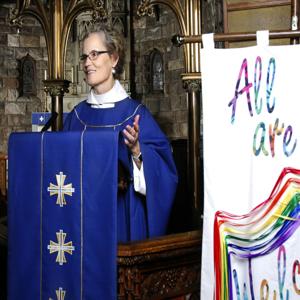


October 5, 2025: May God’s words be spoken, may God’s words be heard. Amen.
Before I get to the sermon, let us just take a moment to celebrate the momentous news our church, which is part of the worldwide Anglican Communion, got yesterday. The new Archbishop of Canterbury was announced. Now, before we go further, for those not versed in all things Episcopal Church, we are part of the global Anglican Communion, which began as the Church of England. The Archbishop of Canterbury, or ABC for short, is the spiritual head of the Church of England and the Anglican Communion. The ABC is the “first among equals” of the Archbishops (or Presiding Bishop in our Episcopal Church) across the whole church, and represents us globally – meeting with the Pope, the Eastern Orthodox Patriarchs, and other ecumenical and interfaith partners. The ABC can be seen in important events in the life of the British Commonwealth, including overseeing the coronations of monarchs, the weddings and funerals of the royal family, and more.
And for the first time in 1,428 years, the Archbishop of Canterbury will be a woman!
Glory, Glory Hallelujah!
It was announced that His Majesty The King has approved the nomination of The Rt Revd and Rt Hon Dame Sarah Mullally for appointment as the 106th Archbishop of Canterbury.
Of course, not all parts of our Anglican Communion are thrilled. The ultra-orthodox GAFCON – mostly in Africa and South America, still believe only men should be ordained to any role, much less the episcopacy – and to be clear – they mean straight men only. And I even saw someone ask on Facebook if this was a DEI hire. Seriously – you can’t make this stuff up. You know, maybe we need to follow the same principle that a friend taught me a long time ago – assume everyone is gay until they come out as straight and ask if it was a DEI hire any time a job is given to a straight white guy. Folks, DEI just means the playing field has been leveled so white straight guys have to compete fairly with everyone else. If they can’t handle that, then they need to get off the field. But, while we will pray for the hardened hearts of these people, we will not allow their unwillingness to embrace all of God’s children equally to divert our attention from the joy of this announcement.
Our church is moving forward into new life!
Let the people say “Amen!”
And now, to the gospel today.
Jesus uses that famous mustard seed example to answer his followers request to “Increase our faith!” He says “If you had faith the size of a mustard seed, you could say to this mulberry tree, `Be uprooted and planted in the sea,’ and it would obey you.” And then he tells them this unsettling bit about a slave returning home after working in the fields. Jesus says that the master wouldn’t invite them to dinner, but expect to be served first, then the slave would eat.
What in the world does a mustard seed have to do with faith, and what is up with that other part about the slave? Well, just to clear up the last part – Jesus is NOT advocating for slavery. As I mentioned a few weeks ago, slavery was a pervasive part of the Greco-Roman world in which Jesus walked. Slavery was not a racial construct, but a societal one of economic status. Jesus himself acted as a slave to his disciples when he kneeled before them and washed their feet. So, this is not advocating for a slavery system, but leveraging the system in place at the time to make a point. Jesus is using this familiar construct to tell his disciples that each of us have a role to play, all of them of value in the household of God.
You know, the thing about this gospel today is how the disciples are asking for what they think they need– this incredible faith that would be without doubt, without question – a sort of super-sized, cape wearing super-hero kind of faith – completely perfect and without flaw. Jesus tells them tells them they don’t need that. In other words – your faith doesn’t have to be super sized to do amazing things in the name of God. Just a little can uproot bushes and send them to the sea.
Seriously Jesus – who cares about doing that? That is, unless it is the pesky NJ invasive Russian Olive bush…I’d sure like to throw a bunch of them into the sea. But maybe that wouldn’t be what we would be asking for today anyway, and it certainly isn’t what Jesus wanted them or us to do. Jesus is just using this example to make a point. Because it isn’t mulberry bushes followers of Jesus should be trying to uproot. No, we don’t want to move bushes to the sea, but to bring peace to the world, to end hatred and bigotry, to eliminate hunger and poverty, and to reverse the abuse of God’s creation.
And it is that last one, Creation Care, that we are celebrating today, and every Sunday in October. “The Season of Creation,… is celebrated by Christians around the world as a time for renewing, repairing and restoring our relationship to God, one another, and all of creation. The Episcopal Church joins this international effort for prayer and action for climate justice and an end to environmental racism and ecological destruction. The 2025 theme is Peace with Creation. In celebrating the Season, we are invited to consider anew our ecological, economic, and political ways of living.”
And so the Jesus’ metaphor in the gospel today, of the mustard seed, the mulberry bush, and the sea, are timely symbols as we launch our creation season focus here at Christ Church. Today people and animals are suffering from the effects of our abuse of God’s creation – the earth, the seas, and the air. The greatest effect is on the poorest populations all around the world, who suffer from chronic illness under toxic living conditions, and also on the animals that are pushed to near extinction as their natural habitats are destroyed. We were charged by God at the beginning of humanity with the stewardship of all of God’s creation, and we have failed miserably. We must live into that call for the sake of the world.
And one person who truly did that was someone we lost this week – Jane Goodall. “Dr. Jane Goodall was known around the world for her 65-year study of wild chimpanzees in Gombe, Tanzania. However, in the latter part of her life she expanded her focus and became a global advocate for human rights, animal welfare, species and environmental protection, and many other crucial issues.” “…She was a remarkable example of courage and conviction, working tirelessly throughout her life to raise awareness about threats to wildlife, promote conservation, and inspire a more harmonious, sustainable relationship between people, animals and the natural world.”[1]
As I thought about the life of this amazing woman, I was struck by the way Dr. Goodall often referred to herself. She would say she was a “messenger of hope.” If we think about it, those of us who follow Jesus are “messengers of hope” too – or at least, that is what we are supposed to be. And so today, perhaps we would ask Jesus, not to increase our faith, but just for faith itself. Faith not just in God, but in ourselves, or perhaps more to the point, that God will strengthen us, guide us, and love us as we work to be the messengers of hope we are meant to be.
Faith that what we do matters.
Faith that we have an important role to play in the larger scheme of history.
Faith that we truly loved unconditionally just as we are, even when we fail from time to time to live our faith as we should.
And maybe, maybe that was what the disciples really wanted too. Not an increase really, just some restoration in Christ Jesus that they were up to the challenges they would face as they lived their lives in Christ as messengers of hope.
And that desire they had is why we come here, to Christ Church, because we need to be restored and renewed in our faith too. We need to be given strength for the journey ahead, as so many before us have done right here in this place.
Which is why this is also a special day for our parish. It is the Fall Founder’s Fest, when we celebrate the anniversary of the founding of Christ Church on October 4, 1858. Today we celebrate the 167th birthday of this place we call our parish home. And in doing that, we remind ourselves of all those who came before us – offering of their life and labor – that we might still be able to worship here 167 years later.
And we have continued to work in partnership with God these many years later, nurturing our mustard seed of faith into harvests beyond our imagination through our very ordinary acts, and by God’s grace, we are growing in faith, serving our neighbors, and creating community, in the name of Jesus Christ. And Christ is calling us forward into new life in the years ahead, new ministry, new ways of living out the gospel in this place, in our lives, and in our communities.
Which brings us to the other thing we launch today – our stewardship season, where we consider the importance of this spiritual home we call Christ Church in our lives, and how we will each do our part to support the mission and ministry of this church in our offering of our treasure and our time. And so, as we do here, each week you will be given a gift blessed at the altar during our Eucharist. Today it is a package of wildflower seeds. Each packet grows a pollinator wildflower garden that provides food and shelter to bees, butterflies, birds, and other winged creatures, promoting biodiversity.
As you work them into the soil, think of the gospel today, and know that you are enough, your faith is enough to do amazing things.
As you envision the wildflowers blooming, let that serve as a reminder of our call to be a messenger of hope, found in the unconditional love of Christ Jesus.
And as you think about the bees and butterflies who will be nourished by these wildflowers, think too of the way this place nourishes you. What would it be like if it were not here? How much more would it mean to you to know that you had a role in moving it forward into the future, so others could feel that same welcome and love?
So, think on those things, and when we have our ingathering of pledges on the Sunday before Thanksgiving, bring yours forward to plant the seed of hope in support of this parish, that by God’s grace, Christ Church will continue through the ages to proclaim the good news that all people are made in God’s image – all are beloved of God – and all are welcome in this place.
Today we have a lot to celebrate – a woman as Archbishop of Canterbury – the leader of our global church, Creation Season – a time to remember our role as stewards of God’s earth and all its inhabitants, the founding of our church so long ago by people who planted the seed of what became Christ Church, and the start of our Stewardship season – when we are able to give back to God, who has given us so much. It’s kind of everything, everywhere, all at once – but all of it a reminder of what is possible when we have a little bit of faith, and use that faith to do the work God calls us to in the world.
And so, when we hear Jesus telling his disciples that they could do amazing things, so long as they had faith the size of a mustard seed, let it remind us that even those with very little can do so very much. In a way, Jane Goodall preached this very point.
She would often say to audiences that came to hear her “You cannot get through a single day without having an impact on the world around you. What you do makes a difference, and you have to decide what kind of difference you want to make.”
Note that she didn’t say they needed a particular education, or lots of money, or fame, or some sort of unique gift – just that each will have an impact nearly every single day – and to consider what you want that impact to be – for building up or for tearing down.
For followers of Jesus – the choice is clear.
We will, with the small seed of faith in our hearts uproot the structures that hold back any child of God, and plant in their place seeds of love, humility, grace, and joy.
We will, with the small seed of faith in our hearts, uproot the systemic abuse of God’s creation, and plant seeds of renewal and restoration for all the creatures of the earth.
For we are, and always will be, Christ’s messengers of hope, the ones who will change the world.
Amen.
For the audio, click below, or subscribe to our iTunes Sermon Podcast by clicking here (also available on Audible):
Sermon Podcast
[1] Jane Goodall Institue. https://janegoodall.org
The Rev. Diana L. Wilcox
Christ Church in Bloomfield & Glen Ridge
October 5, 2025
Pentecost 17 – Year C
1st Reading – Lamentations 1:1-6
Psalm 137
2nd Reading – 2 Timothy 1:1-14
Gospel – Luke 17:5-10
September 28, 2025: May God’s words be spoken, may God’s words be heard. Amen.
Lordy – what a gospel for our time. It practically preaches itself – but don’t get too excited… you are not that lucky.
Now, you may have thought when the gospel first opened that you were getting a repeat of last week, because Jesus starts this parable the same way “There was a rich man…” But, as we will see, this is a completely different message Jesus is giving us here, so let’s take a look.
The rich man in this parable is never named, but the poor man is called Lazarus (not to be confused with Mary and Martha’s brother whom Jesus brought back from the dead). Anyway, the rich man…okay – you know I need to give this guy a name (because, if we don’t, I am likely to break out in song with “If I were a rich man, Ya ba dibba dibba…). So, assuming no one wants to hear that, let’s call him Edmund, or Eddie, from the Old English word for protector of wealth! Anyway, Eddie had fine clothes and lots of food, but Lazarus, whom Jesus points out was right outside his door (or gate), lay hungry, thirsty, and in pain from sores that were left untreated, except by the dogs who licked them. All Lazarus wanted in the world were just the scraps that might fall from Eddie’s table, but they never did.
Before we continue, my dog Lexi would like to point out the following: “Exegetically speaking,” my dog says, “the dogs in this parable are offering comfort and healing, as dogs
Prof. Lexi Wilcox, the three-legged Wonder Dog
do. They are not trying bother the sores of the poor human, Lazarus. As we dogs know, our saliva has good stuff in it for healing wounds. Human saliva does too, but humans don’t have as good a tongue as us dogs. So, the dog was demonstrating for the humans how to be – which, is not surprising. After all, our name spelled backwards is God.”
Thank you Prof. Lexi. Now, back to the humans and this gospel.
Lazarus died, and…because wealth does not buy you immortality, so too does Eddie. They end up in very different places in the eternal afterlife – one in heaven, the other in hell. The long and short of the rest of it is that Eddie finally sees he has erred, and begs Abraham to send Lazarus to warn his five brothers so that they might change their ways and avoid his fate. Abraham refuses saying `If they do not listen to Moses and the prophets, neither will they be convinced even if someone rises from the dead.”
Leaving the drop mic moment that this must have been for the disciples when they encounter the risen Jesus, and remember this parable he told, let’s go back to what Jesus is saying here.
First, let’s be clear about one thing: Jesus is not condemning those who have money.
That said, let’s go back then to look at what happens a little more closely. Eddie wants to warn his brothers that they may avoid his peril. And THAT is the crux of the parable.
Eddie wants to warn his brothers, but here’s the thing that he missed in his life on earth…
Lazarus is his brother too! And no, this isn’t a Darth Vader “I am your father, Luke” moment. Lazarus is not Eddie’s biological brother.
No, what Eddie missed in life is his connection to Lazarus, and he doesn’t even see it when it is laid out for him visually. I mean, he calls Abraham father, but who is Abraham at that moment caring for like his own child? Lazarus! So, if Lazarus is Abraham’s child, and Abraham is father to Eddie, then…Lazarus is Eddie’s brother. If A+1=B and A+1=C, then…B=C. And you thought algebra was a waste of time.
Anyway, Eddie never thought about Lazarus as his brother, and certainly never treated him like one. Instead, Eddie over consumed on his wealth, while his brother Lazarus lay outside Eddie’s gate dying for lack of food and proper care.
Now, whenever I preach on this text, I always like to include a bit of another sermon on it given by a far more gifted preacher – the Rev. Dr. Martin Luther King, Jr.. One, because so many people who rightly admire Dr. King for his civil rights work, while denouncing religion, forget that he was first and foremost, the Rev. Dr. Martin Luther King, Jr. His faith was the foundation for his work. And, in this particular sermon, King cuts right to the core of the message of Jesus in a way no one else can.
In King’s sermon, we first need to know two words that will sound different than what we heard in the text today. The was a time that the rich man was known as Dives, because the Latin Vulgate translation of the Bible used the word “dives,” meaning “rich,” to refer to him. This tradition began in the Middle Ages, when readers of the Latin text began to use Dives as the rich man’s name, even though the text itself does not name him. And in the King James Version prominently used in Dr. King’s time, the chasm was called a gulf.
So, let’s get to that excerpt of King’s sermon, which some of you may remember from the last time I preached on this text.
It was given at Dexter Avenue Baptist Church on October 2, 1955, and he said “…There is a gulf that originates in the accident of circumstance. Circumstances make it possible for some people to get an education, while other people are denied the opportunity. Circumstances make some people rich, social prestige, while others are left gnawing on the crumbs of obscurity…So in the parable Lazarus was poor, not because he wanted to be, but because tragic circumstances had made him so. On the other hand, Dives was rich because fortunate circumstances had made him so. There is a circumstantial gulf between Lazarus and Dives.
Now Dives’ sin was not that he made this gulf between him and Lazarus; this gulf had come into being through the accidents of circumstance. The sin of Dives was that he felt that the gulf which existed between him and Lazarus was a proper condition of life. Dives felt that this was the way things were to be. He took the “isness” of circumstantial accidents and transformed them into the “oughtness” of a universal structure. He adjusted himself to the patent inequalities of circumstance.[…]
Dives sin was not that he was cruel to Lazarus, but that he refused to bridge the gap of misfortune that existed between them. Dives sin was not his wealth; his wealth was his opportunity. His sin was his refusal to use his wealth to bridge the gulf between the extremes of superfluous, inordinate wealth and abject, deadening poverty.”
“He adjusted himself to the patent inequalities of circumstance… Dives sin was not his wealth; his wealth was his opportunity.”
Eddie took the blessings he had received in life as what ought to be, rather than what is, and he never leveraged the blessings he accumulated in his wealth to bridge the divide between him and his brother Lazarus.
Today, we see so much of this going on, do we not? I mean, I have to wonder if any of those powerful folks today, who own 99% of the world’s wealth, have ever heard this parable. And it sure is a timely one for what is happening in our country now. To be clear, the chasms in our day are about more than wealth – it is about power, and like wealth, power could be used to close the chasm of circumstance, but that is not what we see power doing now, is it? Instead, power is being used in this country to oppress, to instill fear, to destroy.
Our President and the Congress recently passed a bill that they called “big and beautiful.” Yet it lines the pockets of those with the most wealth, and to pay for it, the bill strips healthcare from millions of the poorest people in our country. There is nothing beautiful about it.
Today the media we consume, and thereby a primary (and perhaps only source of news) is controlled by a handful of white wealthy men, and is often used to prop up this system of economic inequality, rather than to expose the abject poverty of our sisters and brothers.
Those in power are trying to also use their faith – their Christian faith of all things – not to love and serve the least of these, but to oppress – aligning not with Jesus, but with white supremacists in the quest to instill Christian Nationalism – a heretical movement that propagates a false gospel.
The President is also using his position, not to reduce the widening gap between rich and poor, but to buildup more wealth with his own cryptocurrency launched to provide an avenue for gifts by anonymous international sources, along with other marketing gimmicks.
And instead of tending to the sick that lay outside the proverbial gates of nation and the world, he pulled funding for USAID that provided lifesaving aid to the most desperate populations around the world, eliminated research funding for cancer and other diseases, and propagated conspiracy theories about vaccines and Tylenol. That last one is yet another attempt to blame women for their child’s autism (a part of the sad sexist history of our country), and to stigmatize those on the spectrum.
And rather than seeking to unite us across our differences, and use the wealth of our nation to do this, he and the Congress added billions to the efforts of ICE to detain and deport immigrants, is sending troops into cities (but only those led by the other party), and is trying to lock up his enemies through selective and malicious prosecution, all while stripping away funding for programs that aid the least of these.
Did he even read the gospel he hawks for profit?
Now to be clear, this President does this hoping we will fear him, hoping that we will become numb to his crimes against our sisters and brothers, hoping we will choose the path of Eddie, as we step over the Lazarus in our midst.
Well, let me perfectly clear, Mr. President –
WE WILL NOT!
We, the followers of Jesus, hear the cries of Lazarus now – in our lifetime – and we will not turn our backs or close our hearts. We will go to him and care for his wounds – the festering sores of bigotry and hate, poverty and oppression.
We, the followers of Jesus, will not stand by while our brown and black sisters and brothers are unlawfully arrested, detained, and deported without due process of law, and treated with disrespect. We will fight for their rights, be a voice for them in the streets, and be the light that exposes the darkness of our nation’s heart.
We, the followers of Jesus will not align with any attempt to further demean women and girls – denying them equal opportunity, and attempting to instill a sense of inferiority within them. We will proclaim to all that God created us in Her image – male and female – and we all reflect that image just as we are.
And perhaps most especially during times of authoritarian power grabs, we, the followers of Jesus, will never fear bullies. They are but weak cowards seeking to hurt others as they must have been hurt themselves. We will pray for the healing of their heart, as we stand steadfastly in their way. For we know that bullies always back down when confronted.
We will do all this, because as followers of Jesus, we are the repairers of the breach, the ones called to bridge the chasm between God’s children – not in the afterlife, but here – now.
That is our life – that is our call!
You know, there is a meme that was floating around Facebook this week that speaks to this pivotal time in our nation and in our lives in Christ. It read: “There’s something deep happening beneath the surface of the world right now. You can sense it in your soul. This isn’t just about countries or politics. It’s energy. Light and darkness are battling. And, if you’re reading this, you’re likely one of the souls who came to help. Keep shining. Keep praying. The world needs light more than ever.”
There is indeed a battle of darkness and light happening right now – in this country – and we have a choice to make. It is the same choice people in Germany made decades ago. We can choose to be silent, to fear, to turn our backs and hope it will all go away, or that “someone else” will come to rescue us. Or, we can realize that we are children of God, and if children of God, children of Light, and Christ’s light shines in every single one of us.
There is nothing that can defeat the light of Christ – not the Romans and their cross, and certainly not the likes of an octogenarian dictator wannabe bully or his minions.
God’s love is more powerful than his hate.
Christ’s light is far brighter than the darkness he tries to instill.
And the strength of the Holy Spirit in us will overcome the fear he hopes will topple us.
So yes – keep shining, keep praying.
Because the world does need light more than ever.
And you are the light of the world.
Amen.
For the audio, click below, or subscribe to our iTunes Sermon Podcast by clicking here (also available on Audible):
Sermon Podcast
The Rev. Diana L. Wilcox
Christ Church in Bloomfield & Glen Ridge
September 28, 2025
Pentecost 16 – Year C – Proper 21 – Track 1
1st Reading – Jeremiah 32:1-3a, 6-15
Psalm 91:1-6, 14-16
The post “Keep On Shining” appeared first on Christ Episcopal Church.
September 21, 2025: May God’s words be spoken, may God’s words be heard. Amen.
This week, while noodling the texts for today in my head and preparing to write my sermon, I saw something on Facebook Marketplace that I had been looking for, and at a great price too. When I got to the woman’s house, I started to pay what I thought I owed her, but she said, “Oh, no – I lowered the price by half.” I paid her the new amount, and as I drove home, even happier with my purchase, I thought about this gospel today. And what a crazy one it seems to be.
Now, before we dive in more – this is one of those times when the advice to eliminate those pesky passage titles is so spot on. This particular story has a variety of titles in those types of bibles – like, “The parable of the dishonest manager,” or “The parable of the shrewd manager.” Well, which is it then? And… is it about the manager at all? So, let’s first hear it again.
The story starts with “”There was a rich man who had a manager.” If that sounds familiar, then you know other parables of Jesus in this gospel. One starts with “There was a man who had two sons, and another, which we will hear next week, starts with, “There was a rich man who was dressed in purple and fine linen.”
Anyway, Jesus then says that the man told the manager that there were accusations that he had squandered the man’s property. Now, let’s give these guys names to make it easier. Let’s call the rich man Bert and the manager Ernie. So, Ernie has this internal monologue where he imagines what will become of him when Bert sends him packing. So, he tries to make things right by significantly reducing what others owe – in a way like the person in my Facebook purchase. When Bert hears about this, he commends Ernie’s actions.
Then the text has that bit about Children of Light, which was likely an early add on to the original text, so let’s skip that and head right to Jesus’ summary of the parable. He says “Whoever is faithful in a very little is faithful also in much; and whoever is dishonest in a very little is dishonest also in much, etc.…and then sums it up with: You cannot serve God and wealth.”
So, it leaves us with a puzzle – especially if you are inclined to believe that the characters of parables are always ascribed to God, humanity, etc. Sometimes they are not, so be careful about doing that, especially using our 21st century lens on ancient texts. In this case though, let’s return to the opening. “There was a rich man who had a manager.”
Remember the prodigal son – he squandered the inheritance he had demanded of his father and faced a life of poverty and hardship? The father welcomed him back when he returned home and asked for his father’s forgiveness? And the one next week – the rich man did not help those in need in his life, and loses the opportunity to do good in the world with his money after he dies.
So, here we have this man, Ernie, facing a similar fate as the prodigal son, does something too, only what does it mean and why do we even care?
Well, first – we need to understand a few things…
The passage says that Bert had heard that Ernie had squandered his property. Yet, the Greek word translated for the accusation means slander, lies. Ernie hadn’t necessarily done anything wrong. So why doesn’t Ernie protest this unjust accusation? We can’t really be sure, but perhaps it might have seemed to Ernie that nothing he could say would change what Bernie thought of him, or maybe – deep inside – he knew he could have done better by those who owed his boss.
So, he acts to fix the situation. And this is where it is helpful to know the context. It was perfectly okay for people then, as now, to charge interest on debts – except if you were Jewish, and the debtor was also a Jew. Then you could not charge any interest. As this gospel was likely written by a gentile for a gentile audience, it is unlikely that the characters are Jewish, or that Jesus is referring to Jewish law. So, back to Ernie.
As a manager, Ernie was justified in adding on a commission on the debt that gave him a profit on the loan. This was allowed. However, while it may be allowed by the rules of the Roman empire, by forgiving the interest, he helped himself in the eyes of Bert, the rich man, by making it easier for the debtors to reconcile their debts with Bert, not to mention helping his neighbor, the debtors. Sure, Ernie didn’t get much money off the deal, but he did save himself. That is shrewd indeed! Some say that Ernie wasn’t hired back, but in the context of other parables, I think his relationship with Bert was restored, like the son and the father in the other parable, and he went on serving Bert.
This story provides a good context for Jesus’ final statement – you cannot serve God and wealth. What is just by the laws of the state is not always just in the eyes of God. Ernie did nothing wrong by law, but he needed to do more than abide by earthly rules to be in right relationship with God and neighbor.
And Lord knows, we have seen this play out in our own nation since colonialists first landed here – justifying our lawful behavior, no matter the injustice of that behavior on others.
Slavery was legal by law – but unjust according to God’s kingdom.
Oppression of women was legal by law – but unjust according to God’s kingdom.
Incarcerating LGBTQ+ people was legal by law – but unjust according to God’s kingdom.
That was our past, but sadly even today we know that this disparity between what humanity has deemed legal, and what God finds as just, is huge.
Arresting undocumented people is legal – but denying them due process is not – even by our own laws – and denying them dignity and respect is unjust in God’s kingdom.
And keeping with the parable, charging interest on a loan is legal by our laws – but even in our laws and in the kingdom of God, it is illegal to charge an exorbitant rate, called usury or loan sharking.
In other words – we can do things legally here on earth, but that is not how we should order our life. Or, as the old Hebrew National Hot Dog commercial used to say, “It is legal to add fillers to hot dogs, but we are held to a higher standard.” That higher standard is not to build up wealth here, but to build up our wealth with God – and that is done by relationship with one another and with God.
Sadly today, we keep trying to do this, even while we see so much horror going on in the world around us. We try to follow be in right relationship with God and our neighbor, but day after day after day, we see more of the horrific ways humanity can harm others, including ourselves. It can really wear any person down, no matter how faithful to God they may be.
Today, many of us can resonate with the lament in the passage from Jeremiah we heard this morning. This is one of this prophet’s many laments, as he tries to live out his life in service to God, and the words really hit home in these troubling times:
“My joy is gone, grief is upon me, my heart is sick. Hark, the cry of my poor people from far and wide in the land: “Is the Lord not in Zion?” …For the hurt of my poor people I am hurt, I mourn, and dismay has taken hold of me. Is there no balm in Gilead? Is there no physician there? Why then has the health of my poor people not been restored?”
If that last part sounds familiar, it is because you know that beloved hymn “There is a balm in Gilead.” Hold that thought, if you have that tune now running in your brain.
So, here we are – trying to live justly according to our God, trying to be good stewards like our guy Ernie. Yet some lie, others cheat, violence grows, and injustice abounds, and we are worn to the core. We might rightly cry out too “Is there no balm – no healing – no justice?” What can we do?
Well, the thing is – there is a balm – there is healing – in Gilead and elsewhere. And you know how to find it?
Be Ernie.
He was faced with an unjust accusation, and the loss of everything, yet he did even more to be righteous, forgiving those who owed him, just as God forgives. Was it self-serving? Sure. It saved him from a horrible fate. But perhaps he knew that more than his life could be saved in that moment.
And when we feel like Jeremiah – when we feel worn down by all that we see in the world, when our ministry seems to be overwhelming, then we need to remember the lyrics of that beloved hymn:
There is a balm in Gilead to make the wounded whole,
In other words…Keep on keepin’ on – living and serving Christ no matter what life throws at you, but breathe – come here for rest, allow the Holy Spirit to revive you, and keep doing what you are doing, because it does make a difference.
When injustice abounds against ourselves or others, and so many are crying far and wide in the land –be the balm of healing – showing in word and in deed God’s unconditional love.
When people claim to follow Jesus but offer the heresy of nationalist religion tinged with racism, sexism, and heterosexism – proclaim even louder the true gospel of Jesus – the Christ who healed others, who freed the oppressed, who commanded us to love as he loved, and who chose not the vestiges of power, but the humility of service.
When we feel that our joy is gone, that grief is upon us, that our hearts are sick – come here. Come here to be given that balm of healing for your own heart and soul – found in the body and blood of Christ and in his real presence with us as we gather.
We have choices to make in these difficult days.
We can rail against the injustice of it all – hanging our heads in despair, and crying out. Or, we can let the Holy Spirit revive our souls again, and continue our work of love and service in the name of Jesus.
But sometimes, we can wonder about that work. We may feel inadequate to the huge task we face in the world today. I mean, not everyone may be able to preach, or protest, or any of the other ways many others are living out the gospel. So how should we do as we are all called to do, even when healed by the Holy Spirit of our own pain?
Well, listen to the final verse of the hymn:
If you cannot preach like Peter, if you cannot pray like Paul,
Look – it takes no special talent to live justly in the face of injustice, to love in the face of hate, to offer hope in the face of despair. It just takes an open heart willing to breathe in the gift of the Holy Spirit and to speak openly and honestly about the love of Jesus.
Now, if that last part scares you because it sounds like that “Hey, have you found Jesus” sort of evangelism common among the fundamentalists (and really – I didn’t even know Jesus was lost?), well, don’t let that stop you! Because where those folks get it wrong is that telling the story of the love of Jesus isn’t about conversion of others. It’s about saving ourselves.
When we tell others about the love of Jesus, we remind ourselves that Jesus loved us for who we are – not for what others want us to be – and we feel the peace of God’s love for us.
When we tell others about the love of Jesus, we remind ourselves that Jesus told us he could be found in the prisoner and the poor, the sick and the immigrant stranger – and we see him there where we may have missed it before.
When we tell others about the love of Jesus, we remind ourselves that Jesus washed the feet of Judas who betrayed him, and of Peter who denied him, we find it possible to forgive others, and perhaps most especially, forgive ourselves.
Folks, we don’t tell people about the love of Jesus so they can come to church on Sunday. We tell them because we know this type of unconditional love will be the balm of healing that will change the world.
So be Ernie and don’t let the (insert b-word here) grind you down – go out and show the world that you know who is truly in charge and you know what you are called to do.
For then by your life, you will have preached far greater than Paul could have ever dreamed, and the audit of your life will be found to be just, true, and in service to God, and God alone.
And you will not only be healed by the Holy Spirit in your times of despair, you, as you tell of the love of Jesus, will be a balm for the healing of this broken world.
Amen.
For the audio, click below, or subscribe to our iTunes Sermon Podcast by clicking here (also available on Audible):
Sermon Podcast
The Rev. Diana L. Wilcox
Christ Church in Bloomfield & Glen Ridge
September 21, 2025
Pentecost 15 – Proper 20 – Year C
1st Reading – Jeremiah 8:18-9:1
Psalm 79:1-9
2nd Reading – 1 Timothy 2:1-7
Gospel – Luke 16:1-13
The post “Be Ernie” appeared first on Christ Episcopal Church.
September 14, 2025: May God’s words be spoken, may God’s words be heard. Amen.
This has been a most difficult week, and not because there is no joy in Metville – as Mets fans watch our team self-destruct. If only that was the most difficult news this week. Sadly, it is not.
Once again, violence has struck at a school – this time, Evergreen High School in Colorado, by Desmond Holly, a 16 year old white supremacist who was a student there.
That news was overshadowed by the assassination of political activist and far right podcaster, Charlie Kirk. The motive of the young man who appears to have committed this heinous act remains unclear, but Lordy the entire internet want to tell you why he did it before they even identified him as a suspect. He is just the latest in a string of attacks on political figures, including the murder of Minnesota Democratic State Senator Hortman and her husband, along with the shooting of Minnesota US Senator Hoffman and his wife, Pennsylvania Democratic Gov. Shapiro’s home set on fire, multiple attempts on the Republican President, another against Supreme Court Justice Kavanaugh, and the brutal beating of Democratic Speaker Pelosi’s husband. All of this in the last two years alone.
But sadly, this latest apparent political violence and school shooting wasn’t the only news this week.
Our President ordered a missile strike against a boat from Venezuela, killing all eleven on board alleging it was a drug smuggling craft headed for US shores. Yet, this is also not normal, as we usually arrest and prosecute these types of individuals, not kill them out right. Add to that, it has come to light that the boat was actually turning around. The nautical equivalent of shooting someone in the back.
South Korean engineers, who were in Georgia to set up the new US based EV battery plant, were arrested and detained by our government. While later released, this has caused an international quagmire with one of our strategic allies – all in the name of ridding our country of non-white immigrants.
Israel & Russia continue to kill thousands of civilians, including little children, every day.
And if that were not enough, we remembered those who were killed on 9/11- an act of horrific violence, and those who later died from exposure to carcinogens associated with the debris.
I mean – seriously – all of this in this past week alone!
And, there was likely more that went unnoticed, or unmentioned in the news. That’s the way of things today in our country. In fact, when we hear news like this, it doesn’t shock us anymore. We are saddened, we grieve, but we are no longer surprised.
Lordy, what a time in which we live in where death – violent death – has become a regular part of our daily lives. Where empathy for those who are suffering is based not on our common humanity, but on whether we agree with them, like them, look like them, or love our guns more. I mean, even Mr. Kirk once said, “I think it’s worth it to have a cost of, unfortunately, some gun deaths every single year so that we can have the second amendment to protect our other God-given rights. That is a prudent deal. It is rational.” Rational? God-given rights to weapons? Seriously? And this man claimed to follow Jesus? Lord help us.
We are pained by the words of some of those in the public sphere, we are brokenhearted by the death of innocent children, we mourn the mounting loss of life all around us, we are horrified by the cruelty against those whom God called us to welcome – strangers in our land, and we are saturated with the vitriol that overshadows all of it.
Perhaps we can understand the words of the psalmist this morning, who wrote “The fool has said in his heart, “There is no God.” All are corrupt and commit abominable acts; there is none who does any good. The Lord looks down from heaven upon us all, to see if there is any who is wise, if there is one who seeks after God.” Or to put it another way, God is doing a face palm right now and wondering if maybe this human experiment is beyond repair.
As for the rest of us, the violence, the outright cruelty, and the lack of equitable compassion by some who seem to care only when the victims are people they like or agree with, all of it, well – it can make you feel swirling and lost.
And that’s why the gospel today is so timely.
In the gospel, Jesus tells us that a shepherd, having lost one of his 100 sheep, leaves the 99 in search of the lost, and rejoices once the sheep is found. Jesus then continues and tells the story of the woman with 10 coins, who realizing one is lost, searches the house until she finds it, and then rejoices with her friends over finding it. Jesus is giving us another analogy for the how the kin-dom of God works. Now, generally, who do we think Jesus was talking about as the shepherd? God, right? So, as I like to note each time this comes up – if the shepherd is God (or Jesus)… then the woman is…?
This twin set of shepherd and woman searching for something lost is both a masculine and a feminine image for God. Kinda cool when you think about it, and makes sense, given that we are all created in God’s image. But while that isn’t the underlying message I want to focus on today, I will always point it out, because of our continued patriarchy in the church, as a reminder that God is not a boy’s name.
And here’s the thing we should not miss in these two parables too – the sheep who was lost didn’t go looking for the shepherd. That coin didn’t pop out of the sofa cushions and say “look, here I am!’ If only that would happen when we are trying to find the remote, right? And, neither sheep nor coin did anything to merit, nor help, God to find them.
These parables are a reminder to us, especially in these difficult times, that we are so very precious to God – every single one of us. When we feel we are lost, when we cannot seem to find our way home, God will search us out and bring us joyfully into her loving arms. In that moment – all of heaven rejoices. This is what God is doing right now in these times too – seeking us out – hoping we will feel that sense of belonging to something that will give us life, grace, love, and hope. And this should tell us something – something about God, yes, but also about ourselves, and about everyone else too. Something the people Jesus is addressing had forgotten.
The thing is, Jesus isn’t telling this parable to his disciples. He is responding to the grumbling of the Pharisees and scribes who didn’t like the company Jesus was keeping. They saw him eating with tax collectors and sinners, and said “This guy welcomes THOSE people. Heck, he even eats with them!” That is when Jesus offers these twin parables.
Now, sadly – Christians in the past have sometimes used this to say “don’t worry all you sinners out there…we will welcome you too,” as though somehow the sinners were always people outside of the church, or were “gasp” not Christian at all so therefore lost! The thing is, does that sound like Jesus to you? The Jesus who told us to love one another as he loved us, while washing the feet of Judas, who he knew would betray him, and Peter who he knew would deny him at his most difficult hour, not once, but three times? The same Jesus who is dines with those others would reject, which prompted the whole back and forth with the temple leaders in the first place?
The lost are not always outside the walls of the church, to be sure.
I am reminded of something the late monastic and theologian Thomas Merton once wrote. And a reminder that Merton was an international figure in his day, whose views on the Vietnam war and social justice rankled many in government, so much so that his death, said to be by accidental electrocution while in Bankok, has been a source of alternate theories of political assassination, which, whether true or not, certainly is timely today. Merton wrote, “It is my belief, that we should not be too sure of having found Christ in ourselves until we have found him also in that part of humanity that is most remote from our own.”
“…we should not be too sure of having found Christ in ourselves until we have found him also in that part of humanity that is most remote from our own.”
Today, our nation and the world are all faced with the choice those Pharisees and scribes had – to grumble at people being included in the love and grace of God – people that do not vote, or love, or speak, or act, or look like us – the so called “those people.” We can choose not to see Jesus in them.
Or we can rejoice that there is such unconditional love as found in the embrace of God – not because anyone deserves it, or because anyone is more holy than another, or for any other reason, but that they exist.
In other words, we can grumble that God’s love is unconditional or we can model it, rejoicing as we find those who feel lost, are pushed aside, are oppressed – and love them as Christ loved us.
Yet, do we not see what a false choice this is? Do we not know what can happen when people choose to grumble? When those who may feel lost themselves encounter even more rejection? When people push others to a place of darkness, bitterness, despair, and hopelessness? It is a breeding ground for violence – both by the ones rejecting, and the ones rejected. No good can come of that. But love, grace, and hope? That is the door to peace, wholeness, and joy for everyone.
We must all choose a different path – one that leads to a life of joy rather than bitterness, love rather than hate, life rather than death – not just for ourselves or those we like, but for all people.
For followers of Jesus, we have no choice at all – we must welcome in those others cast aside. We must try to see the Jesus in them as much as we find him in our hearts and in the Eucharist.
And if you think about it, what is better for anyone or for society – to sit around getting angry about how some people are being included, or to act, to do something positive, to go out and celebrate a world where no one feels left out. One zaps us of our own joy, strength, and life. The other is life giving to us and to all we serve in Christ’s name.
Still, we know this isn’t easy. Lord knows, one only needs to read the words of Charlie Kirk to understand how much it takes for some, who have been so deeply wounded by his hateful rhetoric, to express empathy for him and his family. Yet I saw so many do this, and that is the path to healing – for themselves, and for the world.
So when we find it difficult to include, to welcome, to seek, or to be found, we need to come here. Come here to abide with one another, and with Christ Jesus. Our liturgy and worship space provides a transcendent experience, moving us beyond the confines of the day to day, and reaching to places deep within us that we didn’t even know needed healing. And one of the ways this does this for my soul, and for many of you as well I suspect, is through music. Think about it – that’s what is meant by whistling in the dark – music strengthens us in times of fear and despair.
Today, we celebrate the choir and their hard work to bring that music to us each time we gather. The Anglican Choral tradition is truly awe inspiring, and our choir, under Ryan’s direction, is a gift of grace to our parish. When I hear them sing, it feels like heaven is rejoicing indeed, just as that woman with the coin invited everyone to celebrate. We are truly blessed.
And if we let it, if we allow the music we sing and hear each Sunday to enter deep within, it will resonate in our souls when we leave to serve Jesus in the least, the last, the lonely, and the lost. It will be the melody of our acts of love and grace, that will bring healing and joy to this pained world.
And so I leave you with this from our opening hymn today from the hymn written by the Rev. F. Pratt Green, as it speaks directly to the way the music of our faith can be a source of strength for our mission and ministry in difficult times:
“When in our music God is glorified, And adoration leaves no room for pride, It is as though the whole creation cried: Alleluia!
How often, making music, we have found, A new dimension in the world of sound, As worship moved us to a more profound Alleluia!
So has the Church, in liturgy and song, In faith and love, through centuries of wrong, Borne witness to the truth in every tongue: Alleluia!
And did not Jesus sing a Psalm that night, when utmost evil strove against the light? Then let us sing, for whom he won the fight: Alleluia!
Let every instrument be tuned for praise!
Let all rejoice who have a voice to raise!
And may God give us faith to sing always:
Alleluia!
For the audio, click below, or subscribe to our iTunes Sermon Podcast by clicking here (also available on Audible):
Sermon Podcast
The Rev. Diana L. Wilcox
Christ Church in Bloomfield & Glen Ridge
September 14, 2025
Pentecost 14 – Year C
1st Reading – Jeremiah 4:11-12, 22-28
Psalm 14
2nd Reading – 1 Timothy 1:12-17
Gospel – Luke 15:1-10
The post “Whistling In The Dark” appeared first on Christ Episcopal Church.
September 7, 2025: May God’s words be spoken, may God’s words be heard. Amen.
It is so good to be back here with all of you. I loved being on vacation, but this is wonderful to return to.
One part of my vacation had me in Maine for a day or two. I had the chance to go over to the Portland Head Light at Cape Elizabeth. There is a beautiful lighthouse on the rocky coast, with walking paths that seem to go on for miles. I spent hours there – walking, sitting, reflecting, and renewing, and oh how that was needed.
PHOTO: The Rev. Diana L. Wilcox
As individuals, we take vacations, sabbaticals, days off to give ourselves a chance to rest and renew. Church does this for us too – it is our sabbath practice. Here we are restored for another week. That is why it is important to come here, because it is here, particularly in-person, where we step aside from the world, and truly focus on allowing God to work in us and re-work us for our lives.
I was thinking about all of that when I read the passage from Jeremiah for today. Now, to be clear, this passage is about reforming entire nations, not individuals. Still, it is something God does do with us too, though not the whole smashing on a potter’s wheel bit – yikes. If you don’t know what I mean, listen to the first part of it again:
“The word that came to Jeremiah from the Lord: “Come, go down to the potter’s house, and there I will let you hear my words.” So I went down to the potter’s house, and there he was working at his wheel. The vessel he was making of clay was spoiled in the potter’s hand, and he reworked it into another vessel, as seemed good to him. Then the word of the Lord came to me: Can I not do with you, O house of Israel, just as this potter has done? says the Lord. Just like the clay in the potter’s hand, so are you in my hand, O house of Israel.”
Of course, God certainly doesn’t work with us by first destroying us to be re-created, though in a very real sense, that is what baptism does. In baptism, we die to all that holds us back from our lives in Christ, and are resurrected for new life in him. That aside, the larger working of God – with nations – is important too. And, as we see from the prophets, including Jeremiah, God works this renewal of nations through those prophetic witnesses God chooses for mission and ministry. One of those chosen was Jeremiah, of course, but another was St. Paul, and we heard from him in the letter to Philemon this morning.
Now, this letter is well known to many, but not for a good reason. It was used, particularly in this country, to justify slavery. But had those folks actually bothered to really reflect on what St. Paul was saying here, they would have understood that their use of this letter as a means of supporting the forced labor of any child of God was absurd. So, let’s take a deeper look…
First, here are the players: St. Paul – who is writing from prison. Onesimus, a slave who has runaway from the house of Philemon, and has ended up with Paul. Philemon, Apphia, and Archippus – leaders of the church established by St. Paul in Colossae, and likely meeting in the house of Philemon.
As for the historical context, slavery was a pervasive part of the Greco-Roman world. Slavery was not a racial construct, but a societal one of economic status. People of any race could be a slave. Scholars estimate anywhere from 10-20% of the Roman Empire’s population were enslaved.[1]
And now, the letter itself. Paul sends Onesimus with this letter to deliver to Philemon, Apphia, and Archippus. That he sends the letter to all three, and not just to Philemon, is important. The fact that he is sending Onesimus with it is dangerous to this runaway slave, as his former master could kill him. It is also why misguided people used this as a way to justify slavery. They said that Paul was sending the slave back to his master, therefore Paul was saying that slavery is just.
But that would be like looking at that meme of a cow on it’s back in a meadow, legs up in the air, with the words “Really, I’m fine!” and saying “See, everything is okey-dokey.” St. Paul is doing something radical and unexpected here, and those who took the actions apart from the words to justify their own evil in enslaving others missed the point entirely. The words matter here, so let’s take a look at them.
First, he commends Philemon on his ministry in the name of Jesus Christ, referring to him as a brother. Next, he says that he could command Philemon to do something, but he is appealing to him brother to brother (meaning – as brothers in Christ). The rest, you should hear directly from St. Paul, and listen carefully to what he is doing in his words:
“I am appealing to you for my child, Onesimus, whose father I have become during my imprisonment. Formerly he was useless to you, but now he is indeed useful both to you and to me. I am sending him, that is, my own heart, back to you. I wanted to keep him with me, so that he might be of service to me in your place during my imprisonment for the gospel; but I preferred to do nothing without your consent, in order that your good deed might be voluntary and not something forced. Perhaps this is the reason he was separated from you for a while, so that you might have him back forever, no longer as a slave but more than a slave, a beloved brother– especially to me but how much more to you, both in the flesh and in the Lord.
So if you consider me your partner, welcome him as you would welcome me. If he has wronged you in any way, or owes you anything, charge that to my account. I, Paul, am writing this with my own hand: I will repay it. I say nothing about your owing me even your own self. Yes, brother, let me have this benefit from you in the Lord! Refresh my heart in Christ. Confident of your obedience, I am writing to you, knowing that you will do even more than I say.”
Basically St. Paul is putting Philemon in a corner by claiming family relationship in Christ to Onesimus, and doing so in his own hand, so there can be no charge that this was written by anyone else. As he notes, he could have told Philemon to do it, but he chose to invite him to the act of grace on his own. St. Paul understood what we all know too – that it is better to get someone to do the right thing themselves through invitation toward the right path. Anyone who ever had a parent say to us “Well, it is your choice,” knows that is parent speak for “If you want to be an idiot, go right ahead, but know that I will be deeply disappointed in you.” Way more effective than a command.
If that were not enough – He equates the role that Onesimus would play if he stayed with St. Paul to that of the role Philemon played when he worked alongside him in the spreading of the gospel. And finally, St. Paul copies two others in the letter – Apphia, and Archippus, so everybody will be watching to see what Philemon does here.
This is no ordinary letter. This is a challenge to Philemon, and to us. It calls us to discern what is right as followers of Jesus vs. what is normative for society. This is not really an easy thing for us because it requires us to let go of how we do things – to not only do good deeds for others, but to transform the relationships we have with them. St. Paul is asking Philemon to reject what he understands to be his privilege and right – to own Onesimus.
For us today, it would require us to overturn unjust systems, even when we ourselves benefit from them. More than that, it pushes us to embrace as family those who we keep at a distance, because St. Paul reminds us that we are all children of God, siblings with one another, and bound in that common web of life. It means we must cross boundaries we may, consciously or not, actually prefer remain – between us and those who look, think, act, love, speak, or vote differently. That is not an easy thing.
This is a call to radical transformation that can reshape nations, like God’s potter and his wheel, one small act at a time. And in this moment in our own nation, we must not waste any opportunity to get our hands dirty in the clay – working ceaselessly to destroy that which enslaves any child of God, and build relationships of love, grace, hope, and peace in its place.
We may not feel up to the task. Lord knows, things are difficult for us these days. We have more time challenges than we know how to manage anymore.
We are wearied by the constant drumbeat of cruelty by our nation’s leaders against the least of these.
We are fearful that this democratic dream we call the United State may soon turn into an autocratic nightmare.
We mourn the senseless loss of lives to gun violence in our schools, houses of worship, theatres, grocery stores – everywhere.
And we see people perverting the gospel in the rise of Christian Nationalism that is often aligned with racist White Supremacy.
No, with all that is going on, if we are smart, we probably don’t feel up to the task, and the truth is – on our own – we aren’t! And – we don’t need to be. I mean, look at St. Paul. The guy was sitting in a prison cell for crying out loud. Yet, just with words on parchment, he changed countless lives in the course of a single letter. That is the power of the transformation possible by Christ in our lives.
I remember during the pandemic, the diocesan clergy were gifted with several presentations and talks to help us serve in those trying days, when we felt so weary and so inadequate to the task. One that really struck me was by the former bishop of Maine, the Rt. Rev. Chilton Knudsen. She spoke to us about an Orthodox understanding of Christification – a growth in holiness through the power of the Spirit.
She told us that Christ, through the Spirit, is changing us – God willing for the better. Yes – we will have troubles, but we are being transformed. Like potter and clay – the potter throws the clay around, and she knows where to find all of our clay. Referring to the disappointments, challenges, hardships in our lives, the potter folds those sharp corners into the new creation – little bits of us becoming more Christ like.
In other words, even in the most difficult of times, each of us are being continually reshaped by God for the work we are called to do. We don’t need to have anything other than an open heart, and a willingness to pause our busyness and allow the Spirit to renew us.
Remember that St. Paul was an early persecutor of the followers of Christ. Then he was literally thrown off his horse by Jesus, like a potter smashes down clay on a wheel, and he was re-shaped to be a leader in the spread of the gospel.
Even Jeremiah was called when he was only a boy – yet God was able to shape him for prophetic witness.
Each of you are also being worked by God to be agents of radical transformation in a world so desperately in need of it. Or as God would put it “Can I not do with you what I have done with so many more before you?” Well, of course God can.
As the late bishop, the Rt. Rev. Barbara Harris, once said “God doesn’t call those who are worthy. God makes worthy those whom God would call.”
So, as we head into this new program year in the church, let us hear again these words of St. Paul from the close of his letter, and think of them as being addressed to each and every one of us – the saints of the church today – the ones called to be prophets, the ones called to break the chains of oppression in our time:
St. Paul writes, “When I remember you in my prayers, I always thank my God because I hear of your love for all the saints and your faith toward the Lord Jesus. I pray that the sharing of your faith may become effective when you perceive all the good that we may do for Christ.”
Indeed there is much good we can, and need to do, for Christ today in our own communities.
May we open ourselves to be reshaped by God in our time and in our context, becoming more Christ-like each and every day, that we may be transformative agents of change through grace and love, relationship building and invitation – freeing ourselves as we free others – reworking our world into God’s dream of peace and wholeness for all.
Amen.
For the audio, click below, or subscribe to our iTunes Sermon Podcast by clicking here (also available on Audible):
Sermon Podcast
[1] British Museum.
The Rev. Diana L. Wilcox
Christ Church in Bloomfield & Glen Ridge
September 7, 2025
Pentecost 13 – Year C – Proper 18 – Track 1
1st Reading – Jeremiah 18:1-11
Psalm 139:1-5, 12-17
Gospel – Luke 14:25-33
The post “The Potter, Philemon, & You” appeared first on Christ Episcopal Church.
We are in vacation season – yea!!! And I will be heading out on mine tomorrow. I will miss you, but these seasons of rest and renewal are important for all of us to take, and I hope each of you has been getting some time off to recharge.
The church also has seasons – and no, we do not close the church for vacation. Really, our church has several seasons throughout the year. However, our lectionary, the readings we do from week to week alongside most denominations, really has two “seasons” and both of them together tell a full story.
From Advent through to the Ascension (A to A if you will) we answer the question: “Who is Jesus?” In the season of Pentecost, we answer a different question – “What does it mean to follow Jesus?” Well today’s readings are most definitely a sign that we are indeed in the season of Pentecost. Specifically, the text from Isaiah tells us what we are to do, and the gospel tells us how to do it.
The passage from Isaiah starts this way: “Hear the word of the Lord, you rulers of Sodom! Listen to the teaching of our God,
Well, alrighty then. God does NOT seem very happy at the moment, and definitely despises the religious practices of these folks.
Now, before we go any further, because those famous twin cities are named, and I mean Sodom & Gomorrah, not Minneapolis & St. Paul, I need to remind everyone that, despite what some fundamentalists will tell you, the sins of the peoples of those two cities had absolutely nothing to do with homosexuality. In fact, I could give you my full explanation of what their real sin was, but I don’t have to this time, because the passage makes it very clear.
After God angrily disses the religious piety of these people, the prophet continues to relate to us what God wants:
“…cease to do evil, learn to do good; seek justice, rescue the oppressed, defend the orphan, plead for the widow.” And then adds: “Come now, let us argue it out, says the Lord.”
I love that last bit…like – sure, you don’t agree with what I am asking you to do? Well then…I’m listening…go on…. You can just see God standing there like Clint Eastwood as Dirty Harry saying “Go ahead. Make my day.” I mean, would you take up that challenge? Yeah…not.
But setting that aside for a moment, let’s turn to the Gospel. Jesus is telling his disciples to give of what we have to those in need, to “Make purses for yourselves that do not wear out, an unfailing treasure in heaven, where no thief comes near and no moth destroys. For where your treasure is, there your heart will be also.” And he adds, “Be dressed for action and have your lamps lit; be like those who are waiting for their master to return from the wedding banquet….” Or, as I saw on a t-shirt “Jesus is coming – look busy!”
Both texts are answering the question: “What does it mean to follow Jesus?” God tells us by the prophet that we are to love and serve the vulnerable – seek justice for all children of God, and free all of creation from the shackles of oppression.
Jesus tells us though, that the work we are called to do requires that we have a purse that is always full, and that we are prepared at all times for the ministry we are called to live out. That whole always full purse bit naturally makes me think of Hermine Granger’s bag in Harry Potter’s The Deathly Hallows, or Mary Poppin’s bottomless bag. Sounds fun, except that is not really what Jesus is talking about.
Consider what Jesus wanted for them – to be able to continue the work he started. What kind of purse could he be talking about when he also adds the part about selling possessions and giving alms – there’d be nothing in it, so what would be the point? I mean, I hope he doesn’t mean a real one anyway ‘cause you will rarely, if ever, find me with a purse.
No, we are the purses – our bodies, our minds, our spirits. He is telling us that we need to prepare ourselves to live the life we are meant to live.
And one of the most important ways we do this is to come here – to worship. For here we are nurtured in the Eucharist, and in one another. We are renewed and strengthened, such that our treasure and our heart are one and the same. Our purses are made strong, and from here we can live the life we were meant to live in the time we have.
But, you might be thinking – didn’t God say through the prophet Isaiah that religious offerings like worship are bad? Nope. What God is saying is that worship, without living your faith in the world, is an empty and hypocritical act – and that really ticks off God a lot. God wants us to live out the faith we profess in worship – to “…cease to do evil, learn to do good; seek justice, rescue the oppressed, defend the orphan, plead for the widow.”
You might wonder why there is always this focus in the bible on widows and orphans. Well, it is because they were, in that time, vulnerable people. Without the aid of others, they could die.
Today, the orphan we are to defend are the poor, whose healthcare and food are being literally stolen by our government.
Today, the widow we are to plead for are the immigrants, and even citizens, swept off our streets by masked government agents and thrown into prisons near and far.
Today, the oppressed we are to rescue are people of color, LGBTQ+ people, women, and children, who are abused, trafficked, or denied their humanity.
Today, we must reject the evil spewed from the mouths of our nations leaders and seek justice for all of God’s creation – for every human no matter where they live, every creature that dwells on land or sea or air, and even the earth itself – are God’s handiwork. And God calls us to care for all of it.
This is what worship should strengthen us for – this is what it means to follow Jesus. And folks, it will not be easy. It will sometimes feel like we aren’t accomplishing anything. That is when the epistle to the Hebrews that we heard this morning can be helpful to us.
It is a very familiar passage, and speaks to the enduring work of the faithful from generation to generation. The author writes “Now faith is the assurance of things hoped for, the conviction of things not seen.” And after giving an example of the faith of Abraham and Sarah, the author says “All of these died in faith without having received the promises, but from a distance they saw and greeted them. They confessed that they were strangers and foreigners on the earth, for people who speak in this way make it clear that they are seeking a homeland. If they had been thinking of the land that they had left behind, they would have had opportunity to return. But as it is, they desire a better country…”
The assurance of things hoped for, the conviction of things not seen. The better country we walk toward…that is what following Jesus is all about, that is what worship should lead us to, that is what we must prepare ourselves to live out.
Listen to this from the late prophet, the Rev. Dr. Martin Luther King, Jr., who on the night before his assassination, said “We’ve got some difficult days ahead, but it really doesn’t matter with me now, because I’ve been to the mountaintop … I’ve seen the Promised Land. I may not get there with you. But I want you to know tonight, that we, as a people, will get to the Promised Land.”
King was seeking that homeland he could see in the distance that kingdom of God Jesus tells us in the gospel today that is ours – that promised land. But King wasn’t talking about heaven. He was speaking about his faith in something not yet seen – an end to racism. He saw a vision of things hoped for – a world where all people – no matter the color of their skin – will live in freedom, with dignity and respect.
His purse did not wear out because his life and his witness was strengthened in Christ Jesus. His calling rooted in scripture such as all we heard this morning. He did not see the promised land, but his ministry in the world made us all take giant leaps toward it.
We, like the Rev. Dr. Martin Luther King, Jr., have a calling – one that God gives to us in the passage from Isaiah, one Jesus tells us to prepare for in the gospel.
So, let us come here to church, to keep our purses filled with unconditional grace.
Let us leave here to do good; seek justice, rescue the oppressed, defend the orphan, plead for the widow.
Let us always be dressed for action and have our lamps lit with the knowledge and love of Christ Jesus to do the work we are meant to do.
Then we too will be walking toward a vision of things hoped for – one God implores us to work toward – one Jesus calls us to bring about with every ounce of our being – one that the Rev. Dr. Martin Luther King, Jr. worked for and saw from a distance – that beloved kingdom of God – where peace, hope, love, and wholeness are abundant, and where hate, fear, and oppression are no more.
We most certainly will have some difficult days ahead ourselves, yet we know we will, by God’s grace, by living as we are called to live in Jesus, bring us all closer to the promised land.
Amen.
For the audio, click below, or subscribe to our iTunes Sermon Podcast by clicking here (also available on Audible):
Sermon Podcast
The Rev. Diana L. Wilcox
Christ Church in Bloomfield & Glen Ridge
August 10, 2025
Pentecost 9 – Year C – Track 1
1st Reading – Isaiah 1:1, 10-20
Psalm 50:1-8, 23-24
2nd Reading – Hebrews 11:1-3, 8-16
Gospel – Luke 12:32-40
The post “Getting To The Promised Land” appeared first on Christ Episcopal Church.
July 27, 2025: May God’s words be spoken, may God’s words be heard. Amen.
One of the things I often say about some passages of scripture is that they are so familiar to us, we have lost all of its meaning. We have stopped really listening or reading it, but immediately jump to what we “know” about it. This is especially true with some of the parables, like the one we heard two weeks ago about the “Good Samaritan.”
Today the gospel reading from Luke is one of those passages. And while not a parable, it includes something we say every single Sunday – what we call The Lord’s Prayer. Now before we get to it, just a bit about this gospel that is important to remember.
The Gospel of Luke mentions Jesus praying more than any other gospel. It is mentioned 9 times, and only 2 of those times are mentioned in any other gospel. Jesus prays a LOT. Which maybe why the disciples finally asked him about what he was doing and how to do as he does.
And when they do, he says: “…to them, “When you pray, say: Father, hallowed be your name. Your kingdom come. Give us each day our daily bread. And forgive us our sins, for we ourselves forgive everyone indebted to us. And do not bring us to the time of trial.”” It more closely aligns with our alternative Lord’s Prayer form often chosen for use in the Daily Office.
If you don’t know what I mean, take out the BCP in your pew and turn to page 97, for example. Go on…I’ll wait…. See there the two versions. Read the one on the right.
This is why when you are in a service of worship, you should not join in the prayer until you know which one the Officiant is asking everyone to use. I remember our liturgical professor at The General Theological Seminary stopping the entire class mid-prayer. You see, in seminary, every class is opened with prayer, and in his class, it was the Lord’s prayer. Well, we eager beaver seminarians jumped in at the Our Father, and he slammed us. “Which prayer was I going to use? How do you know?” Chastened, we learned to listen, before we speak. So, if you find yourself in a service where the liturgy is not printed out, and the prayer book is being used, wait until you hear the Officiant say “in heaven” or “who art in heaven,” before joining in. Once you hear that, then you know which form is being used.
All this to say that we are so familiar with this one particular prayer, most especially in one particular form, that we can begin to lose sight of what it means for us, or alternative ways of praying it. As Francois Bovon, the Swiss biblical scholar and historian of early Christianity, who taught at Havard Divinity School, once remarked, “The Lord’s Prayer belongs to us and yet escapes us.”[1]
“The Lord’s Prayer belongs to us and yet escapes us.”
Bovon has a point here, and we will come to see that a bit better if we take a step away from the words we know by heart, and see how it was perhaps heard by this first audience of this author. Just a reminder, this is one of two references to this scene with Jesus, and this one differs a bit from the one we get in the Gospel of Matthew. And the thing is, it would, because the author of Luke & Acts, and the author of Matthew, are speaking to two different audiences.
Matthew is written by and for Jewish followers of Jesus. Luke-Acts is written by and for Gentiles (non-Jewish, or non-religious) people of the Greco-Roman world. Those two gospels were also originally written in different languages. Luke-Acts was written in Greek – and a high level Greek too.
Sometimes when we translate something from an original language to another, we lose some of its meaning. And if we were to go back and look at the transliteration of the Greek, we would find that we have lost a bit of the poetry of the prayer. It may have sounded something like this:
“Father in the heavens
Let it be holy, the name of you
Let it be coming, the kingdom of you
Let it be coming, the will of you
As in heaven, and on the land
The bread of us, on being
Be giving to us
According to the day
Forgive us our sins
And ourselves we are forgiving those owing us
And do not bring us into trial,
But rescue us from the evil one.
I love that poetry at the beginning “Let it be holy, the name of you. Let it be coming, the kingdom of you. Let it be coming, the will of you. As in heaven, and on the land.” There is an emphasis on expectancy – “Let it be coming.”
Now, remember what Bovon said, “The Lord’s Prayer belongs to us and yet escapes us.”
I would argue that is true about prayer in general, because setting aside this prayer in particular, we likely will see that the way we pray has moved from expectancy and our responsibilities toward one another to a wishing list we hand over to God.
We have turned prayer into a vending machine, perhaps partly because of what Jesus says right after he teaches them this prayer. Jesus says, “…Ask, and it will be given you; search, and you will find; knock, and the door will be opened for you. For everyone who asks receives, and everyone who searches finds, and for everyone who knocks, the door will be opened.”
Well, alrighty then. If we pray, we will get the healing of our loved one, that new job we want, or the parking space in mid-town Manhattan, right? I mean, we ask, knock, search… BAM! What we want will appear – because Jesus said so!
Well, here’s the thing… Jesus didn’t say that you will get what you asked for when you pray to God. Jesus said you will get what you need. Let’s go back to that bit about the disciples asking Jesus how to pray. He didn’t respond with: “Give us our daily bread, and anything else we ask for.”
The prayer he told them to pray isn’t asking God for anything more than what will sustain us in body and spirit – bread for the body, forgiveness of others and freedom from sin for our spirit. God will always answer that prayer.
But there is more to it than that. God does give us something whenever we ask, something we don’t usually ask for directly, and Jesus makes that clear at the end of this passage. After the knock, seek, ask, bit, he adds “Is there anyone among you who, if your child asks for a fish, will give a snake instead of a fish? Or if the child asks for an egg, will give a scorpion? If you then, who are evil, know how to give good gifts to your children, how much more will the heavenly Father give the Holy Spirit to those who ask him!”
Yes, God always answers prayer. God always gives the Holy Spirit to those who ask – and that will be what sustains us in body, mind, and spirit. That is what makes prayer such a powerful thing for us in these turbulent times.
Now, it would be understandable to say, “But God, I really need my loved one to be made well.” Or, “I really need that job to sustain my family.” We will, of course, forgo the whole parking spot prayer. These are true and deeply felt needs, and God does hear us when we pray about them. So why then does it feel a bit like God hands us a snake when we don’t get the job, or a scorpion when someone we love dies? Because – it is painful and awful when these things happen to us.
But to be sure, God did not bring those things about. God answered our prayer in the only way God answers all prayers – with the gift of the Holy Spirit. In times when joy abounds, it allows us to manifest that joy in ways that will heal the world. In times of sorrow, the Spirit equips us to heal our own brokenness. And sometimes, especially when that gift of the Spirit is multiplied by many praying together, miracles can and do happen, because the Holy Spirit is a powerful thing.
So where is God’s will and kingdom in those times when what we hope for does not come to be? It is not in the outcome, to be sure, but in that gift of the Holy Spirit which sustains us in our sorrow, and which God gives to all who seek, who ask, who knock, through prayer. Truth is, that gift is always there for us, whether we pray or not. But prayer opens our hearts to receiving it.
That is why this passage is so powerful for us today, because prayer itself is a powerful thing. Yet Jesus knew that this prayer in particular is the one we would need most, because it is a promise to allow God to be at work in us, and for us to be Christ like in our relationship with others. And if there was ever a time we need to make this prayer not only belong to us, but not escape us, it is now.
For we are facing a lot of what the author of Colossians, (and I say author any time the actual writer is unknown), is warning about in the part of that letter we heard this morning, and we are going to need to not only pray and allow God to work in us, but to receive the Spirit that God will gift to us.
In Colossians the author writes “See to it that no one takes you captive through philosophy and empty deceit, according to human tradition, according to the elemental spirits of the universe, and not according to Christ.” The author is warning his readers about those who offer quick fixes to your problems, or worse – human traditions in place of living Christ like. That last one is very important. So much so that even Jesus rebuked those who “teach human precepts as doctrine.”
Today, the rise of Christian Nationalism is doing just that. It is using the name of Jesus and the cross of Christianity as foundational building blocks of human power and oppression. The author of Colossians tells the reader instead to “abound in thanksgiving” and to live “according to Christ.”
And as we know, living according to Christ is never about hate, but about love.
Living according to Christ is never about darkness, but about light.
Living according to Christ is never about power over others, but about lifting all of God’s children up.
And when we live according to Christ, we will not ever be captive to empty deceit, but will abound in thanksgiving without even trying.
Folks, we have much work to do in the world as followers of Jesus, and if there was ever a time to pray the Lord’s prayer, it is now. Because we need our daily bread of Christ if we are to be Christ like in the world, modeling our lives on him.
We need to embrace the will of God – that dream of peace, wholeness, love, mercy, and grace for all of creation.
We need God’s gift of the Holy Spirit to give us the strength to save us and everyone else from this time of trial.
The Lord’s Prayer does indeed belong to us.
May we never allow its power to escape us.
Amen.
For the audio, click below, or subscribe to our iTunes Sermon Podcast by clicking here (also available on Audible):
Sermon Podcast
[1] François Bovon, Luke 2: A Commentary on the Gospel of Luke 9:51–19:27, Hermeneia (Minneapolis: Fortress, 2013), 81. As quoted in WorkingPreacher commentary.
The Rev. Diana L. Wilcox
Christ Church in Bloomfield & Glen Ridge
July 27, 2025
Seventh Sunday After Pentecost – Year C – Proper 12 – Track 1
1st Reading – Hosea 1:2-10
Psalm 85
2nd Reading – Colossians 2:6-15, (16-19)
Gospel – Luke 11:1-13
The post “Let It Be Coming” appeared first on Christ Episcopal Church.
July 20, 2025: May God’s words be spoken, may God’s words be heard. Amen.
Any Brady Bunch fans feel like saying “Martha, Martha, Martha?” Yeah…okay – that reference is really to Marsha, but still.
Now, this gospel, for a lot of folks, has been on the top 10 list of annoying scripture readings – right next to that pesky one about divorce, and the other about doing good to those who persecute you – not to mention that ridiculous one about women keeping silent. And this feeling is particularly true for women, because for far too long the church used this text through the centuries to hold women back – to define, really limit, women’s roles in the church.
But that isn’t what is really being said here. If the two people in the story were Peter and James, we wouldn’t assume that the narrative should describe men’s roles, so let’s stop with that already, instead get to the heart of what is going on here.
As we heard, Martha welcomes Jesus and his band of followers into her home, and begins to do as anyone would, to make things comfortable for her guests. We know from other texts, particularly in the Gospel of John, that there is more going on here. Mary, Martha, and their brother Lazarus, are friends of Jesus. So, Jesus hung out there with them from time to time, you know – watching the ball game and catching up on all the latest Jerusalem gossip, as you do.
Now, back to the scene…Inviting someone into your home, even if they were friends, meant preparing food, setting out water to wash with, or other things one might do for travelers who have walked a long way on dusty roads. And Martha, as the hostess with the mostest, intends to do what her faith (and ours) requires, and extend the best hospitality possible to those who enter her home.
But her sister Mary takes the place of a disciple at the feet of Jesus, listening intently to him. Martha is NOT amused, and wants Jesus to tell Mary to get up and get to work. But Jesus says to her, “Martha, don’t tell me, tell Mary. You know triangulation is bad for group dynamics.” Something maybe that would have been very helpful to the church down the line, but not really what he said. Instead, Jesus says “Martha, Martha, you are worried and distracted by many things; there is need of only one thing. Mary has chosen the better part, which will not be taken away from her.”
Dang it Jesus, what exactly do you mean by “the better” part?
I mean, hospitality is important, or so other stories with Jesus would tell us. Remember the Good Samaritan last week, or the sending of the 70 the week before that? No, it is clear from everything Jesus talked about, from the laws of hospitality found throughout the Hebrew scriptures, that Jesus, being a Jew, would never have rebuked someone for being a good host. In fact, he rebuked people for NOT being good hosts. So, if that isn’t it, what is going on here, and why does it matter to us now?
Well, first, it might help to hear a different story about these two women, one we don’t get in scripture. “There is a famous legend told about Martha of Bethany that was popular in the Middle Ages. In this story, which takes place after the resurrection of Jesus, she becomes a traveling preacher and ends up in a small town in France that, unfortunately, has a chronic dragon problem. She manages to slay the dragon and, in doing so, wins the whole town over to Christianity. In that same story, her sister Mary, on that same trip, ends up starting a monastery in the wilderness, meaning they both live out the roles assigned to them in Christian history: Martha acts and Mary studies. Martha represents an active faith, while Mary represents a contemplative faith.”[1]
Here’s the thing this legend teaches us: Mary chose the better part, because it was the better part for her at that time. Is Mary’s choice one that would work for Martha? We don’t know, and Jesus isn’t suggesting that here. If he were, he would have told Martha to do likewise – he does not. Still, given the story, it would seem she would be more inclined to feel antsy sitting quietly listening in that moment.
I know people like that, heck… sometimes I am Mary, to be sure, but often I am a lot like Martha – and I know that does NOT come as a surprise to any of you.
Some of you may be instantly drawn to one or the other. In some ways, given that the world today seems to always align with and respond to extroverts, it would be understandable for introverts to say “Rejoice! We are finally getting our due! Go Mary!” But really, it is a gospel for all of us – Marys & Marthas – and all the in-betweens of our nature.
The same is true for the church as a whole. Some want us to be a place of comfort, of learning, of spiritual renewal – and we are and should be. Others want us to live as Jesus calls us to live in the world – doing as he did – healing the wounded and broken, seeking those in the margins, freeing the oppressed, serving the poor and forgotten, and we are and should be.
But we need to set aside our natural tendency to polarize – to set as good one thing, and its opposite as bad, especially when it comes to this particular gospel story. The parts that Mary and Martha have chosen are not about pitting women’s roles vs. men’s roles, of housework vs. study, or action vs. passivity. It is about balance, not equal at all times, but balance. Mary and Martha are not opposites, but two sides of the same coin – and so is the church – and so are all of you. And these days, we need to balance both within ourselves, and as a church in response to the world in which we live, because there is so much turmoil brewing seemingly everywhere.
Just this week a church was bombed in Gaza, adding on to the continued brutality of response to the attack by Hamas on Israel two years ago. While we in the US can certainly not point fingers about using an attack to engage in unjust war, that doesn’t make what Israel is doing just when children in hospitals, priests in churches, volunteers in NGOs, and many more innocents are slaughtered every day by the thousands. This is intentional genocide against children of God.
This week also saw the continued brutality of our own government – grabbing up people from farms and Home Depots based on the color of their skin or their accent, including a US veteran and countless citizens. Every single human being is made in the image of God by God. That means everything that is done to any brown and black person, any Asian person, any tribal or first nation person, and yes, even any person of European descent, anything done to them is done to the very image of God. And, these actions by our government are not only reprehensible for that reason, but they violate the laws of our faith and our country.
The commandments of our faith call us to welcome the stranger. The laws of our nation require that every person receive due process – all of them, not just citizens.
And sadly there is much more, as the rich are getting richer while the poor are getting poorer here in the US. The earth groans under our long abuse and all of creation suffers from the catastrophic weather and loss of human and animal life that results. More people are pushed to the margins because of who they love, what gender they claim, or what faith they profess.
So, with all that is happening to God’s creation, to the children of God all over the world, if there is ever a time we need to understand this story, it is now.
Because folks, we need to be Martha. Martha who provides for those wearied by the journey of life, who labors to care for others, who welcomes the Jesus that is in the stranger; the economic and spiritually poor; the sick; the physically, emotionally, or spiritually imprisoned. Part of being Martha today is to also be a visible and vocal presence in the world – protesting against that which would seek to harm any part of God’s creation, advocating for the dignity and freedom of every child of God, fighting boldly for peace and justice, and spreading the good news of God’s unconditional love and grace.
Yet, being Martha in the world, doing the work of Jesus, while an important and a vital part of who we are, is unsustainable on its own. It is impossible to feed others, when you are not being fed yourself. It’s kind of like the speech you get from the flight attendants before every take off – “In the unlikely event that the cabin loses pressure, oxygen masks will drop from the ceiling. Place the mask over your face, and tighten with the straps on either side. Please place the mask on yourself first, before assisting others.” They tell you that last bit, because it will be difficult to help anyone if you are gasping for air.
As I have said many times, so many – you likely know what’s coming – church is not the destination, it is where we are given strength for the journey. The church is where we can work out our faith. And, the church is also where we are given the life sustaining oxygen of the Word, the Word of scripture, and the Word of Christ in the Eucharist. Without the renewal we get here, we will find the journey ahead, the one we are called to do as the body of Christ in the world, our Martha work, to be impossible to sustain. And by God, we need to do this work, now more than ever.
So, we also need to be Mary – to come here, to take a rest, to listen to the Word, to be nourished by Christ. I need it, you need it, we all need it. Church is where we can find what we need. Is it any wonder that in times of crisis folks flock to churches? It is because for all the turmoil, we are tired and worn. We need to sit at the feet of Jesus and be restored.
And even coming to church itself there is a bit of both Mary and Martha going on, right? From worship roles like Lector or Usher or Choir, to bringing food for coffee hour or setting the table for the rest of us as part of the altar guild, to monitoring the livestream for those who could not be here in person – the way some get nourishment in Christ is in setting the table for the rest of us. For others, the nourishment is found in contemplative prayer in our pews, coming early for quiet time in the church, or walking the labyrinth. But even so, all become Mary in hearing the Word proclaimed, and in taking in Christ in the Eucharistic Feast.
And when we allow that Mary nature to take hold, we will come to truly understand that right here with us is Jesus. Jesus is in the house – this house! That was true for Mary and Martha, and it is true for us here today. And, Jesus is in the world too – in the eyes of those in need of love, in need of someone to speak for them, in need of peace, in need of wholeness, in need of a welcoming place. And, Jesus is in us too, as the body of Christ.
So, let us be the Mary & Marthas we are meant to be, each choosing the better part – that work that is our particular calling in a particular time and place. The work of sitting at the feet of Christ here to be nourished by him at this altar. And the work of being voices for justice and peace for those who have been pushed to the margins, of spreading restorative love and kindness where others have sewn hate and violence, of being the light of Christ in a world of darkness.
The dragons we slay will free the oppressed.
The monasteries we establish will be a world in peace.
Amen.
For the audio, click below, or subscribe to our iTunes Sermon Podcast by clicking here (also available on Audible):
Sermon Podcast
[1] Workingpreacher.com commentary
The Rev. Diana L. Wilcox
Christ Church in Bloomfield & Glen Ridge
July 20, 2025
Pentecost 6 – Year C – Proper 11
1st Reading – Amos 8:1-12
Psalm 52
2nd Reading – Colossians 1:15-28
Gospel – Luke 10:38-42
The post “Dragons & Monasteries” appeared first on Christ Episcopal Church.
I don’t know about you, but I found it an odd juxtaposition we faced on Friday, July 4th. On the very day that we celebrate courage in the face of tyranny, the President signed an act of Congress so inhumane, harmful to God’s creation, and fiscally irresponsible it can only be thought of as immoral and corrupt. He called it his big, beautiful, bill, but it is truly a sign of the ugliness of depravity that has seeped into the hearts of our nation’s leaders.
What was in this bill?
It extends the tax cuts for the wealthy originally passed in the President’s first term, approves hundreds of billions of dollars in new spending on the military and on carrying out mass deportations. And it partly pays for all that with steep cuts to healthcare and food aid benefits for the poor, as well as clean energy funding. The cuts to healthcare are an estimated $930 billion, which, according to the independent Congressional Budget Office will result in over 11 million people losing their health insurance.
So, let’s just summarize it: To give money to the rich and terrorize immigrants, the President and the majority in Congress, robbed from the poor, increased our dependence on fossil fuels that pollute the environment, and will raise the national debt by over $3 trillion.
But wait, there’s more that happened the week we celebrated Independence from a King who wielded power unjustly…. This same President smiled and laughed while taking promo photos at a new facility for immigrant detainees in Florida, dubbed Alligator Alcatraz, because it is in an area of the Everglades with alligators and pythons. The Everglades is an environmentally sensitive area, not meant for this type of structure, which is more concentration camp than detention facility.
This is how we now welcome the stranger in our midst – by putting them in concentration camps either here or abroad.
This is how we treat children of God – by taking food and healthcare for the poor to line the pockets of the rich.
And we call this country the land of the free and the home of the brave?
Freedom seems not to be for anyone that isn’t white, straight, male, or Christian. And bravery can not be found among the majority in Congress, or in the White House. There we find only cruelty, immorality, and shameful disdain for the least of these. In fact, the President himself said, on July 4th no less, that he hates those that don’t support him. The President of the United States says he hates more than 50% of Americans. The same guy who sells bibles hates the people he is called to serve. Let that sink in. As I have said before – he might want to actually READ the bible he sells.
So, on July 4th, as flags were raised, and fireworks were lighting the skies, I was thinking about all of the horror happening in our country, and the despair so many feel. Despair that seems warranted amidst this daily onslaught of cruelty. Still, while this 4th was deeply troubling, I found inspiration in the reason we celebrate it.
The revolutionary war was fought when the odds were heavily against the colonists. They were up against the world’s greatest army at that time, with a scrappy bunch of folks, many not military trained. Still, they prevailed. And when I think of them, I often think of John Paul Jones during the Battle of Flamborough Head in 1779 on his ship, the Bonhomme Richard. When asked if he would surrender, he defiantly replied “I have not yet begun to fight.”
And then there is the speech of another patriot, Patrick Henry. Patrick Henry delivered an address to the Second Virginia Convention in 1775, who was debating whether to join the other colonies in the fight. And while it was a call to rise up in armed conflict against the British, a courageous act, his words can also serve to inspire those who now resist peacefully the tyranny of our own country.
Part of what he said was this: “They tell us, sir, that we are weak; unable to cope with so formidable an adversary. But when shall we be stronger? Will it be the next week, or the next year? Will it be when we are totally disarmed, and when a British guard shall be stationed in every house? […] We are not weak if we make a proper use of those means which the God of nature hath placed in our power. […] Is life so dear, or peace so sweet, as to be purchased at the price of chains and slavery? Forbid it, Almighty God! I know not what course others may take; but as for me, give me liberty or give me death!”
If you really think about what he was asking, about what took place in the years of that conflict, it reminds us that a few untrained colonists dared to take up arms against the mighty armies of the British empire – it’s crazy and seemingly impossible! And yet, with courage, conviction, and hope – that is exactly what they did. Yes, they had allies – the Prussians and the French, but much needed help came later.
All of which reminds me of the text we just heard in the gospel reading from Luke. Jesus sends his scrappy bunch of disciples out in pairs to go where he intended to go. He sent them with nothing, saying, “I am sending you out like lambs into the midst of wolves. Carry no purse, no bag, no sandals; and greet no one on the road.” Why? Why would Jesus do that?
Well, Jesus knew that not only did they already have everything they needed, going with just the clothes on their back would enable their work. Perhaps we can understand when we look at the Revolutionary War. The colonial army, such as it was, carried no arrogance about their ability to win any particular battle. Initially, they were usually outnumbered, outgunned, hungry, and worn. They were the underdog, and that led them, one might imagine, to view the world differently – to break the mold of the expected. In fact, the British army was decidedly unprepared for the unconventional fighting methods of these colonists. Sure, sometimes they lined up army to army and aim at the other side in an orchestrated neat battle, as was tradition. But they also hid behind rocks and trees, wore out of necessity at first, civilian clothing, which provided a bit of camouflage, rather than the bright red coats of the British army. And, they had something else too. Something more powerful than any of that. They had hope, courage, and tenacity.
And so when we think about this gospel, when those disciples set out, they also carried with them all that they needed, though it may not have felt like that at first. It says that Jesus sent them in pairs where he intended to go, and that wherever they went, whether welcomed or not, they were to tell the people that the kingdom of God has come near them.
Let’s take that last one first. Jesus wasn’t walking along all of them, so how could the kingdom of God have come near?
The kingdom of God isn’t a place or a person – it is the divine spark within us – for followers of Jesus – it is Christ in our hearts. Wherever we go, we go with him.
Not only that, but they carried the peace of Christ within them too. Remember he said to them, “Whatever house you enter, first say, `Peace to this house!’ And if anyone is there who shares in peace, your peace will rest on that person; but if not, it will return to you.”
Lastly, Jesus didn’t send them out alone – they were sent in pairs. They had another disciple to walk with them as they did the work they were called to do.
Those earliest disciples didn’t need riches or extra clothing to take with them. The peace of Christ rested on them, and the kingdom of God was within them, and they had one another to lean on. And with that, they carried all they needed – most especially the hope, grace, and love that is the kingdom of God. And those are the most powerful things we humans can ever have in this world.
For hope is more powerful than any weapon.
Grace can heal the deepest wounds.
And love conquers hate every single time.
As we leave here today, exhausted by what we see our nation’s leaders doing to God’s children and all of creation, we too can sometimes feel like lambs being sent into the midst of wolves. Yet as Patrick Henry said, “…we are not weak if we make a proper use of those means which the God of nature hath placed in our power.”
Which is why the statement issued last week by our Presiding Bishop, the Most Rev. Sean Rowe, matters – because it is calling us to make proper use of those means which God has given us. He wrote “It is shaping up to be a complicated Independence Day for The Episcopal Church. We were once the church of the Founding Fathers and presidents—34 of the 56 signers of the Declaration of Independence were members of what became our church after the Revolution, and 11 presidents, including George Washington, have professed our faith. Today, however, we are known less for the powerful people in our pews than for our resistance to the rising tide of authoritarianism and Christian nationalism emanating from Washington, D.C.
When religious institutions like ours enjoy easy coexistence with earthly power, our traditions and inherited systems can become useless for interpreting what is happening around us. But our recent reckoning with the federal government has allowed us to see clearly the ease with which the Protestant tradition of patriotism can lead Christians to regard our faith more as a tool of dominion than a promise of liberation.”
After giving an overview of Christian witness, and failure to do so, in pivotal moments in history, he then closed with this:
[…] “We did not seek this predicament, but God calls us to place the most vulnerable and marginalized at the center of our common life, and we must follow that command regardless of the dictates of any political party or earthly power. We are now being faced with a series of choices between the demands of the federal government and the teachings of Jesus, and that is no choice at all. This is not the same kind of patriotism that has guided our church since its founding in 1785, but this July Fourth, it may be the most faithful service we can render — both to the country we love and the God we serve.”
It is exactly the most faithful service we can render to God and country. And like those colonists, like those disciples, we do not do this work alone, and we have all that we need.
We have a long fight ahead folks – a righteous one to be a voice for the marginalized, to break the chains of oppression, and to bear witness to the gospel of God’s all inclusive love.
Yes, we are tired, and we are worn, and we have a long road ahead of us, but one thing is for certain – and Mr. President, take note – “We have not yet begun to fight!”
Amen.
For the audio, click below, or subscribe to our iTunes Sermon Podcast by clicking here (also available on Audible):
Sermon Podcast
The Rev. Diana L. Wilcox
Christ Church in Bloomfield & Glen Ridge
July 6, 2025
Pentecost 4 – Year C – Track 1
1st Reading – 2 Kings 5:1-14
Psalm 30
2nd Reading – Galatians 6:(1-6)7-16
Gospel – Luke 10:1-11, 16-20
The post “We Have Not Yet Begun To Fight!” appeared first on Christ Episcopal Church.
June 29, 2025: May God’s words be spoken, may God’s words be heard. Amen.
“Almighty God, you have built your Church upon the foundation of the apostles and prophets, Jesus Christ himself being the chief cornerstone: Grant us so to be joined together in unity of spirit by their teaching, that we may be made a holy temple acceptable to you…”
This prayer, what we call a collect in the church, opened our service today. An appropriate one for the scriptures, of course, because that is what a collect does – collects the themes of the lessons into a short prayer for us to reflect on as we hear them read. But, as this is also LGBTQ+ Sunday, it serves as a reminder to us of our role as followers of Jesus today. For there are prophets and apostles among us – those who dream dreams, and have visions of what is possible, and those who are sent by Christ to proclaim the good news of God’s all inclusive love. They have always been, and will always be – offering us an opportunity to grow into the fullness of all that God hopes for us…if we listen.
Two of those prophets were those we heard about in the reading from 2 Kings this morning – Elijah and his protégé, Elisha. Just a brief recap: The prophet Elijah knew his time on this earthly plane was nearing an end. As he walked with his protégé Elisha, he would stop every so often to offer his disciple an off-ramp – a way to avoid having to follow in Elijah’s footsteps.
Elijah knew that this prophetic work was difficult, and perhaps out of great love, he sought to provide a different path for Elisha. Yet at ever turn, Elisha refuses to separate from Elijah, or from his own call. Finally, after they had crossed the Jordan, Elijah says to his younger charge, “Tell me what I may do for you, before I am taken from you.” Elisha said, “Please let me inherit a double share of your spirit.”
Now, I always like to point this part out because it can get overlooked. I mean – Elisha could have asked for something practical, like, I don’t know, a rule book, or a compass for all those crazy desert crossings, or a maybe a top 10 list of things no wandering prophet should ever do, right? I mean, what would you ask for? But instead, he tells Elijah “Make mine a double!,” and in this very request, he is showing that he has learned something very important about this prophet work.
You see – prophets do not do the work themselves. Elisha knew that if he were to carry this work on, he needed to have the spirit that Elijah had, even doubly so (showing his humility in the presence of his mentor). Elisha asked for the spirit that would enable him to live into his call.
And then, when Elijah was taken up to God in what can only be described as the most fabulously Hollywood dramatic display of fire in almost a space-age version of the chariot race from Ben Hur, Elisha saw that Elijah’s mantle, his cloak of sorts, was left behind. He picked it up and the transition was complete. The journey was now Elisha’s.
Several years ago, the renowned theologian and Hebrew Testament scholar, Walter Bruggeman, spoke in our diocese on the subject of “Becoming Disciples.” I told you about this years ago, but as this wonderful scholar died just a few weeks ago, on June 5th, I want to remind you of it again.
Bruggeman talked about these two big Es of our scripture – Elijah & Elisha. Now, I’ll try my best to do say this as he did, because it was fabulously Bruggeman, but here is what he said, and I want you to imagine he is saying it to you:
“…when Elijah found Elisha, he didn’t say anything to him, he threw his cape over him, he threw his mantle over him. And that defined his existence. So, the question that I want you to think about is:
Who threw the mantle over you?
And what did they expect of you?
And…how’re you doing?”
There was a lot of laughter at all of this, and perhaps it is because for anyone who has crossed the proverbial Jordan into a new part of their life journey, we know that the transition across that river is rarely easy, and what we find on the other side is usually not the straight, smooth, and flat path we had hoped, but filled with all sorts of twists and turns. And we, the Elisha’s of the world, realize that we cannot do it alone, and if we are going to succeed, we need a heaping portion of help along the way.
But we also come to know that there are Elijah’s in this world too – the ones who are groundbreaking prophets, the ones who lead others, often without intending to be anything more than true to themselves. And they can offer that help to us.
As this is LGBTQ+ Sunday in the Episcopal Church, I want to share with you the story of one of those people, one who has been nominated to be on our calendar of saints, and with good reason. And this person wasn’t from a long time ago. You may have even seen a depiction of her[1] in the movie about another prophet of our time – RBG – Justice Ruth Bader Ginsburg. For she was Elijah to Justice Ginsburg’s Elisha – a person who influenced Ginsburg’s legal work. Her “influence on Ginsburg was so profound that in 1971, Ginsburg’s first brief to the Supreme Court in Reed v. Reed listed [her] and her ACLU colleague Dorothy Kenyon, though neither had directly participated in its writing. “We owed them so much, for they kept the idea—and the hope—alive,” Ginsburg later said. She won, the first time the Supreme Court ever struck down a classification based on gender, and laying the groundwork for successive wins at the highest court that transformed American law and life.”[2]
Who was this modern day Elijah?
It was Pauli Murray.
If I were to tell you her whole incredible life story, we would be here until next Sunday and beyond. But briefly, Pauli was born Anna Pauline Murray in Baltimore, Maryland on November 20, 1910. Her mother died when she was still very young, and her father, who suffered from depression exacerbated by the long-term effects of typhoid fever, was eventually confined to Crownsville State Hospital, where he was later murdered by a white guard in 1923. So Pauli, orphaned at a young age, was raised mostly by her relatives in Durham, North Carolina.
And yet, despite this difficult beginning, this child grew to become a twentieth-century human rights activist, legal scholar, author, labor organizer, poet, Episcopal priest, multiracial Black, LGBTQ+ person who lived one of the most remarkable lives of the 20th century. Murray was the first Black person to earn a JSD (Doctor of the Science of Law) degree from Yale Law School, was a founder of the National Organization for Women, and was the first Black woman to be ordained an Episcopal priest.
And Pauli was she/he/they/them.
Yes, Pauli Murray was also trans at a time when just being a woman, a person of color, or in her case – both – came with enough discrimination on its own, and trans was not even in the vocabulary of the world. I have been using the feminine pronouns, but all would apply equally to Pauli.
And on this Sunday, when we take a moment to see the face of Christ in LGBTQ+ people, perhaps we can pause as well to ask for a double share of what Pauli had, because if we even had half – just the smallest of her prophetic gift, her grace, her courage, her faith…we could move mountains, to be sure. For there were many walls put up to stop her, many paths closed to her, and many doors shut in her face. Yet she did not waiver, nor did she turn from her calling. Murray instead just picked up a hammer to blast that wall down, blazed a new path, and broke down the door.
And in this world today, when LGBTQ+ people are still being persecuted, still being killed, still being denied dignity and respect, we must have a double share of Pauli’s spirit. As St. Paul reminds us in the passage from his epistle to the Galatians we heard this morning, “Christ has set us free. Stand firm, therefore, and do not submit again to a yoke of slavery.”
St. Paul is telling us this, because the effect, and even the purpose, of oppression is to break the spirit – to bring us all to a place where we feel unable to see beyond our current condition, too exhausted to speak, too despairing to rise up. And so, we must not submit to that yoke, but carrying Christ in our hearts, and guided by the example of people like Pauli Murray, we must rise up and change what is to what may be. And that yoke, as St. Paul makes clear, is broken by the gifts of the Spirit: love, joy, peace, patience, kindness, generosity, faithfulness, gentleness, and self-control.” Oh, self-control…if only our nation’s leaders would hear this and absorb its meaning in their lives.
Let us remember that charge of St. Paul on July 1st. For that is the day when all in The Episcopal Church will reflect on the life of Pauli Murray, because in 2012, the General Convention of the Episcopal Church voted to honor Murray as one of our saints, to be commemorated on July 1, the anniversary of her death. It is the same day we remember another great saint, the author, Harriet Beecher Stowe. The collect for that day is a prayer for our time and for her example to guide us. It begins like this:
“Liberating God, we thank you for the steadfast courage of your servant Pauli Murray, who fought long and well: Unshackle us from the chains of prejudice and fear, that we may show forth the reconciling love and true freedom which you revealed in your Son our Savior Jesus Christ…”
So, let us take on the mantel of our modern day prophet Pauli Murray with humility and the grace of God, and continue her work for the rights of all children to be free, to live without fear, and to know God’s all inclusive love.
Because we know that our freedom in the knowledge of Christ’s love calls us to be the light of hope that defeats the darkness of hate we see everywhere. And folks, there is power in hope – it is the hammer that breaks that yoke of oppression. Pauli Murray knew that when she wrote one of her most celebrated poems, Dark Testament Verse 8, which I would like to share with you now:
Hope is a crushed stalk
I know we are all worn to the bone by the onslaught of hate and violence that seem to be our daily life here in the US now. Yet, as long as we have Christ in our hearts, we will be given the strength we need to sing a powerful song of hope, even if our throats seem incapable of offering the smallest of sounds.
So let us, in the footsteps of Pauli Murray, sing from our weary throats, that the world can hear it.
Let us sing a song of faith, as a people who believe in it – believe in the power of God’s all inclusive love.
Let us sing a song of kindliness, that our country can begin to live into its promise.
Let us sing a song of hope and love, that the hearts of children everywhere will hear it, and their yoke of oppression will be broken forever.
Amen.
For a documentary about The Rev. Dr. Pauli Murray, here is a link: https://www.amazon.com/My-Name-Pauli-Murray/dp/B09DMPMWCP
For the audio, click below, or subscribe to our iTunes Sermon Podcast by clicking here (also available on Audible):
Sermon Podcast
[1] Pauli went by several pronouns – she, he, they/them. For simplicity, I am using she at this point in the sermon.
[2] https://savingplaces.org/stories/how-pauli-murray-helped-shape-notorious-rbg
The Rev. Diana L. Wilcox
Christ Church in Bloomfield & Glen Ridge
June 29, 2025
Third Sunday After Pentecost – Year C – Proper 8 – Track 1
1st Reading – 2 Kings 2:1-2, 6-14
Psalm 77:1-2, 11-20
2nd Reading – Galatians 5:1,13-25
Gospel – Luke 9:51-62
The post “Hope Is A Song In A Weary Throat” appeared first on Christ Episcopal Church.
From the publisher's feed