
Sign up to save your podcasts
Or

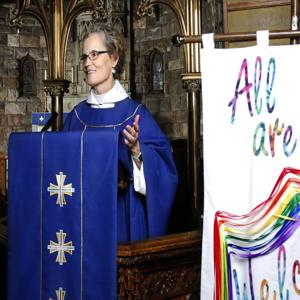


February 8, 226: May God’s words be spoken, may God’s words be heard. Amen.
You know, when I left Minneapolis and the -35 windchill weather, I did NOT remember packing that cold air to bring back to New Jersey. Lordy! I had hoped to leave that behind, but it is smacking us in the face now, isn’t it? I am glad to be inside this time, rather than out in it for hours marching down the street. I am also grateful to those of you who ventured out into this insane cold to be here this morning. Perhaps we all have a better appreciation for the people of Minneapolis and all they do in weather colder than this.
So, given all the ice that is around these days, on the sidewalks and armed in the street of our cities, I was glad to hear the texts for today. In the gospel we are hearing part of the sermon on the mount. After the familiar “Blessed are those…” statements we call the beatitudes, Jesus then says “You are the salt of the earth; but if salt has lost its taste, how can its saltiness be restored? It is no longer good for anything, but is thrown out and trampled under foot.
“You are the light of the world. A city built on a hill cannot be hid. No one after lighting a lamp puts it under the bushel basket, but on the lampstand, and it gives light to all in the house.”
“You are the salt of the earth.”
“You are the light of the world.”
Well, that’s good news – considering both will melt ice (come to think of it – maybe that is an appropriate acronym then for that armed band of hate enforcers – it shows just how vulnerable they really are).
But here’s the thing about this proclamation of Jesus…he isn’tinviting us to those things. He is telling us that we already ARE those things. This isn’t a choice folks. We are salt. We are light.
Then he offers absurd comments about salt losing its saltiness and hiding a light under a bushel basket. Jesus did have a sense of humor, and clearly his sarcasm is showing here, because salt cannot lose its saltiness, and no one would put a basket over an open flame, which is what a light would be in those days. Both scenarios are ridiculous, but then again, Jesus wasn’t trying to offer a science or fire safety lesson. He is preaching and being a bit cheeky to make a point, as he sometimes does.
So, what was Jesus trying to tell his followers – then and now?
I am reminded of two sayings by the Buddha: “Three things cannot be long hidden: the sun, the moon, and the truth.” And, “There are only two mistakes one can make along the road to truth; not going all the way, and not starting.”
Some have suggested that Jesus studied Buddhist principles in India during his early adult life, but whether he did or he didn’t, he is certainly preaching them here. He wants humanity to understand a fundamental truth – our very essence – in the hope that we will honor that truth within ourselves, allowing God to shine in us and through us. We can turn away, we can forget, we can get lost…but the truth of who we are cannot be hidden – not to God anyway. And, as the Buddha says, the path to understanding that truth is only impossible if we don’t try, or we stop trying.
But still, what does it mean for us to live this truth – what does that look like in our lives? Well, maybe we need to think about what salt and light do, particularly for those in the time of Jesus, to understand how important it is for us to be what we were born to be.
The thing is, we are so far removed from what these things would have meant to the people in the Ancient Near East, that the meaning of Christ’s metaphor may be lost to us. We have refrigeration and electricity. But they did not.
Salt was a way to preserve the life of meat and fish, and to enhance its flavor, and it was used in health regimens. It was so important to them that Roman soldiers were sometimes paid with salt – hence the word we use today – salary – sal being the Latin for salt.
And light – well, in these dark days of winter, even with our electricity, we can understand the value of that, but imagine living where there is no electric light. It is hard for us now, but if you think about it – in the long history of the world, there has been less than 150 years of light bulbs. In the time of Jesus, and up until 1880, there was the sun, and then there were oil lamps, candles, fires, moonlight, and torches for the night. Light then and now makes it possible to see dangers in the night, to keep warm, and to thrive, and without the light of the sun, life would be impossible.
Jesus is telling us that we can enhance and preserve life and overcome darkness for the world. But note – not for ourselves alone. Salt’s very purpose is to enhance or preserve life. The purpose of light isn’t to shine for itself, but to illuminate other things, to dispel the darkness.
If we are the salt of the earth, and the light of the world – and we are – then what does that mean in practical terms for us now? We get that answer in the passage from Isaiah we heard earlier.
First, we need to understand the setting: The powerful elite who benefited from the oppression of others believes its pious rituals of fasting will please God. But God tells them that there is only one fast that is righteous – the one that comes from a place of empathy and compassion, not haughtiness and privilege. In words we will hear again on Ash Wednesday, God makes it clear that only a fast from oppression by loosening the bonds of injustice, and freeing the captives, is what we are to offer. Only a fast from abundance by caring and feeding the poor and the hungry, will be acceptable to God. Notice then, that the acts God wants from us are not ones that draw attention to ourselves, or are miraculous feats, but are ones that serve others.
The truth that Jesus is asking us to see is that we are the salt that will give life to those who have been pushed to the brink of death. We are the light that will overcome the darkness of hate and division. We live this truth when we offer the fasts God chooses – compassion, mercy, grace, and love in whatever small way we can. Or, as our own Anglican archbishop, the late Most Rev. Desmond Tutu, put it “Do your little bit of good where you are; it’s those little bits of good put together that overwhelm the world.”
And so that brings me to the Olympics. How many of you watched the Opening Ceremony of the Winter Games Friday? It was wonderful. But there was a message there too that we need to consider today.
The theme of this Olympiad is Armonia, meaning Harmony, and of course – the parade of athletes is always one of the best parts. But this Olympiad’s opening ceremonies had a message for the world too.
Sure, like all them, it celebrated the beauty and gift of the host country’s culture, in this case, Italy, but far more was going on this time. It was essentially a colorful display of diversity, and the hope for harmony in a world filled with conflict and division.
From red, yellow, and blue paint seemingly pouring down onto the platform from enormous suspended paint tubes, to multi-colored swirls of people dancing across the platform, the message of harmony amid difference was hard to miss. But it was the speech of Kirsty Coventry, a seven-time Olympic swimming medalist, and the 10th President of the International Olympic Committee, given just before the lighting of the Olympic flame, that I think offered the world a good definition of what it means to be the salt of the earth and the light of the world, even if that was not her intent.
Speaking first to the athletes, Ms. Coventry said “Over the next two weeks, you’re going to give us something truly special. You’ll show us what it means to be human. To dream. To overcome. To respect one another. To care for each other. You’ll show us that strength isn’t just about winning – it’s about courage, empathy and heart. You will not only make incredible memories. You will reach your Olympic dreams – and you will show the world how to live.
This is why we all love the Olympic Games. Because through you, we see the very best of ourselves. You remind us that we can be brave. That we can be kind. And that we can get back up, no matter how hard we fall.”
Then she addressed everyone, saying “And to everyone watching, here in Italy and around the world – thank you for joining this moment. Thank you for believing in the magic of the Olympic Games.
When we see an athlete stumble and find the strength to rise, we are reminded that we can do the same. When we see rivals embrace at the end of a finish line, we are reminded that we can choose respect. When we see grace, courage and friendship – we remember the kind of people we all want to be. The spirit of the Olympic Games is about so much more than sport. It is about us – and what makes us human.
In Africa, where I’m from, we have a word: ubuntu. It means: I am because we are. That we can only rise by lifting others. That our strength comes from caring for each other. No matter where you come from, we all know this spirit – it lives and breathes in every community.
I see this spirit most clearly at the Olympic Games. Here, athletes from every corner of our world compete fiercely – but also respect, support and inspire one another. They remind us that we are all connected, that our strength comes from how we treat each other, and that the best of humanity is found in courage, compassion and kindness.”
Coventry was telling everyone that the very things the athletes embody at the games are examples for all of us. Jesus might call their example being salt and light. God might say “Yup – do that!” I just want her to come preach here some Sunday.
Now, in the audience that night was the US Vice-President, and watching were millions across our nation. I can only hope that her message, and that of these games, sinks deep into their hearts, because clearly the scriptures they claim to believe in have not. But, whether or not that happens, she is right, we all can take a lesson from those athletes, especially followers of Jesus, because it is a model for our lives in Christ.
Of courses, when we watch these games, and see the competitors fly through the air, twisting and turning, speeding down icy tracks, or spinning effortlessly on ice, we should remember – that isn’t what God is asking of you. Remember the passage from Isaiah – it isn’t the great feats, but the compassion, kindness, and respect they share that we are to model. Each of us will be salt and light in the way God has gifted us to be, so long as we model that.
Remember too that every athlete at those games started as a small child of God with a calling. To be where they are today, they had to make a small start. The skier had to put on a pair of skis and be willing to go down the bunny slope for the first time. The skater had to strap on skates and put their feet on the ice. And, to get where they are today, they had to train constantly, get up after they fell or failed, and get back out there to live their truth. It is as the Buddha said: “There are only two mistakes one can make along the road to truth; not going all the way, and not starting.” We have to start, and then we have to keep going, even if we fall.
And there is more to what we can learn from these athletes to help us in our own quest to do what we are called to do. One of the sponsors of the Olympics is a mattress company. And in the ads, the athletes remind viewers that rest isn’t a break from training – it is a part of their training. Without it, they would break and never make it. The same is true for us who are salt and light. We too need rest from our training, our continued work in the world. And we get that renewal here at this table, and among the fellowship we find here in Christ.
So, today we rest.
Tomorrow we do what those athletes do – show the world what is possible when we are strong enough for empathy and courageous enough for love.
You are the salt of the earth.
You are the light of the world.
There is no one who can keep you from that truth but yourself, and there is no time that truth is needed more than now.
Amen.
For the audio, click below, or subscribe to our iTunes Sermon Podcast by clicking here (also available on Audible):
Sermon Podcast
The Rev. Diana L. Wilcox
Christ Episcopal Church in Bloomfield & Glen Ridge
February 8, 2026
Fifth Sunday After The Epiphany – Year A
First Reading – Isaiah 58:1-9a, (9b-12)
Psalm 112:1-9, (10)
Second Reading – 1 Corinthians 2:1-12, (13-16)
Gospel – Matthew 5:13-20
February 1, 2026: May God’s words be spoken, may God’s words be heard. Amen.
Tomorrow there’s this pesky groundhog that is supposed to tell us how much winter we have left, and I swear, if that rodent sees his shadow I’m gonna go have a word with him, and it won’t be pretty. This has been a rough winter – bitter cold, lots of snow, and darkness that is cutting us to the core.
But the groundhog isn’t the only thing that happens tomorrow. February 2nd is primarily, for catholics, Roman or Anglican anyway, the Feast of the Presentation, which is the final day of Christmas – for real this time – despite the stores telling you that Valentine’s Day goes from December 26th– February 14th.
Now, you may have noted that our gospel today is from Luke Chapter 2, and we are clearly still in the birth narrative, as Jesus is all of 40 days old. He isn’t even out of onesies or eating solid food yet. It’s a bit of whiplash, since he was just walking around as a 30 something calling his disciples in the gospel we heard the last time we were able to be here on January 18th. But as it is such an important moment in his life, the church marks it as a special feast day on February 2nd..
Now, the church expects us to only celebrate this feast on the actual day. But, because so many do not attend special weekday services, this day, like other feasts – of the Magi, for example – will get ignored if we do not celebrate them on a Sunday. So, as we did last year, today we will celebrate the Feast of the Presentation today. It is also a day on which candles are blessed for use at home and the church, so it is called Candlemas.
The scriptures of this moment feature so much in our daily lives for those of us who pray what is known in our church as the Daily Office. It also is part of our parish’s history, with two prominent stained glass windows associated with it – the center window of the Tiffany triptych in St. Mary’s chapel, and this one up there in the main tower. The chapel window shows the scene, and the tower windows have the words of Simeon, which we heard in the gospel reading. Now, let’s get to this story, because it is offers something important for us in the context in which we live now.
In the verse just before what we heard today, we find that Jesus is going to a bris, and unfortunately for him, he isn’t the one bringing a gift. Joseph and Mary have him circumcised and he is named. Then we get to this story today, where 40 days after his birth, they bring Jesus to the temple to be presented to God in accordance with the law for her purification and his redemption that we get in that fabulous book that everyone loves – Leviticus. All this to say that Jesus is raised in the knowledge and adherence to Jewish scripture and law. There’s a lot going on in these verses, but I want to focus on two people – Simeon and Anna.
Now first we need to set the scene. The temple isn’t like the size of our churches today. This place is huge – many times larger than our largest cathedrals. So, you’d think no one would really pay any attention to this little family walking in. And yet, against all odds, two people did notice them – Simeon and Anna.
Simeon was, according to the text, a righteous and devout man who had been told by God that he would not die until he had seen the Messiah. He is guided by the Holy Spirit to come to the temple that day, and he listens and goes. There he sees the child Jesus, and takes him in his arms and says what is known in the church as the Nunc Dimmitis, Latin for the first words “now depart.”
I will use the version we say in Evening Prayer, which differs slightly from the wording we heard today: “Lord, you now have set your servant free to go in peace as you have promised; For these eyes of mine have seen the Savior, whom you have prepared for all the world to see: A Light to enlighten the nations, and the glory of your people Israel.” He then foretells to Mary the destiny that awaits this child, and that it will pierce her heart.
Then Anna, a prophet, sees the baby Jesus, and also proclaims the destiny that awaits him and what it will mean for the people of Israel. Of course, Simeon gets the focus in our prayer book, and Anna is essentially forgotten – what else is new, right?
So, what does all this have to say to us?
Well, let’s go back to our righteous guy Simeon. He says “…these eyes of mine have seen the Savior, whom you have prepared for all the world to see: A Light to enlighten the nations…”
To be sure, this is about far more than bringing light into the darkness – which, of course, is a powerfully important thing to do. But this is also about that light casting aside ignorance and bringing knowledge to the people – specifically, the knowledge of God.
Jesus would do both.
His presence among the people was the light that overcame the shadows of darkness, and he taught his followers what it meant to be part of the kingdom of God, rather than of humanity. He did this, not by sitting back in Galilee preaching in the synagogue, but by being out in the world healing the sick, advocating for the vulnerable, and spreading the good news of God’s love.
We are called to be like Jesus – a light to enlighten the nations. – in what we proclaim, and by our actions in the world.
And if there was ever a time to live out our lives in Christ, it is now, because darkness has spread across our country. People are being snatched out of their homes without a warrant, pushed to the ground and beaten, children are grabbed and sent to prison, protestors exercising their first amendment rights are sprayed intentionally up close with chemical irritants or bombed with tear gas, and others are brutally killed. This is a time when all the world hopes for a light to enlighten our nation! And folks, there are a LOT of followers of Jesus being exactly that right here in our country.
Clergy and laity are in the streets loving their neighbor, welcoming the stranger, protecting the vulnerable, and crying out for justice for the oppressed. Two days ago, 150 Episcopal bishops signed a letter that put a simple question before us: “Whose dignity matters?” They called “on Americans to trust their moral compass” – “to question rhetoric that trades in fear rather than truth.” Noting that “As Episcopalians, our moral compass is rooted firmly in the Gospel of Jesus Christ.” Indeed. And I take heart, as I hope you do, that our leadership in the church is witnessing to that gospel of all inclusive love.
We must join with them, and so many others, as a witness to the gospel – as lights to enlighten this nation. We must do this both by what we proclaim and by our actions in the world. What that looks like will depend on your own situation. As I said last time we were together, if you are caring for others, are aged or infirm, or are vulnerable yourself – you will need to protect yourself first, and proclaim the gospel in ways that do not put yourselves at risk. The rest of us – we need to be out in the streets. And as your priest, I cannot ask of you what I will not do myself. I am called to set an example in word and deed, even to the cross if necessary.
Now, I shared much of what I am about to tell you in an article I wrote for the Diocese of Newark, but I also want to share it with you now, in case some have not read it.
When I got home from church two weeks ago, after preaching on the Rev. Dr. Martin Luther King, Jr. Sunday, a call went out from clergy in Minneapolis to clergy across the country. Echoing King’s call to clergy to come to Selma, they asked us to come to Minneapolis to stand, march, and pray with them on January 23rd for what was being called A Day of Truth & Freedom. Like many others, I knew in my heart that I had to answer that call.
Yes, we were being asked to enter a dangerous situation. Yes, it would be winter in Minnesota, with temperatures predicted to be 30 below with the windchill. Yes, we are exhausted, like so many of you, having shown up again and again for vigils, marches, and protests. And yet, as King’s words resounded from our pulpits on the day we celebrated him, I was reminded of something he said that I had just included in my sermon on that very Sunday: that there comes a time when one must take a position that is neither safe, nor politic, nor popular, but must do it because conscience demands it.
How could I preach it, and not live it?
And so, on Thursday night, January 22nd, I found myself in Minneapolis during an extreme cold warning. The morning of the march, I woke to a temperature of -21 degrees and layered myself accordingly. I headed to Gethsemane Episcopal Church, a closed parish of the Diocese of Minnesota just a few blocks from The Commons, where the march was to begin. The streets were empty, the shops and schools closed – all part of this act of resistance.
When I arrived, clergy and laity were already gathered to pray before joining the thousands who had come to stand against the brutality, cruelty, and lawlessness of the federal occupation of this once-peaceful city. While there, I received a text warning that federal agents might use water cannons on protesters – which, of course, in that type of cold, would be deadly. I put my phone away, donned my make-shift tear-gas mask, and joined my colleagues as we headed out the door.
Singing “This Little Light of Mine,” we left the church and merged with thousands entering from every direction. The crowd was so massive that it took nearly an hour for those of us gathered at the starting point to fully enter the march. We moved slowly, navigating ice-covered streets before surging forward into the march itself.
Despite the bitter cold, which with windchill was about -35, nothing could dampen the fervor of the protesters or quiet our voices. We called for ICE to leave Minnesota. We spoke aloud the name of Renee Good, killed by an ICE agent. We named Liam Ramos, a five-year-old child used as bait by ICE to lure out his family before being sent with his father to a prison in Texas. We demanded justice, accountability, and an end to the occupation.
It is impossible to describe the joy I felt seeing so many people there – 50,000, we were told. For most, this was not a single day of action. They were living this resistance daily: patrolling neighborhoods to warn of federal agents, distributing food to those unable to leave their homes, and caring for one another. Clergy tended their people, preaching the gospel in both word and deed. I was surrounded by prophets – exhausted, unwavering, and deeply inspiring.
When I could no longer feel my feet with a quarter mile left to go, their courage carried me forward. People passed out hand warmers and tissues. Two marchers ahead of me wore backpacks reading, “If you are hungry, tap my shoulder,” and “If you need hand warmers, tap my shoulder.”
Even in anger and pain, Minnesotans chose to meet hate and violence with compassion, grace, and love.
At the rally, which thankfully had been moved inside, faith leaders proclaimed that God’s love is greater than any hate this government can unleash. And, indigenous leaders reminded us that no one is illegal on stolen land.
Walking back through deserted streets, I passed the statue of Mary Tyler Moore tossing her hat into the air in an iconic moment of liberation. It is from a TV show that some of a certain age remember well. The theme song’s title came to my mind: “Love Is All Around,” and I thought – it sure was that day. I went back to my hotel believing, as the song says, that we’re “gonna make it after all.”
I flew out the next morning, later learning that as I traveled above the city, below Alex Pretti was being beaten and killed by Federal agents. Does that mean it was all for nothing? Not at all. It means the struggle continues, and those of us who are able must keep answering the call of Christ – to be the light that enlightens the nations – our nation – even to the cross. To bring the knowledge of the gospel to those who need it most. The ones who govern – that they may turn from their evil acts against our neighbors, and live the law of God – to love one another, and to care for the least of these. And the ones being oppressed – that they may know that they are loved, and they are not alone or forgotten – not by God, and not by any of us.
That is our faith and it will change the world, but it will not be easy, and it will pierce our own hearts too. It was reported yesterday that an ICE agent told a protestor “If you raise your voice, I will erase your voice.” I kid you not.
But let me be perfectly clear – they can try to erase our voice – but we will only grow louder, because no ICE agent, or anyone else, can ever erase the voice of Jesus. Lord knows, and he does, the Romans tried that long ago in the most brutal way. It didn’t work then, and it won’t work now.
Christ showed the world that God’s love is stronger than human hate, and Christ’s light will always overcome the darkest of humanity in the end. So, in the days ahead, we will with our voices and our actions show the world that God’s love is all around, and I promise you, that if we do that – we will make it after all.
Amen.
For the audio, click below, or subscribe to our iTunes Sermon Podcast by clicking here (also available on Audible):
Sermon Podcast
The Rev. Diana L. Wilcox
Christ Church in Bloomfield & Glen Ridge
February 1, 2026
Feast of the Presentation (trans.)
1st Reading – Malachi 3:1-4
Psalm 84
2nd Reading – Hebrews 2:14-18
Gospel – Luke 2:22-40
January 18, 2026: May God’s words be spoken, may God’s words be heard. Amen.
Twelve years ago tomorrow, I celebrated the Eucharist here for the first time as your Rector. It was January 19, 2014 at 10:30am. I remember it well. I knew way back then I had been called into something amazing – a new relationship with all of you. And so, twelve years ago today I stood here by God’s grace and nothing for me, and I pray for you, has been the same since. That is why the date of January 19th at 10:30am is something I will never forget.
It’s the way it is with life altering events, right? Folks remember the day a child was born, the first date we had with our spouse (and of course the day of the wedding itself – or we better!). And, on a sadder note, the day a loved one died – their saint day, as we like to call it in the church, is a day each year that doesn’t go unnoticed.
We remember too moments that changed the country or the world – the day Pearl Harbor was attacked, WWII broke out, President Kennedy was shot, Astronaut John Glenn put his foot out onto the lunar surface, the Challenger spacecraft exploded, the 9/11 terrorist attack, and the January 6th insurrection. And, those who were around for it remember too when the Rev. Dr. Martin Luther King, Jr. delivered his “Dream” speech to the thousands gathered for the March on Washington for Freedom & Jobs…and where they were when they heard the terrible news that he had been assassinated.
These moments changed us – challenged us – demanded something of us. And we were never the same from those points forward.
And so when we hear in the second part of the gospel of John read today this story of people’s first encounter with Jesus, it should not surprise us that the community that wrote this gospel noted something about it. The gospel account says “The next day John again was standing with two of his disciples, and as he watched Jesus walk by, he exclaimed, “Look, here is the Lamb of God!” The two disciples heard him say this, and they followed Jesus. When Jesus turned and saw them following, he said to them, “What are you looking for?” They said to him, “Rabbi” …where are you staying?” He said to them, “Come and see.” They came and saw where he was staying, and they remained with him that day. It was about four o’clock in the afternoon.
It was about four o’clock in the afternoon.
That’s a kinda funny thing to write down, don’t ya think? What was so special about it being 4pm? Something tells me it wasn’t the first century version of “It’s 5 o’clock somewhere.”
Clearly the community that wrote this fourth gospel knew that the lives of first disciples would be changed so much in that initial encounter with Jesus that they would never forget where they were and what time it was when it happened. That is what call does. It stops us in our tracks for a moment, and we are forever changed as we accept Christ’s invitation to come and see.
I suppose the question for each of us now is – do you recognize that moment for you and what will you do about it? Because Christ is calling us to come and see in this life altering moment for our community and in this country.
As we watch ICE agents, sent by our President only into cities that did not vote for him, terrorize people regardless of citizenship status – wounding and killing children of God as they drag them without warrants out of their homes and businesses, shatter the windows of their cars with children inside, attack those who dare to peacefully protest with tear gas, pepper spray, and flash bombs, as well as using lethal choke holds (like the one that killed George Floyd) on those they detain.
As this country fails to support those who are laying their life on the line for democracy in Ukraine, while the President imitates Putin, calling the US to invade Greenland, a sovereign territory of Denmark, and threatening NATO allies that have sent military and financial support to Greenland to prevent it.
As we read the social media comments of people who think ICE agents have a right to abuse, kill, or deport people without due process because they are “illegals,” in a land where none of us are originally from here, save those of the indigenous tribes.
As we find that our nation’s highest court, in defiance of precedent and the US Constitution, affirms the right of ICE agents to target people based on the color of their skin, their accent or the language they speak, or their place of work.
As we mourn the 32 killed by this administration ICE enforcement action in 2025, including Jean Wilson Brutus, who died while in custody at Delany Hall in Newark.
As we hear our President refer to the countries these people come from as s-hole countries, while saying that we need more people from places like Norway – translation – he wants less people of color or Asian descent and more white people.
As we continue to wait for the Department of Justice to follow the law and release the files associated with the pedophile Epstein and stop protecting anyone who was involved in this horrific human trafficking of young girls for sex.
As we hear over and over again the racist, misogynist, homophobic, and xenophobic garbage this President, his staff, and those who support him spew on a near minute by minute basis.
I could go on and on and on…it’s exhausting, isn’t it?
But in the midst of all of this – Jesus bids us to follow him as he goes to where he always stays – beside the vulnerable and afraid, alongside the oppressed and the lost. This is a pivotable moment for every one of us as we stand amid this turning point in our nation. We see, surely, what is happening. The question for us is – will be follow Jesus when he bids us to come with him?
It is a good question to consider as we celebrate the life of a man who did follow Jesus – followed him all the way to the cross – the Rev. Dr. Martin Luther King, Jr.
King’s final Sunday sermon was at our own Episcopal cathedral in DC. In that grand pulpit of Washington National Cathedral, King said this:
“…Our experience [is] that the nation doesn’t move around questions of genuine equality […] until it is confronted massively, dramatically in terms of direct action […] I submit that nothing will be done until people of goodwill put their bodies and their souls in motion and it will be the kind, the sole force brought into being as a result of this confrontation that I believe will make the difference […] On some positions, cowardice asks the question: is it expedient? And then expedience comes along and asks the question, is it politic? Vanity asks the question, is it popular? Conscience asks the question, is it right? And there comes a time when one must take a position that is neither safe nor politic nor popular. But [one] must do it because conscience tells [them] it is right.” (https://cathedral.org/blog/today-in-cathedral-history-mlks-final-sunday-sermon/)
Folks, that time is now. Jesus’ call to us is now.
And here’s the thing – the passage in Isaiah about the prophet we heard this morning was telling us something perhaps we need to hear as we consider what Christ is asking of us. Because in no less a way as was said about the prophet Isaiah, God is saying this to each of you now: “I formed you in the womb to be my servant, and I give you as a light to the nations, that my salvation may reach to the end of the earth.” And that salvation, my friends, is the hope God has in mind for all of us – that beloved community where all are welcome, and no one is harmed.
This is who you were formed in the womb to be – God’s transformative agent, following Christ to where he abides – with the least, the last, the lonely, and the lost. This is our faith, what we committed to in baptism. And this is how we should honor the saints, like King, too.
Because if we truly want to honor people like the Rev. Dr. Martin Luther King, Jr., then we have to do more than attend breakfasts and recall his sermons/speeches – we must live as he lived, and be willing to die as he did.
And if we truly want to follow Jesus, we must do more than go to church, pray, and read scripture – we must live as he lived and be willing to die as he did.
This past week, the Rt. Rev. A. Robert Hirschfeld, Bishop of the Episcopal Diocese of New Hampshire, put it this way:
“We are now engaged in a horrible battle that is eternal, that has gone on for millennia. […] and we are now, I believe, entering a time, a new era of martyrdom. Renee Good being the last of note of those martyrs.
New Hampshire’s own Jonathan Daniels, a man also of white privilege, stood in front of the blast of a sheriff in Haynesville, Alabama, to protect a young black teenager from a shotgun blast. He died and was martyred.
We know of the women, the Maryknoll sisters, who stood alongside the poor and the oppressed in El Salvador and were brutally raped and murdered in the name of Jesus.
[Archbishop] Oscar Romero, in a mass, called upon the death squads of El Salvador to lay down their arms or risk excommunication [and ] was martyred the next Sunday at the altar.
I have told the clergy of the Episcopal Diocese of New Hampshire that we may be entering into that same witness. And I’ve asked them to get their affairs in order—to make sure they have their wills written, because it may be that now is no longer the time for statements, but for us with our bodies to stand between the powers of this world and the most vulnerable.
And it may mean that we are going to have to act in a new way that we have never seen perhaps in our lifetime, except for these remote stories that I’ve just cited, to put our faith in the God of life, of resurrection, of a love that is stronger than death itself.” (https://www.nhepiscopal.org/blog)
Amen Bishop! Amen. “Now is no longer the time for statements, but for us with our bodies to stand between the powers of this world and the most vulnerable.”
Not everyone can do this to be sure. Those who care for others, like young children or aging parents, those who face physical, mental, or emotional challenges, and of course – the vulnerable themselves. The rest of us though – we must make a choice and it is by no means easy. Neither was it for Jesus, for Dr. King, or for any of the other martyrs of the church.
This does not mean we recklessly engage in violence, but it does mean we act not only on social media, but with our voices, our feet, our very bodies in the streets, in the halls of government, anywhere that children of God suffer – anywhere Jesus calls us to come and see.
If we do this, if we follow Jesus, then King’s words will come to be. In the end of that sermon at Washington National Cathedral, he said:
“So, however dark it is, however deep the angry feelings and the violent explosions are, I can still sing “We Shall Overcome.”
We shall overcome because the arc of the moral universe is long but it bends toward justice.
We shall overcome because Thomas Carlyle is right: “No lie can live forever.”
We shall overcome because William Cullen Bryant is right: “Truth, crushed to earth, will rise again.”
[…] With this faith, we will be able to hew out of the mountain of despair the stone of hope.
With this faith, we will be able to transform the jangling discords of our nation into a beautiful symphony of brotherhood.
[…] God grant that we would be participants in this newness and this magnificent development if we will, but do it. We will bring about a new day of justice and brotherhood and peace. And that day, the morning stars will sing together and the [people] of God will shout for joy.”
And so, as we enter into our thirteenth year together amid these deeply troubling times, as we consider in our hearts the path that lay before us, I leave you with this from the epistle of St. Paul we heard this morning – that you may know my deep gratitude for all that you do in the name of Jesus, and be reminded of all that you have been given by God for the work that lay ahead.:
St. Paul wrote: “I give thanks to my God always for you because of the grace of God that has been given you in Christ Jesus, for in every way you have been enriched in him, in speech and knowledge of every kind […and] He will also strengthen you to the end.”
Amen.
For the audio, click below, or subscribe to our iTunes Sermon Podcast by clicking here (also available on Audible):
Sermon Podcast
The Rev. Diana L. Wilcox
Christ Church in Bloomfield & Glen Ridge
January 18, 2026
The Second Sunday After The Epiphany
1st Reading – Isaiah 49:1-7
Psalm 40:1-12
2nd Reading – 1 Corinthians 1:1-9
Gospel – John 1:29-42
January 11, 2026: May God’s words be spoken, may God’s words be heard. Amen.
Now, if you have been here these past few weeks of Christmastide and the Feast of the Epiphany, you would be right thinking that Jesus sure grows up fast, I mean we just celebrated his birth, then last week he’s a kid being visited by Magi, and now he’s a grown man! I mean, at this rate, a week from now should be Palm Sunday, right? Wrong. Well, sort of – Ash Wednesday is coming up in just a few weeks, so buckle up.
Still, you couldn’t be blamed for feeling a bit of lectionary whiplash right about now. Kinda the way you feel the day after Christmas when there’s stuff in the stores for Valentine’s Day, which I do NOT appreciate given that happens to be my birthday, and there is no need to rush it.
But, back to the texts we heard today from the Gospel of Matthew and from Isaiah. In the gospel we here the story of Jesus’ baptism. Left off of what we heard today, is what Jesus does just afterward. He is led into the wilderness by the Holy Spirit where he encounters evil. And in the wake of all that has happened in our nation this past year, and most recently, this past week, it would seem a message we very much need today.
I will speak more about that in a minute, but it is important to first underscore what we are hearing in today’s texts – about Christ’s baptism, yes, but also about our own.
And in our passage this morning from Isaiah, we hear some of what that covenant requires of us. About the prophet, God says “I have given you as a covenant to the people, a light to the nations, to open the eyes that are blind, to bring out the prisoners from the dungeon, from the prison those who sit in darkness.”
Now, think about that…and then hear again the vows we all make at baptism either for ourselves, or was made by our parents, and Godparents, and we later confirmed. We promise to “seek and serve Christ in all persons, loving our neighbor as ourselves, and striving for justice and peace among all peoples, respecting the dignity of every human being.”
See, the thing is…when we are baptized, we are baptized into something…or really baptized into someone. It is an identity that comes with a calling – the calling to free the captives, fight for justice and peace, and to love and serve. We are baptized into a life of Christ – because we are the body of Christ alive in the world today. And as the body of Christ, we don’t just leave the waters of baptism, grab a towel, and continue as though nothing happened. We do as he did after his baptism – we live the life we are called to live – a life of ministry in a broken world – a life of wilderness moments when we are challenged, and pushed to the brink.
And Lordy, we are in the wilderness now.
This past week our government continued its horrific, unconstitutional, racist, and cruel violence against the people of our nation. Renee Nicole Good, a US citizen and young mother of three, was gunned down while in her car by an ICE agent in Minneapolis this past Wednesday. Her wife, Becca Good, is left to care for their 6 year old son. The video of the attack is brutal to watch, and the lies about her and the incident by our government just add to the horror.
Renee is not the first to be killed, or tortured, or imprisoned unlawfully. She sadly will not be the last. In fact, on Thursday, the very next night, two more people were shot by ICE agents in their vehicle in Portland. These are very dark days for our nation and for the world.
Like many of you, I have been at more than one vigil in response – one of them just down the street from my home on the Newton Green– which is in the middle of a very red part of our Garden State. Like the other vigils, it was a community gathered in love amidst tragedy and hate. Sadly, even as we stood together, someone shouted out from a passing truck “ICE, ICE, Baby!” The cruelty of our President and his followers seems to be the point. Yet we were not deterred, and continued to stand together to be a witness to the horror that has taken yet another life.
One of the things I have said at these vigils is that our faith is one that follows a man who preached love and peace, and was executed by the government because of it. Yet his resurrection taught us all that light will always overcome darkness, life is stronger than death, and love will always defeat hate. It is the only thing that can.
Renee Good understood that truth. Her wife, Becca Good, said in a statement after her murder, said: “I am now left to raise our son and to continue teaching him, as Renee believed, that there are people building a better world for him. That the people who did this had fear and anger in their hearts, and we need to show them a better way.”
Indeed we do. We must. Because love is the only way out of this long national nightmare.
But that does not mean the road will be easy for us. It certainly wasn’t for Jesus. He had his time in the wilderness, and we are now deep within it too. Today, we are faced with a seemingly never-ending onslaught of cruelty by those who should be servants of the people. We are worn to the bone by the vitriolic hate our President, his team, and his supporters spew nearly hour by hour, all amid a daily avalanche of lies and purposeful misdirection by the ones we are supposed to trust. The purpose is to knock us off center and keep us so disoriented that we feel helpless, hopeless, and filled with rage.
Why would they want this? It’s simple really – it is so we respond with the same in kind. For evil knows that darkness will feed darkness, hate will fuel hate, violence will breed violence. They fan the flames to incite those who oppose them to be just like them, which will give them fodder to increase the violence in a never-ending cycle. And in moments like this, it is very tempting to give into it.
Why not fight fire with fire – violence with violence, hate with hate. We feel so drawn to it, do we not, if we are honest with ourselves? But the thing is, we need to consider who tries to draw us to hate and violence. Remember what happened to Jesus in the wilderness – the evil one spoke to him – catching him when he was worn from his long journey in that place – and showing him a path forward that seemed so simple.
If Jesus would only turn aside from God, everything would be great – he would be great – the evil one said. You could understand the temptation. I mean – he was promised he could turn stone into bread – that would solve all the hunger in the world. He could be made king over everyone – imagine today if you could take the power away from all the world’s brutal dictators, including our own? Yet Jesus knew that isn’t the path toward peace, toward wholeness, toward grace. It wasn’t for him, and it most certainly isn’t for us.
At that vigil the other night in Newton, the organizer wanted to close with the hymn Amazing Grace, but wasn’t sure of the words. So, I stood beside her and helped lead everyone in singing those lyrics of redemption. One of those verses is: Through many dangers, toils, and snares, I have already come; ’tis grace that brought me safe thus far, and grace will lead me home.
Grace is God’s gift to us, and it, not hate, will always lead us through the wilderness and to home – where we will be grounded in the knowledge and love of Christ, and renewed to live as we are called to live in our baptismal covenant. And folks – that will change the world. It really will.
God’s grace is how we will get through this.
After I spoke at the vigil in Newton, a young mother of two boys – a teen of about 14 years old or so, and the other about 10 – came up to me. The teen apparently had told his mom after listening to me that he wanted to go to church, and she – a person who had been harmed by her own church experience – wanted to know where I was a priest, feeling that it would be inclusive. Since our parish is so far from where this was, I told them of another one they should try.
That conversation filled me with hope – to see young people yearning for a relationship with God. And it is certainly something seen a lot these days as church attendance by all ages is on the rise. I believe that this is a sign of the future of the church, as people seek a way forward, and they witness us living out our lives in Christ. Because so many people today are yearning for an alternative to the madness they are witnessing.
In a world filled with conflict, violence, hate, war, poverty, and abuse of the environment – seekers hope to be connected to something they sense is larger than all of that – stronger than all of that – to a God that loves unconditionally, and a faith community that reflects that love openly, consistently, and with intention. They are looking for comfort and peace, yes, but most especially, they want to know that God loves them in a place that welcomes everyone, amid a world that wants to exclude them.
That is why what we do here is so important. It feeds us in a time of deep hunger, but it also is food for the world. Here is where we are given the strength for our wilderness journey. Here we offer that food of life to others. Here we are reminded of our baptismal contract with God – a life of prophetic witness, rooted in the love of Christ, that calls us to speak truth, to act for justice, to stand for peace, to offer hope and love to a people in darkness.
We have made a commitment to God to be the ones to speak up against those who traffic in hate and violence.
To be the ones to stand against those who seek to oppress and marginalize.
To be the ones to respond to hate with love and lies with truth.
And especially to be the ones to counter the racist, homophobic, and sexist, words and actions by earthly rulers and proclaim in the streets, in the halls of government, in our churches, and everywhere in the world that God loves EVERYONE– NO EXCEPTIONS – and so will we.
For like the prophet in Isaiah, and like our savior in whose name we are baptized, we too were given “as a covenant to the people, a light to the nations, to open the eyes that are blind, to bring out the prisoners from the dungeon, from the prison those who sit in darkness.”
There are many in prisons now – dungeons of bigotry and oppression, poverty, hopelessness, loneliness, and addiction. This is not time to throw the covers over our head and attend the church of the Holy Comforter. This is not a time to tune out. This is not a time to not pay attention. This is not a time to forget who we are, and whose we are.
This is the time for us to be who we were born and baptized to be – prophets of his light, grace, and love – God’s beloved agents of transformation.
And there is nothing – no President or other leader, no ICE agent or army, no person or organization, that can stop what we, together, and by God’s grace, will bring about – the overturning of evil, and the restoration of the world.
They may have killed Renee Good, but by the good in each of us, rooted in the love of Christ – we will prevail.
Amen.
For the audio, click below, or subscribe to our iTunes Sermon Podcast by clicking here (also available on Audible):
Sermon Podcast
The Rev. Diana L. Wilcox
Feast of the Epiphany (trans.) – January 4, 2026: May God’s words be spoken, may God’s words be heard. Amen.
Today we celebrate the Feast of the Epiphany. The actual feast is on January 6th, and today would be the Second Sunday after Christmas. Still, this year, the story of the magi’s visitation to Jesus would have been a part of the text choices for today, so all good.
Now, this feast, which occurs on Tuesday, ends our Christmastide – our twelve days of Christmas. So, as I said in previous years, don’t let anyone give you a hard time about still having the tree up. Besides, they can be thankful you don’t celebrate Christmas until Candlemas on Feb. 2,nd as some do!
Every year we tell the story of the Magi who travel from the East to bring gifts to the Christ child, and as it is good to repeat each time the origin of this story of the three wise guys.
Matthew, the only gospel account of the magi, never tells us how many there were, or even if they were all men. But since Matthew mentions three gifts, later Christian tradition came to identify three of them. And in the late sixth century Armenian Infancy Gospel, the Magi are even given the names-Melkon or Melchior, Balthasar, and Gaspar. But just as we don’t really know the names of the people who wrote the gospels, we also don’t know the names of these folks, so call them whatever you want – Larry, Mo, and Curly –really up to you.
This story is one that is celebrated not only because of gifts, but as a symbol that the child born to us at Christmas was for all the people of the world, because the sages came from lands so very far away.
Whatever you name them, we know you can’t call them “on time.” As we hear today, Jesus was not a baby anymore, but a child, and living in a house. Apparently, Waze or Google Maps was not available to these Eastern travelers.
Well, even if they were late, and brought really weird gifts to a young child, each year we like to tell the story of their visit…
Loud Knock Heard From The Back
Ceremonial Music Plays As King Approaches
King 1 presents Mother Diana with gift.
Mother Diana opens the box, inside is a snow gauge.
Mother Diana reads the scroll aloud –
“We saw a star and were guided by its light to the Christ child. As we moved along, we needed to always check that we were still on the right path.
The truth is – While being too restricted is not good for anyone, taking an occasional measurement on your life journey does allow you to be sure you are still on the right path. His life should be the measure you use.”
Mother Diana rolls up the scroll and says,
Thank you great sage! While I love a beautiful snowfall, let’s hope I don’t need to use this too often. Now, as I was saying…
Loud Knock Heard From The Back
Ceremonial Music Plays As King Approaches
King 2 presents Mother Diana with gift.
Mother Diana opens the box, inside is Bluetooth speaker, and a scroll.
Mother Diana reads the scroll aloud –
“We stopped along the way at the palace of King Herod. He told us to return and tell him where we found the Christ child. Yet we were warned in a dream not to return to Herod, and went home by another way.
The truth is – There is a lot of noise in the world, and many voices will try to tell you who you are, where you are to go or what you are to do. Be sure you are listening to the right one.”
Mother Diana rolls up the scroll and says,
This is sooooo cool! I can’t wait to set this speaker up. Now, as I was saying…
Loud Knock Heard From The Back
Ceremonial Music Plays As King Approaches
King 3 presents Mother Diana with gift.
Mother Diana opens the box, inside is a wreath of bird food, and a scroll.
Mother Diana reads the scroll aloud –
“We brought gifts of gold, frankincense, and myrrh to the baby Jesus. Impractical? Perhaps. But a symbol of who he was to be for the world – King, God, and Sacrifice. Yet he was clear about the gift we are to bring in his name, and it was none of those things.
The truth is – Food is essential for life, and the law of God in our time, and yours now, is to care for the stranger among us. How you feed others is the gift of love you bring to Christ.”
Mother Diana rolls up the scroll and says…
Wow – thank you great sage – I am so excited to think about this gift – it looks so pretty. Let’s see…three magi, three gifts, I guess we must be done. So…
Loud Knock Heard From The Back
Ceremonial Music Plays As King Approaches
King 4 presents Mother Diana with gift.
Mother Diana opens the box, inside is a mixing spoon and a scroll.
Mother Diana reads the scroll aloud –
“The star awakened us to something important happening in the world, and Christ stirred us to new life.
The truth is – There are important things happening in the world now too, and Christ desires us all to come to him, to follow him, to be him in the world. This is a time to be stirred up.”
Well, thank you great and final sage??? – You have given me a lot to think about.
Are we done? [look around]
Well, this is an assortment of cool gifts, right? A snow gauge, a Bluetooth speaker, a bird food wreath, and a mixing spoon. These Magi have given us something to really think about, haven’t they?
The thing is, these all might be quirky gifts, but the magi did manage to come up with just what we need this year.
Especially in this time when it seems the world is spinning and we struggle to know where to go or what to do.
Especially in this moment in the world where the voices of bigotry and hate are not only prevalent, they are coming from our nation’s leaders.
Especially now, when we hunger for righteousness, and hear the cries of the vulnerable who are starving for lack of shelter, food, and most especially – love.
Especially now, when we are worn to the bone, but there is oh so much more work to do in the name of Christ.
These gifts we received today can be a reminder to us all of who we are and whose we are, and what that means for us as we welcome the Christ child into our hearts.
As we move through the world, there will be many who try to guide our paths. The measure of our lives will not be like measuring snow, which is needed only for a season, and tells us only what is true in a snapshot of time. It will be how we measure up to our commitment to the Christ born to us that will be most important for us to keep in our heart and mind. Here, at this table, and among other travelers in our faith, we are able to check-in, gauge our lives, and adjust as needed.
This world is filled with so many angry and hateful voices, who will try to lead us to abandon the Jesus in our midst to the cross. For he told us that he is in the immigrant, the sick, the poor, and the imprisoned. But like those sages of long ago, we are meant to listen to his voice, not to these others. How do we discern which is which? His will always be the voice of compassion, generosity, kindness, and love. We will always be reminded of that voice here too – in the scripture and at this table.
So many cry out in hunger – hunger to be seen, to be heard, to be fed, to be loved. All of creation groans from our abuse and neglect too. We feed on him here, so that we can feed him in the world. The food of life that is Christ, is to strengthen us for the journey, that we may feed others, caring for them and all of creation by his love shining in us and through us.
And finally, the world is too dangerous and dark for us to be silent, to be hesitant, or to hide away. We must not only be stirred up, we must stir up the conscious of the world! There is no time to waste, not a moment to spare. People are dying – physically, emotionally, spiritually – God’s children – our sisters and brothers. What is done to any one of them is done to Jesus himself. We cannot sit here in the warmth of his love, and then ignore his pain when we leave. If we do, we render Christmas meaningless for ourselves, and all the world.
The wise folks brought Jesus symbols of who he was – gold for a king, incense for a deity, myrrh for a sacrifice. Today they bring symbols of who we are as followers of that Christ child. And just as that night so long ago changed everything, letting all the world know that God’s love is stronger than hate, that light will always overcome darkness, and that death is forever defeated by life – by our lives lived in Him the angels continue to rejoice in heaven as he is reborn in each of us at Christmas, and every day we open our hearts to Him.
So, with all that in mind, as I do each year I offer this quote by Michael Dougherty. “When the carols have been stilled, when the star-topped tree is taken down, when family and friends are gone home, when we are back to our schedules, the work of Christmas begins…to welcome the refugee, to heal a broken planet, to feed the hungry, to build bridges of trust, not walls of fear, to share our gifts, to seek justice and peace for all people, to bring Christ’s light to the world.”
May we, like the magi, be willing to follow where God leads us, trusting that there is always another path to take that will lead us out of darkness into light –His light.
May we know that we need no star, only an open heart, to see the God who yearns to love us – and wants so much to be in relationship with us.
And most especially, that once we receive the gift of Christmas, the Christ child, in our hearts, that we do the work of Christmas and share that light with the world.
Because it is we, not the magi, who are now meant to reveal Christ to a world who hungers for God’s love.
Christmas isn’t over…it’s only just begun.
Amen.
For the audio, click below, or subscribe to our iTunes Sermon Podcast by clicking here (also available on Audible):
Sermon Podcast
The Rev. Diana L. Wilcox
Christ Church in Bloomfield & Glen Ridge
January 4, 2026
The Feast Of The Epiphany (Trans.)
1st Reading – Isaiah 60:1-6
Psalm 72:1-7,10-14
2nd Reading – Ephesians 3:1-12
Gospel – Matthew 2:1-12
Christmas Eve – December 24, 2025; May God’s words be spoken, may God’s words be heard. Amen.
This is the most wonderful time of the year, or so we are told by Johnny Mathis and others. It really is though, even if the turkey didn’t thaw out in time, the kids are hyped up on sugar and dreams of Santa Claus, and the in-laws are about to send you to a therapist’s couch. Yet sometimes when we think about Christmas, we get caught up in the Hallmark version of it – the lights, the carols, the cookies, and the gifts, that when we hear the story of that first Christmas, whether here at church or from Linus in A Charlie Brown Christmas, it seems so far away from who we are that we lose sight of what it means for us. But the thing is, this story isn’t as foreign to our lived reality as we sometimes make it – and that knowledge helps us to see something we need to know now.
The author of Luke, from where Linus and we get the birth story we usually hear on Christmas Eve, sets the scene for us in the midst of human history – it was when a certain ruler was in charge and had commanded a census of “all the world.” Now, just for context, things were difficult in those days – they were indeed a people who walked in darkness (though the prophet Isaiah was speaking about an earlier time). The empire’s taxes were hard, and most labored for their own food. Poverty was crushing most of the people, while a small elite profited off of them and lived lavishly. And there was political unrest caused by an appointed ruler, Herod, a larger than life sort, who the people viewed with suspicion because of his ties to the empire. This is the setting into which God chooses to enter, and there is a lot we can all resonate with in it to be sure – but more on that later.
Back to the story itself – this census moves Mary and Joseph from Nazareth to Bethlehem, a journey of nearly 100 miles (with no trains, planes, or automobiles to get them there). It also likely meant a lot of others were making similar journeys, so as the song goes – there may be No Place Like Home for the holidays, but the traffic really is terrific! And then there is the problem of trying to find places to stay along the way. I have to wonder if Joseph and Mary made their place in Nazareth an Air B&B, given all the folks traveling in the opposite direction.
At any rate, all that travel must sound familiar to a lot of folks today who stood in long TSA lines, navigated bumper to bumper traffic, or was trying to figure out where to put everybody who made it home for the holidays. Add to all of that is the fact that Mary is very pregnant! Lordy – that’s gotta be a tough trip.
So, back to our Holy Family – they get to Bethlehem, and there is “no room for them in the inn.” Now, that may mean Joe forgot to make reservations (you know that meant a big argument later – right?). But it wasn’t like they had to go to a barn somewhere on the property. Likely, because other guests already took over the host family’s guest rooms, it was sort of like telling them they had to sleep on the old lumpy sofa in the unfinished basement.
Homes in those days had a lower level where animals were brought in for the night and in cold weather. That is where the host family had to send Mary and Joseph. If you can imagine that for a moment – it means the house was filled with people – all there for the census taking one supposes. That is a made for Hallmark crazy time moment for sure, that many of you here likely know far too well.
And for this couple, who already had a lot going on, sleeping among the animals may have been the most peaceful part of their days – a respite from upstairs where perhaps Joe’s crazy Uncle Roy was getting into it with Grandma Lucy, who had a bit too much eggnog. At least the animals aren’t likely to break out into a fight over politics. From the animals point of view though, this was a nightmare.
I mean, first this couple comes down, takes over two of their beds of hay, and dang it – then they have a baby (what a noisy mess) and worse – they put that little human on their food in their manger – yuk! The animals were probably like – What the heck! And as for the birth, you know that was crazy time at the OK Corral.
Women upstairs likely came down to help, making things a bit crowded; and birth scenes, even for the virtuous like Mary, are typically not quiet events, despite what the hymn says. Giving birth then, and even today is joyous and noisy. Sadly, it is also dangerous – for both the mother and the child. And after all that – shepherds arrive to tell them that angels appeared in the sky and confirming what the angel had said to Mary at the beginning of this journey. No wonder she pondered it all in her heart – before nodding off for a much needed nap.
What a wild family story this probably became over the years, right? I mean, can you imagine on the 10th Christmas, somebody saying – Hey Joe and Mary, remember that crazy year of the census? And them saying back “Lordy what a time that was” as Joe grabs another eggnog and Mary chases Jesus and his siblings away from the presents.
Seriously though – that was the Luke story. Filled with very human stress, joy, and a bit of craziness – and all wrapped up in love. The Matthew story was much less chaotic, but far more dangerous. Mary was pregnant, but she and Joseph were engaged, not married – which in those days, and in some parts of the world today – means danger for Mary and her unborn child. In a dream, Joseph is told by an angel not to discard her, but to marry her as planned.
After the baby is born, a few wise people from the East come to their house (with very impractical and odd gifts). Then, Joseph has another dream where an angel tells him that King Herod is out to kill Jesus. So ,the Holy Family become refugees. They flee the danger in their homeland, cross over the border into Egypt, and stay there until Herod dies. Thankfully for most, this story in Matthew is not as familiar to their Christmas gatherings as the one in the Gospel of Luke. But it is to many in this country now, who fled from danger in their home countries, often with children and just the clothes on their backs, to come here for safety. To them, this flight to Egypt is very familiar.
So, if we really take in the story we celebrate tonight we may just find a place for ourselves in its familiarity. Sure, we don’t ride donkeys generally (although how cool would that be – well, except not from the donkey’s perspective, I suppose). We don’t trudge for miles on all dirt roads (even if in NJ it feels that way), have farm animals on the first floor of our house, or have to travel for our government census (they kinda frown on that). And we don’t typically see choirs of angels singing, have shepherds coming over with strange news, people bearing odd gifts knocking on our door, or an awe inspiring astrological phenomenon shining in the sky above (which I can guarantee meant that it was cloudy over New Jersey that first Christmas night, as it always is when there is something cool to see).
No, we don’t have any of that on our Christmas to do or see list, but then again, it is not those things that matter anyway. What makes this birth we celebrate so important to remember is the rest of it. God chose to enter into the world through relationships of love – the love of parents for their newborn child, of a young couple starting their life together, of family, friends, and neighbors gathering in likely too small a space but somehow making it work. This birth, that changed the world forever, begins among family relationships that are messy and wonderful all at the same time, and amid moments when we feel exhausted or lonely even in a crowd (as it must have felt for Mary, Joseph, or the shepherds sometimes).
It is in the mundane, the mess, the fear, the joy, the hurt, and the longing – the ever day ordinariness and sometimes craziness of human existence – that God comes – choosing to connect heaven and earth in the form of a vulnerable baby, born to world weary parents, in a humble setting, amid a chaotic family gathering, to a people who walked in darkness.
Today we too are a people who walk in darkness – the deep night of bigotry and hate, oppressive governmental leaders, marginalized people, poverty and loneliness, violence and war. And here’s the thing, we who live in a land of deep darkness, need to remember most of all this night – Jesus is being born now too, and we have a part to play in that birth.
Long ago, God chose Mary because God knew she had the courage to say Yes to that call, the faith to trust the Holy Spirit even when things got crazy, and the will to bring Jesus into a world in need. And God chooses us to do the same now.
You, and you, and you, all you-all, are not spectators this night.
You are a part of the story. The story that is happening now.
You are the one God now calls to bring the light of Christ’s love into the darkness.
You are the one that needs to trust the Holy Spirit amid the insanity of this time and place.
You may not see angels flying around in the sky, or shepherds knocking at your door in the middle of the night, but you are meant to be a part of this story nonetheless. You are meant to be Mary – bearers of Christ to those who walk in darkness. We all are.
And perhaps Mary’s need to ponder all of it in her heart makes a lot more sense to us now. It is a lot to think about – more than whether the tie you got for your dad was a good idea or not. Because while the gifts we give at Christmas will someday be put away and forgotten, this gift – to be Mary – to carry Christ’s light within us, give birth to his love for the sake of others, nurture him in the world – it is the gift of a lifetime – and the call we all have. And perhaps like her, we may be wondering:
Why me?
Why would God come into this crazy world at this time and place?
Will I be able to do what God is asking me to do, and will it really matter?
And when you need to ponder that, come here among your parish family, where you will be given what you need for your life journey, just as Mary was so long ago. Remember that when she became pregnant as the Archangel Gabriel told her, she traveled to her cousin Elizabeth, who affirmed her call. Here is where you too can take a moment from the busy-ness of the world to come among family and be affirmed about your life and in your call.
The story of Christmas – of the birth of Jesus – is our story – of God active in our lives and in the world. It reminds us that mystery and wonder abounds even in chaos, that healing and restoration come with humility and grace, that God’s great love appears in the most unexpected ways, and bursts into our ordinary lives to bring freedom and justice for the oppressed, and to proclaim for all to hear that everyone is a beloved child of God – no exceptions. And perhaps most especially, that God chooses us to help bring this all about.
God chooses us to be Mary – bearers of Christ into the world.
So let us all have a Mary Christmas!
M-A-R-Y and the other kind too.
For then we may one day truly see peace on earth, and good will for all.
Merry Christmas Everyone!
For the audio, click below, or subscribe to our iTunes Sermon Podcast by clicking here (also available on Audible):
Sermon Podcast
The Rev. Diana L. Wilcox
Christ Church in Bloomfield & Glen Ridge
December 24, 2025
Christmas Eve
1st Reading – Isaiah 9:2-7
Psalm 96
2nd Reading – Titus 2:11-14
Gospel – Luke 2:1-20
December 7, 2025: May God’s words be spoken, may God’s words be heard. Amen.
You’all know I love Hallmark Christmas movies. However, there is nothing quite like the ultimate story we hear at this time of year – A Christmas Carol, by Charles Dickens. And as much as I love Hallmark, they just do not compare in their remakes of that classic, to the ones that star Alister Sims or Sir Patrick Stewart.
Now, we are in Advent, not Christmas, so why do I bring this classic tale of Christmas up? For the same reason I did many years ago when I was preaching on the texts for this Sunday – especially the one from Isaiah, because Dickens knew how to create a setting. And, the truth is, while the movie adaptations are good, nothing is better than the actual book in telling that important part of the story. I mean, isn’t that nearly always the case – Lord of the Rings trilogy, Dune, the Chronicles of Narnia – I know, I am showing my fantasy/scifi side. Even the Harry Potter movies, while really good, were not as good as the books. The same is very true for A Christmas Carol.
The opening paragraph of this Dicken’s seasonal classic makes one thing absolutely clear. It reads, “Marley was dead: to begin with. There is no doubt whatever about that. The register of his burial was signed by the clergyman, the clerk, the undertaker, and the chief mourner. Scrooge signed it: and Scrooge’s name was good upon ’Change, for anything he chose to put his hand to. Old Marley was as dead as a door-nail. Mind! I don’t mean to say that I know, of my own knowledge, what there is particularly dead about a door-nail. I might have been inclined, myself, to regard a coffin-nail as the deadest piece of ironmongery in the trade. But the wisdom of our ancestors is in the simile; and my unhallowed hands shall not disturb it, or the Country’s done for. You will therefore permit me to repeat, emphatically, that Marley was as dead as a door-nail.”
So, I guess Marley, old Scrooge’s business partner, was very much dead? Or, as we get from the coronor in The Wizard of Oz – Marley is “…not only merely dead, [he’s] really most sincerely dead.” Clearly we do not need to ask, in our best Monty Python voice, “Is he dead yet?” Marley is dead. Got it. But why all the fuss – why all the repetition?
Well, as we continue in the story we realize that if we weren’t quite sure about Marley being dead, than it throws off the basis for the very strange set of Christmas Eve visitations that result in a miracle of new life for Scrooge. And it is this new life that is an important part of our Advent journey. The life that grows out of death.
Now you might be thinking, isn’t that Easter, not Advent? Well, it is both, as will see in the passage from Isaiah, and also from St. Paul in his letter to the Romans (who quotes the very scripture in Isaiah we heard today).
The passage begins with this: “A shoot shall come out from the stump of Jesse, and a branch shall grow out of his roots.” That branch, the passage continues, is the birth of a new leader – one who is righteous and faithful, who has compassion for the poor and the meek. Oh, how we yearn even today, for that.
Now we often hear these words and think of Jesus, but Jews then and to today know these words as applying to King Hezekiah of Judah. Still, everyone all over the world yearn for this type of leader – one who has compassion for her people, and knows they are not God, but are there to serve God’s people. The prophet’s words remind all of us what is expected of those that lead the people of God. And it is a proper metaphor for the incarnation too.
So, let’s get back to that stump, that leftover remains of a very dead tree. A tree that, as Dickins would likely say, is as dead as a door nail. Why is this imagery so important to the people then, or us now?
Well, remember last week? The prophet was speaking of a vision of a new world where swords would be turned into plowshares? Well, that hasn’t come about yet. The Assyrians were still a threat to Jerusalem, and had destroyed many a city in Judah and Israel. In fact, in the chapter before the one we read from today, we hear about those rulers who oppress the people, turning aside the needy from justice, and robbing the poor and vulnerable. It was a time of darkness for the people, where hope was far gone and everyone seemed like the walking dead.
The stump is a metaphor for the people who felt dead inside. The shoot is the birth of a new leader who is righteous, faithful, and good. That would be a miracle to those so worn down by the reality in which they lived. But the passage doesn’t stop there. This new life is beyond anything anyone has ever experienced – beyond even swords being made into plowshares. It is what we have come to call the peaceable kingdom…where “The wolf shall live with the lamb, the leopard shall lie down with the kid…”
Of course, this image has been depicted in religious art, and is the stuff of poets. But given the circumstances then and today, many of us might say, “The wolf might lie down with the lamb. But the lamb won’t get much sleep!” We greet these words with a big “Bah Humbug!’ Not because we don’t want it – oh we so dream it could be true. No, we are skeptical because we have become so used to the very unpeaceable kingdom – war, violence, human trafficking, hate crimes, cyberbullying, and leaders who attack the people they are meant to serve, not to mention difficult times in our own lives. We can feel devoid of dreams like this because it can all seem too big to imagine – this time of peace and love for all. It seems like a pipe dream.
We can be so very weary from what life throws at us that we become like those people long ago – the walking dead. Our faith withered so much that we keep a watchful eye, a bit like a lamb near a lion, for what might next prey upon us, and not for miracles of new life.
And so this prophetic witness of Isaiah is not only meant for those long ago, but for us too. Maybe that is why St. Paul quotes the prophet in his letter to the Romans we heard a part of today. He writes “Whatever was written in former days was written for our instruction, so that by steadfastness and by the encouragement of the scriptures we might have hope….and again Isaiah says, “The root of Jesse shall come, the one who rises to rule the Gentiles; in him the Gentiles shall hope.””
St. Paul is reminding the people in Rome, and now us, of the promise of Isaiah – that new life grows out of what seems to be very much dead, bringing hope to all. And folks, as I said last week, hope is a most powerful force amidst the darkness of the world. It is the stuff of transformation, and the heart of Advent. Hope is the spark in the soul that can defeat the darkness, can overcome the strongest enemies, can make dreams – God’s or our own – possible. And hope is the root of joy.
Now, to be clear, joy is not happiness. Joy is not connected to external events. Joy is the inner peace we carry knowing that no matter what life throws at us, God loves us – loves us enough to break into the darkness of our lives with the birth of Christ Jesus.
But here’s the thing. This new vision of the world – this peaceable kingdom and life out of death – this hope and joy – well, we have a role to play in bringing it all about. St. Paul adds this instruction we heard today “Welcome one another, therefore, just as Christ has welcomed you.” This welcome isn’t a polite greeting like we do at the peace, or we might when being introduced at a party. That is far too tame. The Greek used here is more on the lines of “fully embrace.” And it isn’t meant just for people we know well, or even like. It is to fully embrace like Christ! Or to put it in Christ’s own words “love one another as I loved you.”
We are to be the counter-cultural witness to the goodness of God in how we treat one another, how we treat those who are different than ourselves, how we treat all of creation. When we love as Christ loved us, we become the very sprouts of new life for a world that feels dead as a stump. That is how we, by his incarnation in our heart, give birth to God’s vision of love and peace. It happens one welcome – one full embrace – one moment of unconditional love at a time. It is the hope of nations, and the promise of the child we await.
Think about the story of old Scrooge for a moment. His transformation didn’t come about because he got frightened out of his wits by a bunch of ghosts. It started with a warning from Marley, to be sure, but what exactly was Marley telling him?
First, he told Scrooge that the chain he was wearing he forged in life, and that Scrooge’s was just as long and growing ever still. And when Scrooge said, “But you were always a good man of business, Jacob,” Marley shouted back – “Business!” “Mankind was my business. The common welfare was my business; charity, mercy, forbearance, and benevolence, were all my business. The dealings of my trade were but a drop of water in the comprehensive ocean of my business!…At this time of the rolling year, I suffer most. Why did I walk through crowds of fellow-beings with my eyes turned down, and never raise them to that blessed Star which led the Wise Men to a poor abode? Were there no poor homes to which its light would have conducted me?”
Then the Ghosts of Christmas Past, Present, and Future arrive one by one. What did they show Scrooge? Images of hell to scare him? No. They showed him love – love he once had for another person, love of the Cratchit family even amidst all their lot, love his nephew showed to him despite Scrooge’s nasty clapbacks at him. And the reader or viewer sees how the absence of love from others can deaden many a child of God.
That is what the Spirits showed to Scrooge – love. Love not based on being treated well, love not based on the circumstances of life. Just love – that full embrace St. Paul implores us to give – that commandment of Jesus to us all. It is the very thing that will bring forth the shoot of hope and joy from even the deadest of souls, including our own.
So next time you are watching your favorite version of A Christmas Carol, remember this passage from Isaiah and the epistle of St. Paul to the Romans. Remember and see that even a soul as dead as Dickin’s Mr. Scrooge may be given new life through the power of love. Remember too that this miracle of redemptive grace is for everyone – for you and for me. It is the hope that will heal the world and bring about the beloved kingdom for us all, so long as we do our part to bring it about.
And so I leave you with this, the two benedictions St. Paul includes in this part of his epistle. Maybe they be something you can say each morning as you start the day – a reminder of Advent and what is possible by God’s grace, when we share with others our hope and joy in love.
“May the God of steadfastness and encouragement grant you to live in harmony with one another, in accordance with Christ Jesus, so that together you may with one voice glorify the God and Father of our Lord Jesus Christ.
May the God of hope fill you with all joy and peace in believing, so that you may abound in hope by the power of the Holy Spirit.”
Amen.
For the audio, click below, or subscribe to our iTunes Sermon Podcast by clicking here (also available on Audible):
Sermon Podcast
The Rev. Diana L. Wilcox
Christ Church in Bloomfield & Glen Ridge
December 7, 2025
Advent 4 – Year A
1st Reading – Isaiah 11:1-10
Psalm 72:1-7, 18-19
2nd Reading – Romans 15:4-13
Gospel – Matthew 3:1-12
November 23, 2025: May God’s words be spoken, may God’s words be heard. Amen.
For some, this is a day called Christ the King Sunday, but as I say every year, that is not a title he would have ever claimed. As we heard in the Gospel, it was a title given to him by the oppressors who crucified him. No, Jesus would not be happy with this King business I believe, Jesus is Lord is enough, and was for centuries for his followers, as Christ the King wasn’t even a thing until 1925. So, not Christ the King…but it is Advent.
And we have practiced the original seven week Advent here at Christ Church since 2016, and as then, it seems so appropriate now, because Advent is about a people walking in darkness, but not a people without hope.
The people are in crisis. Many live in fear. The country is divided against itself. People don’t know which way to turn, how to take the next step, what to do, because the leaders have failed them. Certainly, this sounds like it is a time of darkness, and even very familiar – but I am not talking about the events in this country, at least not yet. I am talking about the passage in Jeremiah we heard this morning.
If you were in doubt about whether Advent, from a lectionary point of view, is seven weeks long, just look again at our reading today from Jeremiah and the Canticle. Jeremiah begins with a stern warning from God for those in power that because they have abused their people, because they have not care for their flock, they will meet with God’s wrath. Jeremiah had been speaking about the failure of leaders in the time of the fall of Jerusalem to the Babylonians in 587 bce. And the passage ends with a very Advent-y verse “The days are surely coming, says the Lord, when I will raise up for David a righteous Branch…”
God clearly was not happy with the shepherds who failed their sheep. One of the things that our faith, our scriptures, make abundantly clear, is the importance of shepherds. And being a shepherd is about never forgetting that the focus of your work must always be on the welfare of the sheep. This is true, not only for those who watch over flocks, but for all kinds of leadership positions – from President to parent, from CEOs to church leaders.
We don’t have to have lived in the Ancient Near East to understand what can happen when shepherds fail in their work. We have borne witness to this in our lifetimes. Today, we can certainly understand what it must have felt like back in the days of Jeremiah to be a people divided, scattered, fearful of our leaders, and not sure what tomorrow will bring.
Our own nation’s leaders have not only failed to be good shepherds, it is far worse than that. They have actually turned on the sheep. Our country – once a beacon of freedom and democracy to the world – has entered into the dark shadows of oligarchy and systemic oppression.
The President has put masked troops in the street shooting tear gas and pepper balls into crowds of citizens, and callously throwing people, including clergy, onto the pavement – arresting them for the crime of free speech. He is responsible for the execution of over 80 people without due process of law through drone strikes on boats in international waters. He has had thousands detained, including zip tying children (let that sink in), again without due process of law, and even deported many of them to foreign prisons notorious for their human rights abuses. He has dismissed the concern of over a thousand female victims of a child sex predator to protect his own hide, calling their abuse a hoax. And his government has stolen affordable access to healthcare for the poor to give money in tax breaks to the rich and powerful.
And while some may feel this is less important – it goes to his misogyny and eroding of the freedom of the press – the silencing of those who courageously try to protect the flock from predators. He told one woman reporter who dared ask him a question, “Quiet Piggy!” Then he held a meeting at the White House with Mohammed bin Salman of Saudi Arabia, known for his brutality, including the 2018 killing of journalist Jamal Khashoggi, a US citizen, by having him chopped up while still alive. When the President was asked about meeting with him by another reporter (also a woman) he called her “insubordinate.” Insubordinate – as though he is a king who cannot be questioned. And to another who asked directly about the murder of Khashoggi, he said “A lot of people didn’t like that gentleman that you’re talking about. Whether you like him or didn’t like him, things happen.” Things happen? Sure, a guy walks into a bathroom and things like a bone saw just kinda happen to him.
Seriously. You can’t make this stuff up.
These are dark days we find ourselves walking in, to be sure.
And it could make anyone feel like just pulling the covers over their heads and praying that things will change. That perhaps new leaders will emerge and make everything better in some distant future. But, that would be like reading only parts of this passage from Jeremiah – the beginning condemnation of the current leaders in the first two verses, and the promise of a new leader in the final verses, when what we need most to pay attention to today is everything in between. Because if we focus only on the current predicament, and the hope of new leadership, we miss what God intends for us, and it is something so very needed now.
After condemning the current leaders, God then says “I myself will gather the remnant of my flock, and…I will raise up shepherds over them who will shepherd them, and they shall not fear any longer, or be dismayed, nor shall any be missing.”
God declares “I will raise up shepherds…”
Well, guess where God gets those new shepherds?
From right within the flock! God intends to call from among the sheep new shepherds.
As one commentator noted, “While [Jeremiah] opens with judgment and closes with a promise of a future leader who will save and protect the people, the larger book of Jeremiah does not let us — the people — off the hook as we wait.”
So, both sheep and shepherds have responsibilities to the full flock. Everyone has a role to play, especially when we talk about our lives in Christ. Some are called to a dedicated shepherd role. Bishops are the shepherds for a diocese and Deacons assist in that work. Priests are the shepherds for a parish or other type of faith community. But what about the laity, the sheep?
Well, that’s what we hear about in the Song of Zachariah, the canticle, or for Latin nerds, the Benedictus, chanted so beautifully this morning by our choir. Zachariah, after the miraculous birth of his son John by his wife Elizabeth, had a lot to say. Now, you can understand why when we remember what the angel Gabriel did to him before this.
See, back about nine months earlier, Zach was a priest, and it was his turn to serve in the temple. This was not an every week thing. There were a lot of them, and so maybe this was his one shot a year. So, he’s back there doing his priestly work, burning some incense, as you do, when the angel Gabe pops in to tell him “Hey Zach! You and Liz are gonna have a baby! You will call him John, and he will be a great prophet, who will proclaim the coming of the Lord.”
Now, Zach was a bit skeptical, after all, he and Liz were getting on in years. So, he says “Seriously? How is that gonna happen? My wife and I are already on Medicare for crying out loud.” Gabe was not pleased. “I am Gabriel – the best messenger God has! I came all this way to give you this awesome news and you doubt me?” Knowing priests love to talk, he made Zach mute until the baby was born. Which tells you that if an angel appears, even in flames like the movie Dogma, keep your doubts to yourself.
So, as we know now, Liz did get pregnant. Her cousin Mary, the mother of Jesus, came to visit her, etc. Fast forward to today’s passage, and that baby was just born. Zach’s mouth was opened, and he wasn’t holding back. He told all that had gathered to celebrate this birth what this miracle child would do. He told them that salvation was coming for all of them, and that John would be called a prophet, and prepare the way for the coming of Christ. That’s a lot right there for this newborn. But there’s more. John’s prophetic witness would shine light “…on those who dwell in darkness and the shadow of death, and to guide our feet into the way of peace.”
This prophet John, through his witness in the world, would give light where there is darkness, and guide others toward peace. John would be a great prophet of God in a time of deep darkness. He was also an example to us all, most especially now.
John, a sheep of God’s flock, was made for such a time as he lived.
And you know what? So are you. So is every single one of you.
It is in times such as when John was born, such as what we are experiencing now, that light is needed most within the shadows of despair, longing, fear, and hate. And that is when God raises up prophets to carry the light of hope and love into a world of darkness and discord.
While it is true that some will do this in particular calls to ordained life – all of us are called to be John – to be the prophets that guide others to the way of peace. And if you think about it, there is a shepherding quality to prophet work, right?
If you are guiding others, you are a shepherd. And in the church, as all are part of the priesthood of all believers, so each of you is called to be both sheep and shepherd. That is our life as a part of the flock of God, most especially when the flock – the people of God, and the creation in which we dwell – are in danger, are being hurt, are living in fear.
Folks, is it clear that we are in Advent – both in the church and in the world. And God is looking for prophets, for shepherds, to listen, to lead, and to love.
Forget looking to someone else to do it – look in the mirror instead. Because God is calling you – here, now.
In Advent most of all, we know that in the darkest of times, the light will always come. But it is up to each of us, following where the Holy Spirit leads, to be that light too – to be Christ’s light shining in the world.
And one way we do that is by what we will do here today. Later in this service, each of you will bring forward food for the those in need and your pledge cards – a commitment to stewardship of this place, out of which we bring the gospel message of hope to a world in need, and in which we are given restoration for our souls as we do this prophetic work of being shepherds in the world.
The food, for both humans and animals, is our commitment to caring for the folk of God.
The pledges are a commitment to be the prophet our Creator needs today, and proclaim from the highest hills, and the lowest valleys, that God loves everyone – no exceptions.
They are a pledge to be the shepherd of a people who are lost, alone, or living in fear.
They are a step in the longer journey of our life, and in the long history of shepherds and prophets of God.
Long ago, God, through the prophet Jeremiah, lamented those called to be shepherds who failed their flock, who failed in God’s mission and call for them, and declared that other shepherds would be raised up instead. And they were to the hope of all creation.
Long ago, John was born with a call to prepare the way for the One who would bring light into the world.
Today, we are the ones that God has raised up – born in baptism – not to prepare the way, but to be the way – to guide others, by the light of Christ shining in us and through us, into the path of peace. To be both the sheep of God’s pasture, and the shepherd of others.
These are dark and dangerous times, and this will not be easy work. And, so I want to leave you with these words of a 13th century woman who heard her own call to be a shepherd. She cast aside all she knew and left the wealthy life of her noble birth to follow Christ. She was Clare of Assisi, who started the monastic order known as the Poor Clares.
On her deathbed, St. Clare offered this blessing – words that still ring out through the centuries, serving as a reminder that we never do this work alone. Christ is always our partner in our call. And so I offer them now to you to take into your heart as you leave here today to be the shepherds, the prophets, who light the way and guide others into the path of peace, the ones God calls for the sake of the world:
“Live without fear:
your Creator has made you whole,
always walks with you,
and loves you as a mother.
So, follow the good road in peace,
and may God’s blessing remain with you always.”
Amen.
For the audio, click below, or subscribe to our iTunes Sermon Podcast by clicking here (also available on Audible):
Sermon Podcast
The Rev. Diana L. Wilcox
Christ Church in Bloomfield & Glen Ridge
November 23, 2025
Advent 2 (7 Week Advent) – Year C Texts
1st Reading – Jeremiah 23:1-6
Canticle 16
2nd Reading – Colossians 1:11-20
Gospel – Luke 23:33-43
The Feast of All Saints – November 2, 2025: May God’s words be spoken, may God’s words be heard. Amen.
Today we celebrate the Feast of All Saints, when we remember those who have gone before us. Some may think that sainthood is for a select few, or just for those in what we call the Saints Triumphant, who live in eternal glory. But the fact is, any time the Christian scriptures mentions saints, they do so in the context of it being all you’all in the church – every single person, not just those we commemorate on special days.
Now when we hear that word, saint, we sometimes think it also means perfect. Lordy, no. While there are some the church holds up as models of faith, even they were not perfect, nor would they ever claim to have been. And of those we have had the privilege to love here on earth, and remember today, it is doubtful that any of us would say they were perfect people, even if they were perfect for us in their way. We loved them, and they us, but perfection isn’t really possible for humans. So, it’s a good thing that God doesn’t expect that of us.
As I remind everyone each year, All Saints isn’t about perfect people who have died, it is about recognizing that God asks ordinary people do extraordinary things. And given the context in which we all live, that’s a message we need to hear.
We are a deeply troubled and divided nation. It is a time when we can long for the Matthew version of the beatitudes, ‘Blessed are the poor in spirit, for theirs is the kingdom of heaven. ‘Blessed are those who hunger and thirst for righteousness, for they will be filled.’ But that is not what we hear today in our gospel. In fact, we don’t even hear about saints either.
In the gospel, Jesus spoke of four blessings – the poor will have the kingdom of God, the hungry will be filled, the grieving will laugh, and those who are hated will be given a great reward in heaven. Then comes the woes, something not found in the Gospel of Matthew. Woes to those who are rich because that will be all there is, those who are full will go hungry, and laughter will turn to tears. And then he tells them to love their enemies, reciprocate with goodness the evil done to you, and ends with what folks call the Golden Rule – “Do to others as you would have them do to you.”
Now, imagine hearing this for the first time. Even today, this is radical stuff. Especially that last part. I mean, we can all get behind the overturning of fortunes for the poor and rich alike, but that other bit about doing good to those who persecute you? It is a complete overturning of how the world seems to work. You can tell that Jesus grew up in his mother Mary’s household, because this is the Magnificat made present tense.
In the Magnificat, which is only in this gospel, Mary, in recognition of the promise of this child in her womb, echoes the words of Hannah, the mother of Samuel, and proclaims “He has brought down the powerful from their thrones and lifted up the lowly; he has filled the hungry with good things and sent the rich away empty.” Mary saw what this child Jesus would bring about. So, as we all know by now – yes, dang it, Mary knew, in answer to that ridiculous Christmas song.
Now, before we go further, just a very brief review about what is going on here. This is not the Sermon on the Mount we get in Matthew. This is the Lukan Jesus – who is visited by shepherds, not Kings, begins his ministry saying he has come to bring good news to the poor and set the captive free, and in this telling, he is most definitely not up on the side of a hill speaking to people below. This is the Sermon on the Plain and he isn’t talking about some other people either, as we hear in Matthew when he says “blessed are they…”. No, he is standing amidst the folks who need to hear this the most, and he is saying blessed are you, woe to you!
In the setup to what we heard today in the beatitudes, the text sets the scene: “He came down with them and stood on a level place with a great crowd of his disciples and a great multitude of people from all Judea, Jerusalem, and the coast of Tyre and Sidon. They had come to hear him and to be healed of their diseases, and those who were troubled with unclean spirits were cured. And everyone in the crowd was trying to touch him, for power came out from him and healed all of them. Then he looked up at his disciples and said…”
Jesus was among the people, a large crowd of those who were in desperate need, and he is calling for the overturning of the tables of injustice, and laying it out how to do it for his disciples. Yup – he’s Mary’s boy alright.
But what does all that have to do with us today? Everything.
For like it or not, we are standing in the midst of people who are hungry and oppressed – some of you may even be among them. These past few months have been horrific for this nation and the world, but most especially for the vulnerable – the hungry and the poor, the immigrant and the oppressed. The government months ago stopped the assistance for those in need worldwide by demolishing USAID. As of yesterday, SNAP benefits for the hungry poor in our own country has been stopped pending a court battle. And the budget passed months ago, which gave tax breaks to the rich and big corporations, also increased the cost of healthcare for the rest of us, reducing many to going without it.
SNAP helps struggling families, 1 of every 8 in our country. They live in predominantly rural areas, and SNAP helps them to make ends meet so that they will not go hungry. USAID’s work is just as impactful – stemming the rise of disease and famine, which if left unchecked, would have dire consequences worldwide, including us in the US. And Lord knows, everyone not only needs healthcare, but it should be their right to have it.
Blessed are you poor, but woe to you who are rich. Blessed are the hungry, but woe to you who are filled.
But there is more. We the people are the ones who weep as we watch the sickening images of militarized ICE units and National Guard troops sent by this President only to Democratic led cities. We have endured months of seeing tear gas and pepper balls being shot at protestors, who are exercising their constitutionally guaranteed right to stand up to this abuse of power. Clergy or members of Congress are not immune to this horrific use of weapons against citizens.
There are also more reports of boats, reportedly from Venezuela, being hit by drone strikes and blown up. Our government says, without offering any proof, that these are boats that carry drugs. These are extrajudicial killings – murders without due process – that are not only unconstitutional and criminal, they are inhumane and evil. Reportedly, some in congress actually find it all amusing.
Blessed are you who weep, but woe to you who laugh.
All of this appalling behavior by our nation’s leaders can send us to a dark place – filled with rage and a desire for revenge. That is when this gospel needs to be read over and over again.
Jesus, standing amidst so many who are in need, so many who have been oppressed, felt compassion. He looked up and tells his disciples “But I say to you that listen, love your enemies, do good to those who hate you, bless those who curse you, pray for those who abuse you.”
To be clear, Jesus isn’t telling anyone that we should allow ourselves to be abused – not at all. He is saying that we should not allow that abuse to be continued by holding tightly to our anger and desire for revenge, because that only condemns us to that deep and dark place out of which evil is given the power to destroy.
Not only that, it is also a radical response that flips the script and defeats the oppressor. It was true then, as it is for us today. We see it whenever cameras capture peaceful protestors or immigrants being violently shoved to ground or beaten. Scenes like that, just as on that Bloody Sunday back in Selma in 1965, or the photos from Kent State in 1970, can change everything, igniting the flame that will destroy the darkness of oppression.
Just look at how the people of Portland fought back – in inflatable frog, unicorn, and t-rex costumes. Why? Did they not understand the seriousness of what was happening? You bet they did. Yet this was done in part to combat the false rhetoric about the city the President was spewing. And, it made the imagery even more stark – armed militias standing against dancing unicorns, frogs, and dinosaurs. We know who looked ridiculous in that scenario, and it wasn’t the ones in costume. It also took a dangerous situation and deescalated it. Something normally left for our nation’s leaders to do, but had to instead be a lesson the people provided.
So, Jesus wasn’t telling his disciples or us to just take abuse. He was saying that the way to change the world isn’t by fighting fire with fire. That evil will always exist, but we cannot defeat it with evil. Or, as the Rev. Dr. Martin Luther King Jr. said – “Returning hate for hate multiplies hate, adding deeper darkness to a night already devoid of stars. Darkness cannot drive out darkness; only light can do that. Hate cannot drive out hate, only love can do that.” The Rev. Dr. King knew this sermon of Jesus well.
And so, this is the perfect sermon of Jesus for us to hear today, as we celebrate the saints – we who live now, and those who have gone before us. Because living as Jesus calls us to do in the Sermon on the Plain is saint work. It is not easy, to be sure, but perhaps we can take heart from the stories of some of those saints the church lifts up.
Now usually we think these saints are all old, grey bearded, men – or monastic women who lived a life of purity and austerity. Well, some are, but there are others – young and old, of many nations, and some even from ages not so long ago. Some of them are pictured on the cover of our bulletin today, but there are others too.
There is Jonathon Myrick Daniels, who, while attending an Episcopal seminary, heard the call of Dr. King to fight for the rights of people of color in the deep South. After being freed from jail, he took a shotgun blast meant for a young black girl, Ruby Sales. He was only 26 years old.
Then there are the Chaplains of the USS Dorchester, who when their ship was torpedoed during the Second World War, gave up their own life vests when the supply ran out that others might be saved, and stood on the deck of the ship, locked arm in arm, singing hymns and praying as it sank.
Frances Perkins, an Episcopalian, is another one – the first woman to serve in any Presidential cabinet. After hearing about the tragic Triangle Waist Shirt fire, where laborers were locked in their work area unable to escape, she became the primary author of the New Deal that brought about social security and worker protections.
Harriet Beecher Stowe and Frederick Douglas dedicated their lives to the abolition of slavery and the lifting up of the oppressed through their writing and witness.
There are the so-called Righteous Gentiles who risked their lives to save Jews from the Nazis.
And also Constance and Her Companions, a group of Episcopal nuns and priests who died ministering to yellow fever victims in Memphis.
From these, and so many other modern saints, we can take courage. They faced Nazis and torpedoes, the evil of slavery and the horror of labor conditions, extreme poverty, disease, and the brutality of dictators. Yet their faith led them to do what they likely never thought they would be capable of doing. Things that, believe it or not, you are capable of doing too.
So, as we do in Stewardship season, you will be given a gift blessed at the altar to remind you that you too are a saint of the church. That you have all that you need to do the work you are called to do in the name of Christ. These are little journal books with this on the cover: “You are brave. You are loved. You are kind. You are smart. You are amazing. You are strong. You are enough. You are unique.”
Take one of these, and when you get home, write this on the first page “You are a saint!” And in the rest of the pages, take a moment each day to note a response rooted in Christ’s love that you have done, or will do, in response to what you see around you. Take a look at some of the lives of the saints, or look up the people on the cover of this bulletin, and write something about them that inspires and calls you into your life in Christ.
Folks, now is not a time to turn a blind eye to what is happening, but to stand like Jesus amidst the poor and the oppressed.
Now is the time to rise up, ye saints of God, as the hymn says and fight the darkness of the evil we see with the light of Christ shining brightly within us.
Now is the time to join with other disciples and protest peacefully, bringing down hate with love.
Now is the time to be clear about what it means to follow Jesus – it isn’t a call to nationalism and earthly power, but to humble service of the poor, the outcast, and the forgotten.
And that, my friends, is saint work.
We have work to do, and you are the saints Christ needs today. You are brave. You are loved. You are kind. You are smart. You are amazing. You are strong. You are enough. You are unique.
And most of all – you are a saint!
The very saint Christ needs today.
May God, who guided the saints who walked before you, give you grace to do what you are now called to do.
Amen.
For the audio, click below, or subscribe to our iTunes Sermon Podcast by clicking here (also available on Audible):
Sermon Podcast
The Rev. Diana L. Wilcox
Christ Church in Bloomfield & Glen Ridge
November 2, 2025
Pentecost Last – Year C – All Saints Sunday
1st Reading – Daniel 7:1-3,15-18
Psalm 149
2nd Reading – Ephesians 1:11-23
Gospel – Luke 6:20-31
October 26, 2025: May God’s words be spoken, may God’s words be heard. Amen.
Today is our last Sunday of the Creation Season. While we include a prayer for creation every Sunday, over the past month, we have been creation centered – focusing all our intercessions on behalf of the earth, the animals, and the people suffering from environmental destruction. We have also changed the confession – naming our neglect of creation, our failure to care for the earth, and asking for forgiveness and a chance to amend our ways.
This was our first year joining the larger church – Episcopal/Anglican, Roman Catholic, Eastern Orthodox, and a host of protestant denominations, in this intentional reminder of what God has entrusted to our care, our failure to live into that call, and our renewed commitment to change for the sake of all creation. And today, on this final Sunday of this Creation Season, I cannot think of a better scripture for us to hear than something from the prophet Joel.
Now, I don’t know if you remember what you heard in the first reading, but when it was being read, it likely…or perhaps I hope…sounded familiar to you. For those who attend one of the High Holy Days of the church, the Feast of Pentecost, part of what you heard today comes out of the mouth of St. Peter, which is written in the Acts of the Apostles, where we get the story of Pentecost.
But the book of the prophet Joel tells a greater story in its short 3 chapters, and we got a bit more of it this morning. The part we get today is the response of God to verses earlier in this prophet’s work. The land had been ravaged by locusts, and all of creation was suffering. Joel called the people to true repentance – not showy piety, but a rendering of the heart. God then felt compassion for them, and pours down rain to produce abundant harvests from this locust plagued land, so that all will eat and be filled. And then the bit we hear on Pentecost: God said “I will pour out my spirit on all flesh; your sons and your daughters shall prophesy, your old men shall dream dreams, and your young men shall see visions. Even on the male and female slaves, in those days, I will pour out my spirit.” Note that prophesy bit – women included in the preaching of the word of God. Somehow the church forgot all about this for a very long time.
Anyway, the problem with taking scripture literally and out of context, which those who use the bible to promote sexism, to deny LGBTQ+ people their rights, or even at one time, to support the existence of slavery, often do, is that you can miss the truth that God wants us to hear. This is true for this passage from Joel.
On its surface, the text we heard today is very human centric. But, in the verses just prior to this, God first promises deliverance to the soil and the animals. Yup. Before having compassion on humanity, God says “Do not fear, O soil; be glad and rejoice, for the LORD has done great things! Do not fear, you animals of the field, for the pastures of the wilderness are green; the tree bears fruit, the fig tree and vine give their full yield.” So, God provides restoration to the first things God created and loved – the earth and all its non-human inhabitants. THEN God restores humanity. It is a mirroring of the creation story itself.
As we tend to do, we place ourselves in the center of God’s beloved community – as the focus of God’s love – as the be all end all of God’s universe. God, on the other hand, does not. What does that say to us about what we have done to the earth and to the animals that dwell here with us?
It is a question we must ask ourselves, because humanity throughout history have been the proverbial locusts who have ravaged the earth – killing vegetation, animals, and people along the way. We have polluted the sea, the sky, and the earth. We have destroyed animal habitats and pushed many species out of existence. We have prioritized our greed and insatiable desire for instant gratification at a low cost over our responsibility to God and to all of creation. And even when efforts are made to repent an do something about it, we whine and complain about the inconvenience of things like reuseable grocery bags and having to recycle.
And that is why we need to hear from the book of Joel, because this prophet offers a gift to us in these troubling times – a way forward in our repentance from what we have done, or failed to do, to care for creation.
First, Joel calls humanity to true repentance of our sins against God in our acts against God’s creation. This is why Creation Season is a good start, but cannot be all that we do. Yes, we must pray and ask God to forgive us. But take a moment now and pull out that prayer book in the pews. Open it to page 447. There you will find the liturgy for the confession, which is called Reconciliation of a Penitent – meaning of one who confesses. Reconciliation requires not only an admission of what we have done, but a promise to restore the damage we have caused. So while we lament the damage, and confess our complicity in it, we have work yet to do. Because as the prophet makes clear in the verses that follow what we heard today, God does not do this restoration alone – but calls upon the people to do their part. And so we are given an opportunity to partner with God in the restoration of creation.
So, we must move from this time of focus on creation toward mission in the world. What will that look like here at Christ Church? How can we, together with Christ, work to renew creation within our community? I ask you to consider if God is calling you to lead this parish in an intentional act of reconciliation – of ecological renewal – as part of your stewardship in the church. And if so, seek out one of our leadership, or me, to talk about this call.
We must also ask what our reconciliation will look like in the world? For while we here in the US, since the 1990s, had been a part of a global effort to reduce the impact of humanity on climate, the current leadership in Washington has pulled us out of those initiatives, and far worse. This administration has rolled back environmental protections that will result in sickness and death for people near coal mines and power plants, called for the increase in the production of fossil fuels while removing incentives for green energy use, and is opening national parks and nature preserves for destructive drilling and mining. The reason – to increase profits of businesses – prioritizing greed over the health, safety, and viability of God’s creation – human, earth, and animal.
Lordy! The locusts have nothing on these guys.
So there is much reconciliation work to be done, and it can seem overwhelming – which is probably what the people were feeling in the book of Joel. But the prophet reminds us that, while we have failed God, all is not lost. Hope is rooted in our willingness to truly return our hearts to God and ask for forgiveness and a chance to change.
Hope is found in the ability to envision what may be – to dream dreams.
Hope is made manifest in our willingness to take those dreams and prophesy about them – to preach it in word and in deed.
And because we have not yet gotten to a place of total desolation, hope is seen in the green of the trees and the grass that return every spring, it is heard in the birds that sing and in the sound of water running along the riverbank, and it is felt in the freshness of the new fallen snow and an ocean breeze. All of which is a reminder to us of the goodness of God, and our call to be good stewards of God’s creation.
And stewardship itself is an act of hope.
Stewardship is an act of hope – because you do not care for something if you see no future for it, or use of it. Stewardship, by its very purpose, is an investment in the dream, a step toward the vision, a promise of today on behalf of tomorrow.
And there was one woman who understood this more than most. Her name was Wangari Maathai. Her life work would take a long time to tell you, but I will try to give you at least a glimpse into the life of this remarkable woman.
Wangari Maathai was born in the rural central highlands of Kenya. In 1960, she was among 300 young Kenyans selected to participate in the “Kennedy Airlift,” a scholarship program that provided promising African students with an education in the United States, where she earned her PhD in veterinary anatomy.
The willingness of our country to be good stewards of all God’s children, not just those within our borders, was a seed we planted in the life of Wangari Maathai. But it was her dream, her vision, that propelled her to prophesy in word and in acts to change what was to what could be. She saw in her Roman Catholic faith and the traditional spiritual beliefs of her Kikuyu ancestors, the sacredness of nature and the need to treat it with respect as stewards of creation.
After returning to Kenya, Maathai recognized a dual need in her country – to do something about the deforestation that was devastating the land and in doing so, lift up women who were suffering the effects from it. After the non-profit she founded, Envirocare, was gifted 6,000 tree seeds, Maathai went to work. She formed the Greenbelt Movement, and worked to distribute seeds to women to plant, teaching them how to nurture the seedling.
From that small start, she sought to ensure that those trees would generate income for the women who planted them, giving them ownership of them and the products that came from them. This was transformative, as women were not traditionally given ownership of the land they farmed. But she didn’t just hand them a seed and leave. She made sure the women knew how to care for the seeds, and how to market what grew from them. She taught professional forestry techniques, which resulted in job opportunities as educators, tree nursery managers, and rangers.
It wasn’t all easy for her, to be sure. After leaving her university position (and the housing that came with it) to run for parliament, she lost the election. Homeless and jobless, she did not give up the dreams and visions she had for a greener world. She continued her activism on behalf of the environment, women, and others who are oppressed, once having to hide for fear of her life, and on another occasion being hit in the head with a canister of tear gas that knocked her unconscious. She was not deterred. Among the many recognitions of her life work, Wangari Maathai was awarded the Nobel Peace Prize in 2004, the first African woman to be recognized with this honor.
From this one woman, with her faith and some seeds, an entire movement was born, and the lives of so many were changed for the good. This is how stewardship quite literally takes root – with one small seed of hope, which when planted will change the world, and no amount of proverbial locusts can do anything to stop it.
That is the transformative power of hope.
That is the transformative power of stewardship.
With that in mind, while this is Creation Season, it is also Stewardship Season, when we consider how we will plant seeds of hope for the betterment of the world in the name of Christ. And something Maathai said about her beloved trees reminds me of our parish. She said, “A tree has roots in the soil yet reaches to the sky. It tells us that in order to aspire we need to be grounded and that no matter how high we go it is from our roots that we draw sustenance.” Christ Church is our tree – a place where we can feel grounded in community, rooted in the knowledge of the love of Jesus for us, and given sustenance for the work we are called to do in his name.
So, as we do here, you will be given a gift, blessed at the altar. Today it is a small wooden leaf – the perfect size to put into your pocket or hold in your hand as you pray. As you look at it in the days and weeks ahead, let it remind you of our call to care for creation.
Let it remind you of this place, your spiritual tree, where you are able to reconcile your relationship with God, and from here, live a more intentional and hope filled life of purpose.
Let it remind you of the abundance in your life, no matter how small it may seem compared to others, and the way that even the smallest seeds – given to others, as Wangari Maathai did for so many – can spread hope far and wide.
And after the service, grab a few more of those leaves and give them out to others. Invite them into a conversation about environmental stewardship. Share with them your dreams and visions for a better world rooted in your faith, and listen to theirs.
The prophet Joel calls us into true repentance for what we have done. God’s response is compassion and overwhelming grace, a rain of hope from which we are able to dream of what is possible.
So let us consider what vision for God’s creation dwell in our hearts, and how we, as stewards of creation, will sow the seed of hope to live into them, bringing all the world one step closer to the dream of God – that beloved community of peace, wholeness, mercy, and love – where not only humanity will thrive, but all of creation that God loves so very much.
Amen.
For the audio, click below, or subscribe to our iTunes Sermon Podcast by clicking here (also available on Audible):
Sermon Podcast
The Rev. Diana L. Wilcox
Christ Church in Bloomfield & Glen Ridge
October 26, 2025
Pentecost 23 – Year C
1st Reading – Joel 2:23-32
Psalm 65
2nd Reading – 2 Timothy 4:6-8,16-18
Gospel – Luke 18:9-14
From the publisher's feed