
Sign up to save your podcasts
Or



Concerning matters pertaining to that great Movement of Divine Reform known as Spiritualism, orginating from those Excellent Fox Sisters from the Splendid Upstate New York, in which Contact had been made with the Dead in a most Useful fashion that (as We shall see) spread Hither with must Haste across the Country and the Philosophies and Theologies and Phenomena of Such manifest themselves into fictional Narratives in which a balance between Hallucination, the Sciences and Religion is Struck.
Timestamps:
An introduction to Spiritualism (0:00)
Leopoldo Lugones - "An Inexplicable Phenomenon" (1906) (28:54)
Leopoldo Lugones - "The Psychon" (1906) (41:17)
Eduardo Ladislao Holmberg - "The Marvelous Voyage of Mr. Nic-Nac" (1875-76) (50:48)
Marie Corelli - "A Romance of Two Worlds" (1886) (1:37:13)
Bibliography:
Ayres, Brenda and Maier, Sarah E. (Eds.) "Reinventing Marie Corelli for the Twenty-First Century" (2019)
Bennett, Bridget - "Transatlantic Spiritualism and Nineteenth-Century American Literature" (2007)
Braude, Ann - "Radical Spirits: Spiritualism and Women's Rights in Nineteenth-Century America" (1989)
Carr, Kent "Miss Marie Corelli" (1901)
Doyle, Arthur Conan - "The History of Spiritualism, Vol. I and II" (1926)
Ferguson, Christine - "Determined Spirits: Eugenics, Heredity and Racial Regeneration in Anglo-American Spiritualist Writing, 1848–1930" (2012)
Ferreira, Rachel Haywood - "The Emergence of Latin American Science Fiction" (2011)
Kontou, Tatiana and Willburn, Sarah - "The Ashgate Research Companion to Nineteenth-Century Spiritualism and the Occult" (2012)
McGarry, Molly - "Ghosts of futures past: spiritualism and the cultural politics of nineteenth-century America" (2008)
Nevins, Jess - "The Encyclopedia of Fantastic Victoriana" 2nd ed. (2019)
Page, Joanna - "Science Fiction in Argentina: Technologies of the Text in a Material Multiverse" https://quod.lib.umich.edu/d/dcbooks/13607062.0001.001/1:5/--science-fiction-in-argentina-technologies-of-the-text?g=dculture;rgn=div1;view=fulltext;xc=1
Salmonson, Jessica Amanda - "Marie Corelli and her Occult Tales" (1998), Victorian Web, https://victorianweb.org/authors/corelli/salmonson1.html
Containing Facts, Experiments and Matters conserning that wonderful Science of Mesmerism (Of which We do prefer Animal Magnetism as Classification in Strong Preference to the Vulgate Hypnotism) of which Demonstrations are presented through the Northern and Southern Americas (in Addition to those European Fellows) Illuminating Delightlful Portraits of Inheritance and Clarevoyanse.
Timestamps:
A reading of Percy Shelley - "The Magnetic Lady to Her Patient" (1822) (0:00)
an introduction to Mesmerism (4:33)
Edgar Allan Poe - "Mesmeric Revelation" (1844) (43:43)
Edgar Allan Poe - "The Facts in the Case of M. Valdemar" (1845) (58:34)
Edgar Allan Poe - "Tale of the Ragged Mountains" (1844) (1:15:55)
Juana Manuela Gorriti - "He Who Listens May Hear — To His Regret: Confidence of a Confidence" (1865) (1:26:40)
Juana Manuela Gorriti - "Herbs and Pins" (1876) (1:46:37)
Arthur Conan Doyle - "The Parasite" (1894) (1:56:49)
Honoré de Balzac - "Ursule Mirouët" (1841) (2:47:02)
Bibliography:
Baker, William D., Jr - "The influence of mesmerism in nineteenth century American literature"
Binet and Ferre - "Animal Magnetism"
Darnton, Robert - "Mesmerism and the End of the Enlightenment in France"
Ferreira, Rachel Haywood - "The Emergence of Latin American Science Fiction"
Gregory, William - "Animal magnetism or, Mesmerism and its phenomena"
Masiello, Francine - introduction and notes to "Dreams and Realities, selected fiction of Juana Manuela Gorriti"
Sandford, Christopher - "The Man who Would be Sherlock - The Real Life Adventures of Arthur Conan Doyle"
Stashower, Daniel - "Teller of Tales - The Life of Arthur Conan Doyle"
Willis, Martin and Wynne, Catherine - "Victorian Literary Mesmerism"
Containing matters Conserning those deliberate Constructions of vars. Societies which are most frequently (though not altogether Always we may discover) considered Utopias, in partickular chuzing to focus on Those relating to the Subject of Women's Rights, in which many delightful Dreams, Adventures, Philosophies, and the Reactions hitherto are explored.
Timestamps:
introduction, Margaret Cavendish - "The Description of a New World, Called The Blazing-World" (1666) (0:00)
Mary Griffith - "Three Hundred Years Hence" (1836) (46:06)
Annie Denton Cridge - "Man's Rights; Or, How Would You Like It?" (1870) (1:19:40)
Rokeya Sakhawat Hossain - "Sultana's Dream" (1905) (1:50:11)
Anna Bowman Dodd - "The Republic of the Future: or, Socialism a Reality" (1887) (2:04:33)
Two Women of the West - "Unveiling a Parallel: A Romance" (1893) (2:31:34)
Charlotte Perkins Gilman - "Herland" (1915) (3:12:38)
Bibliography of works cited:
Calvin, Ritch. Feminist Science Fiction and Feminist Epistemology: Four Modes
Chalmers, Hero. "Dismantling the myth of 'mad madge': the cultural context of Margaret Cavendish's authorial self-presentation". Women's Writing, 4:3, 323-340, 1997
Cox, Robt. "A Spontaneous Flow: The Geological Contributions of Mary Griffith, 1772-1846". Earth Sciences History (1993)
Kessler, Carol Farley, ed. Daring to dream : Utopian fiction by United States women before 1950.
Lilley, Kate. Introduction to "The Blazing World", Penguin, 2014 ed.
Pepys, Samuel. Diary, 1667
Ockerbloom, Mary Mark. A Celebration of Women Writers. https://digital.library.upenn.edu/women/
Parrington, Vernon L. American Dreams: A Study of American Utopias
Pfaelzer, Jean. The Utopian Novel in America 1886–1896: The Politics of Form
Pohl, Nicole. "'Of Mixt Natures': Questions of Genre in Margaret Cavendish's The Blazing World", , in "A princely brave woman: essays on Margaret Cavendish, Duchess of Newcastle", ed. Stephen Clucas
Purdy, Lillian M. "Mary Griffith’s Three Hundred Years Hence: Utopia, Women, and Marriage". The American Journal of Economics and Sociology. 22 November 2018
Sarasohn, Lisa T. The Natural Philosophy of Margaret Cavendish: Reason and Fancy during the Scientific Revolution
Sargent, Lyman Tower. British and American Utopian Literature, 1516-1985: An Annotated Chronological Bibliography
Schlosser, Lise Mae. "Mrs. Dalloway and the Duchess: Virginia Woolf Reads and Writes Margaret Cavendish", Literature Compass, 2008, no 5
Smith, Becca C. Forgotten Female Fiction: Two Women of the West. https://www.youtube.com/watch?v=Jdtvt4NWTaY
Vanguard. At International Association for the Preservation of Spiritualist and Occult Periodicals. http://iapsop.com/archive/materials/vanguard/
Walters, Lisa. Margaret Cavendish: Gender, Science and Politics
For a list of Gilman studies, see the helpful list at https://en.wikipedia.org/wiki/Charlotte_Perkins_Gilman#Academic_studies
Containing matters which Extend those contained in the previous Episode, chuzing to Focus on matters of Adventure of great Delight, in which vars Persons engage in Journeys of Leisure, as well as for Profit, and in an unexpected Fashion, the nature of the mysterious Identity of the Goode Captain Adam Seaborn is discussed, the Conclusions of which may surprize the Listener, as they are in no Accordance with contemporary electromechanical Analyses of such.
Timestamps:
The "Symzonia" authorship question (0:00)
Edward Page Mitchell - "The Inside of the Earth: A Big Hole through the Planet from Pole to Pole" (1876) (48:48)
Jules Verne - "Journey to the Center of the Earth" (1864) (56:47)
Edgar Rice Burroughs - "At the Earth's Core" (1912) (2:05:01)
Bibliography:
Chaplow, L.I. "Tales of a Hollow Earth". University of Canterbury. 2011
Collins, Paul. "A Quest to Discover America’s First Science-Fiction Writer". New Yorker, Nov 2020.
Eder, Maciej. "Does Size Matter? Authorship Attribution, Small Samples, Big Problem", Digital Humanities, 2010
Janke, Karen L. and Dill, Emily. "New shit has come to light: Information seeking behavior in The Big Lebowski". The Journal of Popular Culture, 2010.
Juola, Patrick. "The Rowling Case: A Proposed Standard Analytic Protocol for Authorship Questions" Digital Scholarship in the Humanities, Vol. 30, Supplement 1, 2015
Lang, Hans-Joachim and Lease, Benjamin. "The Authorship of Symzonia: The Case for Nathaniel Ames", The New England Quarterly, Vol. 48, No. 2 (Jun., 1975)
The Literary Gazette; or, Journal of Criticism, Science and the Arts." Review of Symzonia: A Voyage of Discovery". 1(1): 6–8. 1821.
Miller, Marion. “The Theory of Concentric Spheres” (1947)
The North American Review. "Review of Symzonia, a Voyage of Discovery by Captain Adam Seaborn". Vol. 13, No. 32 (Jul., 1821), pp. 134-143, 254
O'Brien, Frank Michael. The Story of The Sun: New York, 1833–1918 (1918)
Standish, David. "Hollow Earth : the Long and Curious History of Imagining Strange Lands, Fantastical Creatures, Advanced Civilizations, and Marvelous Machines Below the Earth’s Surface". 2006
Yost, Michelle Kathryn. "American Hollow Earth Narratives From the 1820s to 1920". University of Liverpool. 2013
Concerning Matters pertaining to the Geological construct of a Number of solid Concentrick Spheres which hitherto have been Bound within the Confines of the Earth, and the Entrances to such may be found amongst the Many caves and Caverns stretched across our Great Globe, as well as the Notion that the Poles (at this time it does not matter Which, and has even been Speckulated that there are, in fact, Four, that is, Twice the Number of the Two usually Perceived), and of the Societies, Creatures and Beings found within the Depths, which We shall see greatly varies in Terms of the overall Qualities and Character.
Timestamps:
introduction (0:00)
Ludvig Holberg - "Niels Klim's Journey Under the Ground" (1741) (16:36)
authorship disputed - "Symzonia: A Voyage of Discovery" (1820) (50:47)
Edward Bulwer-Lytton - "The Coming Race" (1871) (1:48:26)
Bibliography:
Standish, David. "Hollow Earth : the Long and Curious History of Imagining Strange Lands, Fantastical Creatures, Advanced Civilizations, and Marvelous Machines Below the Earth’s Surface". 2006
Containing matters to Persons or Devices Automated to perform those various Tasks, sometimes of a Benign Nature, representing the delightful Performances of wonderful Music and Dances, the pulling, transportation and otherwise Safeguarding of various Precious Metals, and Others of a Gravely serious Tone, manifested in the Unconsented imitation of Humanity itself for Purposes divers though with Most having a Tendency to be rooted, that is Originating, in the Mode of the Unethical.
Timestamps:
E.T.A Hoffmann - "The Automata" (1814) (00:00)
Edward S. Ellis - "The Steam Man of the Prairies" (1868) (19:50)
Florence McLandburgh - "The Automaton Ear" (1876) (53:18)
Eduardo Ladislao Holmberg - "Horacio Kalibang or the Automata" (1879) (1:11:47)
Jean-Marie-Mathias-Philippe-Auguste, comte de Villiers de l'Isle-Adam - "Tomorrow's Eve" (1886) (1:32:17)
Bibliography:
Ferreira, Rachel Haywood. "The Emergence of Latin American Science Fiction." 2011
Nickels and Dimes. Northern Illinois University Libraries. https://dimenovels.lib.niu.edu/
Containing matters pertaining to the Programme Itself, including Discussions of Omissions (both by Design and by Circumstance), potential Avenues of exploration in the Future, and Works Most Enjoyed up to this partickular point in Time.
Bibliography:
Roberts, Adam. "The History of Science Fiction" 2016
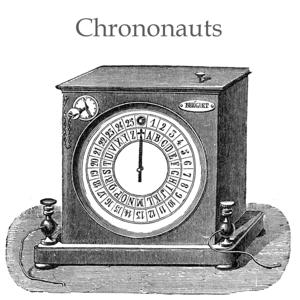
Containing matters related to that Quaternary Dimension, most frequently referred to by Mathematicians and Scholars as Time (though We dare suggest it has other Names in other locations on its own Axis), including transportation by Magickal means, a reflection of the Instrument recursively pushing forward its Influence on the World it Measures, three Journeys encapsulated in vars. Vessels, and concluding with an unfortunate Retraction.
Timestamps:
Introduction, general discussion of time and time travel (0:00)
unknown author(s) - "Urashima Tarō" (8th - 15th c folklore) (35:50)
Edward Page Mitchell - "The Clock that Went Backward" (1881) (51:20)
Enrique Lucio Eugenio Gaspar y Rimbau - "El Anacronópete" (1887) (1:21:43)
H.G. Wells - "The Time Machine" (1895) (2:27:56)
H.G. Wells - "The Chronic Argonauts" (1888) (3:12:39)
Bibliography:
Aldiss, Brian and Wingrove, David. "Trillion Year Spree: The History of Science Fiction". 1986
Gleick, James. "Time Travel: A History". 2016
Main, Michael. Translation of "El Anacronópete". https://www.ittdb.com/fiction/gaspar-el-anacronopete-english.pdf
Molina-Galivan, Yolanda and Bell, Andrea L. Introduction to "The Time Ship: A Chrononautical Journey" Wesleyan University. 2012
Containing several incidents of Selenomania, that partickular Moon Madness which has so captivated the Minds and Pens of Authors since the Ancient Times, including the early works of Messers Verne and Wells, considered by Many to be the Greatest and Most Influential voices in the beginnings of the Science Fiction genre in that excellent nineteenth Century, as well as several shorter Works spanning the scientific and the pseudoscientific, as well as a brief Sketch of that wonderful invention Radio, which we hope does not incense the Appreciators of our Goode Balkan Friend.
Timestamps:
Introduction, Edgar Allan Poe - "The Unparalleled Adventure of One Hans Pfaall" (1835), Richard Locke - "The Great Moon Hoax" (1835) (0:00)
Jules Verne - "From the Earth to the Moon" (1865), "Around the Moon" (1869) (22:44)
H.G. Wells - "The First Men in the Moon" (1901) (1:00:56)
Konstantin Tsiolkovsky - "On the Moon" (1893) (2:19:24)
Bibliography:
Butcher, William. "Jules Verne: The Definitive Biography". 2006
Carlson, Bernard. "Tesla: Inventor of the Electrical Age". 2015
Sherborne, Michael. "H.G. Wells: Another Kind of Life". 2010
White, Thomas H. "Nikola Tesla: The Guy Who DIDN'T 'Invent Radio'". 2012. https://web.archive.org/web/20201002065253/https://earlyradiohistory.us/tesla.htm
Containing discussions of ten individual Stories, represented by Eight authors, concerning three Modes of the Ideal; the First encapsulating Sketches of the Mad Scientist, pursued thither in Grains granulating on the Gradient from the Coarse to the Refined; the Second presenting an Understanding and an Excitement of Sound, Music, Acoustics and Art; and the Third in the preaching of Doomsday in the Russian Orthodox tradition, in which a passionate Defense of the Character of Constance Garnett is offered by one of the Hosts (though Whom at this Time we will not say), which may surprize the Listener.
Timestamps:
The First Steps: The Mad Scientist's Miscellany
Introduction, background on Nathaniel Hawthorne (0:00)
Nathaniel Hawthorne - "Dr. Heidegger's Experiment" (1837) (16:11)
Nathaniel Hawthorne - "Rappacini's Daughter" (1844) (27:16)
E.T.A. Hoffman - "The Sandman" (1816) (46:38)
Fitz-James O'brien - "The Diamond Lens" (1858) (1:18:46)
The Second Steps: Acoustical Resonations
James Davenport Whelpley - "The Atoms of Chladni" (1860) (1:42:55)
Honoré de Balzac - "Gambara" (1837) (2:12:40)
The Third Steps: Russian Doomsday
Semyon Dyachkov - "A Trip to the Moon in a Wonderful Machine With a Description of the Countries There, Customs and Various Rarities" (1844) (2:42:40)
Dmitry Sigov - "Journey to the Sun and the Planet Mercury and All the Visible and Invisible Worlds " (1832), and "The Talk of Moscow Citizens about the Comet of 1832" (1832) (2:55:54)
Vladimir Odoevsky - "The Year 4338: The Petersburg Letters" (3:15:14)
Bibliography:
Boczkowska, Kornelia. "Space exploration in 20th century American and Soviet literature and art". Uniwersytetu im. Adama Mickiewicza w Poznaniu 2015
From the publisher's feed

493 Listeners
409 Listeners
89 Listeners
151 Listeners

201 Listeners
4 Listeners