Sign up to save your podcastsEmail addressPasswordRegisterOrContinue with GoogleAlready have an account? Log in here.
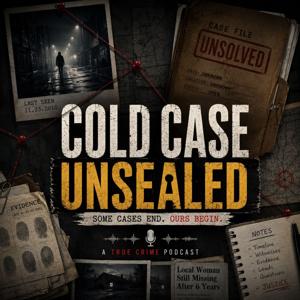
Cold Case Unsealed is a gripping true crime podcast that reopens forgotten investigations, unsolved murders, and mysterious disappearances that never received the answers they deserved. Each episode d... more
FAQs about Cold Case Unsealed:How many episodes does Cold Case Unsealed have?The podcast currently has 259 episodes available.
June 21, 2026SJPD Seeks Public Assistance for 1984 Cold Case HomicideThe episode details the ongoing investigation into the unsolved 1984 homicide of Kelly Ralston, a 21-year-old student and aspiring police officer murdered in her San Jose apartment. Authorities have recently renewed their search for justice by releasing a specific suspect description and highlighting a significant anonymous tip received decades after the crime. The source explores the violent nature of the struggle, the victim's background in martial arts, and the limitations of forensic science at the time of the initial investigation. It emphasizes how modern DNA technology and genetic genealogy offer new hope for identifying the perpetrator forty years later. Ultimately, the narrative serves as a public appeal for information while examining the lasting impact of the cold case on the community and the victim’s family.This episode includes AI-generated content....more41minPlay
June 21, 2026UNH Students, Faculty Help Solve 40-Year-Old Cold Case in New HampshireThis episode details the successful identification of Warren Kuchinsky, whose remains were discovered in the New Hampshire woods in 1986 and remained a mystery for forty years. Through a collaborative effort involving the University of New Hampshire’s FAIR Lab, law enforcement, and the DNA Doe Project, investigators utilized forensic genetic genealogy to finally restore the decedent's name. The narrative emphasizes the vital role of undergraduate students in solving cold cases by applying advanced anthropological techniques to skeletal analysis. Beyond this specific investigation, the source highlights how academic partnerships and modern science provide closure to families while honoring the humanity of unidentified individuals. The FAIR Lab's work serves as a model for blending higher education with public service to resolve long-standing forensic enigmas.This episode includes AI-generated content....more51minPlay
June 21, 2026How an Empty Coffee Cup Solved Lindy Sue Biechler’s Murder 47 Years LaterIn 1975, the brutal murder of 19-year-old Lindy Sue Biechler in Pennsylvania left investigators without a suspect for nearly five decades. The case eventually reached a breakthrough through the use of modern genetic genealogy, which identified David Sinopoli as a person of interest based on his Italian ancestry and proximity to the victim. Detectives surreptitiously obtained the suspect's DNA from a discarded coffee cup at an airport, confirming a match to evidence found at the original crime scene. This forensic link led to Sinopoli’s arrest and subsequent guilty plea in 2022, nearly 47 years after the homicide occurred. The narrative highlights the evolution of forensic technology and the persistent efforts of law enforcement to resolve one of the state's oldest cold cases. Ultimately, the story serves as a testament to how innovation in science can provide long-awaited accountability for victims and their families.This episode includes AI-generated content....more21minPlay
June 21, 20261997 Texas cold case solved after DNA testing leads to arrest in Midland sexual assaultThese sources document the 2026 arrest of James Lee Woodard for a violent 1997 cold case involving a sexual assault at the Midland Park Mall. The breakthrough occurred nearly thirty years after the crime through the application of advanced genetic genealogy and the dedicated efforts of the Texas Rangers’ Sexual Assault Kit Initiative. Investigators successfully linked the suspect to the attack by using modern DNA testing to identify family connections that traditional databases could not find. This resolution highlights the critical role of forensic evolution and inter-agency collaboration in securing justice for survivors long after an incident occurs. Ultimately, the episode illustrates how technological persistence can overcome historical investigative limitations to hold offenders accountable.This episode includes AI-generated content....more39minPlay
June 21, 2026Indiana State Police ramp up cold case investigations with new DNA genealogy teamThe Indiana State Police have established a specialized Forensic Investigative Genetic Genealogy (FIGG) unit to resolve decades-old cold cases by merging advanced DNA technology with traditional family tree research. By securing increased state funding and hiring dedicated experts, the agency can now identify suspects from violent crimes dating back to the 1970s that were previously unsolvable. This innovative approach involves uploading degraded crime scene DNA to consumer databases to locate distant relatives, a method that has already provided final resolution for several families. Beyond making arrests, the program aims to identify unnamed victims and provide a powerful deterrent against future crimes. While the initiative faces ethical and privacy challenges, it represents a significant shift toward using modern science to ensure that justice has no expiration date. Under the leadership of officials and specialized genealogists, Indiana is setting a national standard for forensic innovation and compassionate law enforcement.This episode includes AI-generated content....more48minPlay
June 21, 2026The Golden State Killer and Other Serial Killers Who Mysteriously Stopped MurderingThe episode examines the criminological mystery of serial killers who abruptly cease their violent activities or go into long periods of dormancy. It focuses heavily on Joseph James DeAngelo, the Golden State Killer, who remained undetected for decades until forensic genetic genealogy led to his 2018 arrest. By comparing DeAngelo to other notorious figures like BTK and the Zodiac Killer, the source explores how life changes, psychological substitution through fantasy, and the fear of capture can interrupt a killing cycle. These accounts challenge the popular belief that such offenders cannot stop their behavior without external intervention. Ultimately, the episode highlights how technological advancements are now uncovering the truth behind these cold cases and providing long-awaited justice for victims.This episode includes AI-generated content....more45minPlay
June 20, 2026Rowland Heights Serial Killer Admits Third Slaying and Avoids Death SentenceThe episode details the criminal history and 2009 legal resolution of Wayne Harvey Smith, a serial killer responsible for three murders in California between 1980 and 1985. Through the use of advancing DNA technology, investigators linked Smith to the cold-case killing of Stacy Belcher, leading to a controversial plea bargain that exchanged a death sentence for a confession regarding the disappearance of seven-year-old Donna Fowler. The narrative examines the ethical complexities of such legal deals, emphasizing how prosecutors prioritized providing closure for victims' families over seeking the ultimate punishment. Beyond the legal proceedings, the source offers a humanizing look at the lives of the victims and the enduring trauma experienced by their communities. It also explores the broader evolution of forensic science and the practical challenges of the California death penalty system during this era. Ultimately, the episode serves as a case study on the pursuit of justice and the bittersweet nature of resolving decades-old crimes.This episode includes AI-generated content....more41minPlay
June 20, 2026Emigrant Gap Jane Doe Identified After Nearly 50 YearsThe episode details the 2026 identification of a woman previously known as the "Emigrant Gap Jane Doe," who was discovered murdered in a California snowbank in 1977. Through the persistence of law enforcement and the application of modern genetic genealogy, investigators successfully identified the victim as Melinda “Pip” Beardsley, a mother from Michigan who had been missing for five decades. The sources describe the forensic challenges of the initial 1970s investigation and the collaborative efforts between nonprofit organizations and police that finally linked her DNA to her surviving family. Beyond the scientific breakthrough, the narrative explores Beardsley’s personal history and the societal vulnerabilities that often led to the disappearance of women during that era. While her name has been restored, the homicide investigation remains active as authorities seek to identify the individuals responsible for her death. This account serves as a powerful testament to how advancing technology and dedicated advocacy can provide closure for families of long-unsolved cold cases.This episode includes AI-generated content....more32minPlay
June 20, 2026The Serial Killer Who Evaded Police For 20 YearsThis source details the tragic disappearance of seven-year-old Donna Fowler from her small town in 1980 and the decades-long quest for answers. While her family initially hoped she had simply run away, she had actually fallen victim to Wayne Harvey Smith, a family acquaintance who evaded detection for years. The investigation remained cold until Smith was linked to the brutal murders of two young women in Los Angeles through DNA evidence and eyewitness accounts. Facing the death penalty for his later crimes, Smith eventually confessed to killing Fowler and disposing of her body in a local landfill. This overview highlights the interconnected nature of these cold cases and the ultimate closure provided to the grieving families through a plea agreement.This episode includes AI-generated content....more35minPlay
June 20, 2026Already Convicted Killer Charged in the 1986 Upstate Cold Case Murder of Chelsie Yvonne MossThe episode chronicles the long-awaited resolution of the 1986 homicide of eighteen-year-old Chelsie Yvonne Moss, whose body was discovered in a wooded area of Greenville, South Carolina. After nearly four decades, the Greenville County Sheriff’s Office utilized modern DNA forensic testing to identify and charge Ronnie Lee Williams, a sixty-four-year-old man already serving a life sentence for a separate murder. The sources highlight the critical role of the Cold Case Unit and the evolution of scientific technology in securing justice for victims of historical violence. This breakthrough offers a sense of closure to the family while emphasizing that the passage of time does not grant immunity to perpetrators. Beyond the specifics of the crime, the narrative explores the broader implications of forensic advances and the tireless dedication required to solve cold cases across the country.This episode includes AI-generated content....more34minPlay
FAQs about Cold Case Unsealed:How many episodes does Cold Case Unsealed have?The podcast currently has 259 episodes available.