Cold Case Unsealed

Cold Case Unsealed

By AC WilsonTrue Crime
Download on the App Store

Cold Case Unsealed episodes

  • Detroit Police and Federal Authorities Join Forces in Major Push to Solve Unsolved Missing Person
    Operation United Block represents a significant collaborative effort between the Detroit Police Department and federal agencies to resolve long-standing missing persons cases. This initiative utilizes advanced forensics, K-9 units, and heavy machinery to conduct thorough searches of vacant properties and abandoned sites throughout the city. By expanding upon previous successes in identifying remains through DNA technology, authorities aim to provide closure for families who have spent years in uncertainty. The project highlights the unique challenges posed by urban blight while emphasizing a renewed commitment to investigating cold cases involving vulnerable populations. Ultimately, the sources illustrate a proactive shift in law enforcement strategy, combining community involvement with multi-agency resources to address a deep-seated humanitarian crisis.

    This episode includes AI-generated content.
    38 min
  • Investigators Seek Public’s Help to Identify Woman’s Remains in Refugio Co. Cold Case
    In 1992, construction workers in Refugio County, Texas, discovered the skeletal remains of an unidentified woman who had been fatally shot and hidden in thick brush years earlier. Despite her distinctive attire—including white knee-high boots and a red earring—investigators have struggled for decades to establish her identity or find her killer. Authorities have recently utilized modern forensic tools like updated facial reconstructions and genetic genealogy to generate new leads in this cold case. To encourage public assistance, the Texas Rangers and state officials have increased the monetary reward for information that results in an arrest. This report serves as a call to action, highlighting the persistent challenges of solving homicides in rural areas where evidence often fades over time. Ultimately, the source emphasizes the ongoing commitment of law enforcement to provide justice and a name for this long-forgotten victim.

    This episode includes AI-generated content.
    45 min
  • Secret Motel Killer: Florida Serial Killer Who Targeted Tourists
    These sources detail the harrowing investigations and eventual capture of three distinct serial killers who terrorized different regions of North America. The first narrative follows Florida authorities as they link several bodies found along remote "hog trails" to Daniel Conahan, a sexual sadist who targeted transient men. A second account chronicles the search for a perpetrator near Yosemite National Park, where the brutal murders of four women were eventually traced to motel handyman Cary Stayner. The final segment describes the international manhunt for David Snow, known as the "house hermit," who committed sadistic killings and abductions across Ontario and British Columbia. Together, the episode illustrate how forensic evidence, such as DNA, dental records, and psychological profiling, allowed law enforcement to connect seemingly isolated crimes. These accounts emphasize the critical role of survivor testimony and behavioral patterns in identifying and convicting elusive predators.


    This episode includes AI-generated content.

    59 min
  • The Miranda Project: The Boneyard Murder Investigation
    This source details the harrowing investigation and record-breaking prosecution of serial killers Leonard Lake and Charles Ng. Following Lake's suicide in police custody in 1985, investigators discovered a "killing field" at his remote California cabin containing human remains and evidence of a torture bunker. Law enforcement utilized videotaped evidence and a massive paper trail to link the duo to at least twelve murders, including the disappearances of entire families. Despite Ng's flight to Canada and his persistent efforts to obstruct the American legal system, he was eventually extradited to face justice. The resulting thirteen-year legal battle became the most expensive trial in California history, concluding with Ng's conviction and death sentence. This account highlights the prosecutorial dedication required to solve a complex case spanning over a decade of forensic and international challenges.

    This episode includes AI-generated content.
    59 min
  • 39-Year-Old Murder Case Solved
    The episode details the long-awaited resolution of the 1980 murder of Kathleen O’Brien Doyle, a young Navy wife killed in Norfolk, Virginia. After nearly four decades, investigators utilized DNA evidence and cross-state collaboration to arrest Dennis Lee Bowman, a former Navy Reservist living in Michigan. The sources describe the brutal nature of the crime and the persistent efforts of Detective Jon Smith, whose work eventually linked Bowman to the killing. Beyond the Doyle case, the investigation led to Bowman's confession regarding the 1989 murder of his adopted daughter, Aundria. This narrative highlights the evolution of forensic science and the profound impact of cold case units on providing closure to families. Ultimately, the episode serves as a testament to investigative tenacity and the power of modern technology in holding violent offenders accountable.

    This episode includes AI-generated content.
    21 min
  • Man Pleads Guilty in 35-Year-Old Placer County Cold Case
    This source details the 2026 resolution of a harrowing cold case involving the 1991 kidnapping and murder of Cinthia “Cindy” Wanner in Placer County, California. After vanishing from her sister’s home and being held captive for weeks, Wanner was found dead, leaving behind a grieving family and a 35-year mystery. The investigation finally culminated in a guilty plea from James Lawhead Jr., a repeat sex offender who had been living under an alias in Arizona. Authorities utilized modern DNA technology and genetic genealogy to link Lawhead to the crime, ultimately securing a sentence of life without parole. The episode highlights the persistence of law enforcement and the profound impact of scientific advancements in delivering long-awaited justice for victims of violent crime.

    This episode includes AI-generated content.
    36 min
  • A Sister’s Secret Solves a Cop’s Murder 41 Years Later
    These sources recount two high-profile cold cases where long-held secrets and modern technology finally exposed the truth. The first narrative follows the forty-one-year investigation into the murder of Officer Charles Bernoskie, a case eventually cracked when a relative’s confession and a lone fingerprint on an antifreeze can identified the killers. The second account details the harrowing experience of Jeri Elster, a rape survivor whose quest for justice was initially thwarted by an expired statute of limitations despite a definitive DNA match. Her resilience transformed a personal tragedy into a legislative victory, as she successfully lobbied to change California law regarding forensic evidence. Together, these stories highlight the intersection of persistent detective work, the evolution of forensic science, and the power of victim advocacy in resolving decades-old crimes. Through these examples, the text illustrates how legal loopholes can be closed to ensure that violent offenders are held accountable, regardless of how much time has passed.


    This episode includes AI-generated content.
    49 min
  • 5 Cold Cases Finally Solved With The Most INSANE Twists
    These sources provide detailed accounts of five cold cases that remained a mystery for decades before reaching resolution. The first case describes the 1986 kidnapping of Jessica Gutierrez, where a witness’s description of a "wizard hat" was eventually linked to a cowboy-hat-wearing suspect convicted through fingerprint analysis. Similarly, the 1972 murder of Debbie Randall and the 1987 double homicide of Tanya Van Cuylenborg and Jay Cook were solved through genetic genealogy, a modern forensic technique using public DNA databases to identify relatives of the killers. The 1988 death of Melissa Tremblay also utilized this technology to charge a former prison guard who lived near the crime scene. Finally, the 1966 stabbing of Karen Snider reached a breakthrough in 2024 when a DNA match led to the arrest of a 79-year-old former friend of the family. Together, these narratives highlight how technological advancements and the persistence of investigators can finally deliver justice for victims and their families.


    This episode includes AI-generated content.
    51 min
  • FBI and ATF Partner with Tribal Authorities to Crack Cold Cases
    The episode details Operation Ballistic Backlog, a collaborative law enforcement initiative involving the FBI, ATF, and the Oglala Sioux Tribe to address violent crime on the Pine Ridge Indian Reservation. By utilizing the National Integrated Ballistic Information Network, officials aim to process hundreds of firearms to generate leads for unsolved homicides and cold cases. This effort is part of a broader federal strategy, Operation Steadfast Promise, which seeks to improve public safety in Indigenous communities through increased forensic resources and personnel. The episode highlights the unique jurisdictional challenges and resource disparities facing tribal lands while emphasizing the importance of federal-tribal partnerships. Ultimately, the initiative focuses on providing justice for victims and their families by integrating modern technology with local tribal knowledge.

    This episode includes AI-generated content.
    34 min
  • 40-year-old Virginia cold case finally cracked after new DNA leads to arrest
    In May 2026, authorities finally solved the 1986 cold case involving the brutal murder of Roberta Walls, a young library employee in Virginia Beach. After four decades of mystery, law enforcement arrested Charles Berry, a former Navy sailor, using modern forensic genealogy and advanced DNA testing. The investigation reveals that the victim was randomly attacked and killed while leaving work, a crime that terrorized the local community for years. This breakthrough was made possible through the Virginia Sexual Assault Kit Initiative, which provided the resources to link long-preserved biological evidence to the suspect. The resolution of this case highlights the unwavering persistence of detectives and the transformative power of genetic technology in achieving justice for grieving families. Ultimately, the report serves as a somber reminder of a life cut short and a testament to the fact that criminal accountability has no expiration date.

    This episode includes AI-generated content.
    35 min

About Cold Case Unsealed

From the publisher's feed

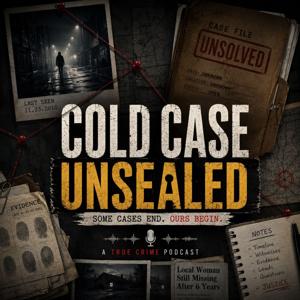
Cold Case Unsealed is a gripping true crime podcast that reopens forgotten investigations, unsolved murders, and mysterious disappearances that never received the answers they deserved. Each episode…