
Sign up to save your podcasts
Or

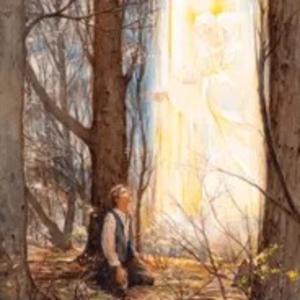


A vision given to Joseph Smith the Prophet, in the temple at Kirtland, Ohio, January 21, 1836. The occasion was the administration of ordinances in preparation for the dedication of the temple.
Doctrine and Covenants 137–138
The revelations recorded in Doctrine and Covenants 137 and 138 are separated by more than 80 years and 1,500 miles (2,400 km). Section 137 was received by the Prophet Joseph Smith in 1836 in the Kirtland Temple, and section 138 was received by Joseph F. Smith, sixth President of the Church, in 1918 in Salt Lake City. But doctrinally, these two visions belong side by side. They both answer questions that many people—including God’s prophets—have about life after death. Joseph Smith wondered about the fate of his brother Alvin, who had died without being baptized. Joseph F. Smith, who had lost both of his parents and 13 children to untimely deaths, thought often about the spirit world and wondered about the preaching of the gospel there.
Section 137 casts some initial light on the destiny of God’s children in the next life, and section 138 opens the curtains even wider. Together, both revelations testify of “the great and wonderful love made manifest by the Father and the Son” (Doctrine and Covenants 138:3).
The word and will of the Lord, given through President Brigham Young at Winter Quarters, the camp of Israel, Omaha Nation, on the west bank of the Missouri River, near Council Bluffs, Iowa.
Announcement of the martyrdom of Joseph Smith the Prophet and his brother, Hyrum Smith the Patriarch, at Carthage, Illinois, June 27, 1844. This document was included at the end of the 1844 edition of the Doctrine and Covenants, which was nearly ready for publication when Joseph and Hyrum Smith were murdered.
Doctrine and Covenants 135–136
The afternoon of June 27, 1844, found Joseph and Hyrum Smith in jail once again, accompanied by John Taylor and Willard Richards. They believed they were innocent of any crime, but they submitted to arrest, hoping to keep the Saints in Nauvoo safe. This wasn’t the first time that enemies of the Church had put the Prophet Joseph in prison, but this time he seemed to know that he would not return alive. He and his friends tried to comfort each other by reading from the Book of Mormon and singing hymns. Then gunshots were heard, and within a few minutes the mortal lives of Joseph Smith and his brother Hyrum had come to an end.
And yet it was not the end of the divine cause they had embraced. And it was not the end of the Restoration of the gospel of Jesus Christ. There was more work to do and more revelation that would guide the Church forward. The end of the Prophet’s life was not the end of the work of God.
See Saints, 1:521–52.
A declaration of belief regarding governments and laws in general, adopted by unanimous vote at a general assembly of the Church held at Kirtland, Ohio, August 17, 1835. Many Saints gathered together to consider the proposed contents of the first edition of the Doctrine and Covenants. At that time, this declaration was given the following preamble: “That our belief with regard to earthly governments and laws in general may not be misinterpreted nor misunderstood, we have thought proper to present, at the close of this volume, our opinion concerning the same.”
Revelation given through Joseph Smith the Prophet, at Hiram, Ohio, November 3, 1831. Prefacing this revelation, Joseph Smith’s history states, “At this time there were many things which the Elders desired to know relative to preaching the Gospel to the inhabitants of the earth, and concerning the gathering; and in order to walk by the true light, and be instructed from on high, on the 3rd of November, 1831, I inquired of the Lord and received the following important revelation.” This section was first added to the book of Doctrine and Covenants as an appendix and was subsequently assigned a section number.
Doctrine and Covenants 133–134
In 1833, mobs attacked and destroyed the Church’s printing press. Among the print jobs in progress at the time was the Book of Commandments—the Church’s first attempt to compile God’s latter-day revelations into one volume. The mob scattered the unbound pages, and although courageous Saints preserved some of them, only a few incomplete copies of the Book of Commandments are known to have survived.
What we now know as section 133 of the Doctrine and Covenants was meant to be the appendix to the Book of Commandments, like an exclamation point at the end of the Lord’s published revelations. It warns of a coming day of judgment and repeats the call found throughout modern revelation: Flee worldliness, as symbolized by Babylon. Build Zion. Prepare for the Second Coming. And spread this message “unto every nation, and kindred, and tongue, and people” (verse 37). The original plans for the Book of Commandments were not fulfilled, but this revelation is a reminder and a witness that the Lord’s work will go forward, “for he shall make bare his holy arm … , and all the ends of the earth shall see the salvation of their God” (verse 3).
Revelation given through Joseph Smith the Prophet, at Nauvoo, Illinois, recorded July 12, 1843, relating to the new and everlasting covenant, including the eternity of the marriage covenant and the principle of plural marriage. Although the revelation was recorded in 1843, evidence indicates that some of the principles involved in this revelation were known by the Prophet as early as 1831. See Official Declaration 1.
Instructions by Joseph Smith the Prophet, given at Ramus, Illinois, May 16 and 17, 1843.
From the publisher's feed