
Sign up to save your podcasts
Or

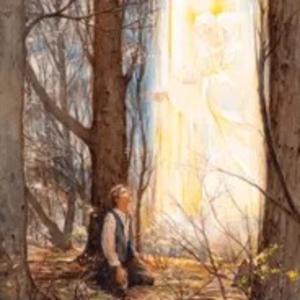


Below are the words of Latter-day Saints who were in the Kirtland Temple during its dedication and in other meetings that followed. Many compared their experiences to what the ancient Saints experienced when they were “endued with power from on high” on the day of Pentecost (Luke 24:49; see also Acts 2:1–4; Doctrine and Covenants 109:36–37).
Visions manifested to Joseph Smith the Prophet and Oliver Cowdery in the temple at Kirtland, Ohio, April 3, 1836. The occasion was that of a Sabbath day meeting. Joseph Smith’s history states: “In the afternoon, I assisted the other Presidents in distributing the Lord’s Supper to the Church, receiving it from the Twelve, whose privilege it was to officiate at the sacred desk this day. After having performed this service to my brethren, I retired to the pulpit, the veils being dropped, and bowed myself, with Oliver Cowdery, in solemn and silent prayer. After rising from prayer, the following vision was opened to both of us.”
Prayer offered at the dedication of the temple at Kirtland, Ohio, March 27, 1836. According to the Prophet’s written statement, this prayer was given to him by revelation.
Doctrine and Covenants 109–110
The doors to the Kirtland Temple weren’t supposed to open until eight o’clock on the morning of March 27, 1836. But Saints who were hoping to attend the dedication services started lining up as early as seven. An overflow location and then a second session were needed to accommodate everyone. And it wasn’t just the living who were eager to be present. Multiple witnesses saw angels inside the temple and even on the roof, during and after the dedication. It really did seem that “the armies of heaven” had come to “sing and [to] shout” with the Latter-day Saints (“The Spirit of God,” Hymns, no. 2).
Why the great excitement—on both sides of the veil? After centuries, there was a house of the Lord again on the earth. The Lord was fulfilling His promise to endow His Saints “with power from on high” (Doctrine and Covenants 38:32). And this, He declared, was only “the beginning of the blessing” (Doctrine and Covenants 110:10). The era we now live in—with accelerated temple work and ordinances available to millions of the living and the dead—had its beginning in Kirtland, when “the veil o’er the earth [was] beginning to burst” (“The Spirit of God”).
See also Saints, 1:232–41; “A House for Our God,” in Revelations in Context, 169–72.
Revelation given through Joseph Smith the Prophet, at Kirtland, Ohio, December 26, 1835. This section was received at the request of Lyman Sherman, who had previously been ordained a seventy and who had come to the Prophet with a request for a revelation to make known his duty.
Revelation on the priesthood, given through Joseph Smith the Prophet, at Kirtland, Ohio, about April 1835. Although this section was recorded in 1835, the historical records affirm that most of verses 60 through 100 incorporate a revelation given through Joseph Smith on November 11, 1831. This section was associated with the organization of the Quorum of the Twelve in February and March 1835. The Prophet likely delivered it in the presence of those who were preparing to depart May 3, 1835, on their first quorum mission.
Revelation given through Joseph Smith the Prophet, at Kirtland, Ohio, November 25, 1834. This revelation is directed to Warren A. Cowdery, an older brother of Oliver Cowdery.
Doctrine and Covenants 106–108
At first glance, Doctrine and Covenants 107 seems to be only about organizing priesthood offices into a leadership structure for the Lord’s Church. By the time this revelation was published, Church membership was outgrowing the capacity of the few leaders it had in place. Outlining the roles and responsibilities of the First Presidency, the Quorum of the Twelve Apostles, the Seventy, bishops, and quorum presidencies was definitely needed and helpful. But there’s so much more to the divine instruction in section 107 than just how Church leadership should be organized. Here, the Lord teaches us about His power and authority, “the Holy Priesthood, after the Order of the Son of God” (verse 3). The purpose of the priesthood is to unlock “all the spiritual blessings of the church” so that all of God’s children can “have the heavens opened unto them” and “enjoy the communion and presence of God the Father, and Jesus the mediator of the new covenant” (verses 18–19). In teaching us about His priesthood, the Savior is teaching us about Himself and how we can come unto Him.
See “Restoring the Ancient Order,” in Revelations in Context, 208–12.
Because Zion’s Camp never restored the Saints to their lands in Jackson County, many people felt that their endeavor was a failure. However, many participants of Zion’s Camp looked back on their experience and saw how the Lord fulfilled a higher purpose in their lives and in His kingdom. Here are some of their testimonies.
Revelation given through Joseph Smith the Prophet, on Fishing River, Missouri, June 22, 1834. Under the leadership of the Prophet, Saints from Ohio and other areas marched to Missouri in an expedition later known as Zion’s Camp. Their purpose was to escort the expelled Missouri Saints back to their lands in Jackson County. Missourians who had previously persecuted the Saints feared retaliation from Zion’s Camp and preemptively attacked some Saints living in Clay County, Missouri. After the Missouri governor withdrew his promise to support the Saints, Joseph Smith received this revelation.
From the publisher's feed