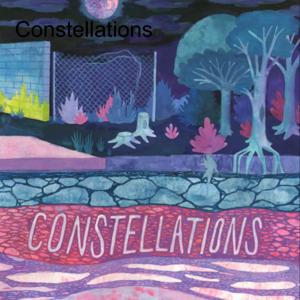
Constellations

Constellations

By ConstellationsArts
Download on the App Store

Constellations episodes

  • BROOD
    BROOD was composed by RUTMEAT.
    RUTMEAT writes:
    This work was created by singing with feedback, using effects pedals, playing cymbals with beadwork and some field recordings. April 30th is when I pulled "the sun, it sets on the empire" through my body by using my voice in this way. The words are from a work by Dzawada'enuxw artist, Marianne Nicholson, who has consented to me referencing her 2017 work, The Sun is Setting on the British Empire. I want to talk about the blockades that were in Vancouver this winter in support of Wet'suwet'en hereditary chiefs (law and governance system that is older than what is now known as Canada). I want to talk about ongoing colonial violence, genocide and hope. About Black and Indigenous communities showing up for each other and demanding more than performative allyship from yt and POC settlers. Talk about how resource extraction always brings ripples of violence. I want to talk about how a generation of Indigenous youth called to shut Canada down and then covid struck. I want to talk about labour that is expected of Indigenous femme presenting people to educate those around them. And I will, with my communities. 
    In the words of Ta'kaiya Blaney, "We are the land protecting itself."
    ~~~~~~~~~~~~~~
    This work was supported by constellations' 2019 Indigenous Sound Art Fundraiser.
    18 min
  • FEEL THE SKY Side B ~ The Burdened Land
    For the first episode of Constellations’ 2020 season, we present FEEL THE SKY, a duo of sound works in conversation composed by JAYE KRANZ (Australia) and MYRA AL-RAHIM (USA). Both extend from the same starting point – a recording from 1992 made by a news reporter unfamiliar with field recording, but entranced by a chance encounter with trumpeter swans on an icy lake. Originally recorded on cassette, Constellations digitized the material and commissioned Kranz and Al-Rahim to compose their own landscapes – both real and imagined – in response. Take an interior road trip in “Are We There Yet” (Kranz), a journey across interior ecologies and mountain peaks. Then venture into “The Burdened Land” (Al-Rahim), a sprawling whorl that considers borders from the perspective of migratory bodies that cannot be contained within them.
    Both works take inspiration from field recordings by HEATHER EVANS on the ancestral and traditional territories of the HAISLA NATION.
    From the mind of Myra Al-Rahim:
    When I began developing “The Burdened Land”, I knew I wanted to create an environmentally-conscious piece, though not in the traditional sense of the term. I wanted the work to have a distinct feeling of space and scale. I sought to explore the thematic interconnectedness between the migratory paths of birds and the sprawling supply chains of capital. Heather's original tape appears close to the beginning of my piece and continues throughout Act 1. I imagined she was taking a new journey through the sonic landscape I created for her to explore.
    18 min
  • FEEL THE SKY Side A ~ Are We There Yet?
    For the first episode of Constellations’ 2020 season, we present FEEL THE SKY, a duo of sound works in conversation composed by JAYE KRANZ (Australia) and MYRA AL-RAHIM (USA). Both extend from the same starting point – a recording from 1992 made by a news reporter unfamiliar with field recording, but entranced by a chance encounter with trumpeter swans on an icy lake. Originally recorded on cassette, Constellations digitized the material and commissioned Kranz and Al-Rahim to compose their own landscapes – both real and imagined – in response. Take an interior road trip in “Are We There Yet” (Kranz), a journey across interior ecologies and mountain peaks. Then venture into “The Burdened Land” (Al-Rahim), a sprawling whorl that considers borders from the perspective of migratory bodies that cannot be contained within them.
    Both works take inspiration from field recordings by HEATHER EVANS on the ancestral and traditional territories of the HAISLA NATION.
    From the mind of Jaye Kranz:
    “Are We There Yet?”  is a strange, recurring road-trip towards home. A home we can never really find or retrieve; while at the same time, being a home we have already found: the one that is already ours. Like a circular roadmap for finding our way there. We hear the same driving tape over and over, but we move through different landscapes, across vast spans of time and place, in a dreamscape where the laws of separation and structure, boundary and contour, do not apply.
    18 min
  • Constellations 2020 is HERE
    Hello, Constellations is returning to your feeds with a delicious new season of audio oddities, soul-filled sounds and feed fucking. We can’t wait for you to hear what we’ve been up to.
    We’re throwing a (n online) party to celebrate our launch, THIS Friday, May 22 at 8:00pm EST / Saturday, May 23 at 10:00am AEST. It’s an intimate listening party and in-conversation with the artists behind our first physical release FEEL THE SKY. Tickets and more info here: https://www.facebook.com/events/836823783469230
    And we’re back on your feeds NEXT WEEK, Friday May 29th, so keep an ear out for us then.
    Constellations~
    FEED YOUR EARS
    2 min
  • RESONANT BODIES [the exhibition]
    Step inside the world of Resonant Bodies with this special hour-long episode that takes you piece-by-piece through the exhibition. Follow your ears through the ambient sounds of the gallery and stop off at each piece. Read alongside with the piece descriptions below.
    [00:24-09:02] Aliya Pabani, Singing on the Line
    Aliya Pabani goes to a vocal coach to look into the extent of her vocal cord damage, and the contours of the voice she has left. Originally constructed as a four-channel audio installation, this piece played back on four speakers fabricated from four balloons.
    [09:02-19:56] Jon Tjhia, Thing-Like
    How is a business phone call like a folk song or jazz standard? How much are non-words, and part-words, involved in how we communicate? Is it possible to speak into the void; to use our voices to communicate nothing at all?
    In Thing-Like, Jon Tjhia has created a suite of 'exercises' – basically analogous to piano études, or studies, for edited sound works. Taking Walter Ong's preoccupations with the 'immersive' and vital nature of oral culture as a point of departure, these pieces tease and critique the heavy burden of speech and its value: as social currency, blunt instrument, monetary resource and point of connection.
    This collection of short works is composed for speakers – inviting, intrusive, implicating the passer-by; and headphones – individual, interior. Traditional interviews, aimless conversations, paid celebrity dedications, forgotten sing-alongs, free improvisations, custom voice synthesis and chance murmurs become material for a process that is both informal and entirely formal. Speakers’ words are manipulated (‘say that again, but opposite’); license agreements are breached. While Ong argues that thought and expression have been fundamentally reconfigured by the technology of writing; Thing-Like suggests ways in which voice and speech have been reconfigured by the technology of money and how it structures time.
    [19:56-30:40] Kaija Siirala, Hamina, Finland
    “Where is the Cloud located on Earth?” Reflecting on the disembodied lexicon of virtual space, Kaija Siirala’s Hamina, Finland situates listeners at an unexpected nexus between digital and physical gathering places: the Hamina sauna. A relic of a retrofitted paper mill, this sauna is an employee perk at the Hamina Google data center in Southern Finland. Uniquely, seawater is channeled here to cool Google’s vast, active server bodies. Simultaneously, human bodies in the neighbouring sauna heat up after a day of work. The piece considers the often-obscured physical consequences of virtual activity by mapping it onto a visceral sauna experience.
    A watery world emerges through a whispered choir of google search histories, including Siirala’s own Hamina sauna research. Sauna is a central component of Finnish culture and is a lifelong practice Siirala inherited from her family. Her field recordings from these times together — sounds of breath, camaraderie, eruptions of laughter — underscore the piece.
    When water is tossed onto the rocks atop the stove, the löyly — steam in Finnish — mounts the heat to an intolerable crescendo forcing participants out of the sauna and into the same cold sea cooling the Google servers. Löyly shares the same etymological root as the Finnish word for “spirit”.
    [30:40-41:17] Cheldon Paterson, Transport Station
    Forests, rain, traffic — all seem to sound louder in the dark of night. For sighted people, hearing is the center point of attention only when visual input is absent or unclear. Cheldon Paterson’s Transport Station, composed as an audiovisual diptych plays with this tendency through spatial isolation of the audio and visual components of the work, so that they can be experienced both together and apart.
    In video form, Paterson’s audio comes first, setting up hearing as the primary mode of perceiving one’s environment. Listeners hear field recordings from urban and natural environments that have been twisted and turned on themselves through turntablism and sampling. The second half of the piece is accompanied by video, which employs the kaleidoscope as a visual metaphor for how the transformation of familiar sounds affects the imagination.
    While the interaction of sight and sound is usually clarifying to the senses, Paterson’s approach refracts memory and imagination, forcing the viewer-listener to succumb to the current of sensual input or become an active participant in meaning-making.
    [41:17-49:51] Chandra Melting Tallow, Protect Me From My Protector
    In her critique of romantic love, bell hooks writes, “This illusion, perpetuated by so much romantic lore, stands in the way of our learning how to love. To sustain our fantasy, we substitute romance for love.” In Protect Me From My Protector, Chandra Melting Tallow pierces the fantasy of romance to reveal the sharp, tense and dark edges of harm within intimate partner relationships. Dropping us into the emotional inner world of the artist, this work explores the intensity, confusion, and disorientation of living within the confines of abuse, including the cycles of trauma and cognitive dissonance that occur when one’s protector is simultaneously inflicting harm.
    The piece extends past personal relationships to confront power relations, particularly between the state as a protectorate and marginalized communities. When these communities are depicted as irrational and hysterical, the state reasserts power to remove their agency. As a result of such abuses of power, the world is heard and experienced differently by marginalized communities, so that music that once signaled romance can be recast as a tool of manipulation.
    [49:51-57:48] Phoebe Wang, Isn’t it lovely?
    Stepping inside Isn’t it lovely?, Phoebe Wang asks the audience to leave the known territory and comfort of the white-walled gallery space to become immersed in an isolated environment. Here, sights and sounds of walls, carpets, speech and din create a faux-warmth that is at once invasive and curious. The listener then must subject themselves to the sounds that enter their ears.
    The fragments of recorded memories that make up Isn’t it lovely? hover over meaning, never landing solidly. As the audio progresses, Wang prompts and engages in a series of conversations that attempt to ask, “why choose to keep going in a world that is not built for you?”
    In Isn’t it lovely?, Wang constructs a refuge of sorts – yet the systems and histories she seeks to evade or emancipate herself from continue to be felt here, too.
    *******************************************************
    Resonant Bodies began as an exhibition in Toronto Canada. In Toronto, we’re situated within the ‘Dish with One Spoon Territory’ on the ancestral and traditional territories of the Anishnaabe, the Haudenosaunee, the Huron-Wendat First Nations, and the Mississaguas of the Credit First Nations. We acknowledge Canada’s First Peoples as the original inhabitants and storytellers of this land, and we pay respects to their ongoing storytelling traditions.
    Resonant Bodies was curated and produced by Aliya Pabani, Michelle Macklem and Jess Shane. Audio mixed by Michelle Macklem. Graphics designed by Jess Shane.
    The artists are: Aliya Pabani, Jon Tjhia, Kaija Siirala, Cheldon Paterson, Chandra Melting Tallow and Phoebe Wang.
    Resonant Bodies received exhibition support from many generous people and organizations. Thank you to Henry Faber, Jennie Robinson, Mitchell Akiyama, Amita Kirpalani, Braden Labonte, Liam Coo, Matthew Kariatsumari, Frank Green, Evan Cartwright, Robin Luckwaldt, Mitch Trachter, and Yuula Benivolski. 
    Special thanks to the terrific folks at the Toronto Media Arts Centre for partnering with us and making this event possible. Thanks also to community partner Charles Street Video.
    Resonant Bodies was supported by the Toronto Arts Council and the Ontario Arts Council.

    1 hr 1 min
  • Phoebe Wang ~ Isn't it lovely?
    Stepping inside Isn’t it lovely?, Phoebe Wang asks the audience to leave the known territory and comfort of the white-walled gallery space to become immersed in an isolated environment. Here, sights and sounds of walls, carpets, speech and din create a faux-warmth that is at once invasive and curious. The listener then must subject themselves to the sounds that enter their ears.
    The fragments of recorded memories that make up Isn’t it lovely? hover over meaning, never landing solidly. As the audio progresses, Wang prompts and engages in a series of conversations that attempt to ask, “why choose to keep going in a world that is not built for you?”
    In Isn’t it lovely?, Wang constructs a refuge of sorts – yet the systems and histories she seeks to evade or emancipate herself from continue to be felt here, too.
    13 min
  • Chandra Melting Tallow ~ Protect Me From My Protector

    In her critique of romantic love, bell hooks writes, “This illusion, perpetuated by so much romantic lore, stands in the way of our learning how to love. To sustain our fantasy, we substitute romance for love.” In Protect Me From My Protector, Chandra Melting Tallow pierces the fantasy of romance to reveal the sharp, tense and dark edges of harm within intimate partner relationships. Dropping us into the emotional inner world of the artist, this work explores the intensity, confusion, and disorientation of living within the confines of abuse, including the cycles of trauma and cognitive dissonance that occur when one’s protector is simultaneously inflicting harm.

    The piece extends past personal relationships to confront power relations, particularly between the state as a protectorate and marginalized communities. When these communities are depicted as irrational and hysterical, the state reasserts power to remove their agency. As a result of such abuses of power, the world is heard and experienced differently by marginalized communities, so that music that once signaled romance can be recast as a tool of manipulation.

    20 min
  • Cheldon Paterson ~ Transport Station
    Forests, rain, traffic — all seem to sound louder in the dark of night. For sighted people, hearing is the center point of attention only when visual input is absent or unclear. Cheldon Paterson’s Transport Station, composed as an audiovisual diptych (though is also released via podcast as audio-only) plays with this tendency through spatial isolation of the audio and visual components of the work, so that they can be experienced both together and apart.
    In video form, Paterson’s audio comes first, setting up hearing as the primary mode of perceiving one’s environment. Listeners hear field recordings from urban and natural environments that have been twisted and turned on themselves through turntablism and sampling. The second half of the piece is accompanied by video, which employs the kaleidoscope as a visual metaphor for how the transformation of familiar sounds affects the imagination.
    While the interaction of sight and sound is usually clarifying to the senses, Paterson’s approach refracts memory and imagination, forcing the viewer-listener to succumb to the current of sensual input or become an active participant in meaning-making.
    15 min
  • Kaija Siirala ~ Hamina, Finland
    “Where is the Cloud located on Earth?” Reflecting on the disembodied lexicon of virtual space, Kaija Siirala’s Hamina, Finland situates listeners at an unexpected nexus between digital and physical gathering places: the Hamina sauna. A relic of a retrofitted paper mill, this sauna is an employee perk at the Hamina Google data center in Southern Finland. Uniquely, seawater is channeled here to cool Google’s vast, active server bodies. Simultaneously, human bodies in the neighbouring sauna heat up after a day of work. The piece considers the often-obscured physical consequences of virtual activity by mapping it onto a visceral sauna experience.
    A watery world emerges through a whispered choir of google search histories, including Siirala’s own Hamina sauna research. Sauna is a central component of Finnish culture and is a lifelong practice Siirala inherited from her family. Her field recordings from these times together — sounds of breath, camaraderie, eruptions of laughter — underscore the piece.
    When water is tossed onto the rocks atop the stove, the löyly — steam in Finnish — mounts the heat to an intolerable crescendo forcing participants out of the sauna and into the same cold sea cooling the Google servers. Löyly shares the same etymological root as the Finnish word for “spirit”.
    21 min

About Constellations

From the publisher's feed

A community of listeners, investigating the world through sound.