
Sign up to save your podcasts
Or

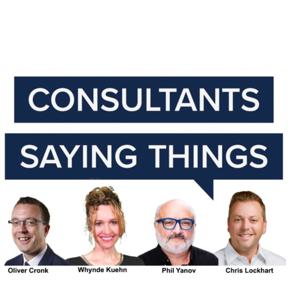


The knock on consulting is that so much of what goes on is either a bunch of fluff and hand-waving at a stratospheric, impractical level or narrowly focused on mostly useless technical gee-wizardry with little connection to actual business need. How do you connect strategy to reality?
Luckily there's a new book that takes dead aim at this issue and serves as a practical guide to developing strategy that delivers real-world value. And even more luckily, the author is one of our own...
"Strategy to Reality: Making the Impossible Possible for Business Architects, Change Makers and Strategy Execution Leaders" by our own Whynde Kuehn is practical, digestible, and evergreen. She applies decades of knowledge and experience in what works and what doesn't and lays out a prescriptive plan for matching vision with delivery.
We wanted to sit down with her and discuss the book, how consultants can apply the knowledge within for their clients, and how leaders in industry can use it as a guide for change.
In this episode:
Hit up Amazon right now and get her book. It's an easy read with so much useful stuff that you'll definitely want a highlighter handy.
Add your thoughts to the conversation on LinkedIn or YouTube.
You can also like and subscribe on the YouTube Channel (and you should!)
Being mentally resilient in the face of everything the world throws at us can be daunting. Whether it's work, family, friends, international politics... there's a lot of stress on us every day. How is a person supposed to deal? (Psst: I have the answer...).
Okay. I personally don't have the answer. But I'm lucky to know some folks that are certified experts in this area.
You may recall in the last episode of the podcast, Phil, Oliver, Whynde and myself discussed our experiences with mental resiliency over our careers. Frankly this amounted to personal anecdotes and clever observations. None of us are actual experts in mental health (which should be obvious to anyone who watches).
Enter a couple of friends of ours: Dr. Haley Dare and Gavin Richardson of https://www.neurequity.com/. Hayley is a Chartered Consultant Clinical Psychologist with over 25 years’ professional experience and Gavin has extensive experience in designing and implementing transformational workplace mental health initiatives to enhance employee engagement and organizational performance. It turns out that they're ACTUAL experts in this space. Through their work, they help companies around the world ensure their employee's mental wellbeing.
We brought them on to discuss mental resiliency, this time through the lens of professionals.
In this episode:
You're not gonna want to miss this one... It should be said that if you are in real need of help due to stress or other mental health issues, don't listen to this podcast. Go out and get the help you need. YOU are the asset. Protect it!
Add your thoughts to the conversation on LinkedIn or YouTube.
You can also like and subscribe on the YouTube Channel (and you should!)
Work can be hard. It can be stressful. Consulting in particular is full of A-Types who work long, busy hours trying to help in often frustrating client situations. What if you break?
Each person's ability to handle things is different, with some having deeper mental capacity buckets than others. At some point, however, most people have experienced that bucket filling up and overflowing.
What happens when you run so hot for so long that you start to burn out? More importantly, how do you bounce back? How resilient can you be? How far can you stretch that stress rubber band without snapping it?
I wanted to chat about this with my smart friends. Of course, while none of us is a medical professional (and mental health should be taken very seriously), we had some thoughts and anecdotes to share around how to be more mentally resilient.
In this episode:
Add your thoughts to the conversation on LinkedIn or YouTube.
You can also like and subscribe on the YouTube Channel (and you should!)
What is an architect? What is architecture? In the business technology context, is architecture a profession? What do architects do? A quick Google search reveals an endless debate on these topics that's been raging for several decades. Let's add more fuel to that fire and stir that pot...
This episode is the third in a mashup series on this topic that began with an episode of IASA Global's "The Argument" podcast hosted by Paul Preiss (https://youtu.be/A6Bli8FYXz0) and continued in an episode of the "Architect Tomorrow" podcast hosted by Oliver Cronk (https://youtu.be/e6Q5y2o6JWU). Check these out as they each have a thematic take on architecture!
While I enjoy a good endless debate with smart people, I wanted to focus on the topic of Architecture through the lens of Consulting. Joining me is Phil Yanov, Oliver Cronk, Whynde Kuehn and Chris Potts. Chris is an internationally recognized enterprise architect and mentor for small and large businesses across industries. He's also the author of a number of business novels about change called The FruITion Triology (https://technicspub.com/the-fruition-series/).
In this episode:
This episode represents the third entry in the Podcast Mashup series representing the following totally awesome podcasts:
Architect Tomorrow - https://youtube.com/ArchitectTomorrow/ Business Architecture Straight Talk https://bit.ly/st-podcasts https://bizarchmastery.com/straighttalk
You can also like and subscribe on the YouTube Channel (and you should!)
Four years ago a friend told me that since I had so much to say about business and technology topics that I should go make a podcast. In retrospect I think he just wanted me to quit bothering him. Joke's on him. I had him join the cast.
50 Episodes later, we've talked to dozens of people on many different topics... all related to how we as consultants can leverage our experience and knowledge to help deliver value to our clients.
We've tried to make the discussions topical, meaningful and most of all, practical. Knowledge isn't particularly helpful if you have no realistic way to use it. Keeping things useful for the cat on the ground has always been important to us.
We've had quite a lot of fun over the years and debated a variety of really interesting subjects. But what we enjoyed was not always what you, the viewers, found to be most helpful.
For this 50th Episode, we wanted to see exactly which episodes where the most viewed on the Youtube channel, on the website consultantssayingthings.com and most listened to via the myriad audio-only services. We've pulled out clips from these Top 5 shows and put them together in one episode.
In descending order, the episodes are:
1) The One About Agile Being Bullshit
2) The One About Business Architecture
3) The One About Consulting 4.0
4) The One About PMO
5) The One About Ethics in Consulting
Keep in mind there are another 45 episodes out there that we think are ALSO pretty good. But these ones are the Top 5.
There's new footage here that never made it into the final edits of the respective episodes. We also begin Episode 50 with what has been almost universally identified as the best cold open of the series to date...
Thanks for continuing to watch.
Add your thoughts to the conversation on LinkedIn or YouTube.
You can also like and subscribe on the YouTube Channel (and you should!)
The work environment can be tough. It is often political and tiresome and exhausting. The work week can be a tough slog. However... the workplace can often be very funny. Or at least, worthy of mockery and parody.
We set about trying to lighten the mood by taking a look at various tropes and memes about work in general and consulting in particular. The jokes are many and can often be NSFW.
We selected a number of memes off of Instagram and discussed them, had a laugh, and tried to decipher whether there was any merit to the meme. Are they true? Are they exaggeration? Are they simply myth?
I'm joined by Phil Yanov, Oliver Cronk and Whynde Kuehn.
In this episode:
Add your thoughts to the conversation on LinkedIn or YouTube.
You can also like and subscribe on the YouTube Channel (and you should!)
In the battle for talent, how do you identify people who are likely to exhibit the qualities you want? How do you do the same with your existing employees? Assessments? Reviews? Rorschach Tests?
Many of us have been part of organizations that sought to understand the strengths and weaknesses of their staff by utilizing personality tests and skill assessments. They've been around for a long time. In fact, the first modern personality test was applied by the US Army in the early 1900s to identify soldiers that may be susceptible to shell shock.
Fast-forward a hundred years and a quick Google search reveals the dozens of tests, frameworks, metamodels, questionnaires, and the like, which all purport to assist people in understanding each other.
Whether it is Myers-Briggs, DISC, True Colors, 16PF, Winslow Personality Test, PCM, the Five Factor Model or any of a few dozen other tests and assessments, the question I had was simple: is any of this useful?
Along with Oliver Cronk, Whynde Kuehn and special guest Andrew Tanner, we delve into that question and attempt to see how practitioners or consultancies might apply the various models.
Andrew is an Organization Development and Change expert who's practiced in the field for over 20 years through his firm, Summerhill Consulting, and is currently the head of Learning and Development for PCF Bank in the UK.
In this episode:
Add your thoughts to the conversation on LinkedIn or YouTube.
You can also like and subscribe on the YouTube Channel (and you should!)
We all know smart people. They often have smart plans and smart designs. Sometimes fancy shoes. But the smartest plan or design is totally useless if it can't be explained to another human being.
As humans, how do we share information in ways that convey our ideas, thoughts, intents, moods, histories? We tell stories. Sometimes the story is visual and can be anything from cave paintings to maps to plays to diagrams to art. Other times it is audio and involves music or oral histories. It can even be as simple as the written words or spreadsheets of data.
The point of storytelling is to communicate. It is how we take simple or complex thoughts and share them with other people. It is how we lead people to see our vision. It is how we plant a flag, define a 'north star' or rally a nation to defend itself against impossible odds.
Storytelling is a core competency for consultants. If you can't narrate, you can't explain your code, your architecture, your business strategy. It is central to what we do as consultants.
I wanted to talk more about this with my smart friends. I also happen to think there is a great example of the "power of narrative" playing out in front of our eyes on the world stage.
In this episode:
Add your thoughts to the conversation on LinkedIn or YouTube.
You can also like and subscribe on the YouTube Channel (and you should!)
There is often a tendency for companies to prioritize action and delivery over planning and analysis. More "Deliver the widgets!" and less "What does our company actually do?"
This can be seen in places where decision making is driven by technology and timelines instead of desired business outcomes, where the "How" and "When" is obsessed over while the "Why" is practically forgotten.
But friends! It doesn't have to be this way!
In the world of effective Business Architecture, understanding the "Why" actually enables and accelerates the "How" and the "When". In other words, if people on Project XYZ actually see and understand what the company does, why it does it, what business problem is being solved by their project and how the thing they're delivering helps move the entire enterprise toward its goals... well... things go faster, smoother, cheaper and end up better for everyone.
My 100,000-foot view sounds easy. To dig into the right level of detail and understand Business Architecture, how it works and what it can really do, I turned to my smart friends Whynde Kuehn, Oliver Cronk and Phil Yanov.
(By the way, Whynde is a globally recognized expert, consultant and educator in this space. A quick peek at her LinkedIn profile will give you the scoop...)
In this Episode:
Add your thoughts to the conversation on LinkedIn or YouTube.
You can also like and subscribe on the YouTube Channel (and you should!)
Well. 2021 is finally over. Did you learn anything? Will you do anything different with your career in 2022? If not now, then when?
For our annual Christmas Special, we wanted to chat about careers in consulting. Not just for folks thinking of maybe entering the field, but also for those who are in consulting and thinking of a lateral change and ALSO those contemplating an exit from consulting.
To help with that conversation, we brought in some folks we know that are living or have lived different aspects of the consulting lifestyle and had some insight to share. After all, the four of us don't know EVERYTHING there is to know about the topic. Hear some great insights from Joel McCreight, Brian Lindner, Max Kanaskar, Ian Liang and special guest star, Shashi Shrimali.
But we also thought it would be cool to invite folks to watch us record the session live via Zoom and YouTube and get their questions answered.
In this special Christmas episode:
Add your thoughts to the conversation on LinkedIn or YouTube.
You can also like and subscribe on the YouTube Channel (and you should!)
From the publisher's feed