
Sign up to save your podcasts
Or

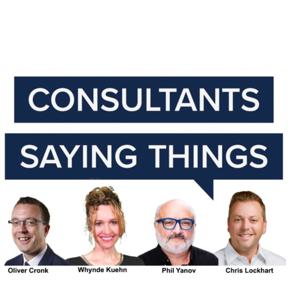


In our connected world of technology, the ways in which we engage with businesses and clients can have a big impact. And as we've seen with the ways in which our public and private data is used by companies like Meta, not all impacts are positive. Some are downright manipulative.
How does a company or an employee or a consultant working with a client know how to operate with transparency and integrity? We know that certain industries have regulations that define what is acceptable and compel compliance (law, medicine, accounting). There are also voluntary standards and practices established by working groups and business consortiums that can serve as guides to ethical behavior.
However, many industries and especially many different forms of consulting lack clearly articulated and codified ethical rules. Is it right or wrong to give or receive bribes (or dinners, or gifts) as part of doing business? Where are the guardrails in fudging timesheets? Is it okay to use user-data, given voluntarily or not, to target ads or shape opinion or manipulate thought? Even if these things are done for 'good' purposes or without ill intent?
Beyond employees or corporate entities, there is an opportunity for those of us who advise and solve problems for our clients to be better Philosopher-Consultants and operate with virtue and integrity.
But ethics can be complex issues, often culturally specific and rarely black or white. Tough scene for consultants to navigate. So I asked my friends Phil Yanov, Oliver Cronk, and Whynde Kuehn to chat with me about it.
In this episode:
Add your thoughts to the conversation on LinkedIn or YouTube.
You can also like and subscribe on the YouTube Channel (and you should!)
Consultants often help clients think about complex problems with few easy answers. There are almost always trade-offs to be made, regulations to follow, expenses to incur all while trying to run a business and make a profit.
One of the most complex issues involving tough decisions is around how best to utilize business (or national) resources in a manner that ensures the business (or nation) can continue to grow and thrive in a way that doesn't negatively impact everyone else.
Are you an oil company looking at how you'll be in business in 40 years if no one is buying gasoline or oil-based plastics? What alternative product lines should you be looking at?
Are you a search-engine giant that uses more electricity than some countries to power your data centers? How do you supply that business need without causing brownouts? Solar? Wind? Fusion?
Are you a Northeastern Pennsylvania-based mid-size paper company that uses a lot of trees? Perhaps finding a way to make your product from fast-growing varieties like bamboo instead of old-growth oak is a good way to ensure your business can continue to make product into the future.
Decisions... some forced by the State, some forced by shareholders, others just good business planning, others perhaps totally altruistic. Sounds like an opportunity for a consultant looking to make a difference.
I gathered my friends to discuss Sustainability and opportunities in that space. Along with Oliver Cronk, Whynde Kuehn and Phil Yanov, I was joined by Jonathan Gibbard who is a Business Unit Director for Sustainable Infrastructure & Operations at Ricardo Energy & Environment in the UK.
In this Episode:
Add your thoughts to the conversation on LinkedIn or YouTube.
You can also like and subscribe on the YouTube Channel (and you should!)
If I were to only read my LinkedIn feed, I'd think every industry is being disrupted all the time, every day...
Certainly a search for "future of consulting" yields plenty of opinion along with thought pieces about new business models and such. Many of these results are a bit frenzied, foreboding and filled with gloom about AI and Gen Z taking over consulting.
I'm not sure exactly what the future of consulting looks like. So I asked my friends, Phil Yanov, Whynde Kuehn and Oliver Cronk to give me their thoughts on the subject.
In this episode:
Add your thoughts to the conversation on LinkedIn or YouTube.
You can also like and subscribe on the YouTube Channel (and you should!)
Is it The Great Rebalance? The Great Reshuffle? The Great Resignation? The Great Discontent? To read about it, companies are really struggling to find workers these days. Clearly there aren't enough people that want to work.
We think that's just a load of codswallop. There was a recent LinkedIn News story about the consulting boom/bust job cycle that caught my eye. The story said that 2 in 3 consulting firms are short-staffed and 1 in 5 have to turn down work as a result. More than half said that recruiting and retention have become much harder this year.
I wondered, is this because the firms didn't forecast demand correctly? Were they spooked by COVID and didn't plan recruiting properly? We know labor force participation in the US is declining... are consultants just dropping out of the workforce? Are people doing their own entrepreneurial thing?
I wanted the input of my smart friends Phil Yanov, Whynde Kuehn and Oliver Cronk.
In this episode:
Add your thoughts to the conversation on LinkedIn or YouTube.
You can also like and subscribe on the YouTube Channel (and you should!)
The model entrepreneur gets up one morning with a great idea, quits their job and boldly strikes out on their own... single-handedly building a great company from nothing, attracting flocks of clients, finding happiness and peace of mind and easily striking it rich. Modern-day gold rush.
Except that's false. Like... totally false. All of it.
So many misconceptions of what entrepreneurship is about, especially among consultants who think that's a great exit strategy someday. I called up my long-time friend Adam Anderson for a chat.
Adam is the kind of cat who has started and run several of his own companies, gone from Founder to CEO a few times and helps others do the same, been entrepreneurship scholar-in-residence at two major Universities, sits on multiple startup boards, hangs out with Richard Branson and is currently trying to figure out how to make moonshine in space... among other things.
I gotta tell you, it was a fantastic conversation. I mean, this is just pure gold.
In this episode:
Add your thoughts to the conversation on LinkedIn or YouTube.
You can also like and subscribe on the YouTube Channel (and you should!)
Consulting may be an old profession (the second oldest?) but no one can argue that it hasn't undergone tremendous change over the past 20 years.
It makes sense, after all. Consulting reflects the business technology challenges and opportunities that clients are experiencing. And there's been incredible business technology change in the recent decades.
Which begs the question, what is it like being a young consultant of Millennial or Gen Z upbringing?
For insight I turned to my smart friends and a smart, young consultant, Ian Liang, with whom I've worked in the past. Ian has been a consultant for a Big 4 firm, worked in market strategy at Uber and is currently in Strategy and Analytics at a media firm in Los Angeles. He may also be scarred for life having worked on my teams in the past.
In this episode:
Add your thoughts to the conversation on LinkedIn or YouTube.
You can also like and subscribe on the YouTube Channel (and you should!)
I used to think that if I could just clone myself a few times I might have the most perfect team and we'd produce the most perfect slides...
Aside from that likely being a disaster, I used to think that's how mentorship worked. I mentor or coach someone to do things in the method of whatever firm we were working for so that I had more arms and legs to do work for clients.
Luckily I learned better.
It isn't about the firm or the client or even the work. It's about individual growth of both the mentor and the mentee.
I wanted to explore the concept of mentorship with some of my smart friends. So I sat down with Phil Yanov, Whynde Kuehn and Oliver Cronk.
In this Episode:
Add your thoughts to the conversation on LinkedIn or YouTube.
You can also like and subscribe on the YouTube Channel (and you should!)
Well it looks like things are getting back to normal. Everyone should just go back to doing things like they did prior to Covid. All will be as it was…
Or not. As the case may be.
Have you heard the predictions for an imminent return to normalcy? Are you excited by the prospect of everyone working the 9-5, Monday thru Friday grind in the old cubicle just like before? Isn’t every consultant thrilled about the notion of going back to that 4am Monday flight to Peoria or Altoona or Wichita to sit in a conference room, face lit by the soft glow of PowerPoint slides and Excel formulas until that late Thursday flight home?
What does the looming return to work portend for business, for clients, for consultants?
I decided to ask my friends for their input on the matter. Joining me is Phil Yanov, Whynde Kuehn and Oliver Cronk.
In this Episode:
Add your thoughts to the conversation on LinkedIn or YouTube.
You can also like and subscribe on the YouTube Channel (and you should!)
Welp. Glad this year's over. Perfect time to pour a drink, to be honest.
It's also a perfect time for the third annual Christmas episode of the Consultants Saying Things podcast! It's great filler for that hole in spacetime between Christmas and New Year's.
Join the full crew of Consultants Saying Things as we look forward to 2021 and what it holds in store for the consulting industry.
We answer questions from LinkedIn and do it with a bit of liquid holiday cheer! And also we have some very special guests!
Joining us:
That wraps season 3 of the podcast. 36 episodes in the 30-90 minute range over the past 3 years. If you have a second, please subscribe.
We'll see you in 2021. Enjoy!
Add your thoughts to the conversation on LinkedIn, Twitter or YouTube.
You can also like and subscribe on the YouTube Channel (and you should!)
It's been a rough year. Companies have downsized and a maybe you've lost your job. You've sent out dozens or hundreds of resumes, worked your network. What now?
Consultants are maybe more used to searching for the next gig, but even for them, times are tough. And for the companies that panicked earlier in 2020 and let go of all of that talent, intellectual capital and institutional knowledge, how on earth do you find the skills needed to power your 2021 plans?
It somehow seems that in a market chock full of talent that can't find gigs, companies can't find anyone to fill their needs.
Enter professional executive recruiters. These are people who's entire life is spent understanding companies and the skills they need, developing relationships over time with talent in the market and playing matchmaker between the two.
To talk about this, I brought in my friend Brent Stokes from Bluesignal. In our conversation:
Add your thoughts to the conversation on LinkedIn, Twitter or YouTube.
You can also like and subscribe on the YouTube Channel (and you should!)
From the publisher's feed