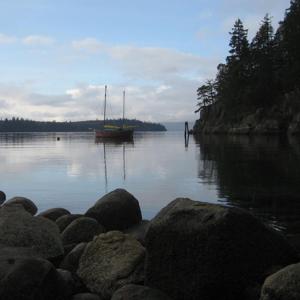
Roy L Hales/ Cortes Currents - Local naturalist George Sirk was sick for Cortes Island’s Spring Bird Count earlier this month, so bird watchers had to rely on a new app to help them identify species. This new app, called Merlin, is one of many topics that he and Nancy Kendel, from the Cortes Island Museum, discussed with Cortes Currents.
The conversation started out with Kendel (NK) giving an overview:
“For quite a number of years, the museum has sponsored two bird counts every year. In December and early January, we co-host with Bird Studies Canada, the Christmas Bird Count, where groups of people spread out around the island and count the actual numbers of birds that they see, as well as recording the species.”
“The Spring Migration Birding Event happens the first Saturday of May and usually includes the day before and the day after. This year the count was on May 7th and included birds spotted on the 6th and the 8th.”
“This birding event has a slightly different purpose. We only count species that we have observed, and it gives birders the opportunity to spend time together, share information and their knowledge with each other. We encourage families and interested novices to birding, to join us. They may pick up some tricks on identifying certain species of birds.”
“The Christmas Bird Count has been happening on the island since 2001, and the Spring birding event has been going since 2004.”
“Birding is a really fun thing to do. George Sirk actually encouraged me to help organize the first Christmas Bird Count. It was one of the most fun things that I had been doing during the whole year, getting out for the day with other people and seeing the birds. Kudos to George for getting this going even way back then.”
To which George Sirk (GS) responded, “I just want to point out that it's just great that the museum takes on the task of organizing the event and then later tabulating all the data and then putting it all on the museum website. Everybody can look at all the different species that have been recorded in the Spring.
“I just wanted to talk a little bit about the ebb and flow of the birds of Cortes.
“All the ducks are in Manson's Lagoon or off of Smelt Bay, or in Squirrel Cove or Whaletown in the wintertime, because ducks from up north come down here. They overwinter here because the area's so rich for food. Sometimes there are over 500 Surf Scoters in the Gorge. There are huge numbers of birds. They're well recorded and documented in the Christmas bird count.”
“Over 95% of them leave here and they go to their nesting territories way up in northern BC, Alaska, and the Yukon.”
“A few of those winter birds stay over because they're probably non-breeding birds, takes 'em a couple of years to mature. They hang around here. So when the museum plans the bird count in the first week in May, they're actually catching the tail end of the wintering birds. They're around in small numbers.”
“The museum's also catching the migration coming up from the Neotropics, from Central America, South America, the birds that come here in the summertime. So a completely different group of birds. Most of them are forest birds. They're still coming every day or every couple of days.”
“Barn swallows weren't on the count in the 6th of May, but John Sprungman got them a week later because the Barn swallow has to come from Argentina, that's a long flight. Not all of them come from there, but that is one of the longest migrations of any of our land birds.”
“Our Wax wings, Western wood pewee and Olive-sided fly catcher have not yet arrived. They come a little later, and of course the last one to arrive is the Nighthawk on the 7th or so of June. It does not like any cold weather. They come here and they're the first to leave in September.”
“That's the ebb and flow of the two groups of birds. And then the third group we have here are the residents. Pileated woodpecker, Varied thrushes, Song sparrows. They're here year round.”