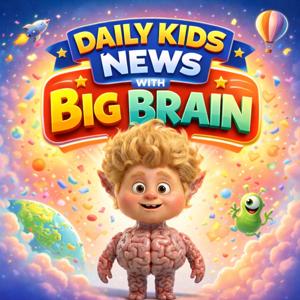
Daily News for Kids with Big Brain

Daily News for Kids with Big Brain

Download on the App Store

Daily News for Kids with Big Brain episodes

  • Big Brain News Ep. 32: Space Snacks, New Art Rooms, and Cherry Blossom Magic
    Episode 32 helps kids connect big projects to teamwork and planning—whether it’s sending supplies to astronauts, building better spaces for art, or getting ready for springtime events.
    What we cover:
    • Space deliveries: What cargo spacecraft bring to the International Space Station (food, tools, fuel, spare parts) and how docking works (matching speed and connecting gently).
    • Museum expansion: Why extra gallery space matters, and how museums protect art with thoughtful lighting, temperature control, and strong display systems.
    • Cherry blossoms: How trees use environmental clues (sunlight and temperature) to time buds and blooms—and how to do a “blossom hunt” anywhere.
    Parent/Teacher Corner:
    Use these stories to talk about planning, roles on a team, and how science and creativity both require careful thinking.
    Discussion Questions:
    1) If you could send one helpful item to astronauts on the space station, what would it be and why?
    2) What’s your favorite way to notice spring changing—flowers, weather, animals, or something else?
    Classroom-friendly extension ideas:
    • Draw a “space supply list” and label each item with its job.
    • Design a mini museum map with 3 rooms (quiet room, big sculpture room, video room).
    • Observe a local tree for one week: buds, petals, leaves, and weather notes.
    6 min
  • Big Brain News Ep. 31: Spring Sunbeams, Space Rockets, and Movie Magic for Earth!
    Episode 31 — March 20, 2026
    Today’s stories (for curious kids and the grown-ups who guide them):
    1) Spring Arrives: The Equinox Is a Sky “Balance Point”
    • What an equinox is: the Sun lines up over Earth’s equator
    • Why people say “equal day and night” (close to equal, not perfect everywhere)
    • Why the date can shift between March 19–21 (calendar math + leap years)
    2) A Giant Rocket Did a “Static Fire” Test in Texas
    • What “static fire” means: engines ignite briefly while the rocket stays clamped down
    • What engineers look for: fuel flow, timing, temperatures, pressures, sensor readings
    • Safety reminder: rocket testing is done by trained teams behind safety fences
    3) Environmental Film Festival Brings Nature Stories to the Big Screen
    • How films can zoom in on details we might miss in everyday life
    • How festivals spark questions about science, sound, and filming locations
    • At-home idea: treat your neighborhood like a living documentary
    Parent/Teacher Corner:
    These stories support curiosity and “explain it back” practice. Invite your child to retell one story using their own examples.
    Discussion questions:
    • What signs of spring can you spot outside this week?
    • If you made a movie about nature, what would you film first?
    6 min
  • Big Brain News Ep. 30: Solar Blanket Spacewalks, Spring Flower Rivers, and a Satellite Internet Swarm!
    In Episode 30, Big Brain guides kids through three short, educational stories that connect science, culture, and technology.
    Story 1 — Spacewalk upgrades: Two NASA astronauts performed a spacewalk to prepare the International Space Station for new roll-out solar panels. These panels unroll like a “solar blanket” to provide more electricity—supporting experiments and everyday systems onboard.
    Story 2 — Spring festival & community art: Valencia, Spain’s Las Fallas includes a Flower Offering where participants place bouquets to create a large, mosaic-like floral display. This tradition is connected to Catholic religious life (the Virgin Mary), offering a respectful chance to discuss faith traditions and world culture.
    Story 3 — Satellites & connection: Starlink has reached about 10,000 active satellites in orbit. The episode explains, in kid-friendly terms, how satellites can relay internet signals to places where cables are hard to reach.
    Discussion Questions (Home or Classroom):
    1) If you could add one helpful gadget to the space station, what would it do?
    2) What’s a celebration or tradition your family likes, and what does it remind you of?
    Keywords: spacewalk, ISS, solar power, festivals, Valencia, flowers, mosaics, satellites, internet, STEM.
    Big Brain News is designed to be calm, safe, and shareable—made for kids and trusted by parents and teachers.
    6 min
  • Big Brain News Ep. 29: Buzzer-Beaters, Green Parades, and Helpful Robots
    Episode 29 (March 18, 2026) | Big Brain News
    In this episode (3 stories):
    1) March Madness begins — We explain single-elimination brackets and highlight teamwork and sportsmanship.
    2) Dublin’s St. Patrick’s Festival — A geography-friendly look at Ireland, plus how music, dance, and parades share culture.
    3) Robots and safety standards — Why robots need clear rules to work safely around people, and how they can help with deliveries and guiding visitors in hospitals.
    Parent/Teacher Corner (quick classroom or dinner-table connections):
    • Teamwork & communication: How do teammates signal and support each other?
    • Rules & fairness: Compare game rules to robot safety standards.
    • Geography: Find Indianapolis (USA) and Dublin (Ireland) on a map; talk about why people gather in certain places.
    Discussion Questions:
    • What’s one rule that helps a game (or a robot) stay safe and fair?
    • If you could invent a helpful robot for your school, what job would it do?
    Designed to be calm, constructive, and safe to share at home or in the classroom.
    7 min
  • Big Brain News Ep. 29: Buzzer-Beaters, Green Parades, and Helpful Robots
    Big Brain News Episode 29
    1. March Madness Begins: One Game, One Chance
    2. Dublin Turns Festive for St. Patrick’s Festival
    3. Robots Learn Safety Rules and Help in Hospitals
    Discussion questions:
    - What’s one rule that helps a game (or a robot) stay safe and fair?
    - If you could invent a helpful robot for your school, what job would it do?
    7 min
  • Big Brain News Ep. 28: Space Internet, Sparkly Movies, and a Giant Culture Party!
    Episode 28 (03/16/2026) — Big Brain News
    Today’s kid-friendly stories:
    1) Space internet and satellites: We explain how satellites in orbit (a “smooth racetrack in the sky”) can help send internet signals to places where laying lots of cables is difficult.
    2) The Oscars: A simple look at how movies are made by big teams—costumes, music, sound, and special effects—plus why creative jobs matter.
    3) Honolulu Festival turns 30: How festivals help communities share traditions through performances, parades, and music.
    Parent/Teacher Corner tip:
    • If your child wonders what an orbit is, compare it to a smooth racetrack around Earth.
    Conversation starters:
    • If you could win an award for making a movie, what would your movie be about?
    • What’s one way technology helps people who live far from big cities?
    Made for kids ages 5–9, and for parents/teachers who want safe, constructive current-events learning.
    6 min
  • Big Brain News Ep. 27: Dragonfly on Titan and a Sideways-V of Stars!
    Big Brain News Episode 27
    1. NASA Builds Dragonfly: A Flying Robot for Titan
    2. Find the Hyades: A Sideways ‘V’ of Stars
    3. Indoor Track & Field: Fast Feet, Big Jumps, and Team Relays
    Discussion questions:
    - If you could send a robot to any planet or moon, where would you send it and what would it look for?
    - What’s one skill you’d like to practice a little each week, like athletes do?
    7 min
  • Big Brain News Ep. 26: Space X-Rays, Super-Design Cities, and Weather That Can’t Decide
    Episode 26 (2026-03-14)
    Story 1: NASA Pauses a New X-Ray Space Telescope Idea
    • What happened: NASA stopped planning the proposed AXIS mission.
    • Kid-friendly takeaway: Big science missions must meet requirements—like a careful, super-sized school project.
    • Vocabulary: X-ray light (invisible light), telescope, mission requirements.
    Story 2: Tokyo Turns Into a Giant Design and Art Playground
    • What happened: Tokyo Creative Salon 2026 (Mar 13–22) spreads design and art across multiple neighborhoods.
    • Kid-friendly takeaway: Design isn’t only decoration—it’s problem-solving with materials, shapes, and smart choices.
    • Classroom/home connection: Notice everyday design (zippers, packaging, maps).
    Story 3: U.S. Weather Does Different Things at the Same Time
    • What happened: Different regions may see snow near the Great Lakes, strong heat in the Southwest, and heavy rain in Hawaii.
    • Kid-friendly takeaway: Air masses (big areas of warm/cold air) move and interact, creating different conditions.
    • Family safety habit (non-scary): Check local forecasts and pick the right gear.
    Parent/Teacher Corner
    These stories are great for talking about how science projects get reviewed, how art festivals work, and how weather can differ across a big country. If weather comes up, focus on planning and everyday safety habits (like checking forecasts) rather than worrying.
    Discussion Questions
    1) If you could invent a space telescope, what would you want it to discover?
    2) What’s a helpful routine your family uses when the weather changes a lot?
    6 min
  • Big Brain News Ep. 25: Magnetar Engines, Space Delivery Trucks, and the No-Waste Challenge!
    Episode 25 (2026-03-13)
    What’s inside:
    1) Superluminous supernovae + magnetars
    - Kid-friendly idea: A magnetar is a super-dense leftover star with an extremely strong magnetic field.
    - Key concept: Scientists use computer models to test whether a spinning magnetar could feed energy into the expanding supernova debris, creating a predictable “rise and fall” brightness pattern.
    - Why it connects to learning: Star life cycles help explain where many elements (like iron and oxygen) come from.
    2) Space delivery to the ISS (Cygnus)
    - Kid-friendly idea: Cargo spacecraft are like careful delivery trucks in orbit.
    - Key concept: Undocking means safely unhooking and slowly drifting away, using planning and precise controls.
    - Why it connects to learning: Systems + teamwork keep a space lab running—supplies in, experiments on, unneeded items out.
    3) Circular economy + textiles
    - Kid-friendly idea: A circular economy keeps materials moving through reuse, repair, and recycling.
    - Key concept: Some recycling is tricky (like mixed fabrics), so improved sorting and processing tools matter.
    - Classroom/home link: Focus on progress, not perfection—choose one item to repair, reuse, or donate.
    Parent/Teacher Corner: Systems thinking
    Try a simple “how it works” chain for each story:
    - Inputs → steps → tools → teamwork → results
    Discussion questions:
    • What’s one thing in our home we could reuse or repair instead of throwing away?
    • If you could send one helpful item to astronauts on the space station, what would it be and why?

    6 min
  • Big Brain News Ep. 24: Space Ribbons, Backward Planets, and Bird Super-Highways
    Episode 24 (2026-03-12)
    Today’s stories (kid-friendly science news):
    1) Space science: Astronomers used the Very Large Telescope to spot a ribbon-like cloud of gas near Sagittarius A*, the supermassive black hole at the center of the Milky Way. Key idea: we learn about black holes by observing nearby matter and motion.
    2) Skywatching: Jupiter’s “retrograde motion” is an optical viewpoint effect. Key idea: Earth’s faster orbit changes what we see against the background stars.
    3) Nature & conservation: Thousands of acres protected along the South Carolina coast can support migrating birds by preserving marsh and wetland habitat. Key idea: healthy wetlands can also help people by soaking up rainwater and supporting cleaner water.
    Parent/Teacher Corner:
    • Try a simple stargazing plan: pick one night this week to look for Jupiter (if visible in your area) and notice how it sits among the stars.
    • Connect conservation to home: talk about one local park, creek, or green space that helps animals—and how taking care of it helps the whole community.
    • Keep it wonder-filled; no need to track space details minute by minute.
    Discussion questions:
    • If you could protect one place in nature near your home, what would it be and why?
    • What’s one thing in the night sky you want to learn to spot this month?
    5 min

About Daily News for Kids with Big Brain

From the publisher's feed

Big Brain is your kid’s curiosity buddy, turning yesterday’s real-world stories into a fun, safe 4–6 minute daily show.