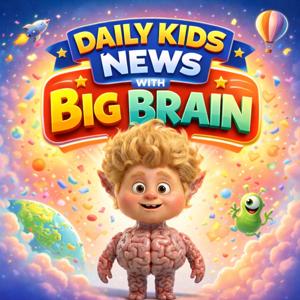
Daily News for Kids with Big Brain

Daily News for Kids with Big Brain

Download on the App Store

Daily News for Kids with Big Brain episodes

  • Big Brain News Ep. 14: Robot Cameras, Red Moons, and Books That Welcome Everyone
    Big Brain News — Episode 14 (March 2, 2026)
    What we cover:
    1) Robot camera phones (kid-friendly tech)
    • A concept phone with a camera that can tilt and rotate using a tiny motor.
    • Gimbal stabilization: like a smooth balancing platform that helps cancel hand wiggles.
    • Subject tracking: software that follows the person you choose.
    • Digital citizenship note for kids: ask an adult before posting, don’t share personal info, and get permission before filming others.
    2) Sky science: Total lunar eclipse (March 2–3, 2026)
    • What’s happening: Earth moves between the Sun and Moon, and Earth’s shadow slides across the Moon.
    • Why it can look copper-red: sunlight bends through Earth’s air, which filters the light so warmer colors reach the Moon.
    • Family tip: Lunar eclipses are safe to watch with your eyes—no special glasses needed.
    • Practical plan: pick a safe viewing spot and time, watch with a trusted adult, and treat clouds as a normal part of sky-watching.
    3) Reading and belonging: Inclusive Books for Children Awards
    • Celebrates UK-published books for ages ~1–9 with main characters from a range of backgrounds and life experiences.
    • Includes accessibility-aware books (example: braille—raised dots read with fingertips).
    • Classroom/home connection: stories can build empathy and help kids feel they belong.
    Discussion questions (great for classrooms and family dinner):
    • If you could invent a phone tool to help with one daily problem, what would it do?
    • What makes a story feel like it includes you and your friends?
    Mini activity:
    • At the library, choose one book that feels familiar and one that helps you learn about a different life experience.

    6 min
  • Big Brain News Ep. 13: Moon Magic, Animal Selfies, and Nature Helper Projects
    Big Brain News — Episode 13 (03/01/2026)
    What we cover:
    • Space science: The Moon “hides” Mercury (a lunar occultation). We explain the word occultation and how the Moon’s orbit makes these events happen quickly.
    • Nature + art + science: The 2026 World Nature Photography Awards. We discuss patience, timing, focus, and framing—and how images can build empathy for wildlife.
    • Communities helping nature: California funding for habitat projects, including wildlife crossings and efforts that support salmon in rivers and streams.
    Try it at home/classroom:
    • “Sky check”: Step outside and look for the Moon. Ask: Does it look still? How do we know it’s moving?
    • “Photo scientist” walk: On a park or schoolyard walk, practice noticing details (shapes, colors, animal behavior) without approaching or disturbing wildlife.
    • Design challenge: Draw a wildlife crossing for a local road (bridge or tunnel). What animals might use it?
    Discussion Questions:
    1) If you could take one nature photo, what animal or plant would you hope to catch on camera?
    2) What’s one thing humans could build to help animals travel safely where we live?
    6 min
  • Big Brain News Ep. 12: Space Delivery, Two-Light Galaxies, and Art in an Airport!
    Episode 12 (2026-02-27) — Big Brain News
    Stories in this episode:
    1) SpaceX Dragon brings science home
    • Dragon leaves the International Space Station carrying over 5,000 pounds of supplies and research.
    • Kid-friendly science idea: the ISS stays in orbit with motion and occasional gentle boosts.
    • Classroom/home connection: talk about microgravity and how scientists compare “before” and “after” experiments.
    2) One galaxy, two kinds of light
    • Hubble shows visible (and some ultraviolet) light; James Webb shows infrared.
    • Comparing images can reveal different details, especially where dust is present and where stars may be forming.
    • Vocabulary to try: visible light, infrared, telescope, dust, galaxy.
    3) Frieze Los Angeles at the Santa Monica Airport
    • An art fair is like a large show-and-tell for galleries and artists.
    • Big spaces (like airports) can fit large artworks and sculptures.
    • Social-emotional learning tie-in: art can communicate ideas without a single “right” answer.
    Parent/Teacher Corner prompt:
    • Invite children to draw what they imagine: a space station, a telescope view in different light, or an airport filled with art.
    Discussion Questions:
    • If you could send one experiment to the space station, what would you test and why?
    • Why do scientists like to look at the same object in different kinds of light?
    6 min
  • Big Brain News Ep. 11: Mars Maps, Mystery Fish, and a House Full of Ideas!
    Big Brain News Episode 11
    1. Perseverance Rover Gets “Super Directions” on Mars
    2. Meet the Bumpy Snailfish: A New Deep-Sea Neighbor
    3. A Real-Life “House of Ideas” Opens in Florida
    Discussion questions:
    - If you could design one room in a “show house,” what theme would you pick and why?
    - How do robots help humans explore places that are too hard to visit?
    6 min
  • Big Brain News Ep. 10: Coral Giants, Sky Glow, and a Reusable Rocket Ride
    Big Brain News — Episode 10 (2026-02-25)
    Today’s learning goals (great for classrooms + car rides):
    • How scientists collect evidence: photos, measurements, and models
    • Earth & space connections: the Sun, Earth’s magnetic field, and auroras
    • Engineering design: why reusing rocket parts can save materials and time
    Stories:
    1) Coral Giants: A huge coral colony on the Great Barrier Reef
    • Key idea: coral is made of tiny animals (polyps)
    • Science tool: many photos → a 3D model to measure and study
    • Why it matters: healthy reefs can provide shelter for many ocean animals
    2) Northern Lights: The sky’s glow paint
    • Key idea: Sun particles + Earth’s magnetic field + upper atmosphere = aurora colors
    • Try it (with a grown-up): look from a dark, safe place and give eyes time to adjust
    3) Reusable Rocket Ride: A twilight Falcon 9 launch and a ship landing
    • Key idea: satellites orbit Earth to support communication
    • Engineering idea: reusable boosters are like a reusable water bottle vs. a one-time juice box
    Parent/Teacher Corner (safety + confidence):
    If stargazing, always go with a grown-up, dress warm, bring a flashlight (red mode helps protect night vision), choose a safe open area away from roads and water, and make sure you’re not on private property.
    Discussion questions:
    • If you could explore the ocean or space for one day, which would you pick and why?
    • What’s one way people can help scientists learn more about nature?
    5 min
  • Big Brain News Ep. 9: Moon Chemistry, Super-Bees, and a Sneaky-Healthy Chocolate Cloud
    In this episode (kid-safe, classroom-friendly):
    1) Jupiter’s giant moons & early chemistry
    • Scientists use computer simulations to model the swirling disk of gas and ice around young Jupiter.
    • In that environment, simple elements can combine into more complex organic molecules.
    • Key idea for kids: “building blocks” in space don’t guarantee life—but they give scientists good questions to explore.
    2) Beekeepers helping a rare dark honeybee
    • Bees pollinate plants, helping flowers become fruits and seeds.
    • Queen bees mate during special flights; too much mixing can make rare types harder to protect.
    • Beekeepers plan controlled “wedding flight” events to support healthy future generations.
    3) Silken chocolate mousse & heart-smart swaps
    • This mousse gets its creamy texture from silken tofu (made from soybeans).
    • Kid-friendly food science: blending traps air for fluffiness; chilling changes texture.
    Parent/Teacher Corner prompt:
    These stories connect to three big themes: exploring space with science tools, caring for ecosystems, and making small, practical food choices.
    Discussion Questions:
    • If you could send a robot to one of Jupiter’s moons, what tools should it bring and why?
    • What’s one small thing our family could do this week to help pollinators like bees?
    6 min
  • Big Brain News Ep. 8: Shadow Selfies, Spotted Quolls, and Sweet Potato Science!
    In this episode, we explore three curiosity-building stories designed for families and classrooms.
    Story 1: Mars rover “shadow selfie”
    • What a rover shadow can show about where it’s exploring
    • What craters are, and why rock layers inside them help scientists study Mars
    • How rover missions look for clues about Mars’ watery past
    Story 2: A rare northern quoll on a trail camera (Australia)
    • What a northern quoll is (a small marsupial)
    • How motion-sensing trail cameras work without bothering animals
    • How sightings help scientists understand and protect habitats
    Story 3: Cook a Sweet Potato Day (food science)
    • Sweet potatoes as storage roots (plants store energy underground)
    • How heat can change starches into sugars during baking/roasting
    • A simple observation game: notice changes in color, smell, and texture
    Parent/Teacher Corner
    These stories support conversations about how scientists observe the world (robot missions and field cameras) and how food connects to plant growth and energy.
    Discussion Questions
    1) If you could send a robot anywhere to take pictures, where would you send it and why?
    2) What’s one new way you’d like to try cooking a sweet potato, and what do you think it would taste like?
    6 min
  • Big Brain News Ep. 7: Gold Medals, Gentle Museums, and a Rocket That’s Rehearsing
    Big Brain News — Episode 7 (02/22/2026)
    What we cover:
    • Winter Olympics teamwork: Team USA earns its 11th gold medal of the Games in freeski mixed team aerials, setting a new U.S. Winter Olympics gold-medal record.
    • Sensory-friendly museums: The Museum of the Moving Image in NYC hosts “Access Mornings,” offering a calmer, less-crowded time designed especially for children on the autism spectrum.
    • Space practice: Firefly Aerospace prepares for another Alpha rocket test mission (planned no earlier than 02/27/2026), highlighting how engineers test, learn, and try again.
    Key words (kid-friendly):
    • Team event: People take turns and combine scores.
    • Sensory-friendly: Adjusting lights, sounds, and crowding to help visitors feel comfortable.
    • Reliable: Working the same safe way again and again.
    • Satellite: A machine that travels around Earth in space.
    Parent/Teacher Corner:
    Use these stories to discuss practice, planning, and designing spaces that work for many different needs.
    Discussion questions:
    1) What’s one place you’d like to be quieter or less crowded, and how could we make that happen?
    2) When something doesn’t work the first time, what helps you try again?
    7 min
  • Big Brain News Ep. 6: Rockets, Tortoises, and a Brand-New Art Playground
    Episode 6 (2026-02-21) — Calm, classroom-ready news for kids ages 5–9.
    What’s inside:
    1) Space & Engineering: Falcon 9 launches satellites, then the booster lands on a drone ship so it can be reused. Key idea: engineers plan, test, and improve designs to save resources.
    2) Nature & Conservation: Young Floreana giant tortoises return to Floreana Island after disappearing in the 1800s. Key idea: breeding programs and habitat restoration can help ecosystems recover.
    3) Art & Community: The Wang Contemporary opens in NYC’s Chinatown during Lunar New Year, featuring performances and red-envelope-inspired paper planes. Key idea: art spaces can be “playgrounds for the brain” that bring people together.
    Parent/Teacher Corner:
    Use these stories to talk about problem-solving—how people plan carefully, test ideas, and work as a team.
    Discussion Questions:
    • If you could reuse one thing in the world like a rocket booster, what would it be and why?
    • How can art or nature projects help a neighborhood or an island feel more “alive”?
    Keywords: reuse, engineering, satellites, Galápagos, conservation, ecosystems, Lunar New Year, community arts.
    6 min
  • Big Brain News Ep. 5: Mars Weather, Spring Festivals, and Fish Road Trips!
    In Episode 5, Big Brain News explores:
    1) Nature teamwork in the Northeast
    • Why some fish migrate between rivers and the ocean
    • How fixing barriers (like old dams and culverts) can help fish travel
    • How protecting habitats supports grassland birds and golden-winged warblers
    2) Nowruz (Persian New Year) and welcoming spring
    • Nowruz as a celebration of new beginnings
    • What kids might do at a family festival: storytelling + hands-on activities
    • The haft-seen table and how symbols can represent hopes for the year
    3) Mars science with the UAE’s Hope Probe
    • What it means to “orbit” a planet
    • Mars’ atmosphere and how it connects to weather
    • Why long-term observing helps scientists find patterns
    Parent/Teacher Corner:
    Use these stories to discuss how communities help nature, and how cultural celebrations bring families together with traditions, art, and meaning. If your child enjoys the festival story, consider finding a local spring event to attend together.
    Discussion Questions:
    • If you could design a “wildlife helper” for one animal, what would it be and how would it work?
    • What is one spring tradition your family likes, and what new tradition could you try?
    7 min

About Daily News for Kids with Big Brain

From the publisher's feed

Big Brain is your kid’s curiosity buddy, turning yesterday’s real-world stories into a fun, safe 4–6 minute daily show.