
Sign up to save your podcasts
Or



An old leather-bound ledger: 2,151 entries. Not addiction, not rebellion—obedience. Father’s curriculum: drink more, dominate more, fuck more. Mother’s footnote: women are cold, rejecting, prefer absence. The formula set early—masculinity as consumption plus domination, divided by her disappointed silence. Every encounter a chemical shout against the void she left and the cage he built: I am here. See my damage? It proves I am a man.
Hidden column: the men. Grip on the neck, proving “you’re my bitch”—purest execution of the script. Connection was never intimacy; it was a weapon, a fortress of flesh where he could be alone inside someone and never found wanting. Thirty-four years clean, recovery didn’t erase the math—it exhausted the bodies. The numbers stopped adding up to a feeling, only fatigue. With 2,151 amends impossible, the honest report: the damage isn’t something he did. It’s what he is—built from their equation, performing an autopsy on the monster only to find the blueprint in his own hands.
A man fresh out of prison justifies five years for beating the lover of his partner—“If I don’t do something, the boys’ll think I’m weak.” In the car after an NA meeting, the narrator challenges the cost of that instinct, but the lesson doesn’t land. Weeks later, reading about enslaved children sold away triggers a darker thought: if someone ever threatened to “sell” his own ten-year-old daughter, he’d do whatever it took—even decades in a cage.
He voices the hypothetical to his wife. She hears not protection, but threat—afraid he’s lost sight of who he’s protecting. In that silence, the gap opens: intention twisted into madness when spoken aloud. The real line isn’t violence versus peace—it’s instinct versus responsibility, reaction versus reason. Love, unanchored, can sound like danger. He’s still figuring out where his line sits. Damage reported.
From the trenches of the Somme to the wharves of union battles, contempt for “pricks with bird-shit on their shoulders” was the family heirloom—officers and bosses alike, wasting days or getting men killed. The narrator grows up believing this distrust is normal, a personality forged at the kitchen war table.
Decades later, daylight-saving night shift: clocks jump forward, he heads home at honest knock-off time. The supervisor—another set of epaulettes—blocks him, points to the lying wall clock, threatens docked pay. The confrontation isn’t about minutes; it’s the grandfather’s trench and father’s wharf reborn under fluorescents. Hostility wasn’t chosen—it was inherited, burned in long before the words were spoken. Some lessons don’t need daylight to stick.
1990s tropical therapy closet: a violent client justifies hitting his wife because she called him a faggot—the word “made” him do it. The therapist repeats the slur back, flat and clinical: “But you are a faggot.” The man freezes on the edge of violence but doesn’t strike—proof, the therapist once believed, that choice always existed. He packaged it as therapeutic victory for years.
The real report comes later: it wasn’t healing—it was dominance. Running his father’s crude manhood ledger—dominate, humiliate, prove superiority—only translated into professional dialect. He drank the man’s silence, hammered his shame, used the crisis to secretly confirm his own inherited masculinity. The violence didn’t vanish; it migrated from fist to authorised tongue. Same ritual, cleaner hands. This episode exposes how “helping” can be just another way to knock a man down.
Mid-1990s. A Reclaim the Night march built on the sanctity of “No.”
One woman says 'NO" clearly, repeatedly—eight times. The organiser overrides her, announces her name anyway, extracts a devastating story. The crowd applauds the “empowerment.” The only man in the room counts every refusal in real time and stays silent, protecting his fragile place in the space. He tells himself it’s respect. It isn’t. It’s comfort.
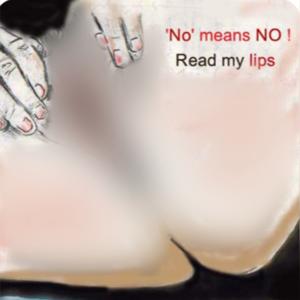
The next day he calls out the hypocrisy; he’s shut down. That night, bitter, he creates a graphic poster—exposed, swollen genitals, fingers parting them, captioned “NO means NO” and “Read my Lips,” branded with the movement’s name. It wasn’t critique. It was retaliation, using a symbolic woman’s body the same way the organiser used another’s story: mining flesh to make a point. Same violence, different dialect. Clarity without courage is just another form of damage. This early report sets the season’s unflinching stance: self-incrimination over self-absolution.
A tired voice in an empty room welcomes you to Season Two—no gimmicks, no uplift, just the stripped-bare truth.
Last year’s clever spelling and “twisted tales” were just another dodge. This isn’t storytelling anymore. It’s inventory.
What follows is a damage report: the cold list of what broke, when it broke, and how much of it I still carry like it’s useful. Inherited rage, toxic wiring, manhood built on fear with good posture, and the lies we tell ourselves first so we can keep telling them to everyone else.
This season starts with me—the original people of the lie—and works outward: the quiet violence of petty authority, the loneliness of defensive positions, the wreckage we pass down like family heirlooms.
No victory laps. No redemption arcs. Insight isn’t action; it’s just observation. Some damage doesn’t heal—it possesses.
If you’re ready to sit with the ruin, stay. If you need hope or heroes, this isn’t the place.
Damage Reports. Season Two: People of the Lie begins now.
Soft Cocks and Therapy: Twisted Tales
"If abortion had been legal... I would have had one."
Welcome to a raw, unforgettable episode of PHUCT FABLES: Twisted Tales. This story strips away the cute trauma narrative. It’s a brutal look at maternal rejection, misogyny, and the kind of pain that turns a man into a functional emotional assassin.
Hear the true story of a 1960s NZ upbringing, the legacy of "soft-cock" shaming, and chasing love just to abandon it—all while sitting in a therapist's office. If Bukowski got clean and joined a 12-step group run by narcissists, you'd get this.
CW: Suicide, trauma, intense content. Find us wherever you seek the dark truth. Stay messy.
"When are you men ever going to stop beating us women?"
In this brutal episode of PHUCT FABLES, we crash a 1991 rehab group therapy session where the narrative of victimhood meets the undeniable evidence of the scar.
A woman’s bitter diatribe against "all men" is countered by a silent, shocking display: every man in the room reveals a physical wound inflicted and lasting scarred by a woman.
This is a raw, cynical examination of trauma, shame, and the stories we refuse to tell—or to ask about. The scar is sacred because you were taught to kiss the hand that struck you.
(CW: Domestic violence, physical abuse, raw language.)
After the Professional Hour? I Love You Too
"Stop apologizing. Learn the difference between discomfort and danger."
Welcome to PHUCT FABLES where the hour is professional, but the therapy is pure trauma.
In this episode, we eavesdrop on a brutally cynical therapist whose coping mechanisms include sketching and chainsawing. His client? A man feeling "soft, like nacho cheese," desperate for a blueprint for masculinity.
The advice delivered is toxic gold: Don’t fix her problems; misery is her generator. Compassion is terminal softness. Strength is constipation.
Listen to the raw, unedited rules of performative masculinity, then hear the therapist’s quick, shattering admission of vulnerability as soon as the door closes. Find out what the cost of being "fine" truly is
Pussy-Whipped by Empire
"The approval you crave is the cage you built."
This episode of PHUCT FABLES dives into the slowest, most corrosive violence: internalized colonial trauma.
We explore the "mind job" that outlasts the land grabs—the psychic scar that teaches Indigenous peoples (specifically referencing Māori, Aboriginal Australian, and Native American experiences) to hate their own reflection and apologize for their ancestors.
Hear the brutal critique of seeking approval from a system built on stolen wood. This is about the pressure to shrink, to smile, to rehearse being acceptable, and the anger that gets medicalized and punished.
This isn't history; it's the aftertaste of empire, and it's happening right now.
(CW: Colonial trauma, racism, psychological oppression, explicit language.)
From the publisher's feed