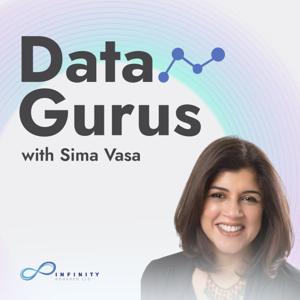
Data Gurus Podcast | Insights on Business Strategy, Mergers and Acquisitions, Market Research & Data Collection

Data Gurus Podcast | Insights on Business Strategy, Mergers and Acquisitions, Market Research & Data Collection

By Sima VasaBusinessInvesting
Download on the App Store

Data Gurus Podcast | Insights on Business Strategy, Mergers and Acquisitions, Market Research & Data Collection episodes

  • Perspectives on the MRX Industry + Running for President of ESOMAR Council with Kristin Luck | Ep. 124
    Sima Vasa is excited to welcome Kristin Luck once again as her guest! Kristin is the founder and managing partner of Scalehouse Consulting, and Kristi and I are both advisors at Oberon Securities, on the investment banking side.
    Where the industry is, as related to the impact of Covid
    The abrupt impact of the pandemic on the overall economy brought the industry to a near standstill last spring. It is unlikely to return to its 2019 turnover levels until 2022.
    ESOMAR
    Although ESOMAR initially predicted a downturn in research revenues of up to 30%, we still ended up with a stronger third and fourth quarter than predicted, particularly with tech and digital businesses.
    The digital side of the industry
    There is a lot of controversy surrounding the digital side of the industry regarding its accuracy, approach, and basis in terms of true research methodology.
    A revolution
    The pandemic is accelerating a revolution in the research space. So there were many naysayers about many of the digital technologies, particularly on the qualitative side of the business, going into 2020. When the pandemic hit, it started to fuel the tech revolution and acted as an accelerator to the dynamic shifts that we were already seeing with the digital technology segments and the established market research segments.
    Masking the effects of the pandemic
    The performance of the tech and digitally-enabled segments masked the effect that the pandemic had on the established part of the industry. The established part experienced a downturn of 15% last year, in contrast to the 9% growth expected across the digital and tech-enabled segment.
    Face-to-face qualitative
    Kristin does not think that face-to-face qualitative is dead. She feels that there is value in face-to-face contact with respondents. And in many cases, qualitative research can be conducted in a digital format and still produce quality results.
    Migration to more digital techniques 
    We will see a substantial and permanent migration to more digital techniques. And there will be a combination of methodologies that will integrate both types of tech and digital.
    Blockchain
    Most of the companies that started in the blockchain space have pivoted. Although blockchain as a technology still has value, many businesses that were focused on being blockchain-only companies realize that they need to have products that deliver value other than the blockchain platform. Although blockchain is a means to the end and can enhance a portfolio of products and solutions, it is not the end to the product.
    An ESOMAR member
    Kristin has been an ESOMAR member for almost eleven years, and she has been on the board called ESOMAR Council for the last six years. For the past two years, she was Vice-President.
    ESOMAR
    ESOMAR is a little different from some of the local and regional associations in that they are truly a global association. They look at everything from privacy to data ethics and sound research methods around the globe. And they give those a global perspective.
    A global perspective
    Kristin has been involved with ESOMAR for a long time because having that global perspective has been invaluable to her career and the businesses she has developed. Getting some insight into how research gets conducted in other regions gives Americans a broader look at opportunities for researching new and different ways.
    How ESOMAR differs from other industry associations
    The overall global look is what sets ESOMAR apart from other industry associations. ESOMAR focused on keeping track of the lobbying for privacy and data ethics all around the world.
    The structure of ESOMAR
    The ESOMAR Council consists of elected individuals.
    Underrepresented
    North and South America, Africa, and Asia are underrepresented in ESOMAR. So ESOMAR members need to remember to vote for the candidates in their region.
    Running for President
    Kristin is running for President of ESOMAR. She was inspired to do so for several reasons. She has been on the ESOMAR Council for many years. She has over a decade of experience in building and scaling businesses and non-profits. And she also has a keen understanding of how to navigate rough waters during turbulent times.
    Three key pillars
    Kristin feels passionate about three key pillars for her candidacy. They are:
    Expanding on Council and their platform of building bridges to become a truly global association that serves its members on all continents.
    Bringing younger researchers into the industry and ESOMAR so that it can remain relevant to the new generations that are driving the evolution of the industry.
    Opening ESOMAR’s arms to data scientists and second and third-party data providers so that the importance of data quality and ethics does not get lost as the research industry evolves.
     
    Quotes:
    Kristin:
    “The abrupt impact of the pandemic on the overall economy brought the industry to a near standstill.”
    “Although ESOMAR originally predicted up to a 30% downturn in research revenues, we ended up with a stronger third and fourth quarter than predicted.”
    “The industry is likely not returning to our 2019 turnover levels again until 2022.”
    “The pandemic is accelerating a revolution in the research space.”
    “When the pandemic hit, it started to fuel the tech revolution.”
     
    Sima:
    “The technology is bringing in new players, new capital, and new excitement to the industry.”
    “Blockchain is a means to the end, but it is not      the      end      product.”
     
    Links:
    Email me your thoughts!
    LinkedIn
    Twitter
    Infinity-2.com
     
    Sponsors:
    Paradigm Sample
    In Person Qualitative Research Companies
    21 min
  • Qualitative Resilience –The Prediction | Ep. 123
    Sima Vasa is excited to have Bob Qureshi join her today. Bob is the co-owner and managing partner of i-view viewing facilities in London.
    Bob talks about the history of his business
    In the 1960s and 1970s, most of the qualitative research in the UK took place at the home of the recruiter. Over the years, specific facilities for research were being built in the US. Then, in the 80s, that also started to happen in the UK.
    A game-changer
    In 2010, Bob looked at the UK facilities and saw that they were all laid out like recruiter’s living rooms. They lacked things like white marker boards, places to put stimulus, and the ability to screen. So Bob decided to start with a game-changer and build everything they needed on one floor, in an easy to get to location in central London, with wide doors and access for people with special needs. They paid specific attention to detail, which means they made sure that they took account of everything.
    Bob’s background
    Bob’s background was in the corporate client-side, and he has always had an interest in qualitative research.
    Best Viewing Facility
    For the last three years in a row, i-view was awarded Best Viewing Facility in the UK. That is not an easy thing to do, and Bob feels very humbled by it.
    The impact of the pandemic
    The impact of the pandemic has been quite devastating for Bob.
    Collaboration
    Bob realized that the key thing was to replace the word “competition” with the word “collaboration”. So he decided to talk to the other viewing facilities, to collectively agree on which message they would send, who they would send it to, and how they could drive it forward.
    Rates relief
    In stopping unnecessary costs in the UK, they managed to save the municipality rates relief of over a million pounds across all the viewing facilities. They managed to recover very quickly as a result.
    A similar standard
    Through the collaboration, all the viewing facilities in the UK are sending out the same message and adopting a similar standard to deal with the prevention and spread of the virus.
    In-person
    What Bob and those with whom he is collaborating have to look at, in terms of when in-person will resume, are some of the key statistics and figures that are coming out. Essentially, they are looking for infection rates and death rates to fall and the vaccine levels to increase so that the most vulnerable in their society do not fall prey to the pandemic.
    When lockdown will finish
    Bob believes that in the UK, they will not get any indication of when they can open up again until the end of February. He assumes that lockdown will finish in March- possibly mid-March to late March or early April at the latest.
    Attitudes are changing
    People’s attitudes are changing because they feel restricted. So they are no longer as cautious as they were at the beginning of the pandemic.
    Bob’s passion for qualitative research
    Bob loves qualitative research because he wants to understand the emotional reasons for what drives people’s decision-making and causes them to behave in particular ways.
    Technology
    Bob feels very fortunate to run online focus groups or online interviews and test everything beforehand to eliminate any potential problems.
    Bob’s other business
    Early on, he decided to have several business areas that would complement each other. It means that if one sector is not doing too well, another will have the opportunity to make up for the shortfall. That is why he also owns another business, a telephone center B2B data collection agency, called Provision Research. And it has been doing very well because people are at home and easy to contact currently.
    Colour of Research
    Bob is the cofounder of Colour of Research, which started officially in June of 2020. It is a mentorship program where people of different ethnic groups can see others who look like them, who are either doing well at work or are on the way to doing well. Bob feels that it is one of the best things that has come out of the pandemic for him.
     
    Bob’s quotes:
    “We are all project managers at heart.”
    “Attention to detail is trying to make sure that you’ve taken account of everything.”
    “For the last three years in a row, i-view was awarded Best Viewing Facility in the UK.”
    “We realized that the key thing to do was to take out the word competition and replace it with collaboration.”
    “I believe that in the UK, we are probably not going to see any clear indication of when you may open up, certainly until the end of February.”
    Links:
    Email me your thoughts!
    LinkedIn
    Twitter
    Infinity-2.com
     
    Sponsors:
    Paradigm Sample
    The In-Person Qualitative Collective
    29 min
  • The Glow of Research with Tim Clover | Ep. 122
    Sima Vasa is excited to welcome Tim Clover as her guest for today’s podcast. Tim is the CEO and Founder of Glow, based in Australia. Tim is originally from the UK and has been living in Australia for the last ten years.
    About Glow
    Glow is an online research platform, and people often compare it with SurveyMonkey on steroids. For Tim, it is about a lot more than just creating surveys. It is about the whole workflow for research.
    Some background
    As a kid, Tim was into engineering and finding out how things work. He started his first business after getting his engineering degree. He tried to use Excel macros to standardize processes and do things like process mapping. And he wanted to work out how to create channels into different markets. Although he earned enough to pay the rent and eat, he needed to gain more life and company experience, so he ended up working for a UK company, doing business simulation work.
    Not fitting the mold
    A friend called Tim and suggested that he apply for a role at the company he was working for because they needed someone with his skill set. Tim applied for and got the job. But he felt that did not quite fit that mold, which was generally very academic and did not involve much thinking outside the box.
    Assumptions
    Tim became interested in the sensitivities around many of the assumptions in the models that were being used in the company he was working for. He wanted to understand where the data was coming from that was feeding those assumptions. That pushed his career within that company into a role of story-telling, and into dealing with much more senior people in the organizations, to challenge them and help them form assumptions. From doing that, he became well-known within the organization.
    Australia
    In Australia, they were trying to do a similar thing. They wanted to build a team to analyze data and analytics from an operational perspective. So Tim decided to move there and help the company build a team in Melbourne.
    Retailers
    Tim did a lot of work with retailers. A big retailer called Coles was going through a major transformation at the time, and Tim’s team helped them pull together all their data together.
    The birth of Glow
    It took a long time to get their customer data together, and Tim started tinkering around to find ways to speed things up. Through his endeavors to find a better way to capture the information, Glow was born.
    Glow
    Glow, as a concept, was born because of a gap in the ability to reach consumers. It was a way that companies could tap into their customers more quickly and directly. Initially, Tim did not think of it as a survey platform. He just wanted to close the gap in hard-to-reach places and create experiences for the customers to engage.
    Good times and bad
    When starting a business, you have to weigh up the personal risk and realize that the path will be hard. If you’re not absolutely focused and completely determined, you’re going to find the ride pretty tough. Tim has had some fantastic times and some tough times over the last seven years.
    At first
    At first, Glow was all about getting data from hard to reach places and leveraging their tech to fund growth. In the background, they were investing more heavily in the ability to write the surveys themselves.
    Clients could log in
    After starting to write the surveys themselves, about three years ago, they released the first version of Glow where their clients could log in, look at their account, see the surveys running, and change some of the questions.
    Getting data
    Before, Tim was more of an insights person than a researcher. So when he got into research, it was about getting data.
    Online panel
    Three years ago, Schweppes asked Tim to do an online panel. He looked into it to find out how it might work, and it eventually took about two hours to get it working beautifully. The panel that Tim created takes people from building a survey to creating links to get responses, to then analyze the data online.
    The big change
    Integrating with the panels made the bits of the experience that used to be hard very easy, and it made a big change for Glow from a business model perspective. They have seen enormous growth in their revenues and business.
    The role of insights
    Tim believes that the role of insights is to take on the big programs and do them well. And to use your resources to find ways to capture the other questions that the business is asking and serve them with the information they need
    The future of Glow
    Glow shares their data, and they encourage others to do the same.
    Tim sees the future of Glow being about building a narrative around data shared quickly is a good thing because it enables people to get involved and important topics discussed.
    Data quality
    The data quality for Glow is about the quality of the panels.
    When Glow manages projects for their clients, they are responsible for looking at the data quality. They actively invest in tools that help identify quality data.
    One of the risks
    One of Glow’s risks is that people could use the data inappropriately. They are mindful to avoid creating more of a problem than what they are trying to solve.
    The future
    The future of Glow will follow their vision. Their vision is to provide more access to better tools that more quickly surface data and reduce some of the half-life challenges that data has. Their future also involves a seat at the table around trying to achieve more of a human-centric future.
     
    Tim’s quotes:
    “Glow is an online research platform, so people compare us often with SurveyMonkey on steroids.”
    “It’s not just about creating surveys. It’s about the whole workflow for research.”
    “Retail is one of the industries everyone has an opinion about because we all participate in it.”
    “Glow, as a concept, was born of a gap in the ability to reach consumers.”
    “When you start a business, you have to weigh up personal risk.”
    “When starting a business, if you’re not absolutely focused and completely determined, you’re going to find the ride pretty tough.”
    “I believe that the role of insights is to take on the big programs, to do them well.”
     
     
    Links:
    Email me your thoughts!
    LinkedIn
    Twitter
    Infinity-2.com
     
    Tim Clover on LinkedIn
     
    Sponsors:
    Paradigm Sample
    The In-Person Qualitative Collective
    30 min
  • Understanding Performance of New Product Launches with Ken Roshkoff | Ep. 121
    I am happy to welcome Ken Roshkoff, the CEO of AMC Global, as my guest for today.
    Ken’s father started AMC Global
    Ken’s father started their company in 1979. He was a true researcher who loved working with data, doing analytics, and working with project staff.
    The competitive component
    Ken always loved the competitive component, so he spent much of his childhood focused on sports. He loved tournaments and competing, so he knew that he would eventually embark on a career with competitive elements.
    Getting involved with AMC
    When Ken initially got involved with AMC, his father started training him to crunch the numbers and become an expert in running projects. However, Ken quickly realized that was not going to be his thing. He felt that for him to be excited about what he was doing, he had to bring his clients into a space that would be more interesting to him.
    Giving the business another shot
    After less than a year, Ken left the business to go to grad school to get an MBA. Coming out of that, he decided to give the business another shot. He wanted to do things a little differently, however.
    A unique methodology
    Given his interest in CPG, he identified an opportunity in product launch tracking. In around 1991, he developed a unique positioning and created and patented a unique methodology that would help major CPG companies capture robust insights from the purchasers of the products in the market. That program became known as PFU (Purchaser Follow Up).
    Marketing the PFU program
    Ken then began actively marketing the PFU program to CPG companies. He created a niche. Then he leveraged it to form relationships with some of the largest CPG companies in the world.
    Working at all stages of the product life cycle
    AMC does work at all stages of the product life cycle.
    Where the program fits
    Ken’s program fits between pre-launch and post-launch work.
    The launch phase
    The issue for many of Ken’s clients is that they were not getting reliable repeat information until six months, or longer, into the launch. Ken's launch phase starts from day one of the launches and runs throughout the first three to six months.
    A robust way to capture insights
    He developed the PFU program as a robust way to capture insights, both qualitative and quantitative, from the very first purchasers of new products. Then they track those consumers to understand how well the products fit into their lifestyle if they are re-purchasing, and if not, why not.
    What the PFU program involves
    The PFU program works by placing an invitation in or on a package, in a slightly disguised way because it is not meant to be a purchase driver. Ken wants people to find the invitation when they get the product home and use it. When they open the product, they typically find an offer for a prepaid cash card.
    A built-in usage period
    They build in a usage period. So after the extended usage period, they send the purchasers a cash card with instructions for how to activate it by doing a phase-two survey. It is a bit like an in-market home-use test, and it is flexible. And it can get used globally.
    The beauty of the system
    As long as the product sells, they can provide their clients with top-line information at any point during the project.
    Trends related to launching new products
    Lately, Ken has been seeing a lot of companies shortening the pre-launch process. And that makes the launch-phase tracking that Ken does even more important.
    Historical product launch data base
    Ken uses his historical database to benchmark new products against other similar test products that they have tracked for other clients.
    Post-launch activities
    They also do a lot of the more traditional brand health tracking for their clients. Once the products are out there for a longer time, in addition to using more traditional panel-based systems, they also leverage the database they developed from using the PFU program during the launch phase so that they can go back to those consumers and do further testing at different stages of the product life cycle.
    A good time to get new products out there
    Since Covid, sales have gone crazy for a lot of Ken’s clients in the CPG space. As a result, he has seen that a lot of his clients pushing ahead with new launches. It has been a good time to get some new products out there into the retail space.
    The team
    In Ken’s type of business, you need to assemble the right kind of team to grow. Ken’s team is his number one asset, so he is cautious about who he brings onto the team. Those people need to be innovative, a fit for the culture, and a fit for their clients.
    The future
    Going forward Ken wants to offer the highest quality to their clients and collect solid researchers along the way. He wants to train his juniors up to be the next generation of best researchers in the industry and have structured growth over time.
     
    Ken’s quotes:
    “We developed the PFU program as a robust way to capture insights, both qualitative and quantitative, from the very first purchasers of new products.”
    “As a result of all the video conferencing, I feel like we’ve got stronger relationships with our staff and our clients.”
    “I grew up around market research.”
    “I always loved the competitive component.”
    “I developed a unique positioning and I created and patented a unique methodology that would help major CPG companies capture robust insights from the purchasers of the products in the market.”
    Links:
    Email me your thoughts!
    LinkedIn
    Twitter
    Infinity-2.com
     
    Sponsors:
    Paradigm Sample
    The In-Person Qualitative Collective
    24 min
  • 2021 Perspectives for the Data Industry | Ep. 120
    This is the first episode in our MRX Podcast Network series. I am excited to kick this year off with an episode focused on perspectives and thoughts related to our industry for 2021.
    A year like no other
    2020 has been a year like no other. As an industry, we collaborated, we called on each other for help, and we were there for each other, both personally and professionally. That was an important statement, and it showed me that, as an industry, we are resilient, we can adapt, we can pivot, and find a path forward.
    No playbook
    We have no playbook to follow. And we can’t look at history to know what will happen with consumer behavior, consumer attitudes, consumer perceptions, and the decisions and choices that companies will make, both on the supplier side and the in-client side.
    The good news
    The good news for our industry is that people need information and insights to inform the decisions they have to make. I think that 2021 is going to be a vital time for our industry to get more engaged and to focus on being able to provide solutions.
    Stakeholder capitalism
    2020 was a year when we saw stakeholder capitalism take place. Employees and consumers wanted companies to stand for something beyond profit and loss, and they wanted companies to be linked to the values they represent. They wanted to vote with their dollars as to the companies they believed in, and the products and services they believed in that were in line with their value system.
    A big question
    The big question is, as brands, organizations, and companies grow, will that concept allow for sustainable growth? And does that translate to performance and something real that shareholders and investors can believe in? Those are topics that need to be researched and understood.
    Playing a vital part
    The silver lining is that our industry can play a vital part in helping companies to answer some of those questions.
    2021 is going to be similar to 2020
    In 2020, every week felt like a month because many decisions were getting made. So we had to be faster because things were moving. In my mind, 2021 is going to be similar. It will continue to be fast because brands and clients will have to accelerate the speed at which they operate.
    Technology
    Technology is essential in our industry. It will cut across the entire landscape.
    Faster and more efficient
    Organizations will have to be faster and more efficient in how they go to market, launch new products, develop campaigns, sell, manage their supply chain, manage their employees, and hire. Every function and business process will need to be quicker, and companies will need to keep up because if they don’t do it, a competitor will.
    Deliver solutions
    As part of the data, marketing, research, insights ecosystem, we need to deliver solutions to meet those needs. And to do that, we will have to adapt and do things a little differently in 2021.
    Impacting each part of the data ecosystem
    Over the years, we have seen tech-enabled companies impacting every part of the data ecosystem. When there is technology, there is scale. And when there’s scale, there is investment. So, I believe that in 2021 and beyond, we will continue to see capital getting put into our industry. And that is a good thing because it keeps innovation alive and allows us to grow our share of the pie in terms of dollars spent.
    The driver
    The driver is speed and to facilitate decision-making as efficiently as possible.
    Strategic research
    We need to continue doing strategic research and using metrics to understand how we are doing.
    Parts of the value chain where technology plays a vital role
    You can enhance what you are doing with technology. You can create a new business model where we are seeing tech and scale, subscription revenue, and a different sales model.
    API (Application Protocol Interface)
    API has made a big impact in the sample world and it will continue to be prominent and grow. And we will get additional data sets through API connections, making us faster and more efficient in delivering richer data.
    Consumer insights
    Consumer insights within brand organizations will do well to democratize the use of information through visualization and platforms that create automated charts and get the insights faster to a broader audience and make the value more about the decisions that get made around the insights because people need to get empowered with insights.
    Empower people
    To operate faster, we need to empower people with insights. People need to understand quickly what the results of a study are.
    Change is hard
    Change is hard, but it takes just one company to change, and others will follow.
    Data
    The data is not the power. It is the fuel that drives decisions.
    An opportunity
    Consumer insights and market research professionals have a huge opportunity now because many tech-enabled platforms did not get developed by traditional researchers. They got developed by innovators and people who want to build new business models. And they need the partnership, the experience, and the understanding of what the playbook is for data. And they need to know what the parameters that are going to guide the decision-making are. So, as a result of the technology, there will be a great need for data governance, improved data quality practices, and ultimately, data stewards.
    We have an opportunity to blend our industry, up our game, and share our experience. And as a result, we can make our industry even stronger.
    We need to be open, embrace change, and ultimately, be leaders of this journey.
    Links:
    Email me your thoughts!
    LinkedIn
    Twitter
    Infinity-2.com
    Sponsors:
    Paradigm Sample
    22 min
  • The MRX Podcast Network | Ep. 119
    I am excited to share some news with you today. Some of my fellow podcasters and I came up with the concept of an MRX Podcast Network.
    The main mission of the podcast network is to be able to podcast on a topic on our respective podcast channels, and provide multiple points of view, perspectives, and formats on how we address the specific topic, and give all our listeners in the industry a broader perspective as it relates to that topic.
    We are starting this year with what we think that 2021 holds for our industry. These are not predictions or forecasts. They are about what each one of us wanted to share, related to 2021, and our thoughts about the market research industry, data, and analytics space.
    We hope you enjoy what we have to share. We will be publishing the first series over the next few days.
    For this podcast, we have put together a teaser to showcase some of what will be coming up in each of our podcast episodes, related to the outlook for 2021. Stay tuned for more!
    2020
    We will remember 2020 for many things, including a rise in the number of podcasts. Currently, 37% of Americans listen to podcasts monthly, and in 2020, more than a hundred million Americans listened to at least one podcast each month. It was the first time that that has ever happened.
    Today’s show
    We will be hearing from six podcasters today, and each podcaster will give their outlook for market research in 2021.
    David Paul – The Audible Insights Podcast from the Insights Association
    This podcast focuses on quick-take conversations during industry events and longer interviews with industry leaders. They strive to keep everyone up to date with the market research industry, the latest methods and techniques, and the trends for the future.
    Kathryn Korostoff – Conversations for Research Rockstars Podcast
    Conversations for Research Rockstars is a video podcast that Kathryn has been running for a couple of years. It is about advancing the work and careers of market research and insights professionals. Kathryn has thousands of subscribers, and she has had some amazing conversations in the series.
    Merill Dubrow – On the M/A/R/C®
    Merrill has just completed his first year with 56 episodes. There is one episode for every year that M/A/R/C® research has been in business. Each episode is unscripted, uncensored, unrehearsed. There are plenty of takeaways from the amazing guests that he has had, including a mix of professional athletes, insight leaders, and CEOs.
    Sima Vasa – Data Gurus
    The mission of the Data Gurus podcast is to help everyone in the data ecosystem navigate the sea of change. Sima speaks to leaders, practitioners, CEOs, and change agents in the industry.
    Stephen Griffiths – Digging for Insights Podcast
    The Digging for Insights Podcast is a marketing and career podcast with advice from insights leaders from companies like Nestle, Ipsos, and General Mills. As a client-side researcher, Stephen focuses this podcast on helping client-side and supplier-side folks get the insights they need to grow their careers and the businesses on which they work.
    Jamin Brazil - Happy Market Research Podcast
    The Happy Market Research Podcast has had over 300 episodes and covers four industry trends per year. For each trend, they interview subject matter experts from major brands, including Adobe, Microsoft, and Proctor and Gamble.
    David’s outlook for market research for 2021
    David's focus is on seeing the rebound of in-person research happening as soon as possible. He is anxious to support the ability to safely and quickly get people back in-person, doing in-person qualitative, and ramping that part of the industry back up.
    Kathryn’s outlook for market research for 2021
    Kathryn thinks that survey research for 2021 will be about the areas that are likely to be hot. For quality researchers, she thinks that we will see some of the people who had to pivot to online research go back to in-person research, to some extent. Many people have said that they will never go back to the level of in-person research they had before because their online has worked so well.
    Merrill’s outlook for market research for 2021
    For Merill, 2021 is all about opportunity and insight. Clients are changing, and insights will be more important than ever. He thinks that there will be opportunities in the insight community to build products and services around geo-targeting and geo-fencing. We could also be heading towards a cashless society.
    Sima’s outlook for market research for 2021
    Sima thinks that the demand for insights could not be greater. She sees the democratization of insights coming into play and providing quick-turn research. And the visualization of data allows the democratization of insights through large brand organizations, enabling people to make decisions more quickly and efficiently. She also thinks there will be more conversations around data quality and privacy, and how to protect consumers and technology will play a big part.
    Stephen’s outlook for market research for 2021
    Stephen sees a change coming in the way we are working, especially on client-side companies. He sees that the idea of agile and experimentation is starting to take hold. The desire to be more agile and get real-world learning will continue to be a trend for the future.
    Jamin’s outlook for market research for 2021
    Jamin thinks we need to take the time to get to know all the people we work with because they are our best resources for all the rest of our careers. He believes that we will continue to invest in the asset of a relationship because it is the one thing that is unmoveable in our ever-fluid world.
    Links and resources:
    David Paul – The Audible Insights Podcast
    Kathryn Korostoff – Conversations for Research Rockstars Podcast
    Merill Dubrow – On the M/A/R/C®
    Sima Vasa – Data Gurus
    Stephen Griffiths – Digging for Insights Podcast
    Jamin Brazil - Happy Market Research Podcast

    13 min
  • Leadership, Growth and Management with Steve Schlesinger | Ep. 118
    We are excited to welcome Steve Schlesinger, the CEO of the Schlesinger Group, as our guest for today’s show.
    Join us today to learn about Steve’s journey. You will hear the story behind the Schlesinger Group and find out how it got founded by Steve’s mother back in 1966.
    Steve’s mother’s story
    The Schlesinger Group was founded by Steve’s mother in 1966.
    A few years before, she started looking for a part-time job, and a friend of hers who was working for a company in New York City, got her a job as a phone interviewer, working from a bedroom in the house in which Steve grew up.
    She was very good at what she was doing, and after a year or two, she was promoted to Regional Supervisor.
    In around 1966, some of the companies she was working for encouraged her to open a company and set herself up so that she could manage several groups of people, and they could feed her business.
    Her business got incorporated in 1966, and she built up a roster of clients for whom she did the field data collection.
    A group of women
    Steve’s mom was part of a phenomenal group of women who all started in the data collection space more or less at the same time in the late 1950s. They built up businesses over the years, and some of those businesses ultimately got bought out by other companies. Those women did a wonderful job of building up the data collection aspect of the market research world.
    Working for his mother
    When Steve was seventeen, he started officially working for his mother by doing intercept interviews at New York Airport for United. He did that for her many times while he was in high school.
    Growing up
    While Steve was growing up, there were often leftover products from product tests in their house. Occasionally, he would get asked to deliver something to an interviewer or a responder. That was fun for him.
    Starting to understand 
    Steve’s mother used to do focus groups at their kitchen table when he was a teenager, and while he was growing up, there was generally a lot going on in the house. That was when he started to understand what his mother was doing, and talking about, in terms of ad campaigns.
    After college
    Steve took a year off after his first year at Medical School. During that year, his mom insisted that he worked for her while figuring out what he wanted to do with his life. He ended up falling in love with the work he was doing for her and decided to keep on doing it.
    Building the business
    In light of that, and knowing that she would soon retire, his mother decided to build up the business to make it more substantial. She also decided to open up an office to get Steve out of the basement of their house. He worked for his mother for about six or seven years before taking over and running the business himself.
    A strong foundation
    Steve’s mother had a good reputation, and she was very ethical and honest. That gave their business a strong foundation and allowed it to grow. Steve has always appreciated what his mom gave to the business, and he still lives by those same principles today.
    Some of the early lessons Steve learned
    You need to learn as you grow because as the business grows, you need to manage and lead it differently. You need to make new decisions about what you want your business to be and do what it takes to get there. Ultimately, you need to learn from your mistakes, and you need to change as an individual within the organization during all its different stages of growth.
    Steve’s style of leadership
    Steve is a good delegator, and he does not enjoy micromanaging. He is a good listener, he is good at putting faith and trust into the people around him, and he believes in staying humble and appreciative, regardless of the success you might have achieved.
    He is not a control freak. That works when you’re scaling up and trying to evolve a business.
    The Schlesinger Corporation has been around for 57 years. Adapting, changing, evolving, and staying relevant is what Steve is most proud of having achieved.
    Feedback loops
    Having feedback loops will give you the insights and information that you could otherwise easily overlook, and they will ultimately help you make better decisions.
    Partnering with Gauge Capital
    In more recent years, the growth of the Schlesinger Corporation has been more modest than it has been in the past. For more opportunities and to improve their service, financial success, and the way the company functions, they decided to bring in Gauge Capital as a capital partner. That helped them to transform the business in a short time.
    The potential for more growth
    Steve believes that the company could potentially grow to be three or four times its size in the next four to five years.
    Integration
    Steve thinks of integration as a critical component of the acquisition game. For him, it is always about the people. So if you get that right, everything else will fall in line.
    Steve’s quotes:
    “My mom started in the market research business in 1963.”
    “My mother was part of a phenomenal group of women who all started in the data collection space more or less at the same time.”
    “Part of our growing up was all those products around our house, plus the fact that the business was in our house.”
    “I took over the business, give or take, maybe twenty-five years ago.”
    “My mom allowed our business to have this really strong foundation.”
    “You don’t need to know everything, and you don’t need to be good at everything.”
    Links:
    Email me your thoughts!
    LinkedIn
    Twitter
    infinity-2.com
    Sponsors:
    Paradigm Sample
    In-Person Research
    29 min
  • Leadership, Transformation, Integration with David Shanker | Ep. 117
    We are excited to welcome Dave Shanker as our guest for this episode. Dave is the CEO and Founder of David Shanker Consulting.
    Dave’s journey
    Dave’s career spans more than thirty years, and he has mostly been involved with market research, running different market research agencies. He has also been involved in startups and has had a family business along the way.
    Dave’s leadership style
    People have often told Dave that he is authentic and that he wears his heart on his sleeve, so what you see is what you get. And he communicates a lot, he cares, and he gets invested in employees, clients, and the business.
    Winning
    Dave wants to win, and he wants his team to win just as much.
    What makes people scared
    Early in his career, Dave learned that not knowing is what makes people scared. And if people don’t know, they will make assumptions, and they will probably be wrong.
    Building trust and credibility
    You need to be very forthright, upfront, and candid with your employees, over time, to build trust and credibility.
    Moving an organization to the next level
    Dave believes that putting together a combination of caring, being passionate about a business, and getting invested in the employees, the clients, and the business, starts a good foundation for building a culture change and moving an organization to the next level.
    Communication
    Dave has always sent out weekly emails to his entire company, telling everyone what he has been doing. However, he knew that he needed to change from typing emails to doing video. So one day, he made a video and spoke for five minutes, and he was blown away by the response he got.
    Lightspeed
    Dave joined Lightspeed at an interesting time. He had a challenge from day one there in working out how to bring the three different business units together. The fun part of it for him was looking across the three sales teams and thinking about ways to get them working together so that one plus one plus one would equal ten. They were successful because the sales teams all saw the benefits of working together.
    The start
    Dave started with the employees. He spent many hours talking to the employees one-on-one.
    One truth
    The one truth that Dave found was that you can't get to where you are going unless you know where you are. And for him, the way to do that was to talk to his employees.
    Customers
    After talking to the employees, he started talking to his customers because frequent communication is necessary to get your customers to buy-in.
    Points of resistance
    Some of the points of resistance that he ran into were around sharing customers, doubts about whether or not his commission would get paid, and whether someone else would manage to deliver as efficiently as he could.
    Driving growth
    Through the change, they did not drive growth equally across the three different business units. Because of the things Dave put in place, however, they managed to drive growth in two of the three business units. And they realized some substantial wins in how they went about the day-to-day of the business.
    After Lightspeed
    After Lightspeed, Dave went to a B2B media company called Ensemble IQ and had to do some heavy lifting there. He approached it in the same way as he approached Lightspeed, by thinking about what they could do at the back end to create efficiencies and become seamless, to have one operations team delivering across everything. Although the people at Ensemble IQ were very resistant to change, he still managed to do it fairly quickly.
    Centralization
    For the most part, Dave likes centralization across shared services, no matter which stage the company is at.
    The companies that Dave prefers working with
    Dave enjoys working with companies with challenges in figuring out how to sell into the market they would like to get into. And with companies that are struggling to get to the next level.
    Account planning
    Dave leans towards keeping things simple with account planning. For him, account planning is about having a conversation with the salesperson about what you want to accomplish at that account during the next twelve to twenty-four months. After agreeing about what you want to accomplish you need to think about what you need to do, to get there.
    Links:
    Email me your thoughts!
    LinkedIn
    Twitter
    infinity-2.com
    Sima is passionate about data and loves to share, learn, and help others that share that passion. If you love data as much as she does, subscribe on iTunes, and don’t forget to leave a rating and review!
    Contact Dave:
    Website
    24 min
  • The Impact of Covid-19 on Consumers with Rebecca Brooks | Ep. 116
    I’m happy to welcome Rebecca Brooks to the show. She’s the founder and CEO of Alter Agents, a full-service, strategic market research consultancy reimagining research in an era of shifting decision making. Rebecca has enjoyed an amazing trajectory to her successful career, and her work has never been more relevant and necessary than it is in today’s world. 
    About Rebecca
    Rebecca fell into market research without intending to make it her career, but she quickly fell in love with this kind of work. Ironically, her college background was in primate behavior, which she touts as entirely applicable to her work today.
    How Alter Agents has matured 
    Rebecca felt strongly that she shouldn’t have to choose between a career she loved and the family she wanted. She decided that she could run a great market research company and do it differently by focusing on her employees’ priorities. Ten years later, Alter Agents has had their best year ever, even in the time of COVID; they have hired seven new people in 2020. What makes Rebecca the proudest of her company is that she lives up to her commitment by creating a culture that employees want to join. 
    Highlights of a study in friendship
    During the time of COVID, we are all trying to understand how relationships are changing and what the challenges are in a new environment. Rebecca’s company joined in a study with Snapchat that encompassed 16 countries and 30,000 interviews. Alter Agents helped develop tools to help Snapchat grow in the friendship space and capitalize on a basic human need. 
    What you can learn from the refrigerator
    The friendship study research showed an interesting practice in the immigrant community. Many people are using a visual platform like Snapchat to check up on loved ones by asking for a picture of what is in their refrigerator to make sure they have what they need. Much more than a text or phone call, Snapchat’s platform has become a positive way for technology to help friends and families to stay connected.
    Fear and anxiety in the time of COVID
    Alter Agents began a survey in the US in November 2019 to ask what made people feel fearful in their daily lives. The conclusion was that fear and anxiety in the general public was way worse than most people realized--and this was before the pandemic began. The same research a few months later showed a startling decline in comfort and safety for Americans, especially for the African-American population. 
    How COVID has highlighted the differences
    COVID clearly exacerbated the problems in our economic systems, and the disadvantages were magnified. This occurred more dramatically in the African-American community because of their history of being under cared for in our healthcare system. The differences were also dramatically revealed in the Native American population. The Alter Agents study found that COVID highlighted the brokenness of our system for non-Caucasian people. 
    Rebecca’s advice to brands
    People want the brands they purchase to align with them politically and ethically like never before. They turn to corporations for stability and structure when their government isn’t working well, and they vote with their dollars. Corporations need to recognize this tendency and realize that it goes far beyond a marketing campaign. Rebecca’s advice is to evaluate the position you take in marketing and who you are, and what you stand for all the way up the supply chain. 
    Women in the workplace
    Even before COVID, the research showed that the disparity between moms and dads as they parent is even greater than the difference between men and women in the workplace. COVID has disproportionately affected women as many have left the workplace in making the unimaginable choice between their careers and caring for their children. COVID took away the support structure that women relied upon while expecting the same workload and results. The challenge for corporations is how to best support their employees. 
    Links:
    Email me your thoughts!
    LinkedIn
    Twitter
    infinity-2.com
    Sima is passionate about data and loves to share, learn, and help others that share that passion. If you love data as much as she does, subscribe on iTunes, and don’t forget to leave a rating and review!
    www.alteragents.com
    22 min
  • Understanding the Psychology of Sales (Part 2) with Julie Kurd, Rick Odello& Kenny Thompson | Ep. 115
    Sima’s goal for this two-part podcast series is to help senior leaders understand the mindset and psychology of sales. She would like to help sales leaders understand how they need to think about sales as a profession, how sales integrate into an organization, and the psychology behind what makes a salesperson tick.
    So many companies struggle with one of the biggest components of scaling their businesses, which is sales. That means getting a balance of the right personality and the right leader and making sure that there is lockstep with the product.
    Adam Jolley joins Sima today in presenting the second part of this two-part series.
    This week we have Julie Kurd, the VP of Sales and Revenue at CMB, Kenny Thompson, Director of Client Solutions at Schlesinger Group, and Ricky Odello, the VP of Sales at Lucid, as panelists.
    CMB is not a SaaS company
    CMB is a strategic consultancy and not a SaaS company. Their process begins with the client and not with a product.
    The sales process for consulting
    Typically, the sales process for consulting is based on selling relationships. It is about establishing long-term relationships and focusing on different kinds of problem-solving and various kinds of longer-term play.
    A unique perspective
    Ricky comes from a traditional ad hoc type sales environment, which has given him a unique history and perspective. He was with FSI for about ten years, and then he moved to Lucid which is more of a software subscription focused organization.
    Ad hoc sales environment
    Ricky has found that in a more ad hoc type of sales environment, you are typically dealing with fewer stakeholders, so it is like selling to a person rather than to an enterprise. And the cycle can be a lot faster.
    Software subscription sales
    Selling the software subscription involves a much longer sales cycle and possibly more stakeholders. Although it takes time, it can be most rewarding once you achieve the contract.
    Offering qualitative and quantitative solutions
    At the Schlesinger group, they can offer qualitative and quantitative solutions to their clients at scale. They grow their relationships long-term at the facility level through engagements and bidding. Schlesinger has done a great job of having a comprehensive solution set for the industry and their clients so that they can provide them with solutions for all their needs.
    A human touch
    Kenny brings a human touch to everything, making it warm, fun, and real.
    Your personality and style
    Everyone is different in the way they work with their customers. Whether you work for a product company or a consultative sale company, either way, you can bring your personality and your style. One starts with the product, and the other one without a product, to begin.
    It is important to be genuine 
    It is important to be genuine and authentic about who you are because your colleagues and customers can feel when you are real, and when you are not.
    The human connection 
    Salespeople sometimes get a bad rap, or a stigma, about not being real and authentic and just going in for the sale. Realizing that you are helping people to solve their complex business problems can motivate you to do more research and also help you in the execution of the sale. You need to find a human connection.
    Failure
    Julie points out that failure is a part of sales. We win and lose every day.
    Characteristics
    For success in sales and sales management, Ricky feels you need to be a leader within your organization, and you need to have good ethics.
    Trust and authenticity
    Kenny has always inspired trust in people. He is genuinely interested in others. As a result, he is authentic with them. And he always felt he could believe in himself to succeed if he put in the effort. For sales, you need to have tenacity and authenticity. You also need to build trust and be hyper-responsive in your communication.
    Coping with the highs and lows of sales
    You need to remain calm and keep focused if you want to weather the storms and avoid getting too whipped up about your gains and losses. Don't allow yourself to get too emotional or attached to the highs of the wins. And don't let yourself get too down about your losses. Stay committed and believe in the process.
    Culture
    The culture at CMB is very fluid, and everything they do gets arranged around the client. The whole team works together in a way that advances the entire effort.
    At Lucid, they are a group of people who all care about each other, their community, and their customers. Respect for their community is paramount to them.
    Kenny felt like he landed at home when he started at Schlesinger. Adding mental health days, giving everyone a half-day to vote, and giving vacation days in Q4, showed him that the company knows and understands that their people work very hard, and they sometimes have personal issues and struggle professionally.
    Walking in the shoes of sales
    Any entrepreneur would do well to walk in the shoes of sales because sales are where the business starts. Sales are vital to any business.
    Links:
    Email me your thoughts!
    LinkedIn
    Twitter
    infinity-2.com
    Sima is passionate about data and loves to share, learn, and help others that share that passion. If you love data as much as she does, subscribe on iTunes, and don’t forget to leave a rating and review!
    Julie Kurd
    Ricky Odello
    Kenny Thompson
    28 min

About Data Gurus Podcast | Insights on Business Strategy, Mergers and Acquisitions, Market Research & Data Collection

From the publisher's feed

Welcome to the the Data Gurus Podcast! The world around us is changing faster than ever before. From automation, artificial intelligence, big data, geo-location to every aspect of how we work and…

More shows like Data Gurus Podcast | Insights on Business Strategy, Mergers and Acquisitions, Market Research & Data Collection

Pivot by New York Magazine

Pivot

9,602 Listeners